
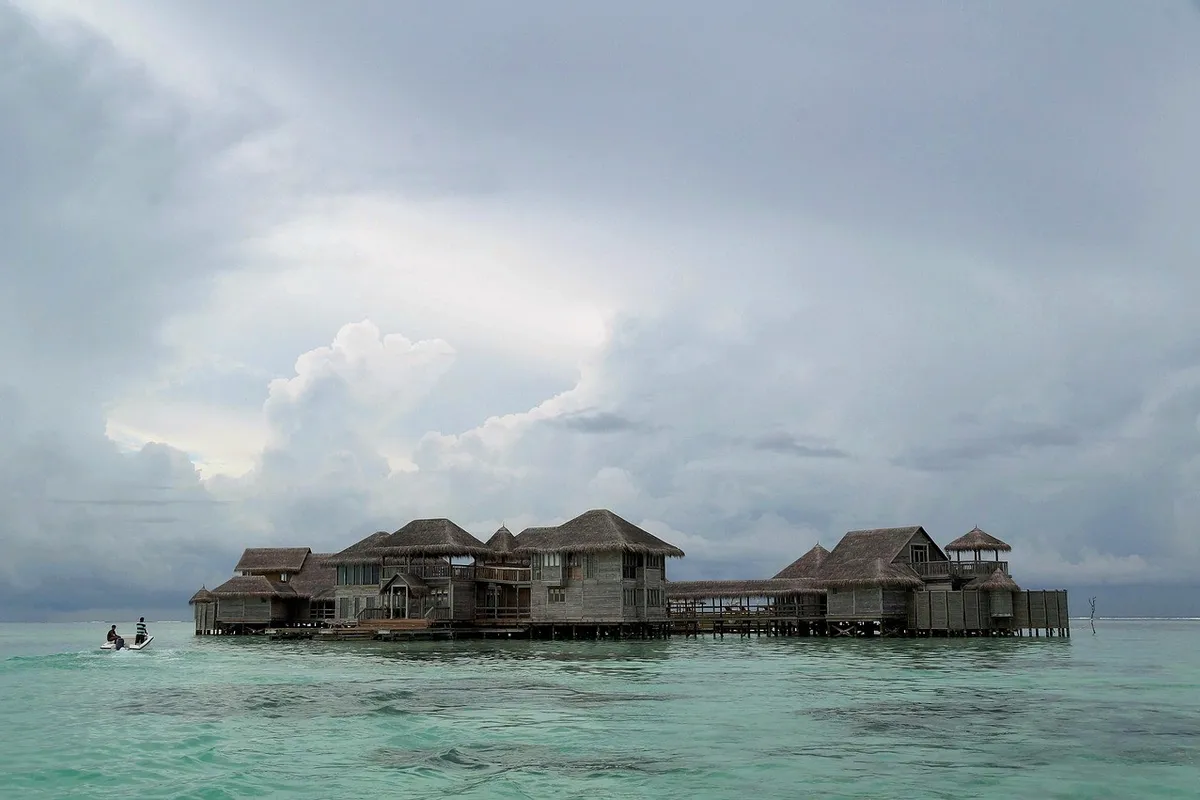
Stricter maritime environmental mandates and local tourism surcharges introduced across coastal zones in 2026 have altered how floating resorts worldwide operate. From non-negotiable luggage weight limits on regional transfer flights to mandatory zero-discharge sewage holding rules in protected waters, booking an unanchored marine stay now carries rigid financial and physical liabilities that glossy booking portals omit.
Urban catamaran hotels suit city travelers seeking central moorings without significant motion sickness risks, while intertidal wilderness lodges fit self-sufficient travelers willing to pack under tight aircraft weight limits. Deep-water reef pontoons demand solid vestibular resilience and strict scheduling flexibility around unpredictable sea conditions.
Engineering Floating Resorts Worldwide: Buoyancy, Tides, and Mooring Physics
Buoyancy Foundations vs. Seabed Pilings: Stability, Tides, and Seiche Effects
The architectural distinction between stationary overwater bungalows vs floating villas centers on how the sub-structure interfaces with the water column. Traditional overwater suites in destinations like Bora Bora or the Maldives rest on a rigid foundation of 8 to 20 reinforced concrete or steel pilings driven 6 to 15 meters into the seabed. These stilted units remain stationary regardless of wave action, but they risk structural inundation during severe storm surges.
By contrast, true floating suites utilize a pontoon buoyancy foundation engineered from continuous expanded polystyrene (EPS) cores encased in reinforced marine concrete or welded marine-grade aluminum hulls. These buoyant structures rise and fall with tidal range displacement, maintaining constant freeboard above the water line regardless of astronomical tides. When I watched the moorings at a coastal pontoon, the deck level remained exactly 65 centimeters above the waterline while the shoreline shifted several meters horizontally.
In narrow marine fjords and semi-enclosed river bays, water bodies experience the seiche wave effect—a standing wave oscillation triggered by sudden atmospheric pressure shifts or continuous offshore wind. Without calculated counter-ballasting and compartmented pontoon hull layouts, resonant seiche frequencies can amplify roll angles inside guest suites, turning minor surface chop into disorienting low-frequency swaying.
- Foundation rigidity: Piled villas are rigidly fixed into seabed substrate; floating pontoons displace water dynamically and float on the surface.
- Tidal adaptation: Stilted bungalows face shifting clearance heights; buoyant pontoons preserve identical water-to-deck clearance through any tidal swing.
- Hydrodynamic surge response: Pilings absorb shear forces from breaking swells; floating foundations rise atop wave crests while transferring lateral energy to mooring lines.
- Relocation capability: Piled suites cannot be moved without complete structural demolition; pontoon suites can be uncoupled and towed to sheltered bays.
Gangway Articulation and Mooring Chains Under Dynamic Water Movement
Connecting a buoyant pontoon resort to an immovable shoreline requires articulation systems designed to withstand constant kinetic stress. Marine engineers install heavy-duty shore bridges featuring slip-joints, hinge abutments, and roller-travel channels that glide along shoreward bearing plates as the water level fluctuates. These mechanisms prevent torsional stress from warping the boarding platform as incoming swells lift the outer edge.
Extreme low tides test these connections to their mechanical limits. When tidal amplitude expands during spring cycles, the gangway articulation angle can steepen past 30 degrees, turning an ordinary gangway into a slick descent hazard that requires integrated self-leveling stair treads rather than flat ramps. Facilities in high-velocity river channels also face severe river current velocity drag, where thousands of tons of moving water press continuously against submerged hulls.
Station-keeping relies on anchor chain tensioning systems coupled to automated deadweight tension winches or submerged catenary anchor arrays. In riverways carrying high volumes of floating timber, resorts often position upstream debris deflector booms to divert waterlogged tree trunks away from boarding ladders and hull seams, preventing mechanical punctures during flood conditions.
During extreme spring low tides, shore gangways can tilt past safe accessibility thresholds. Guests with balance limitations should request tidal charts from the harbor master to avoid transiting ramps during maximum water drawdowns.
Off-Grid Marine Utilities: Power Umbilicals, Greywater, and Bilge Systems
Delivering modern utilities across an aquatic interface introduces points of mechanical failure absent from terrestrial hotels. While harbor-based botels connect directly to municipal infrastructure through an armored shore-power umbilical cable, isolated wilderness lodges generate their own electricity. Many remote operations moor a dedicated generator barge downwind to reduce structural vibrations and divert diesel generator barge exhaust away from guest windows.
Wastewater management is subject to zero-discharge marine standards. Guest suites route plumbing through a marine macerator toilet that pulverizes blackwater before transferring it under vacuum pressure to a central greywater holding tank. These sealed holding reservoirs are periodically pumped out by commercial servicing vessels or treated through biological filtration chambers installed inside secondary service pontoons.
Internal hull integrity relies on automated bilge management. Beneath the floorboards of every certified luxury floating hotel suite, multi-stage bilge pump float switch arrays monitor moisture levels in watertight bulkheads. If sea spray or seam weeping raises the inner water line, primary 12-volt pumps activate automatically, while high-bilge alarms alert the engineering station long before buoyancy calculations are compromised.
Check the utility run along the service gangway outside your cabin. If you hear continuous high-pressure pumping or smell diesel fumes blowing toward your private deck, the utility lines or generator placement may disrupt sleep during night-time shifts in wind direction.
Best Floating Hotels in the World: Remote Wilderness Barges and River Lodges
Pacific Northwest Marine Lodges: Nimmo Bay and King Pacific Lodge
Operating along the rugged coastline of British Columbia requires balancing isolated wilderness access with extreme naval logistics. Nimmo Bay Wilderness Resort operates as an intertidal pontoon facility anchored in the Great Bear Rainforest, where suites rest on buoyant cedar and aluminum platforms that shift alongside deep fjord tides. For the Nature and Nurture season, all-inclusive 3-night packages start at 8,399 CAD per person based on double occupancy.
Further north in Milbanke Sound, King Pacific Lodge provides a different structural footprint: a 15,000-square-foot non-propelled commercial steel wilderness barge towed into sheltered anchorages for the angling season. King Pacific Lodge lists fully guided 4-day, 3-night charter packages starting at 7,445 CAD per angler, deploying heavy-displacement stability to withstand incoming swells from open sounds.
Reaching these remote operations introduces rigid aviation constraints. Floatplane transfers to Nimmo Bay enforce a strict baggage ceiling of 35 lbs (15 kg) per person according to the Nimmo Bay packing and luggage policy. Rigid wheeled suitcases like aluminum travel frames are prohibited because aircraft cargo pods in de Havilland DHC-2 Beaver or DHC-3 Otter planes require soft-sided duffel bags to optimize floatplane payload weight limit envelopes.
| Resort Property | Foundation Type | Mooring Environment | Transit Method | Luggage Allowance |
|---|---|---|---|---|
| Nimmo Bay | Wood & aluminum pontoons | Tidal fjord bay | Commercial floatplane | 35 lbs (15 kg) soft duffels |
| King Pacific Lodge | 15,000 sq ft steel barge | Coastal sound anchorage | Charter seaplane / boat | Soft duffel constraints |
Sub-Arctic Seasonal Adaptations: Arctic Bath’s Dynamic Freeze-In
On Sweden’s Lule River, Arctic Bath demonstrates a seasonal transformation unique among the best floating hotels in the world. Its circular timber spa and floating Water Cabins operate on a cyclical hydrodynamic schedule: during the summer months, the structures float freely upon the flowing freshwater current, whereas sub-polar winter drops temperatures enough to lock the hulls into solid river ice.
Double-occupancy rates for floating Water Cabins operate on dynamic seasonal schedules that include breakfast and guided spa access, ranging from 6,900 SEK to 9,600 SEK per night as outlined by the Arctic Bath Water Cabin tariff guide. Guests transition between elevated saunas and the central open-water pool carved out of the ice ring, requiring thermal layers suitable for sub-zero exposure.
The Arctic environment demands firm financial commitments. According to the official Arctic Bath cancellation policy, cancellations made less than 14 days prior to arrival incur a 100% cancellation fee. Travelers must secure comprehensive winter travel insurance covering sudden northern weather cancellations, as road or helicopter links can shut down without notice during polar blizzards.
During winter months, pack thermal footwear with rubber-cleated outsoles. The external timber walkways connecting the Water Cabins to the main spa building develop layers of hard-packed river frost that smooth-soled city shoes cannot grip.
Luxury Floating Hotel Suites and Marine Observatories on Open Reefs
Australia’s Coral Sea Pontoon: Cruise Whitsundays Reefsuites
Moored at Hardy Reef roughly 39 nautical miles off the Queensland coast, Cruise Whitsundays Reefsuites offers rare access to open-ocean marine biology. Suspended directly beneath the central Reefworld pontoon platform, two submerged underwater observatory suite bedrooms give guests panoramic floor-to-ceiling perspectives into the Coral Sea through 100-millimeter-thick acrylic viewing panels.
Pricing for the Reefsuites experience starts at 1,495 AUD per person based on twin-share occupancy, covering full meal services, local beverages, and marine activities on the outer reef as documented by the Cruise Whitsundays Reefsuites specifications. The operator enforces a minimum guest age limit of 6 years old, and any accompanying child is billed at the full adult per-person rate.
Transit to Hardy Reef requires traversing open water across 39 nautical miles aboard high-speed catamarans departing from Port of Airlie or Hamilton Island. In sea states featuring 2- to 3-meter ocean swells, this two-to-three-hour transit challenges travelers prone to motion sickness before they even step aboard the outer reef pontoon.
The open-ocean mooring exposes Reefworld to high-seas weather patterns. If Coral Sea gale warnings or cyclone alerts force high-speed catamaran cancellations, access is halted and overnight guests must be evacuated back to mainland Queensland early.
Urban Catamarans and Moored Luxury Vessels: OFF Paris Seine
Moored permanently at Quai d'Austerlitz on the Seine, OFF Paris Seine shows how converted commercial hulls can serve as urban floating pontoon resort outposts. The structure is built atop a custom catamaran hotel hull consisting of twin buoyancy chambers that counteract wake displacement produced by passing commercial barges and sightseeing bateaux-mouches.
Base room rates start from 140 EUR per night. When calculating the total stay expenditure, guests must account for the mandatory Paris municipal tourist tax for 4-star accommodations, which adds 8.45 EUR per adult per night according to the OFF Paris Seine terms and conditions.
Unlike isolated wilderness barges, urban floating hotels benefit from uninterrupted city infrastructure via subterranean water and high-capacity electrical conduits. For travelers evaluating alternatives across European waterways, our guide to European urban botels and converted barges analyzes how central city berthing permits influence cabin acoustics and night-time motion.
- Acoustic profile: City traffic noise is muted by the river wall, but low-frequency commercial boat engines create periodic morning vibration.
- Wake displacement: Passing diesel barges generate lateral roll that shakes unsecured bathroom accessories.
- Gangway transit: Street access remains level except during winter flood crests when the Seine rises toward the upper quayside.
Modern Floating Pontoon Resort Concepts: Megaprojects to Rustic Lodges
The Kempinski Floating Palace Dubai: Scaled Mobile Architecture
The Kempinski Floating Palace project in Dubai represents an engineering expansion of the luxury floating hotel sector. As announced in project releases, the master plan specifies a central floating palace housing 156 rooms anchored off Jumeirah Beach Road, flanked by a perimeter of 12 detached, solar-powered luxury floating villas designed with independent electric propulsion systems.
The technical hurdles of executing mega-scale floating hospitality projects are evident in ongoing schedule revisions. Marine development in open coastal waters requires navigating structural approvals from maritime safety authorities, configuring dynamic positioning systems, and engineering helipads capable of absorbing kinetic touch-down loads on buoyant decks.
Crucially, classification authorities must register self-propelled floating villas under dual legal codes: both as fixed civil hospitality structures and as seaworthy marine vessels. These regulatory challenges explain why ambitious deep-water resorts face longer timelines than standard shore-based luxury developments.
Riverine and Jungle Lodges: Bamboo Barges vs. Concrete Pontoons
Across freshwater river basins, foundation choices reflect local timber availability and water chemistry. In Southeast Asia, lodges on the River Kwai in Thailand or the Tatai River in Cambodia rely on lightweight floating frameworks of treated hardwood lashed to bundles of thick bamboo culms or sealed polymer buoyancy drums. These floating bases provide organic buoyancy but demand extensive maintenance every two to three years to replace waterlogged timber.
By contrast, modern Scandinavian designs utilize a concrete floating pontoon foundation containing dense expanded polystyrene cores wrapped in sulfate-resistant reinforced concrete. At facilities like Salt & Sill off Sweden’s Klädesholmen Island, these industrial concrete pontoons provide high displacement weight, lowering the vertical center of gravity and damping surface chop far more effectively than lightweight timber rafts.
Travelers should note that not every overwater property floats. In the Caribbean, lodges like Punta Caracol Acqua-Lodge in Panama use traditional palafitos—cabins elevated upon static wooden stilts driven into coral beds. These stilted suites do not adapt to water levels, meaning guests experience fixed vertical heights above tidal surges rather than the floating motion of true pontoon hulls.
| Foundation Type | Primary Materials | Typical Lifespan | Motion Damping | Maintenance Overhead |
|---|---|---|---|---|
| Concrete EPS Pontoon | Reinforced concrete, EPS | 30–50 years | High (heavy mass) | Low (periodic zinc anodes) |
| Steel Wilderness Barge | Welded marine-grade steel | 25–40 years | Moderate to High | High (hull scraping & paint) |
| Bamboo / Timber Raft | Bamboo culms, hardwood | 3–6 years | Low (very buoyant) | Very High (annual timber replacement) |
| Seabed Stilt (Palafito) | Hardwood / concrete piles | 15–25 years | None (static structure) | Moderate (borer insect checks) |
Logistical, Physical, and Health Trade-Offs of Floating Accommodations
Kinetic Sensation and Health: Managing Vestibular Motion Sickness
The sensory conflict of sleeping inside a luxury floating hotel stems from mismatched environmental cues. When lying inside an enclosed bedroom, your visual system registers a stationary space while your vestibular balance canals detect low-frequency micro-pitching and rolling caused by harbor wakes or ocean swells. This sensory discordance triggers nausea, dizziness, and sleep disruption.
Clinical management requires applying a motion sickness prophylactic before vestibular irritation begins. In accordance with the CDC Yellow Book motion sickness guidelines, transdermal scopolamine patches (1 mg designed for 72-hour delivery) should be applied to the hairless skin behind the ear at least four hours before embarking on marine vessels. Alternatively, oral antihistamines such as meclizine (25 to 50 mg taken one hour prior to departure) reduce vestibular sensitivity.
Guests must also anticipate Mal de Débarquement Syndrome (MdDS). After spending three or more consecutive nights on a dynamic pontoon foundation, the human central nervous system adapts to constant kinetic rolling. Returning to dry land frequently causes phantom rocking sensations that persist for 48 to 72 hours before re-adaptation completes.
If you are prone to motion sensitivity, request a cabin positioned centrally along the main pontoon axis at water level. Cabins located on outer perimeter corners or elevated second-story sun decks amplify angular roll displacement by up to 40%.
Floatplane Payload Restrictions, Steep Gangways, and Mobility Limits
Logistical friction for remote ocean floating suites begins long before arrival at the dock. Wilderness air charters strictly enforce the floatplane payload weight limit to maintain safe balance envelopes during water take-offs. When boarding floatplanes to lodges like Nimmo Bay, baggage weighing over 35 lbs (15 kg) is rejected at the hangar, and rigid clamshell suitcases will not fit into curved fuselage storage compartments.
On-site infrastructure poses physical challenges for travelers with mobility limitations. Because floating pontoon resort foundations rise and fall with the tides, access bridges cannot maintain static slopes. At low water, a gangway articulation angle can become steep, transforming an otherwise simple walkway into an incline that exceeds standard wheelchair and ADA slope regulations.
Deck surfaces introduce secondary safety hazards. Wet timber pontoons develop micro-algae growth that creates slippery footing during dawn dew or sea mist, while sub-floor expansion gaps between pontoon segments present tripping hazards. Floating lodges rarely feature elevators, step-free threshold entries, or roll-in shower basins due to structural hull compartmentalization.
Floating lodges are generally unsuitable for travelers dependent on wheelchairs or walking frames. Narrow gangway rollers, steep tidal shifts, and raised watertight door sills create physical barriers that cannot be modified.
Decision Framework: Selecting the Right Floating Resorts Worldwide
Comprehensive Comparison: Rates, Hull Types, and Transit Logistics
Selecting among floating resorts worldwide requires balancing financial budgets against transit friction and structural motion. A stay that combines high transit costs with strict booking commitments requires careful planning to prevent costly logistical mistakes.
City catamarans like OFF Paris Seine require minimal transit logistics, offering straightforward walk-on access from public sidewalks at standard European hotel rates. In contrast, deep-water outposts like Reefsuites demand a 39-nautical-mile high-speed catamaran transit across open ocean, an age minimum of 6 years, and all-inclusive per-person pricing that covers dedicated offshore operations.
Sub-Arctic and wilderness lodges demand the highest travel investment. King Pacific Lodge and Nimmo Bay incorporate dedicated air charters and marine guides into all-inclusive tariffs exceeding 7,000 CAD per guest, while Arctic Bath enforces a strict 14-day 100% cancellation penalty for its sub-polar river cabins.
| Resort Property | Location | Baseline Pricing Model | Hull / Foundation | Transit Complexity | Critical Booking Policy |
|---|---|---|---|---|---|
| Reefsuites | Hardy Reef, Australia | From 1,495 AUD / person | Submerged observatory pontoon | 39 nm open-sea catamaran | Minimum age 6; child pays adult rate |
| Nimmo Bay | British Columbia, Canada | From 8,399 CAD / person (3 nights) | Intertidal wood/aluminum pontoons | Charter floatplane | Strict 35 lb (15 kg) soft duffel limit |
| King Pacific Lodge | Milbanke Sound, Canada | 7,445 CAD / angler (4 days/3 nights) | 15,000 sq ft steel barge | Floatplane charter | Fixed multi-day charter itineraries |
| Arctic Bath | Lule River, Sweden | From 6,900 to 9,600 SEK / night | River pontoon (free / frozen) | Regional road transfer | 100% fee if canceled <14 days out |
| OFF Paris Seine | Paris, France | From 140 EUR / night | Moored catamaran hull | Urban metro / taxi walk-on | Mandatory 8.45 EUR/night tourist tax |
Editorial Verdict: Matching Traveler Archetypes to Floating Stays
For wilderness enthusiasts and dedicated anglers, heavy steel barges like King Pacific Lodge or intertidal pontoon networks like Nimmo Bay provide wilderness immersion. Booking these remote outposts requires accepting rigorous luggage weight limits, zero walk-on road access, and floatplane schedules dependent on coastal fog clearing.
Marine wildlife observers wanting true pelagic immersion should look toward Cruise Whitsundays Reefsuites. Sleeping below the waterline surrounded by Coral Sea marine life justifies the long 39-nautical-mile open-sea crossing, provided all travelers in your group are at least 6 years old, resilient against ocean swell, and comfortable paying full adult rates for every berth.
For wellness travelers drawn to Nordic thermal traditions, Arctic Bath delivers dynamic architectural adaptation. Its transition between summertime free-floating and wintertime ice freeze-in offers an authentic cold-bath setting, provided you commit to rigid non-refundable cancellation terms within two weeks of arrival.
If you experience vestibular instability, require wheelchair access, or travel with extensive hard-sided luggage, avoid remote tidal pontoons. Choose an urban catamaran hotel like OFF Paris Seine, where municipal shore power, flat quayside approaches, and stationary river moorings provide aquatic views without the physical friction of offshore life.