
Understanding Urban Botels Europe: Vessel Architecture and Mooring Infrastructure
Urban botels across the continent operate across four distinct naval architectural classes, ranging from decommissioned freight hulls to bespoke floating architecture. Stationary floating hotels are legally distinct from cruising riverboats because they remain permanently tied to municipal quaysides under certified concession agreements. Their naval design dictates everything from interior cabin volume to how much motion you feel when harbor tugs cruise past.
Converted Barges, Pontoon Structures, and Historic Yachts: Vessel Typology
The European botel inventory relies on four principal hull types: converted inland freight barges, heavy industrial pontoon hotels, decommissioned maritime heritage vessels, and custom twin-hull catamarans. Decommissioned Spitz and Peniche barges measure roughly 38 to 50 meters in length, providing narrow, low-profile accommodation blocks that sit low in the water. Industrial pontoons, such as the 8-million-kilogram structure housing Good Hotel London at Royal Victoria Dock, function as floating concrete-and-steel blocks engineered strictly for stationary urban habitation.
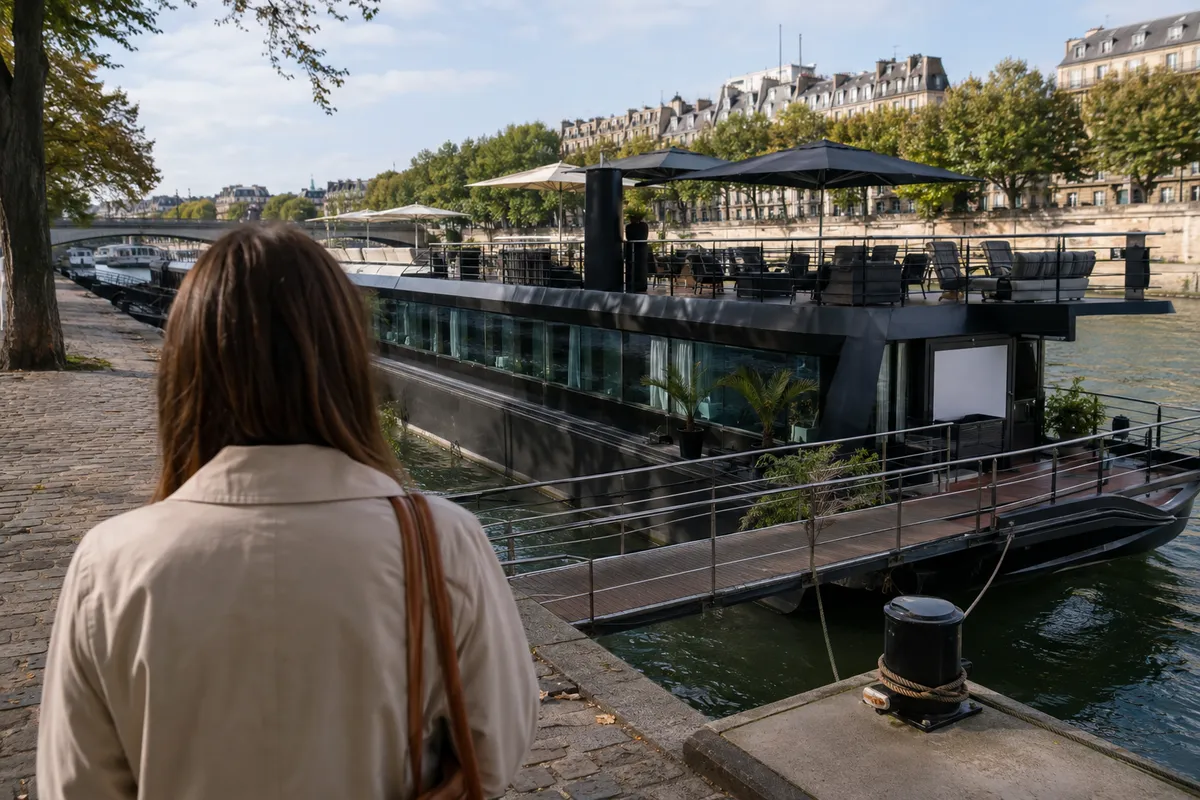
Preserved heritage craft include vintage motor yachts and full-rigged tall ships, exemplified by the 1924 diesel yacht Mälardrottningen and the 1888 sailing ship STF af Chapman in Stockholm. Bespoke multi-hull builds, such as OFF Paris Seine on the River Seine, use twin catamaran hulls to provide structural stability and wider interior deck footprints than conventional narrowboats can accommodate.
Stationary floating establishments operating in European inland waterways are certified under the CESNI ES-TRIN technical requirements (Directive EU 2016/1629) and classification standards such as Bureau Veritas NR580. These frameworks enforce strict stability calculations, hull thickness thresholds, and buoyancy safety reserves. Most operational urban botels maintain drafts between 1.5 and 2.5 meters, ensuring continuous clearance above riverbed silt during seasonal late-summer low-water periods.
Waterfront Regeneration and Mooring Berths: How Botels Integrate into City Docks
Urban botels serve as primary anchors in municipal waterfront revitalization programs across major river corridors and post-industrial basins. In Prague and Budapest, converted river craft occupy historic central stone embankments along the Vltava and Danube, placing passengers within short walking distance of old-town cores. Conversely, cities like Amsterdam and London locate floating properties within former maritime transport hubs like NDSM Wharf and the Royal Docks, driving foot traffic to repurposed industrial harbor lands.
A permanent mooring berth requires fixed municipal infrastructure rather than self-sufficient marine systems. Stationary botels connect directly to urban utility grids via specialized, flexible umbilical lines designed to articulate with fluctuating water levels and river surges.
Technical Callout: Municipal Shore Hookups
Stationary botels avoid running noisy internal generators by drawing shore power through high-amperage cables meeting EN 16840 standards (>125 A). Potable water enters the hull continuously through food-grade delivery hoses adhering to ISO 5620-1 specifications. Onboard blackwater and greywater discharge into municipal sewer mains through pressurized flexible lines using EN 1306 cam-lock couplings, preventing wastewater release into public rivers.
These physical hookups anchor the botel to municipal grids, but they also mean that any municipal water main maintenance ashore directly interrupts cabin showers on board.
Staying on a Botel: Cabin Realities, Onboard Physics, and Maritime Rules
Sleeping on a converted barge hotel requires recalibrating your spatial and acoustic expectations. Marine architecture prioritizes buoyancy, watertight compartmentalization, and hull stability over expansive living areas. Understanding how shipbuilders organize interior space prevents frustration before boarding.
Cabin Dimensions, Layout Efficiency, and Porthole River Views
Floor plans aboard urban botels run significantly smaller than land-based European hotel rooms. Historic crew quarters aboard vessels like Mälardrottningen Yacht Hotel and Grand Jules - Boat Hotel measure between 6 and 10 square meters for entry-level single bunks. Standard refitted double cabins across properties like Good Hotel London, Botel Albatros, and OFF Paris Seine average 13 to 14 square meters, while multi-berth family cabins occasionally reach 20 to 24 square meters.
Space optimization inside these cabins relies on functional maritime carpentry. Beds feature built-in under-berth clearance of roughly 20 to 25 centimeters for luggage storage, wall surfaces replace wardrobes with open peg rails, and writing tables fold flat against bulkheads. At Good Hotel London, standard rooms apply a screen-free digital detox layout with zero in-room televisions, directing visual attention toward the dock through fixed windows.
Luggage Management Alert
Rigid hard-shell suitcases measuring over 70 centimeters cannot slide under low-clearance bunks or open flat on cabin floors without blocking access to the bathroom door. I pack collapsible duffel bags that flatten into the 20-centimeter sub-bed void, leaving precious floor space unobstructed.
Portholes and river-facing windows sit close to the water surface, offering clear views of passing river traffic. However, exterior wake spray and seasonal river silt coat exterior glass quickly, and heavy harbor moisture can obscure visibility during cooler mornings.
Below-Waterline Environment: Hull Soundproofing, Microclimate, and Wake Vibrations
Urban botels moored along inland rivers and sheltered docks experience negligible oceanic pitch or rolling. However, water transmits sound waves and kinetic energy directly into steel hull plates. When passing diesel-powered commercial barges, commuter ferries, or high-speed tourist bateaux-mouches pass within close range, guests feel low-frequency wake vibrations and hear continuous water-slapping acoustics against the hull.
Sub-waterline cabins operate under unique thermal conditions. Raw exterior steel plates remain chilled by the surrounding river current, which creates a sharp dew-point gradient against warm indoor air. Modern botels counteract condensation through forced mechanical fresh-air ventilation, but baseline humidity levels in lower-deck cabins stay higher than in standard land-based accommodations.
Submerged steel hulls also function as natural Faraday cages. Structural metal plates scatter high-frequency cellular signals, which can cause mobile data reception to drop out entirely inside lower cabins. Connecting to the internet in sub-waterline berths requires relying on hardwired Ethernet access points and corridor Wi-Fi repeaters installed by the property.
Maritime Living Rules: Macerator Toilet Pumps and Vessel Fire Safety
Marine plumbing operates on mechanical suction and motorized waste reduction rather than gravity. Urban botels utilize electric marine macerator pumps, commonly known as sanibroyeurs, mounted directly behind cabin toilets. These units feature high-speed rotating blades that shred organic waste before pumping it through small-diameter pipes into holding tanks or municipal sewer connections.
Flushing wet wipes, paper towels, facial tissues, or menstrual hygiene products jams macerator impellers immediately. A jammed pump burns out its motor within minutes, halts wastewater drainage, and causes rapid toilet bowl flooding into the cabin. Floating hotels display explicit warnings in cabin bathrooms stating that guests who induce mechanical blockages will be held liable for emergency pump repairs and replacement fees.
Fire regulations on moored vessels are strictly enforced due to the structural complexity of metal ship interiors. In Prague, Botel Albatros enforces a strict zero-smoking policy across all enclosed cabins and exterior open decks. A single smoking violation triggers an immediate fine of 5,000 CZK (approximately $215) and instantaneous expulsion from the vessel with zero refund.
Guests must also navigate raised watertight coamings throughout passenger companionways. Mandated under ES-TRIN Chapter 19 safety rules, these solid steel thresholds rise 15 to 30 centimeters above the deck floor at every bulkhead door, requiring careful step-overs to avoid tripping.
Premier Boat Hotels in Europe: Top Urban Ship Hotels for City Breaks
European urban botels span historic capitals, offering distinct operational features, transit links, and room classes across Western, Central, and Northern waterways.
Western European Ports: Design Catamarans and Floating Communities in Paris, Amsterdam, and London
Western European floating hotels showcase modern naval engineering and creative industrial conversions. In Paris, OFF Paris Seine operates as a 4-star twin-hull catamaran moored at 20-22 Port d'Austerlitz. The vessel houses 54 guest rooms and 4 design suites starting at 14 square meters, with nightly rates ranging between €140 and €280 ($152 to $305). The catamaran features a central open-air plunge pool and an onboard cocktail bar open to the general public until 1:00 AM.
In Amsterdam, Botel Amsterdam sits moored at NDSM Pier 3 in the city's northern shipyard district. This 3-star floating hotel offers nightly cabin rates from €70 to €150 ($76 to $163). Guests reach Amsterdam Centraal Station via the municipal GVB ferry F4, which runs free of charge every 15 to 30 minutes directly from the pier.
London's floating hospitality is anchored by Good Hotel London at Royal Victoria Dock in Newham. This 8,000-tonne repurposed social-enterprise pontoon offers 148 compact rooms measuring 13 to 14 square meters, priced between £75 and £120 ($98 to $157) per night, positioned within easy walking distance of the IFS Cloud Cable Car and ExCeL London.
| Property | Vessel Type | Room Size | Nightly Rate | Transit Connection |
|---|---|---|---|---|
| OFF Paris Seine | Custom Catamaran | From 14 m² | €140–€280 | Gare d'Austerlitz (Metro 5, 10 / RER C) |
| Botel Amsterdam | Converted Pontoon | From 12 m² | €70–€150 | Free GVB Ferry F4 (NDSM Wharf) |
| Good Hotel London | Heavy Pontoon | 13–14 m² | £75–£120 | Royal Victoria DLR / Custom House (Elizabeth line) |
Central European Riverfronts: Converted Cargo Barges and Refitted Botels in Berlin, Prague, and Budapest
Central Europe's waterways feature converted vintage river barges and historic floating hotels permanently secured along central urban embankments. In Berlin, Shipotel Berlin comprises two moored riverboats—the Eastern Comfort and Western Comfort—docked along the River Spree beside the East Side Gallery. The ships provide both private ensuite cabins and budget shared-facility bunks with rates between €55 and €100 ($60 to $109) per night.
Prague offers extensive floating lodging along the Vltava River. Botel Albatros cabin specifications detail an extensive Art Deco interior refit across 84 standard cabins (14 m²), 3 deluxe cabins (18 m²), and 3 family cabins (20 m²), moored permanently at the Ludvíka Svobody embankment since 1969 with rates starting from 1,600 CZK ($66 / €61). Nearby, Botel Matylda and its companion barge Klotylda near Masarykovo nábřeží feature 25 cabins priced between 1,800 and 3,500 CZK (€72 to €140 / $78 to $152) per night, spread across multiple interior levels without elevator service.
In Budapest, Grand Jules - Boat Hotel operates under official 3-star status, moored along the Danube Buda embankment directly opposite the Hungarian Parliament building. Entry-level single cabins measure 10 square meters, while family configurations reach 24 square meters, with rates ranging from €55 to €110 ($60 to $120) per night.
| Property | Waterway & City | Cabin Count | Refit / Status | Rate Range |
|---|---|---|---|---|
| Shipotel Berlin | River Spree, Berlin | Twin Vessels | Ensuite & Shared | €55–€100 |
| Botel Albatros | Vltava River, Prague | 90 Cabins | Art Deco Refit | From 1,600 CZK |
| Botel Matylda / Klotylda | Vltava River, Prague | 25 Cabins | Heritage Timber Interior | 1,800–3,500 CZK |
| Grand Jules - Boat Hotel | Danube River, Budapest | Multiple Decks | Official 3-Star Vessel | €55–€110 |
Nordic Maritime Heritage: Preserved Historic Yachts and Tall Ships in Stockholm
Stockholm integrates preserved historic ships directly into its inner-city archipelago hospitality network. Mälardrottningen Yacht Hotel, moored at Riddarholmskajen on Riddarholmen Island, occupies a 73-meter luxury diesel motor yacht built in 1924. The vessel houses 65 guest cabins ranging from compact 6-square-meter single sailor bunks to 17-square-meter owner suites, with nightly rates running between 750 and 1,800 SEK ($72 to $173).
Moored nearby across the central harbor basin, STF af Chapman & Skeppsholmen operates aboard an 1888 three-masted, full-rigged steel sailing ship. Private twin cabins below deck rent from 660 to 1,100 SEK ($63 to $105) per night, featuring authentic curved hull walls, exposed structural rivets, and shared washroom facilities located along the central corridor.
Stockholm Mooring Check-in Procedures
Check-in for STF af Chapman does not take place on the tall ship itself. Guests must register at the shore-based reception desk located inside the brick Hantverkshuset building on the Skeppsholmen quayside before walking across the ship's gangway. The property enforces a strictly cashless payment policy; domestic pets are permitted only in designated land-side superior rooms for an extra fee of 250 SEK ($24) per stay.
Standing on the teak foredeck of the af Chapman at dawn, I listened to the rigging cables chime against the mainmast in the harbor breeze—a mechanical sound unique to heritage sailing hulls.
Pricing Realities, Booking Methods, and Tourist City Tax Surcharges
Headline room rates on booking engines omit municipal tourism levies and specialized marine surcharges. Factoring local taxes and booking channels into your calculation ensures realistic financial planning.
Municipal Surcharges and Fiscal Levies: Amsterdam, Paris, Prague, and Budapest
European municipalities levy targeted lodging taxes to offset municipal tourism infrastructure costs. According to the City of Amsterdam tourist tax portal, Amsterdam imposes a municipal tourist surcharge of 12.5% on the net room rate—the highest accommodation levy in Europe—compounded by the Dutch national short-stay lodging VAT rate rising from 9% to 21% as of 2026. A €120 base cabin rate at Botel Amsterdam incurs an extra €15 in city tax alongside national VAT.
In Paris, OFF Paris Seine collects a flat municipal stay tax (*taxe de séjour*) of €8.45 per adult per night on behalf of the City of Paris. In Prague, guests staying at Botel Albatros or Botel Matylda must pay a mandatory local stay tax (*místní poplatek z pobytu*) of 50 CZK (approximately $2.15) per person per night for all guests aged 18 and older, collected directly at the front desk upon check-in.
The Grand Jules Boat Hotel terms and conditions outline Budapest's municipal lodging tax (*idegenforgalmi adó / IFA*), set by national law at 4% of the net accommodation price per night for guests aged 18 and over. Third-party aggregators frequently display an estimated flat fee of €2.19, but the hotel calculates the legally mandated 4% against your confirmed net room rate upon arrival.
| City & Property | Local Tourist Tax Rate | National Lodging VAT | Collection Timing |
|---|---|---|---|
| Amsterdam (Botel Amsterdam) | 12.5% of net room rate | 21% (effective 2026) | Due at check-in |
| Paris (OFF Paris Seine) | €8.45 per adult / night | 10% | Due at check-in |
| Prague (Botel Albatros) | 50 CZK per adult / night | 12% | Collected at desk |
| Budapest (Grand Jules) | 4% of net room rate (IFA) | 5% | Due at check-in |
Aggregators, Cashless Check-In, and Direct Association Discounts
Urban botel cabins are listed across major online travel agencies including Booking.com, Expedia, Agoda, and metasearch engines like KAYAK. These platforms offer standardized cancellation policies, but booking through third parties can forfeit specific institutional discounts available directly through non-profit operators.
Reserving a berth on STF af Chapman through the official STF af Chapman booking portal grants Swedish Tourist Association (STF) and Hostelling International (HI) members a fixed discount of 50 SEK per adult per night. For a three-night stay in an authentic tall-ship cabin, direct booking saves 150 SEK compared to aggregate agency rates.
Harbor properties increasingly enforce fully cashless check-in protocols. Botels across Scandinavia and the United Kingdom require chip-and-pin debit cards, major credit cards, or contactless mobile payments for all transactions, including quayside bar tabs and baggage storage locker rentals.
Gangway Access Code Protocol
Urban botels often lock their shore gates and retract boarding gangways after late evening hours (typically between 22:00 and midnight). If your flight or train arrives late, email the boat reception desk at least 24 hours in advance to secure the digital keypad entry code for the quayside security barrier and gangway gate.
During my late-night arrival at NDSM Wharf, the shore gate lock was illuminated with a keypad requiring a four-digit access code sent via SMS, without which I would have been stranded on the open pier until the morning ferry service resumed.
Honest Drawbacks and Risk Factors: Mobility, Noise, and Structural Constraints
Stationary ships impose distinct physical barriers that do not exist in conventional land-based hotels. Before confirming a reservation, consider the structural limitations of converted marine hulls.
Gangway Accessibility and Companionway Stairs: Severe Physical Limitations
The vast majority of converted European botels and heritage barge hotels lack passenger elevators. Multi-deck vessels like Botel Matylda and vintage yachts like Mälardrottningen rely entirely on original companionway stairs. These marine ladders feature narrow wooden or steel treads, steep pitch angles exceeding 45 degrees, and low overhead clearances that demand caution when carrying baggage.
Boarding gangways fluctuate constantly with river hydrography. Under European standard EN 14206 (Gangways for passenger vessels), access gangways can safely operate at slopes up to 30 degrees. However, urban accessibility standards for travelers with reduced mobility (PRM), outlined in ES-TRIN Chapter 19 and building standard DIN 18040-1, mandate maximum ramp inclinations of 6% to 8.3% (approximately 5 degrees).
During low-water river cycles or tidal shifts, gangways tilt at steep angles, and the transition plates connecting the floating pontoon to the stone quay develop noticeable ridges. These structural angles make wheeled mobility devices, wheelchairs, and heavy multi-wheeled suitcases impossible to roll smoothly across the threshold without physical assistance.
Acoustic Isolation, Nightlife Vibrations, and Missing Standard Amenities
Sound travels efficiently across water and resonates through steel plates. Beyond wake vibrations from early-morning freight barges, botels host internal noise sources. Properties with integrated social venues, such as the floating cocktail lounge aboard OFF Paris Seine operating until 1:00 AM, generate footstep thumps and bass vibrations that carry into lower-deck guest rooms.
Climate control varies substantially by vessel age. Refitted ships like Botel Albatros feature modernized central HVAC climate systems installed during recent interior renovations. Conversely, historic heritage vessels such as STF af Chapman and Mälardrottningen cannot accommodate split-unit air conditioning ductwork without damaging historic timber bulkheads, relying instead on central radiator heating in winter and basic desk fans during summer heatwaves.
Essential Botel Gear Checklist
Pack the following items to counter floating accommodation constraints: high-attenuation silicone earplugs (rated 30+ dB NRR) to block low-frequency hull vibrations and morning barge traffic; a multi-port European USB-C charging block to manage scarce single wall outlets; and low-profile shoes with slip-resistant rubber soles conforming to EN ISO 20347 to maintain traction on wet exterior steel gangways and morning-dew teak decks.
Checking these equipment items off your packing list helps mitigate the structural compromises inherent in marine accommodation.
Botel vs. Traditional Hotel: Objective Selection Framework and Final Verdict
Choosing between an urban botel and a conventional city hotel involves weighing waterfront views against living space and accessibility.
Comprehensive Comparison: Floating Accommodation vs. Land-Based Hotels
The primary advantage of European urban botels lies in their real-estate efficiency. Converted ships secure moorings along prime city-center river embankments—such as the Vltava directly below Prague Castle or the Buda Danube facing the Hungarian Parliament—at nightly rates between €55 and €150. Land-based boutique hotels sharing these exact waterfront views routinely charge triple those rates.
However, that price advantage comes at the expense of room dimensions, storage volume, and elevator access. A standard €100 hotel room in Berlin or Prague provides 18 to 22 square meters, a full wardrobe, an elevator, and a standard gravity-drain bathroom. An urban botel cabin at the same price point offers 10 to 14 square meters, under-bed storage slots, steep companionway ladders, and an electric macerator toilet.
| Evaluation Criteria | Urban Botel (Converted Ship) | Traditional Land-Based Hotel |
|---|---|---|
| Location Cost Efficiency | High (Prime waterfront at €55–€150/night) | Moderate to Low (Waterfront premiums apply) |
| Usable Cabin Floor Area | Compact (Typically 10–14 m²) | Standard (Typically 18–25 m²) |
| Barrier-Free Accessibility | Poor (Steep gangways, high coamings, no lifts) | Compliant (Elevators, flat thresholds) |
| Plumbing Sensitivity | High (Macerator pumps; zero non-paper items) | Low (Standard gravity municipal sewer lines) |
| Acoustic Profile | River wakes, hull slapping, metal companionways | Street traffic, corridor footfalls |
Traveler Profiles: Who Should Book an Urban Botel and Who Should Avoid Them
Urban botels serve travelers who value waterfront character and historic craftsmanship over expansive personal square meterage. They are well-suited for solo adventurers, maritime heritage enthusiasts, architectural tourists, and city breakers planning stays of 1 to 3 nights with compact, soft luggage.
Conversely, botels present significant obstacles for travelers with reduced mobility, families traveling with multi-piece stroller systems, and light sleepers sensitive to low-frequency wake rocking and early-morning river traffic. Guests who expect room service, expansive ensuite baths, and full-service bellhops should book land-based accommodations.
If you desire waterfront atmosphere without marine structural trade-offs, look into converted dockside hotels on land. Properties like 25hours Hotel HafenCity in Hamburg, CitizenM Rotterdam at the Old Harbour (Oude Haven), or CitizenM London Bankside along the Thames provide maritime design elements, full elevator access, standard municipal plumbing, and double-glazed acoustic isolation.