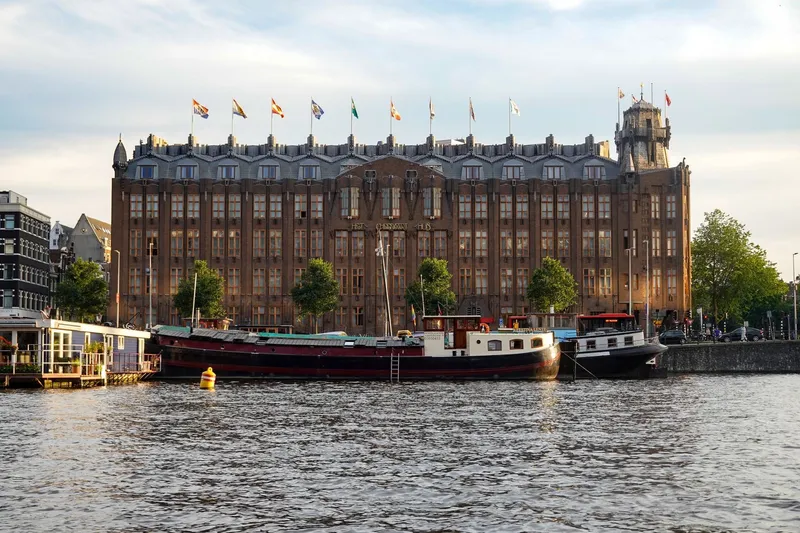
The ship sits on a sheltered basin, so the motion question most first-timers ask about is a non-issue here; the real constraints are space, stairs and the clock.
Getting to the boat from Centraal
Leave the station on the eastern side (Stationsplein Oost), follow Oosterdokskade past the big black public library (the OBA), then cross the Mr. J.J. van der Veldebrug footbridge toward the basin. The address is the dock, not the ship: the vessel itself is at Steiger 3, about 900 metres from the station, which is 12 to 15 minutes at a normal pace with a bag.
From Schiphol, any train to Amsterdam Centraal takes about 15 to 20 minutes and runs through the night, so the whole journey from the plane is a train ride plus that walk. The walk itself is flat and paved, and a wheeled bag rolls easily on the street; the hard part starts at the pontoon.
Steiger 3 is behind a locked perimeter gate, and the Gandalf has no round-the-clock desk. Message the hosts your arrival time in advance and keep your phone charged, because the gate is where you will need it. Arriving without warning means waiting on the quay for someone to come down.
In practice the last stretch goes like this:
- Walk from Centraal along Oosterdokskade to the Oosterdok basin.
- Find the Steiger 3 gate and call the number on your confirmation.
- Wait at the gate until a crew member lets you through.
- Cross the pontoon ramp to the gangway; it takes one person at a time.
- Step down the companionway to reception for check-in.
My first arrival here came in sideways rain off the IJ, and I stood at the gate with a wheeled case and a phone, dialling the number from the confirmation. A crew member came down within minutes, but the wet steel ramp left an impression: the ridges that give grip are slick when soaked, and pulling a hard case over them needs both hands and a slow step. I message my arrival window before leaving Centraal now, and I pack so the bag can be carried.
If walking is not the plan, GVB tram 26 stops at Muziekgebouw Bimhuis on Piet Heinkade, about five minutes from the gangway, and bus 43 from Centraal toward Borneo-eiland calls at Piet Heinkade and Kattenburg. Bus 22 is not useful here: it ends at Centraal. Timetables shift with the seasons, so check the GVB journey planner on the day.
The National Maritime Museum (Het Scheepvaartmuseum) at Kattenburgerplein 1 and the NEMO Science Museum both sit within a few minutes' walk of the mooring, and Nieuwmarkt, with its cafes and the edge of the old canal ring, is about ten minutes south-west. That makes the Oosterdok basin a quiet base on the doorstep of the museum quarter.
Cabins: fixed berths and a wet-room pod
There are ten cabins in two layouts: twins with two parallel single beds, and triples with a lower single berth plus an upper bunk. The beds are built into the hull framing and cannot be pushed together, so couples sleep in separate berths. Every cabin has a radiator that runs warm in winter, which matters more than it sounds on a steel boat in a damp harbor.
Each cabin carries its own wet-room: a single composite pod with a wall-mounted shower head, a marine toilet and a small basin, and the whole floor drains. Water pressure is steady, though the floor takes a couple of minutes to clear after a shower. Taller guests will find the elbow room tight, which is normal for a Dutch passenger barge of this size.
Every cabin here is en-suite, which is worth noticing: several of the cheaper botels on the same basin put the showers and toilets in a corridor, and the comparison of en-suite and shared-facility cabins is the fastest way to see the difference in price and comfort. The ten cabins here open off one corridor, with a small bar and lounge area for guests and a smoke alarm and key access in every room.
What is in the cabin, and what is not:
- Fixed berths for two or three, with towels and basic toiletries provided.
- A private wet-room pod with shower, toilet and basin.
- A heating radiator, key access and a smoke detector.
- No desk, no wardrobe and no in-cabin Wi-Fi.
A rigid hard-shell case is the one thing I would leave at home. On an autumn stay I wheeled one into a twin cabin and it would not go under the lower berth at all; open on the floor it blocked the aisle for the whole visit. A soft duffel slides under the bunk and squashes flat, wall pegs take the coats, and toiletries stay in the bag instead of on the basin ledge.
Wi-Fi, noise and what a moored night is really like
Wi-Fi is listed for the public areas only, and steel is an effective radio shield, so do not count on a signal in a lower-deck cabin. Plan on mobile data if you have calls to make; 4G and 5G are solid across Oosterdok, and the salon and breakfast room are the reliable spots for anything that needs a stable connection.
I learned that the hard way in spring, joining a video call from a lower-deck cabin and watching the picture freeze twice before giving up. I finished the meeting at a table in the breakfast room, coffee in hand, and worked from there for the rest of the stay.
Because the ship is moored with its machinery off at night, there is no engine rumble and no generator drone. What you hear instead travels through the cabins: footsteps in the companionway, voices next door, and the pumps that flush the marine plumbing. Light sleepers should bring earplugs. Guests rate the stay well overall – Booking.com shows 8.6 out of 10 from around 386 verified reviews, and Tripadvisor puts it at 4 out of 5 from roughly 60.
Breakfast on the upper deck
Breakfast is served in the communal room on the upper deck, with windows onto Oosterdokskade. It is a continental spread of Dutch bread, cheese and cold cuts, boiled eggs, spreads, yogurt, fruit juice, tea and coffee, and the listing says vegetarian, vegan and gluten-free items can be arranged on request. Tables are shared, trays are cleared by guests, and the room is the quietest place on board to work before the city wakes up.
Whether breakfast is included depends on the rate you pick. Some channels sell room-only, so read the line item on your voucher before paying; if it is charged separately on arrival, the dockside cafes along Oosterdokskade cost more than a breakfast-inclusive rate would have. On this ship the flexible rate that bundles breakfast is usually the better buy.
What you actually pay: rate, VAT and city tax
Aggregators quote twin cabins from around $110 (€100) a night in low season, and prices climb steeply in tulip season and on summer weekends. The part that catches people out is the tax, which changed at the start of 2026. VAT on Dutch overnight accommodation rose from the reduced 9% to the standard 21% on 1 January 2026, as set out in the Ministry of Finance lodging tax amendment, and Amsterdam adds its own tourist tax of 12.5% of the room price excluding VAT (City of Amsterdam tourist tax). The city tax is charged per night with no cap on the number of nights.
Together the two charges add about a third to the net rate – 33.5% – so a ≈ $110 (€100) cabin bills at ≈ $150 (€133.5) before any extras. On the booking screen, check whether the figure shown already includes municipal taxes or whether you settle them at the ship; over three nights that difference is real money.
| Component | On a ≈ $110 (€100) net rate |
|---|---|
| Net room rate | ≈ $110 (€100) |
| VAT (21%) | ≈ $23 (€21) |
| Amsterdam tourist tax (12.5%) | ≈ $14 (€12.5) |
| Total | ≈ $150 (€133.5) |
Two money details are worth settling before you book. Cancellation terms follow the rate tier: flexible rates allow free cancellation up to the deadline shown at booking, while non-refundable promotional rates forfeit the whole amount. The ship also takes a refundable security deposit at check-in, so ask the hosts about the amount and the method when you confirm; there is no ATM at Steiger 3, so bring any cash you will need from Centraal.
Because the ship has only ten cabins, tulip season and summer weekends sell out early, and holding a specific berth on a flexible rate months ahead is cheaper than buying late.
Check-in hours and house rules
Check-in runs from 14:00 to 22:00 and check-out from 08:00 to 10:00, and there is no night porter at the gangway. An arrival after 22:00 needs a prior arrangement; without one you are on the wrong side of a locked pier gate. It is the most common way a stay starts badly, and it is easy to avoid: message the ship as soon as your flight or train slips.
If you are running late, contact the ship before 22:00. The pier gate is locked overnight and there is no one on the dock to let you in.
On board, pets are not allowed and smoking is banned in the cabins and salons, with the open deck the only place for it. Children are welcome – the listing includes a children's buffet and board games – but there are no cots or fold-out beds, so families need to book enough fixed berths, usually a triple.
Parking if you drive
Driving into central Amsterdam is where the paperwork bites. Since 1 January 2025 a diesel car needs Euro 5 or cleaner to enter the area inside the A10 ring, while petrol cars are not checked at all; the zone is camera-enforced and the fine for a car is ≈ $140 (€130). Check your registration document before you set off, using the City of Amsterdam low-emission zone rules and the Milieuzones Nederland overview.
Street meters near Oosterdok are the costliest option, running to about $8.8 (€8) an hour in the centre. The underground Parking Centrum Oosterdok on Oosterdoksstraat 150 charges ≈ $8.8 (€8) an hour with a ≈ $50 (€45) daily cap; a pre-booked online day ticket runs ≈ $28 – $33 (€25 – €30) and an evening dinner ticket ≈ $11 (€10). For more than a night, Park and Ride is the only sensible route.
| Option | Cost | Notes |
|---|---|---|
| Street meters (centre) | up to about $8.8 (€8)/hour | Short stays only; rate depends on the zone |
| Parking Centrum Oosterdok | ≈ $8.8 (€8)/hour, ≈ $50 (€45)/day cap | Online day ticket ≈ $28 – $33 (€25 – €30); dinner ticket ≈ $11 (€10) |
| P+R (Zeeburg, RAI and others) | ≈ $14 (€13) first 24h on weekday mornings, then ≈ $6.6 (€6); ≈ $6.6 (€6) otherwise | Requires GVB/OV travel; 96h cap, RAI 24h |
Amsterdam runs P+R sites at Zeeburg, RAI, Sloterdijk, Bos en Lommer, Olympisch Stadion, Johan Cruijff ArenA and Boven 't Y, so pick the one that matches your approach road. The discount pays off only if you follow the rules exactly: park, then travel into the centre and back by public transport using an OV-chipkaart or a paper GVB ticket. Contactless OVpay, the OV-pas and digital barcode tickets are not accepted at the machines (P+R Sloterdijk is the exception), and this is where many drivers lose the discount. The city sets out the steps and the current rates on its P+R rules and rates page.
Where the boat gets awkward
The gangway drops from the fixed pier to the hull and moves with the water; it fits one person and a bag, so two people cannot pass. From there, steep narrow companionways lead down to the cabins. The handrails are solid, but this is not a place for a wheelchair, a walking frame or anyone unsteady on stairs, and heavy multi-piece luggage is hard work.
Motion is the least of your worries. Oosterdok is an enclosed basin, screened from the IJ by dikes and bridges, so the ship sits still; the only movement is a brief wash when a tour boat passes the outer harbor in the afternoon. Cooling is the real seasonal issue: there is radiator heating for winter, but no air conditioning, so in a July heatwave the cabins hold the warmth and you sleep with the portholes open, listening to gulls and dock traffic.
Who it suits, and what else is moored nearby
Two things are worth skipping. Street parking near Oosterdok is one: at up to ≈ $8.8 (€8) an hour it is a poor use of money when P+R costs ≈ $6.6 (€6) a day. The other is any room-only rate if you plan to eat on board, because a breakfast-inclusive flexible rate undercuts the dockside cafes and the difference is not small.
| Traveller | Fit | Why |
|---|---|---|
| Couples and solo travellers with soft bags | Good | Clean, quiet berth 15 minutes from Centraal; only ten cabins |
| Budget city-break visitors | Good | Water view and breakfast for well under canal-house hotel rates |
| Guests who need a desk and in-cabin Wi-Fi | Poor | Wi-Fi is in the public areas; cabins are too small for a workspace |
| Guests with mobility limits or heavy luggage | Poor | Narrow gangway and steep companionways |
| Families with infants | Poor | No cots; berths are fixed and the ship holds ten cabins |
If Gandalf is full, the same converted-cabin formula runs along Oosterdok: Hotelboot Zwaan and AmicitiA botel are both a few minutes away, and the wider Amsterdam botel and ship hotel roundup covers the Amstel and NDSM Wharf options too.
If you decide you want an elevator, a bathtub and a 24-hour desk instead, book on land: MEININGER Amsterdam City West beside Sloterdijk station has standard private rooms, and The Flying Pig Downtown near Centraal covers the hostel end of the market.