
Amsterdam Botel Review: Berthing Hubs, Fiscal Changes, and Waterway Realities
Staying on Amsterdam's waterways in 2026 involves steep new financial realities that catch unprepared visitors off guard. On January 1, 2026, the Dutch national value-added tax on hotel and short-stay lodging jumped from 9% to 21% under statutory tax reforms published by the Government of the Netherlands. Combined with the municipal tourism tax (toeristenbelasting) of 12.5% calculated against the net room rate, statutory levies now inflate raw base prices by more than a third across every commercial hull and private mooring in the city.
Finding the right berth depends on balancing transit friction against sleep tolerances and deck space. Budget travelers seeking central walkability gravitate toward converted historical freight barges in the Oosterdok basin, while modern travelers wanting functional hotel infrastructure choose the purpose-built floating complex across the northern bay at NDSM Wharf. Independent groups willing to self-cater and manage domestic municipal rules often bypass commercial piers entirely to secure whole-vessel charters along the residential sections of the Amstel.
The Floating Hotel Landscape: Amstel, Oosterdok, and NDSM Wharf Compared
Amsterdam's waterborne lodging is divided across three distinct hydrographic and urban zones: the industrial IJ river waterfront at NDSM Wharf, the enclosed historical harbor basin of Oosterdok, and the regulated canal riverbed of the Amstel. Each berthing hub presents vastly different exposure to wind, commercial vessel traffic, and connection speeds to the historical center.
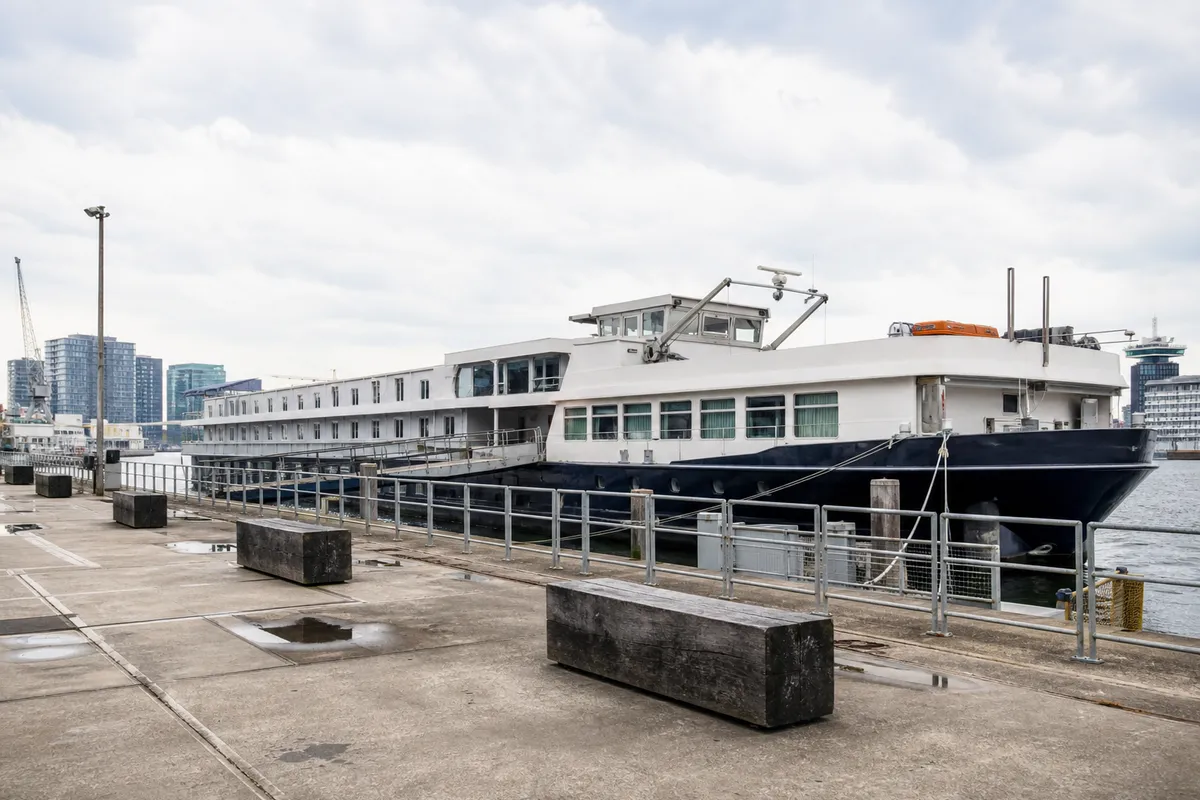
At NDSM Wharf (NDSM-werf), Botel Amsterdam operates as a static three-star vessel housing 175 guest cabins along a deep-water industrial pier. In contrast, Oosterdok Steiger 2 and 3 provide sheltered berths for converted commercial hulls—predominantly Dutch tjalk and luxemotor craft—within walking distance of central rail platforms. Further south, the Amstel river houseboats consist of permanently moored residential vessels, offering isolated living environments rather than standard front-desk operations.
| Berthing Hub | Vessel Typology | Waterway Environment | Center Connectivity |
|---|---|---|---|
| NDSM-Werf (Pier 3) | Purpose-built 175-cabin cruise botel | Open industrial river IJ; swell from cargo traffic | 14-min free municipal ferry to Centraal |
| Oosterdok (Steiger 2 & 3) | Converted tjalk and luxemotor freight barges | Enclosed harbor basin; minimal commercial wash | 10- to 12-minute walk to Centraal Station |
| Amstel River | Static concrete-hull and iron residential barges | Regulated canalized river; frequent tour boats | 10- to 15-minute metro or tram ride to core |
During my inspection at NDSM Pier 3 on a blustery autumn morning, the vessel rocked noticeably against its heavy nylon mooring hawsers whenever sea-going tugs navigated the IJ channel, whereas the barges tucked inside the Oosterdok basin remained motionless against their timber dolphins.
Mandatory Lodging Taxes, Transit Integrations, and the 2026 Surcharge Impact
Calculating the true cost of an amsterdam botel review requires auditing mandatory taxes that online booking platforms frequently omit from initial headline search results. As of 2026, every overnight visitor pays a 12.5% municipal toeristenbelasting alongside the revised 21% national lodging VAT. Because the city tourist levy applies directly to the net nightly rate before VAT, a base cabin advertised at €100 incurs an extra €12.50 in municipal tax plus €21.00 in VAT, yielding a final charge of €133.50 per night.
Calculate your stay using the base formula: Total = Net Base Rate × 1.335. On a five-night stay booked at €180 per night, mandatory Dutch and municipal lodging taxes add exactly €301.50 at checkout.
Local transit logistics have become simpler thanks to the nationwide contactless system. Travelers no longer need to spend €7.50 on a physical anonymous OV-chipkaart or pay the €1.00 surcharge for single-use paper tickets. Municipal operator GVB supports OVpay contactless transit across all trams, metros, and buses; passengers simply tap an NFC debit card, credit card, or smartphone at the entrance and exit turnstiles.
NDSM Botel Stay: Evaluating Botel Amsterdam at NDSM-Werf
Stationed permanently at NDSM-Pier 3 in Amsterdam-Noord, Botel Amsterdam represents the largest commercial floatel in the Netherlands. For broader context on how converted passenger vessels operate across other European waterways, consult our guide to European urban botels and converted ships. The vessel functions as an independent hospitality property anchored directly into the revitalized shipbuilding yard of NDSM-werf.
On-Deck Experience: Standard Cabins vs. Rooftop Loft Letter Suites
Accommodations aboard Botel Amsterdam divide strictly into two design categories: standard subterranean/waterline cabins and the rooftop architectural lofts. Standard double and twin cabins measure 15 square meters, providing functional modular bathrooms, integrated wall-mounted desks, and double-glazed rectangular portholes. Rates for standard cabins average between €85 and €180 during off-peak autumn and winter months, climbing to €190 to €320 on peak summer weekends.
Perched on the upper sun deck are five distinctive 6.5-meter-tall red sculptural letters spelling 'BOTEL', conceived by MMX Architecten. Each letter encloses a standalone designer loft measuring 25 to 30 square meters, carrying nightly tariffs between €250 and €450 depending on seasonal demand. The interior spaces feature non-standard layouts: letter 'B' contains a dual-level bedroom with a skateboard half-pipe curve, while letter 'E' incorporates multi-tiered resting platforms.
The rooftop Loft Letter suites lack elevator service. Reaching them requires ascending steep external stairs and navigating tight internal spiral companionways that cannot accommodate hard-shell suitcases over 18 kilograms.
While third-party hostel platforms enforce an 18+ age restriction and a 6-night maximum stay for shared inventory, Botel Amsterdam as a whole is not an adults-only venue. The vessel accepts families directly and features dedicated 20-to-25-square-meter quadruple family cabins on its lower accommodation decks. When I measured the berth frames in cabin 114, the usable mattress clearance measured exactly 195 centimeters, which tall travelers should keep in mind.
GVB Ferry Logistics, Night Timetables, and Waterfront Access
Transit between Botel Amsterdam and the historical city center relies on the GVB ferry F4 route running from the IJ-side pontoon behind Amsterdam Centraal directly to NDSM Wharf. The 14-minute crossing is free for pedestrians, bicycles, and mobility scooters. During operational hours, vessels depart every 15 to 30 minutes, providing seamless access to the city center.
However, an ndsm botel stay demands strict timetable awareness after dark. The daytime F4 ferry stops running around midnight (departures finish between 23:45 and 00:15 depending on the day). Travelers stranded on the city center side after midnight must use contingency routes:
- Night Ferry F5 (Nachtelijk Westveer): Connects Centraal to NDSM, running until 01:40 on weeknights and 02:55 on weekends at 30-minute intervals.
- 24/7 Buiksloterweg Ferry (F3): Operates continuously across the IJ; requires an onward 3.8-kilometer (15-minute) bicycle ride or a €20 taxi back to NDSM Pier 3.
- GVB Night Bus N93: Departs Centraal for Klaprozenweg/Atatürk (costing €5.70 via OVpay), followed by a seven-minute unlit walk across the industrial yard.
During winter squalls, the walk along NDSM Pier 3 is exposed to severe northwest crosswinds driving across the IJ. Steel gangway ramps shift along grease plates, and spray from passing freighters routinely coats the approach path.
Oosterdok Barge Hotels: Historic Tjalks and Luxemotors by NEMO
Travelers prioritizing central walkability over modern amenities choose the cluster of historic vessels berthed in the Oosterdok basin. These oosterdok barge hotels deliver affordable city-center lodging without the need for ferry transfers.
Mooring Dynamics and Atmosphere at Oosterdok Steiger 2 and 3
The Oosterdok fleet berths along Steiger 2 and Steiger 3, positioned across the inlet from the sloped green copper hull of the NEMO Science Museum. Converted working hulls—including Vita Nova, MPS Holland, and The Cabin at MPS Noorderzon—provide budget private cabins typically priced between €60 and €140 per night in shoulder season. This pricing undercuts traditional brick-and-mortar hotels in the adjacent Nieuwmarkt and Medieval Center districts by 40% to 60%.
Foot access from Amsterdam Centraal takes 10 to 12 minutes, crossing the pedestrian Mr. J.J. van der Veldebrug (bridge no. 1939) from Oosterdokskade. The floating timber pontoons of Steiger 2 and 3 rise and fall along guide pilings with seasonal rainwater discharge. When boarding Vita Nova after an afternoon rainstorm, I noted that the wet Douglas fir decking on Steiger 2 became slick, and the hinged transition plate connecting the dock to the steel barge gunwale clattered under heavy foot traffic.
Footwear with non-marking rubber lug soles is essential on Steiger 2 and 3. Smooth leather shoes lose traction on the wet wooden pontoons and narrow steel barge thresholds.
Converted Dutch Tjalk and Luxemotor Barges: Physical Comfort vs. Heritage Quirks
The vessels moored in Oosterdok were originally built between 1900 and 1935 as working freight ships, built with flat bottoms and heavy riveted iron plates to haul peat, grain, and gravel through shallow canals. Converting these working cargo holds into guest quarters results in tight interior dimensions and idiosyncratic ergonomics. For an overview of cabin layouts on converted freight hulls, read our breakdown of sleeping on water and cabin living reality checks.
Cabin bulkheads are constructed from lightweight plywood fitted between original steel ribs, resulting in minimal acoustic privacy between neighboring berths. Footsteps on the upper steel deck resonate into the sleeping quarters below. Furthermore, these historic craft feature steep, narrow nautical companionway stairs angled sharply down into the hold, making them inaccessible to wheelchair users and challenging for anyone managing luggage heavier than 15 kilograms.
Historic Oosterdok barges do not have compressor-based air conditioning. Cabins rely on passive water cooling through the hull and open portholes. In July and August heatwaves, hold cabins become warm and humid.
Ceiling clearance inside the hold corridors generally tops out between 1.90 and 2.00 meters. Tall occupants will find themselves ducking beneath exposed overhead steel stringers and door coamings throughout their stay.
Amstel River Houseboats: Private Amsterdam Ship Accommodation via BookaHouseboat
Chartering a whole vessel along the residential banks of the Amstel offers a completely private alternative to commercial botels. This style of amsterdam ship accommodation operates under residential leases rather than hospitality frameworks.
Independent Barge Charters vs. Commercial Botels: Privacy, Space, and Pricing
Independent charters secured through platforms like BookaHouseboat average €220 to €550 per night. These rates secure private access to a converted tjalk, luxemotor, or concrete-hulled ark, complete with a functional residential galley, separate living quarters, and private deck space along the riverfront. For travelers unfamiliar with residential mooring agreements, our guide to static houseboat stays and rented houseboat hotels breaks down domestic inventory expectations.
Unlike commercial botels, private houseboats do not provide luggage storage, daily housekeeping, or 24-hour reception desks. Access is handled via key lockboxes bolted to canal-side mooring bollards, with owners enforcing narrow arrival windows between 15:00 and 18:00. In neighborhoods like Weesperzijde and the Plantage, guests handle their own provisions, using supermarkets such as the Albert Heijn branches on Sarphatistraat 39 and Wibautstraat 80, and carrying their waste to municipal underground bins on the quay.
| Operational Dimension | Commercial Botel (NDSM / Oosterdok) | Private Amstel Houseboat Charter |
|---|---|---|
| Check-in Infrastructure | Staffed reception desk (24h or fixed hours) | Key lockbox or restricted host arrival window |
| Luggage Storage | On-site baggage room or storage lockers | No luggage holding before check-in/after check-out |
| Space & Self-Catering | Compact cabin (7–15 m²); no galley cooking | Full vessel (45–90 m²); residential kitchen included |
| Daily Oversight | On-site night porter and crew | Complete self-management of domestic utilities |
Municipal Regulations, Rental Night Caps, and Waternet Enforcement
Short-term holiday rentals of residential houseboats are regulated by the City of Amsterdam. Under municipal housing bylaws, residential houseboats outside the center may only be rented to tourists for up to 30 nights per calendar year. On April 1, 2026, the Centrum district enforced level 6 of the municipal holiday escalation ladder, cutting the short-term rental cap down to just 15 nights per calendar year.
Operating an unregistered or over-limit rental carries municipal administrative fines up to €21,750 (rising to €43,500 for repeat offenses), along with penalty orders (last onder dwangsom) up to €50,000. When booking private watercraft, confirm that the listing displays an official 16-digit municipal registration number (registratienummer). Listings lacking this number risk abrupt administrative cancellation without host compensation before your trip begins.
Waterway enforcement authority Waternet strictly fines open-deck sound systems €140 on the spot, backed by equipment confiscation. Canal speed limits are capped at 6 km/h, with speeding fines starting at €95.
While sitting on an Amstel houseboat deck near Torontobrug, I observed a Waternet inspection patrol boat intercept an open craft playing music through a portable loudspeaker, issuing a written citation within ten minutes.
Living on the Waterline: Hull Acoustics, Motion, and Marine Plumbing Realities
Life aboard any moored vessel exposes guests to environmental forces that land-based hotels insulate against. Understanding hull physics, motion, and wastewater limits prevents unpleasant surprises once you are onboard.
Steel Hull Insulation, Wake Motion, and Porthole Drafts
Moored vessels transmit kinetic and acoustic energy directly into cabin interiors. At NDSM Wharf, where the IJ channel carries commercial barges and container ships, displacement wakes strike Botel Amsterdam's steel plate hull as low-frequency hydrodynamic shocks. This hull movement creates intermittent creaking along mooring lines and fenders. By contrast, the Amstel river experiences shorter wakes from glass-topped tour boats, subsiding into flat water after 22:00.
Inside the cabins, automated bilge pumps cycle periodically, producing a momentary low vibration and hum that wakes light sleepers. Seasonal variations in water temperature also impact indoor comfort:
- Hull Condensation: Cold autumn and spring canal water cools steel hull plates below the interior air temperature, causing water droplets to form on uninsulated steel surfaces behind cabin baseboards.
- Waterline Acoustic Slap: Wavelets continually lap against the exterior waterplate, creating a hollow, rhythmic sound directly behind the head of your berth.
- Porthole Drafts: Traditional brass dogs and rubber gaskets on operational portholes allow cool air drafts to seep in during high-wind channel squalls.
Maintaining air circulation via roof cowls or ventilation louvers helps prevent moisture from accumulating in mattress corners against cold steel hull frames.
Marine Wastewater Systems: Sanibroyeur Pumps and Waternet Mandates
Sanitation aboard moored vessels in Amsterdam is regulated by strict environmental rules. Direct discharge of wastewater into the city canals is illegal. Municipal utility Waternet requires every permanently berthed houseboat and commercial floating accommodation to connect to the municipal sewer via an electric pumping system with an operating pressure of at least 0.8 bar.
To move solids through narrow flexible discharge pipes into the street mains, vessels rely on electric macerating units (frequently manufactured by Sanibroyeur). These compact pumps use high-speed rotating blades to grind waste before pumping it under pressure to shore-side connection points. However, macerator units are vulnerable to mechanical jams if foreign materials enter the system.
Never flush wet wipes, paper towels, or personal hygiene products into a marine toilet. A jammed macerator motor requires complete mechanical disassembly to clear.
Standard houseboat lease agreements hold guests financially responsible for toilet clogs. While not an official municipal fee, private hosts routinely deduct €150 to €300 from security deposits to cover emergency plumber (loodgieter) callouts needed to disassemble fouled macerator units.
Choosing the Best Boat Hotels in Amsterdam: Verdict and Decision Matrix
Selecting among the best boat hotels amsterdam requires matching your travel style against realistic shipboard constraints. Vessel accommodations reward travelers who value proximity to the water, but punish those expecting the sound isolation, luggage elevators, and climate control of conventional hotels.
Location Trade-Off Matrix: NDSM vs. Oosterdok vs. Amstel Charters
The comparative matrix below shows how Amsterdam's three primary waterborne hubs balance against one another across operational metrics, including all 2026 tax increases (21% VAT + 12.5% tourist levy):
| Operational Criterion | NDSM Botel Amsterdam | Oosterdok Barge Fleet | Amstel Houseboat Charters |
|---|---|---|---|
| Nightly Cost (Taxes Included) | €113 – €427 per cabin | €80 – €187 per cabin | €294 – €734 whole vessel |
| Centraal Station Travel Time | 14 min (free ferry F4) | 10 min (flat walk) | 10–15 min (tram/metro) |
| Physical Accessibility | Elevator to 3rd deck; steep stairs to roof lofts | Steep companionways; no wheelchair access | Single-story arks accessible; older hulls steep |
| Hydrodynamic Motion | Moderate swell from IJ commercial river wakes | Static, sheltered harbor basin conditions | Light daytime wake; calm after dark |
| Late-Night Return Options | Ferry F5 (until ~02:00), F3 + 3.8 km bike, Bus N93 | Continuous 24/7 pedestrian access across footbridge | 24/7 night bus network, tram, or pedestrian access |
| Atmospheric Profile | Post-industrial arts yard, street art, large bars | Maritime heritage basin, quiet harbor setting | Residential canal living, neighborhood cafes |
Traveler Profiles: When to Book a Botel and When to Stay on Land
Solo travelers and budget duos wanting cheap accommodation close to central train lines get the best value on Oosterdok Steiger 2 and 3. In exchange for compact 8-square-meter cabins and shared saloon bathrooms, they save hundreds of euros compared to nearby city-center hotels. Travelers interested in post-industrial architecture and creative culture will appreciate NDSM Wharf, provided they factor late-night ferry timetables into their evenings.
Families and small travel groups will find the best space and privacy on an Amstel houseboat charter booked via BookaHouseboat. Having an onboard galley, multiple bunks, and an open river-level deck provides an authentic residential experience that commercial botels cannot match.
Conversely, stay in a traditional land-based hotel if any of the following dealbreakers apply to your travel party:
- Mobility Impairments: Narrow 60-degree nautical companionways on historic barges cannot accommodate wheelchairs, walkers, or travelers with limited balance.
- Bulky or Heavy Luggage: Transporting hard-shell suitcases over 18 kilograms down steep companionway stairs risks injury and structural scuffs.
- Light Sleeping Habits: Moored ships produce continuous ambient noise, including lapping waterline chop, hull creaks, automatic bilge pumps, and morning footsteps on overhead decks.
- Midsummer Heat Sensitivity: Because historic iron freight barges lack active air conditioning, hold cabins can retain heat during sustained July and August warm spells.