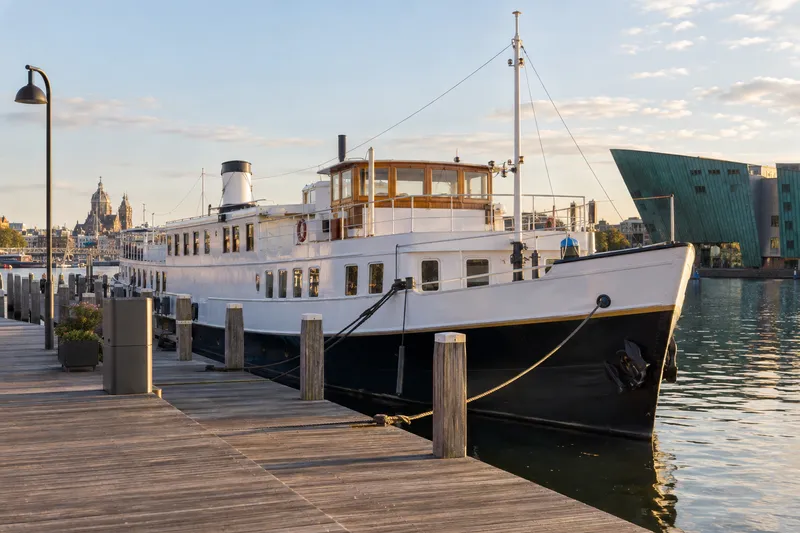
The trade is concrete: the cabins are bunk rooms, the bathrooms are down the corridor, and the companionway between the salon and the lower deck is a ship ladder.
Where Passengership Avanti moors, and how to reach it
Its base is Oosterdok Steiger 3, 1011 VX Amsterdam, on the southern shore of the basin and directly opposite the green, ship-shaped copper exterior of the NEMO Science Museum. Steiger 3 is a floating wooden pier reached through a gate on the quay promenade, where several historic hulls moor side by side. The gate is locked; the code comes from the crew with your arrival instructions. Mine arrived by message before I reached the quay.
The gangway from the quay to the pontoon is short and angled, and the wooden deck is slick after rain; keep one hand on the rail. The last 50 metres from the street are pedestrian only, which means a taxi cannot pull up at the boat; you stop on Prins Hendrikkade and walk down. Pier lighting is subdued at night, and the pontoon is harder to read in the dark than the quay above it.
From Amsterdam Centraal the walk is roughly 800–900 metres east along Oosterdokskade, about 10–15 minutes at an ordinary pace. It is flat except for the bridge arches, and the surface is brick and cobble rather than smooth asphalt. With a wheeled bag, allow the upper end of that range.
Buses are not the shortcut that older guides suggest. GVB line 22 runs west from Centraal to Sloterdijk, and line 43 runs east along Piet Heinkade to Borneo-Eiland; neither serves the Oosterdok quay. Use the 9292 journey planner for the rest of the city, but from Centraal the useful last leg is the walk.
Contactless payment covers the GVB network. Tap in and out with a contactless debit or credit card, or a phone wallet, on buses, trams and metro gates; you do not need a paper ticket or a separate transit card. The ferry to Amsterdam Noord is free and needs no ticket, which is relevant if you are comparing the Avanti with the Botel at NDSM.
Parking at Oosterdok: what it actually costs
The closest covered garage is Parking Centrum Oosterdok, about 400–500 metres from the pontoon. It is an independent public facility with no connection to the botel. The garage sells a cheaper day ticket online; the drive-up rate is hourly with a daily cap. Book online before you arrive if you want the lower rate.
| Parking option | Cost | How it works | Distance to Steiger 3 |
|---|---|---|---|
| Pre-booked day ticket, 00:00–23:59 | ≈ $28 – $33 (€25 – €30) | Reserve online before arrival | 400–500 m, about 5–7 minutes on foot |
| Pre-booked evening ticket, 18:00–23:59 | ≈ $11 (€10) | Reserve online before arrival | 400–500 m, about 5–7 minutes on foot |
| Drive-up standard | ≈ $8.8 (€8) per hour, ≈ $50 (€45) daily maximum | Pull a ticket at the barrier | 400–500 m, about 5–7 minutes on foot |
Oosterdok lies inside Amsterdam's low-emission zone, which covers the area within the A10 ring. Since 1 January 2025 a diesel passenger car needs emission class Euro 5 or higher; diesel cars from Euro 0 to Euro 4 are barred. Petrol cars are not checked. Enforcement is by automatic number-plate cameras, and the fine is ≈ $140 (€130). The City of Amsterdam emissions-zone map shows the boundary; check your plate before you drive in.
Cabins: 15 two-berth rooms and what 4 m² means in practice
Below deck, 15 cabins open off a single corridor, each with two single wooden bunks stacked vertically, a wardrobe space, a porthole and a hand basin. Bathrooms are shared. Agoda lists the cabin at 4 m²; that is the OTA's floor figure rather than an official naval measurement, and it is a fair warning. The bunks take most of the footprint, leaving a strip of floor wide enough to stand in but not to open a suitcase.
Standing space is limited to the strip between the bunk frame and the opposite bulkhead. A hard-shell case has to stand in the doorway, where it blocks the door swing; a duffel slides under the lower bunk. The cabin I was given faced the pontoon, and every footstep on the wooden deck came through the porthole. Earplugs solved the footsteps; the porthole view of the water was worth keeping.
Each cabin has a circular porthole looking at the waterline or the adjacent pier. It opens for fresh air but has to be secured in bad weather. Storage is a short rail of hooks and a shelf above the bunks, enough for a phone and a charger. There is no desk and no individual climate unit; the operator describes a central climate-control system and central heating in winter. Wi-Fi is listed as free in public areas, and a steel hull is not a friendly place for a weak signal, so do not plan to work from the bunk.
- Bunk arrangement: two fixed single wooden bunks with a wall ladder.
- Overhead clearance: limited between bunks; taller guests have to duck when sitting up on the lower mattress.
- Ventilation: one operable porthole; no separate cabin air handling.
Shared bathrooms and the morning queue
Every cabin has hot and cold water at the basin, which takes some pressure off the shared block: you can brush your teeth, shave and wash your face without leaving the room. The shared block has four showers and six toilets for 15 cabins; at full occupancy that is 30 guests. The queue builds between 08:30 and 10:00, when breakfast and the 10:30 checkout overlap. Bring shower sandals and a quick-drying towel; the duckboards are wet at that hour.
Guest scores reflect the shared plumbing. Trivago aggregates 3,595 reviews at 7.4, with location around 9 and cleanliness around 7.8. amsterdam-stays.com lists 6.8/10 from 1,691 reviews, and Tripadvisor shows 3/5 from 161. The spread tracks the shared bathrooms and the age of the hull; guests also mention worn linen, damp and mold in some cabins, and slow replies from the operator. If a private bathroom is non-negotiable, this is the wrong vessel, and the en-suite comparison is a better starting point.
The salon, the sun deck and the operator
Above the cabins is an enclosed salon with tables for the whole complement, a self-service drinks counter, a small bar and a lending library. It is the only indoor space where you can sit upright with a laptop or a book, and in winter it is the warmest part of the boat. Large windows look across the basin to the museum docks and the passing harbor traffic.
The open sun deck above has perimeter railings and bench seating. In mild weather it gives a clear view across the basin to NEMO and the Maritime Museum; the benches are most useful before 09:00, while the basin is still. After that, the water keeps moving and the deck is better for a short look than a long sit.
The vessel is operated by Hollandsche Vaartochten Maatschappij, which also runs multi-day charters on Dutch and Belgian waterways. That dual role explains a common confusion: the ship is a hotel on some nights and a charter boat on others. The hotel side has a direct line, +31 6 28652430, and info@vaarmij.nl. The office answers during business hours; use the line for group bookings, late arrivals or anything an OTA message cannot answer.
Charter work can also take the ship off its base: guests describe the vessel moving to another mooring during a stay, in one case without prior notice. If your plan depends on the Oosterdok address, ask the operator to confirm the berth in writing.
Breakfast: the cold Dutch table, and when it is included
Breakfast is served in the salon and follows the Dutch cold-table model: bread, butter, sliced Gouda, ham, sweet spreads, yogurt, cereal and juice, with filter coffee and tea from thermoses. There is no hot cookline, so no made-to-order omelettes, bacon or sausages. Booking.com's property description lists the same cold table; whether it is included depends on the rate, so check the conditions rather than the photos. When it is included, the buffet runs 08:30–10:30.
If it is included, it is good value against a sit-down café near Centraal, where a similar cold plate and coffee costs noticeably more. The tables are communal, which suits solo travellers and couples but not anyone who wants a silent start. I skipped the salon once to catch an early train and bought a dry station sandwich for roughly the same money; now I eat on board even if it means leaving ten minutes later.
Coffee and tea stay out during the day, which is useful after a cold walk back from the museum quarter. There is no packed lunch and no dinner service for hotel guests. Independent guests eat lunch and dinner out, with Nieuwmarkt and Kadijksplein a short walk west and the Albert Heijn to Go inside Centraal useful for supplies.
Charter catering is not your hotel rate
The ship also runs multi-day charters, and charter groups use the salon and kitchen differently from hotel guests. If you see a per-person charter price, it is not the room rate; hotel bookings are room-only or room-and-breakfast, and catering for a charter is quoted separately. Ask the operator what is included rather than assuming dinner is part of the deal.
This matters most for groups. A group that takes most of the boat should ask for a charter quote rather than booking cabin by cabin; the hotel booking path is designed for individual travellers, not for a party that wants the salon to itself.
What is genuinely inconvenient on board
Noise is the first thing to accept. The Avanti is moored in a working basin, and every tour boat or supply tender that passes sends a ripple under the hull. The basin is sheltered, so there is no ocean swell; what reaches the hull is wash from other boats. Mooring lines creak against the bollards, fenders press against the pontoon, and the water laps at steel a few centimetres from your pillow. Between cabins the bulkheads are timber rather than masonry, so corridor footsteps and closing doors carry. The ship's own generator is silenced and can be switched off; the wash and corridor traffic are what you hear. The harbor is quieter than a street-facing room in the Red Light District, but it is not silent.
Temperature is the second. Central heating handles autumn and winter, and the salon is warmer than the cabins. Summer is the weak point: a steel hull sitting in the sun holds heat into the evening, and the porthole is the only cabin vent. Ask for a fan if you are booking July or August, and do not expect the cabin to cool down as quickly as a land hotel with air conditioning.
The stairs are the third. The companionway from the salon to the cabins is steep and narrow, more ship ladder than hotel staircase, and the watertight coamings at the bottom are a trip hazard in the dark. Anyone who cannot manage a steep stair with a bag should not book; if you use a wheelchair, ask the operator about access before booking. Tall guests should also check the bunk clearance before booking, because sitting up on the lower mattress is not guaranteed.
Children are not permitted. Agoda and Trip.com list the property as adults-only, and Booking.com's room policy rules out extra beds and cots. If you are travelling with a child, confirm with the operator before you pay.
Rates, taxes and booking conditions
Rates are dynamic. Booking.com and Agoda listings for a midweek double usually sit between ≈ $77 (€70) and €140 outside event weeks; a Friday or Saturday during a big city event can be listed at ≈ $180 – $280 (€160 – €250). Peak summer is higher than autumn, and January–February midweeks are the cheapest. There is no fixed tariff.
The widget above pulls live availability. Some booking links on this page are affiliate links: if you reserve through them, I earn a small commission, and the price you pay is the same. Compare the operator's direct rate for a group, because OTA inventory and charter inventory are not the same.
Breakfast inclusion changes the comparison. Two offers that look ≈ $11 (€10) apart can invert once one includes breakfast and the other does not. Check the rate conditions before you compare totals, and check whether the city tax is already in the total or collected at check-in.
The tax line: VAT and city tax
Since 1 January 2026, short-stay accommodation in the Netherlands carries the standard VAT rate, up from 9%. The Belastingdienst confirms it for hotels, pensions and short-stay logies. On top of that, Amsterdam charges tourist tax on the net room rate before VAT. The City of Amsterdam tourist tax page lists the rate at 12.5%, so the combined load on a net rate is about 33.5%.
| Tax or surcharge | Rate | Basis and authority | How it is collected |
|---|---|---|---|
| Accommodation VAT | 21% | Belastingdienst, from 1 January 2026 | Usually included in the quoted room rate |
| Amsterdam tourist tax | 12.5% | City of Amsterdam, 12.5% of the net room rate | Pre-paid or added at check-in |
The calculation is the part people get wrong. On a ≈ $110 (€100) net room rate, city tax is ≈ $14 (€12.5) and VAT is ≈ $23 (€21), so the guest pays ≈ $150 (€133.5). The 33.5% figure applies to that net rate, not to a price that already includes VAT. If a booking page quotes ≈ $110 (€100) including taxes, check which taxes are inside that number; do not add another 21% or 12.5% on top.
Check-in, check-out and cancellations
Check-in runs from 14:00 to midnight. Check-out is 06:30–10:30 on both Agoda and Trip.com; breakfast runs 08:30–10:30, so the shower queue peaks in that hour. If you have an early train, ask about an earlier departure when you check in. If you plan to arrive after 20:00, call the operator during the day; the office is not staffed around the clock, the gate code arrives by message, and the pontoon has no lobby to wait in.
Cancellation terms depend on the rate. Flexible rates usually allow free cancellation for a few days before arrival; non-refundable rates charge immediately. The booking page states the deadline in the rate conditions, and that is the version that applies, not a general policy in the hotel description. Group bookings are quoted separately, with their own terms.
How the Avanti compares with AmicitiA, Vita Nova and Botel NDSM
The Oosterdok has three budget boats in a row, and they are more similar than the marketing suggests. AmicitiA and Vita Nova both use two-berth cabins with hand basins and shared bathrooms, and both sit beside the Avanti in the same basin. The differences are cabin size, breakfast and the age of the fit-out, not the location.
| Property | Mooring | Cabin and bathroom | Families | Access | Typical double range |
|---|---|---|---|---|---|
| Passengership Avanti | Oosterdok Steiger 3 | 15 two-berth cabins, 4 m², hand basin, shared bathrooms | Adults only | Steep companionway | ≈ $77 – $150 (€70 – €140) |
| AmicitiA | Oosterdok, opposite NEMO | 18 two-berth cabins, 3 m², hand basin, shared bathrooms | Adults only | Gangway and stairs | ≈ $50 – $180 (€45 – €165) |
| Vita Nova | Oosterdok, next to NEMO | 24 cabins: 20 twins (4 m²) and 4 singles, hand basin, shared bathrooms | Adults only | Gangway and stairs | ≈ $61 – $230 (€55 – €210) |
| Botel Amsterdam | NDSM wharf, north bank | 175 rooms, private bathroom and toilet | Quadruple family cabins | Lift; free ferry to Centraal | from ≈ $140 (€125) |
Typical listed double ranges on Booking.com, Agoda and Trip.com, room-only unless the rate includes breakfast; city tax and VAT extra. The Oosterdok boats are priced for the location rather than the room.
The three Oosterdok boats sell location and a maritime night at hostel prices; the Botel sells a conventional hotel room with private plumbing and adds a ferry commute. If you want to walk out of your cabin to NEMO or the Maritime Museum before breakfast, the Oosterdok boats win. If you want a lift, a private bathroom and a room that does not move when a tour boat passes, the Botel is the safer purchase.
AmicitiA's twins are the smallest of the three; the Avanti and Vita Nova twins are a step up, though still bunk rooms. Vita Nova adds four single cabins, and its saloon has a microwave and a shared fridge, but no restaurant on board. None of the three takes children, so a family with a pram needs the Botel or a land hotel; a large hard case is a poor fit on any of them.
Who the Avanti suits, and who should book elsewhere
The Avanti works for a solo traveller or a couple who want a central mooring and will trade cabin space for it. The cabin is a place to sleep; the salon and the city are where you sit. What you buy is the address: NEMO, the Maritime Museum and Centraal are within ten to fifteen minutes on foot.
It does not work for a family with young children, anyone who needs step-free access, or a light sleeper who cannot use earplugs. Nor does it suit a traveller who wants to unpack a large suitcase and spread out: the cabin is a bunk room with a strip of floor, the bathroom is down the corridor, and the companionway is steep.
If you are choosing between the Oosterdok boats, pick on cabin size and breakfast rather than loyalty. If you need a private bathroom, skip the Oosterdok trio and look at the private-bathroom boats or the Botel at NDSM. If you are arriving by car, pre-book the Oosterdok garage and check the emissions zone before you leave.
For a group, call the operator rather than booking cabin by cabin. The Avanti is a small vessel, and a group that takes most of the cabins changes the atmosphere for everyone else on board. The charter side of the business is the right place to ask about group terms.