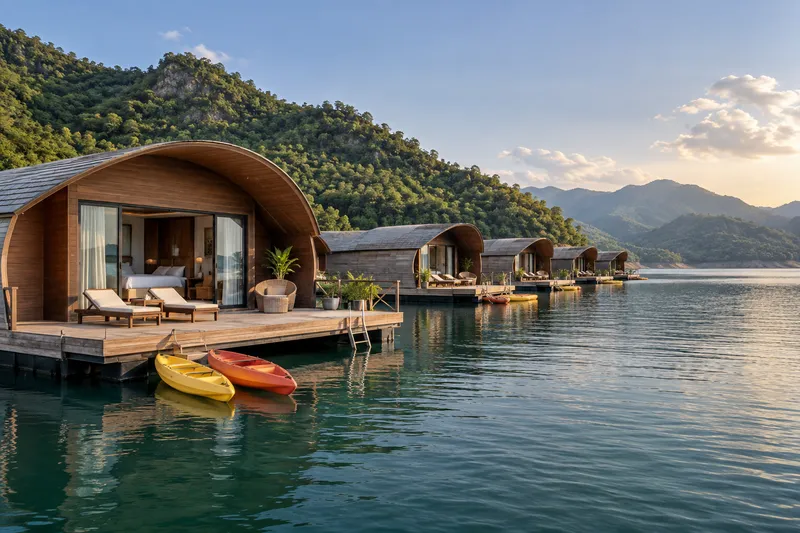
My first stay was a weekday in the cool season. I left Bangkok after a late breakfast, lost close to an hour on the western ring road, and rolled into the lakeside car park as the light went orange. Staff carried the bags down the embankment stair while I followed with a bag of tangerines bought at a roadside stall in Si Sawat; it burst on the last bend and rolled the length of the car. The car smelled of tangerines for the rest of the trip.
Getting there: Route 3199 from Bangkok and Kanchanaburi
From central Bangkok or Suvarnabhumi, budget most of a day: roughly 220–240 km, or 3.5–4.5 hours once you are clear of the city perimeter. The Kanchanaburi bus terminal sits about 80 km short of the resort, around 90 minutes by car, and the Erawan park gate about 22 km, or 20 minutes up Route 3199. Free open-air parking is on the shoreline directly above the pontoons, with EV charging points near reception.
No bus runs all the way to the pier, so non-drivers need two legs. Local bus 8170 leaves the Kanchanaburi bus terminal for Erawan National Park for ≈ $1.8 (฿60) and takes about 1.5 hours; you can also flag it down on Highway 323 before the River Kwai bridge. From the park gate you still need a private taxi or songthaew for the last 22 km along Route 3199, and that transfer should be lined up while you are still in Kanchanaburi, not at dusk from the park car park.
- Kanchanaburi to Erawan, Monday to Friday: 08:00, 09:40, 11:00, 13:00, 16:00, 17:40
- Kanchanaburi to Erawan, Saturday and Sunday: 08:00, 09:40, 11:00, 13:00, 15:00, 17:40
- Erawan back to Kanchanaburi, daily: 05:20, 06:10, 08:30, 10:00, 12:00, 14:30, 16:30
After dark on Route 3199
Past Erawan the road bends through steep, wooded country with blind corners and no overhead lighting at all. The real hazard after dark is not the road but what is on it: farm trucks and motorbikes running without working tail lights, appearing late on an unlit bend. In daylight it is an easy drive. Check-in runs 14:00 to 18:00 and the desk closes at 18:00, so if a delayed flight or highway congestion puts you past six, tell the resort at least a day ahead so a late-arrival pass can be arranged. Without it you may find the gate locked and the hillside dark.
The villas: from compact rafts to a pool suite
Around twenty raft villas sit moored in a wide crescent on the reservoir, each on its own pontoon chassis. The entry tier, South the Scene, is the one to weigh up carefully. Its listed area is 25 m², and a guest who slept in it put the real feel nearer 20 m²; it holds a king bed, an en-suite and a water-facing deck, and it is sold for two adults with no extra bed. Escape North roughly doubles the space at 50 m² and adds indoor seating, more circulation around the bed and a wider overwater deck, takes a third guest and permits one rollaway. Escape North Deluxe is listed at 78 m² on the booking platforms and adds a built-in hot-tub jacuzzi on the open deck. The top category is the Private Pool Villa Suite, which the resort's own page calls the Private Suite Pool Villa: 133 m² with a two-metre king bed, a broad indoor lounge and a covered plunge pool set into the raft engineering itself.
| Villa | Area | Sleeps | Bed | Rollaway | Deck |
|---|---|---|---|---|---|
| South the Scene | 25 m² (269 sq ft) | 2 adults | 1 king | Not available | Timber deck, beanbags, swim ladder |
| Escape North | 50 m² (538 sq ft) | 3 | 1 king | One, on request | Lake-facing terrace, loungers, swim ladder |
| Escape North Deluxe | 78 m² (840 sq ft) | 3 | 1 king | One, on request | Deck with outdoor hot-tub jacuzzi |
| Private Pool Villa Suite | 133 m² (1,431 sq ft) | 3 | 1 king (2 m) | One, on request | Covered plunge pool, direct lake access |
Each deck is a run of interlocking pontoon floats joined by metal hinge plates, which is why the timber gives slightly underfoot as the sections pivot, and why footsteps on the shared walkway do not carry into your room. Decks are fitted with beanbags or loungers and a swim ladder straight into the water.
Deluxe units and the Private Pool Villa Suite
The Deluxe earns its surcharge mainly in the cool season, when the evening air has a bite and you would rather not drop into the lake; through the hot months the jacuzzi goes largely unused. The Private Pool Villa Suite has angled privacy screens, so the sightlines into the living space and the pool are screened even though sound still travels across the water between villas. I would not book the pool suite for a single night: by the time you have arrived, swum once and slept, the plunge pool is the most expensive thing you never used.
What every room includes
All villas come with quiet split-system air conditioning, an en-suite with a hot rainfall shower, hairdryer, kettle, bathrobes, basic toiletries, a desk and a flat-screen TV on cable channels with no streaming apps. The daily minibar of bottled water, soft drinks and snacks is restocked once a day at no charge, and breakfast for two is part of the rate the resort sells directly, served in the central dining pavilion from 07:00 to 10:30; some agency rates are room-only, so check what you are buying. Wi-Fi is free in the villas and the public areas. The pontoon chassis isolates the wastewater plant under the structure, so you do not get the stale-water smell that hangs around older water hotels like The FloatHouse River Kwai downstream.
Occupancy rules are strict. One child under 12 stays and eats breakfast free when sharing existing bedding; an extra bed for a child aged 0 to 11 costs ≈ $21 (฿700) a night, and a third guest aged 12 or over must be booked into an Escape North, Deluxe or Pool Suite and pay a rollaway surcharge of ≈ $41 (฿1,400) per night, breakfast included.
On the water: kayaks, paddleboards and deep-lake safety
Free, unlimited non-motorised craft is the reason many people choose this lake over the River Kwai. Sit-on-top kayaks, paddles and stand-up paddleboards sit at the central floating dock and are self-service through daylight hours, roughly 06:30 to sunset at 18:00. The bay is sheltered from the reservoir's boat traffic, and there is no current to fight, so a beginner can paddle the shoreline bluffs without any real technique.
One morning I was on the water before the kitchen opened, pushing a kayak off the central dock while the surface was mirror-flat. Beyond the next headland there was no wind and no wake, and the only sound was my own paddle and a longtail somewhere out of sight. By mid-morning a thermal breeze arrives and the open water past the point gets a chop, which is why the early start is worth the lost hour of sleep.
Depth and the swim rules
The bottom shelves very little. Within a few strokes of the swim ladder the reservoir floor drops away with no sandbar or shallow ledge in reach, and the resort's safety briefing puts the depth off the decks at more than 20 m. That is the operator's round number rather than a survey, but for a swimmer the result is the same: nothing to stand on. The reservoir sits behind the 140 m Srinagarind Dam, so depth is the norm here, not a local dip in the floor. Life jackets are required for swimming, paddleboarding and kayaking off the docks, and fitted vests in adult and child sizes hang in every wardrobe and at the boat station. In water this deep the real risk is fatigue, and that is why staff enforce the vest rule.
Motorised sports and drone rules
Jet skis, wakesurfing behind the towboats and guided speedboat runs around the reservoir can all be arranged at the dock for an extra charge, with sessions starting around $44 (฿1,500). With a free kayak and a quiet bay alongside, I would skip the paid speed: you are buying distance to the far coves, and the coves are the only thing you cannot reach under your own paddle.
Flying a camera drone in Thailand needs registration with the Civil Aviation Authority of Thailand through its UAS portal and with the National Broadcasting and Telecommunications Commission (NBTC), and unregistered flight carries real penalties. The resort also restricts low flight directly over the villas, so settle the paperwork before you pack the drone.
Eating at Zmone Coffee & Bakery
All on-site food runs through Zmone Coffee & Bakery, an open-sided floating restaurant and lounge tied to the main pier. It opens at 07:00 and serves residents through the evening.
Breakfast format depends on how full the resort is. On busy weekends the kitchen lays out a buffet; on quiet weekdays you get a pre-order sheet at check-in and choose between a Thai set of pork or chicken congee and rice soup, or a Western plate of eggs, sausage, ham and toast, with fruit, juice and coffee alongside. The all-day menu leans on Central Thai cooking, with tom yum, som tam, pad kra phao and deep-fried reservoir fish in fish sauce, plus pasta and burgers. Most dishes land between ≈ $5.3 (฿180) and ฿450, so a dinner for two without much alcohol usually comes in around $21 (฿700) to ≈ $35 (฿1,200).
This is the only kitchen within reach, and the menu is short and fixed. Reviewers who stayed more than a couple of nights note the limited choice and prices a little high for the class of the resort, though the food itself draws few complaints. If you want variety, eat in Kanchanaburi or near the Erawan gate on the way in; the resort does not allow outside food in the villas.
Nights, insects and the screens
Once the longtails and jet skis leave the bay, the reservoir goes close to silent, broken only by water against the floats and cicadas in the hills. Footpaths are lit with low recessed lights, and you should watch the metal hinge plates between floats when you cross them in the dark.
Over open freshwater in the tropics, the insects come at dusk and any lit cabin draws them. Each villa has heavy sliding glass doors with fine mesh screens, and the routine that keeps the room clear is simple: seal the screens and shut the patio doors before you switch on the interior lights. One night I turned the lamps on with the door still cracked and spent a while chasing midges off the ceiling with a towel; once I started closing up first, the cabin stayed clear. Dust and slow shower drainage turn up in a handful of guest reviews, so it is worth checking the drain on arrival rather than on your last morning.
Rates, surcharges and booking
Pricing follows a weekday/weekend split, and a mandatory surcharge lands on Saturdays, Thai public holidays and long weekends; peak dry-season weekends are the most expensive nights of the year. These are published bands, and they move with the season and differ between the resort's own booking page and the big agencies. One guest reported paying just under ≈ $120 (฿4,000) midweek for a South the Scene, which is the low end of what the entry villa can cost.
| Villa | Weekday base (Sun to Fri) | Weekend / holiday surcharge | Peak dry-season weekend |
|---|---|---|---|
| South the Scene | ≈ $110 – $150 (฿3,800 – ฿4,990) | +≈ $30 (฿1,000) / night | ≈ $190 – $210 (฿6,360 – ฿7,200) |
| Escape North | ≈ $160 – $180 (฿5,500 – ฿6,200) | +≈ $30 (฿1,000) / night | ≈ $210 – $240 (฿7,200 – ฿8,100) |
| Escape North Deluxe | ≈ $190 – $210 (฿6,500 – ฿7,200) | +≈ $30 (฿1,000) / night | ≈ $230 – $260 (฿7,900 – ฿8,800) |
| Private Pool Villa Suite | ≈ $280 – $330 (฿9,500 – ฿11,000) | +≈ $44 (฿1,500) / night | ≈ $370 – $440 (฿12,500 – ฿15,000) |
Check-in runs 14:00 to 18:00 and check-out falls between 11:00 and noon. Cancellation terms move with how you book: the big online agencies swing between free cancellation two to four weeks out and non-refundable flash rates, while direct reservations through the resort's own site (z9resorts.com) take an upfront bank or card deposit that is non-refundable inside the final two weeks. Confirm the rate in writing at booking, because these cards shift with the season.
How it compares with the River Kwai rafts
The usual alternative is an older raft hotel downstream on the River Kwai Noi, and the difference that matters is hydrology. A River Kwai raft lives in a moving current that pulls against its anchors and hull through the day; swimming there means jumping in upstream and drifting down to a stern ladder, and paddling a board or kayak upstream is close to impossible. This reservoir behaves like a still mountain lake, with no drift, negligible movement unless a boat wake rolls through, and two-way paddling straight from your deck, the same freedom that makes 500 Rai on Cheow Lan Lake work well. The trade is scenery and sound: open water and long horizons here, a shaded jungle canyon and running water on the Kwai. The site's Kanchanaburi and Southern Thailand floating resorts guide sets the two models side by side.
Who it suits, and what to sort out first
Access and mobility on site
Getting down to the water is the main physical hurdle. From the car park you descend a long, steep metal-and-timber staircase cut into the embankment; there is no lift, ramp or chairlift. Below, the walkways are floating boardwalks connected by articulating joints, open at the sides and without railings, over deep water. Suitcases are carried by hand, and a wheelchair or stroller is not workable on that route. One recent guest review asks the resort to add handrails on the stair, which tells you how the descent feels with luggage. If step-free access matters, this is not the property.
- Shoes with grip for the metal stair and wet boardwalks.
- A dry bag for the kayaks.
- Insect repellent for after dusk.
Who it fits, and who should look elsewhere
Self-drive couples, calm-water paddlers and photographers get the most from it. Families with toddlers or unsteady children should think hard, because the boardwalks are open-sided over deep water with no rails. Non-drivers have a harder time, since there are no shops, food stalls or cafes within walking distance; you eat where the resort eats. Pets and service animals are not accepted. And if you cannot reach the gate by 18:00, arrange the late pass or move the booking.
How many nights, and what to pair it with
One night is swallowed by the drive and the check-in window, leaving an afternoon and a morning on the water. Three nights is where a single restaurant and the absence of a nearby town start to show; by the third dinner the menu is familiar. A two-night stay threads between the two, with an afternoon paddle, a full morning on the water and one Erawan stop, and it is what most repeat guests book. Repeat visitors tend to settle on the same choices: a weekday stay to dodge the surcharge, an Escape North that beats the entry raft because the extra deck is where the day actually happens, and a morning at Erawan folded into the drive north. Erawan itself pairs easily, since the park opens at 08:00, takes last entry at 15:30 and charges foreign adults ≈ $8.9 (฿300); walk the falls early, eat near the gate, then take the last 22 km north and be on the water by afternoon.
For a firm plan, book direct, pay the deposit early and get the late-arrival pass confirmed in writing. The OTA flash rates are cheaper on paper but bite if the drive from Bangkok runs long.