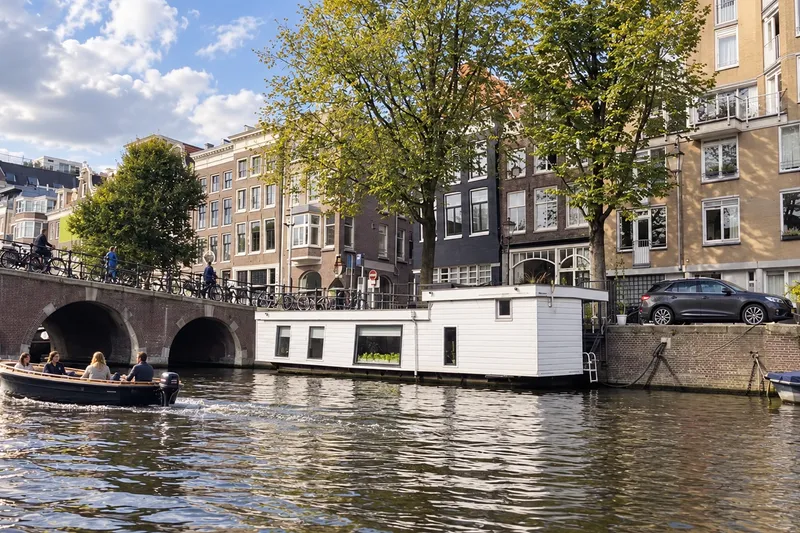
What separates a good floating suite from a bad one
Hull material and mooring decide how the cabin moves and sounds. The Lightship is welded steel in an enclosed basin, with no working engine and no generator running at night, so the water under the bed stays flat; the only movement comes from a passing canal boat. Asile's fleet mixes a riveted-steel tjalk with an oak North Sea botter, all tied in the calm Johan van Hasseltkanaal. The Botel is a converted river cruiser on the open IJ at NDSM, where ferry wash arrives several times an hour. Steel explains the sound as well as the stability: the Lightship kept its original bulkheads and portholes, and the conversion added sub-floor heating, but rain on the deck plates still drums through the cabin. I have lain awake through a wet night in the Machinery Room listening to exactly that while the hull itself stayed dead flat. Ask whether the boat runs a generator at night: a diesel set will hum through the hull in a way shore power does not.
Room names hide the difference in floor area. A deluxe cabin on a botel can be a box with a shower curtain over the toilet; a suite on a converted hull can have a separate saloon and two cabins. The table below gives the square metres and the sleeping capacity, which is more useful than the label. At cabin size, two open suitcases take the floor and the bathroom is a wet room; at apartment size, you can leave a bag open and still walk around it. A ladder between the sleeping area and the bathroom also changes how a stay feels at 3 a.m.
Ask what heats the cabin, and whether the windows sweat. Little Amstel has central heating, air conditioning and a sedum roof; the Lightship has sub-floor heating; Zwaan's cabins have electric heating and air conditioning. Ports and cabin windows collect condensation when the cabin is warm and the canal is cold, so wipe the sill before it runs and keep bags off the floor against the hull. The toilet is the other system to question: Little Amstel and Asile pump waste through macerators, and only ordinary toilet paper goes in. A broken pump is the largest item on Little Amstel's damage schedule, and Asile deducts macerator repairs from the deposit.
The brochures are least useful about access. Little Amstel ends with municipal stone steps down to the quay and a gangway that moves with the water. The Lightship has steel companionways steep enough that you go down backwards, plus raised watertight sills at every bulkhead. Asile's jetty has open water on both sides and hatch ladders narrower than a hard-shell case. The Lightship, Asile and Little Amstel are not step-free, so a wheelchair or a pushchair rules them out; the Botel has a lift to its letter deck, though the gangway still moves with the water. Zwaan's cabins are reached by steep stairs.
If you are booking one of the historic hulls, bring a soft bag. The hatch openings on Asile's boats and the companionway on the Lightship are narrower than a wheeled hard-shell case, and the paintwork on a restored hull scuffs easily.
Wi-Fi is the check most people skip, and the review scores separate the five more honestly than the marketing does. Booking.com guests rate the Lightship 9.5 out of 10 for Wi-Fi, Asile 8.3, the Botel 7.6 and Zwaan 7.1, the lowest score on Zwaan's listing. Reception weakens inside a steel hull, so ask where the router sits before you plan a working week. If you need video calls, compare the Wi-Fi in Amsterdam's floating hotels before you book, because the gap between 7.1 and 9.5 decides whether a call holds.
Five floating hotels: what's inside and what it costs
Amsterdam has far more floating beds than five, including budget barges with shared bathrooms and compact bunk cabins; the guide to Amsterdam floating hotels with private bathrooms covers that end of the market. This shortlist is the design-led end: five stays where the hull, the layout or the location justifies the price. Rates are the ranges the operators and booking channels quote for low and peak dates; treat them as ranges, and check whether the quote includes VAT before you compare.
Comparison by price, area and downsides
| Property and berth | Vessel, size, sleeps | Rate range per night | Honest drawback |
|---|---|---|---|
| Lightship Amsterdam (Mariadistelkade 6, Amsterdam-Noord) | 1952 British lightship LV-12; two suites of 60 and 65 m²; 2 adults each | ≈ $350 – $500 (€320 – €450); two-night minimum; breakfast and minibar included | No hob or oven; adults only; no step-free access |
| Hotel Asile Flottant (Korte Papaverweg 2, De Ceuvel) | Six Dutch and Danish working boats, 25–80 m²; 2–6 guests per boat | ≈ $210 – $430 (€193 – €393) per boat | No hob, oven or hotplate; some apartments capped at four guests; no desk on the pier |
| Houseboat Little Amstel (Amsteldijk 700 for A/B; Nieuwe Meer for C/D) | Two 15 m² studios on the Amstel, two on the Nieuwe Meer; 2 guests each | ≈ $200 – $290 (€180 – €260) per studio | 15 m²; card hold and damage schedule; stone steps to the quay |
| Hotelboot Zwaan (Oosterdok steiger 2/3) | Winter-only passenger barge; eight cabins of about 10 m²; Captain's Lodge 50 m² | Standard cabins about $110 – $140 (€100 – €130); Lodge from ≈ $110 (€100) a day | Cash only; closed April–September; seven-night minimum for the Lodge |
| Botel Amsterdam (NDSM-pier 3) | Converted river cruiser; 175 cabins below the letters, five letter lofts on the roof | Standard ≈ $100 – $150 (€95 – €135) low season, ≈ $180 – $280 (€160 – €250) peak; letter lofts ≈ $240 – $420 (€220 – €380) | Lightweight prefabricated bulkheads; no air conditioning in standard cabins; ferry crossing required |
Zwaan settles everything in cash at the gangway, including the key deposit and the city tax. Little Amstel releases its app key only after the card authorization is on file, which is worth doing before you leave home. Asile hands over the key on the pier between 15:00 and 18:00; the arrival window you email is a commitment, because there is no desk to wait at.
Amstel, Oosterdok and NDSM: what each mooring feels like
Little Amstel's A and B studios sit near the Toronto Bridge, across from the InterContinental. The bridge carries the S100 ring road, so heavy vehicles register as a low rumble through the hull; river traffic is gentler, a brief list that the mooring lines absorb. Weesperplein metro is close, and De Pijp's cafés are five minutes beyond that. The address defeats satnav: on a wet afternoon in early spring I followed the pin to the street side of Amsteldijk and walked past the entrance twice; now I aim for the bridge, keep the Amstel Hotel in view and take the stairs down to the quay.
The C and D studios are a different stay: they are on the Nieuwe Meer, a lake southwest of the centre, with bikes included and Dam Square 20 minutes away by bicycle. The trade is a peaceful mooring for a daily ride into town. If your trip is built around the canal ring, book A or B and check the studio letter on the confirmation.
Zwaan's basin is the calmest of the three. Oosterdok is enclosed, NEMO is 120 m away and the water stays still enough that the hull barely registers a passing boat. The boat draws shore power, so there is no generator note at night; what you hear is a door latching, footsteps on steel and the shower pump. Check-in runs from 15:00 to 20:00 and there is no desk outside those hours, which matters if your train is late. On my first winter stay I arrived with a card and a single ≈ $22 (€20) note; the note covered the key deposit and left nothing for the city tax, so I walked back to the ATM at Centraal.
NDSM is the liveliest. The F4 crossing from Centraal is the price of the location; from the NDSM pontoon it is 250 m of flat pier to the gangway, and the wind on that stretch is the real welcome. The five letters on the roof are individual rooms: Richard Hutten's B has a wooden half-pipe, Jord den Hollander's E a projection screen and a split-level bath, and MMX's T is the one with work desks. On a festival weekend the bass comes through the hull; check the wharf calendar before you book a Saturday.
Asile's six boats are tied in the Johan van Hasseltkanaal at De Ceuvel, a former shipyard where the jetty crosses phytoremediation planting. Café De Ceuvel sits at the head of the pier, close enough that conversation and music reach the boats on a warm evening; the operator's quiet hours from 22:00 bind guests, and the café runs music and events through the summer. The free Buiksloterweg ferry is the usual approach, and the walk along Papaverweg is the last stretch; I would ask for a boat at the far end of the row if sleep matters more than the view of the terrace.
What the invoice adds: VAT, city tax and deposits (2026)
Amsterdam adds two levies to every floating booking, and they are calculated on different bases. Since 1 January 2026 the standard Dutch VAT rate of 21% applies to overnight accommodation, according to the Belastingdienst lodging rules. The city's tourist tax is 12.5% of the overnight price excluding VAT, per the City of Amsterdam tourist tax page. Most estimates get that second detail wrong.
Take a net quote of ≈ $110 (€100). VAT adds ≈ $23 (€21), and the city tax is 12.5% of the ≈ $110 (€100) net, or ≈ $14 (€12.5), for a total of ≈ $150 (€133.5). If the rate you see is ≈ $130 (€121) and already includes VAT, the city tax is still 12.5% of the underlying ≈ $110 (€100) net – about $14 (€12.5), or 10.3% of the advertised figure, not 12.5% of ≈ $130 (€121). A ≈ $220 (€200) net rate becomes ≈ $290 (€267); a ≈ $270 (€242) gross rate becomes about $290 (€267) as well. Budget roughly a third on top of a net quote, or a tenth on top of a gross one.
Both rates are reviewed annually, and the VAT change is recent enough that older booking engines still show the 9% figure. Check the Belastingdienst page and the city page before you budget for a stay in the next calendar year; the 12.5% city rate has been stable, but it is a municipal decision that can change with the city's budget. If a platform quotes a tax-inclusive total, ask whether the city tax is inside it or collected at the property; the answer changes the cash you need at the gangway.
Deposits are the other line that surprises people. Little Amstel authorizes ≈ $170 (€150) per studio on a credit card; the money is held on your card and released after checkout, and the app key is not released until the authorization is confirmed. The damage schedule is specific: ≈ $55 (€50) for uncollected rubbish, a lost remote, excessive soiling or small breakages; ≈ $110 (€100) for the Bluetooth speaker; ≈ $280 (€250) for a broken sewage pump. Asile takes a ≈ $220 (€200) deposit and deducts macerator repairs from it. The Botel takes a ≈ $55 (€50) card deposit at arrival and releases it within seven days of checkout. Zwaan takes no cards at all: a ≈ $22 (€20) cash key deposit and the city tax in cash. Photograph any existing damage when you arrive; the deposit is the only record you have if a deduction is disputed.
Getting to the berth: ferries, metro and tickets
The free GVB ferries are the reason NDSM and De Ceuvel work as bases. F3 to Buiksloterweg runs around the clock from the rear of Centraal and takes about three minutes; F4 to NDSM takes 14 minutes and runs from about 07:00 until the small hours, so check the last departure before a late dinner in the centre. F7 links NDSM with Pontsteiger in under seven minutes from the west. Bikes travel free on all of them.
For the Amstel berth (Studios A and B), the metro does most of the work. Little Amstel is 10 minutes on foot from Weesperplein (lines 51, 53 and 54) or a few minutes from tram 4 at Stadhouderskade, though both routes end with steps down to the quay. Zwaan is a 10–12 minute walk from Centraal along Oosterdokskade. The Lightship is about 1.3 km from the Buiksloterweg landing. Asile is a 20-minute walk or six-minute bike ride from the same pontoon; both are also about a kilometre from Noorderpark metro, one stop from Centraal.
Tickets are cashless. OVpay on a contactless card or phone caps GVB travel at ≈ $11 (€10) a day, according to I amsterdam, so you do not need a plastic OV-chipkaart for a city break. If you plan to reach Zandvoort or Zaanse Schans, the Amsterdam & Region Travel Ticket costs ≈ $25 (€23) for one day, ≈ $37 (€34) for two and ≈ $48 (€44) for three in 2026; it is valid from first check-in until 04:00 the morning after the last day. The same ticket covers Connexxion and EBS buses in the region, which makes Zaanse Schans practical without a car. Tap in and out on every leg.
If you arrive by car, the pier addresses are not road addresses: Botel's guests are told to enter Mt. Ondinaweg, and Little Amstel's operator warns that satnav struggles with Amsteldijk 700. Parking in the centre is metered and scarce; the Little Amstel garage is ≈ $55 (€50) a day, and the Oosterdok garage is the sensible place for Zwaan. None of this is worth doing unless you are carrying equipment; the ferry and metro cover the five berths.
Which of the five fits your trip
For two people who want the ship itself to be the trip, I would take the Upper Store at the Lightship over the Machinery Room: daylight through the portholes and a few steps to the front terrace beat the engine-room atmosphere. Book dinner ashore.
Little Amstel is a one-bag stay: A and B put the Amstel outside the window, C and D are on the Nieuwe Meer with a bike included. If you need floor space or a lift, skip it.
Asile Flottant suits a group that wants a whole boat. De La Soul has the cinema room and is the one for a friends' weekend; Les Six Frères is the better layout for two couples, with cabins at opposite ends. Confirm the head count in writing before you pay: the city fire note caps some apartments at four guests even where the boat sleeps six.
Zwaan's Captain's Lodge is a winter let, so it fits an extended stay. For a short city break on the water, the Botel's letter lofts are the better fit; if silence matters, the DoubleTree by Hilton on the same wharf is the land alternative. The Lovers Nest is the Zwaan cabin to avoid with a heavy case or a bad knee: it is down a steep stair from the foredeck.