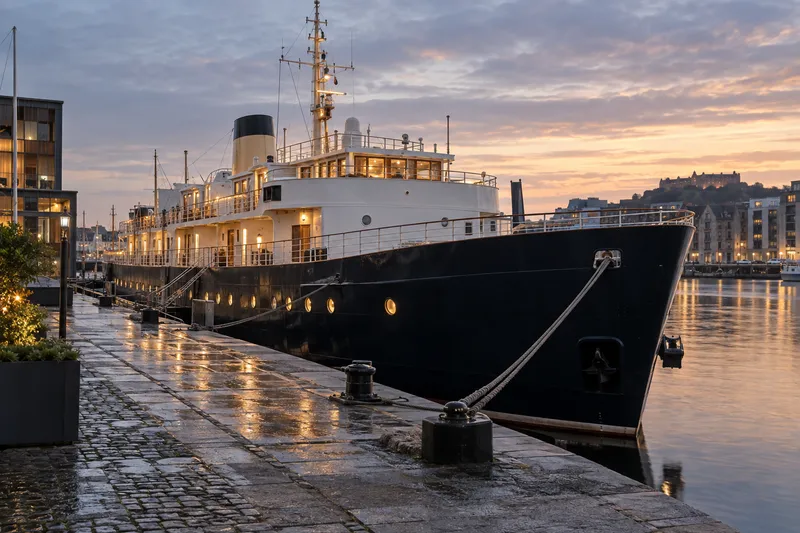
She is berthed at Alexandra Dock in Leith, about two miles north of Princes Street, inside a working dock. The hull sets the rules: curved bulkheads, low doorways in places, and portholes instead of floor-to-ceiling glass. That is the trade you make for sleeping on a 1963 lighthouse tender. The rest of this review is about whether the trade is worth it for your trip.
What Fingal Was Before It Was a Hotel
A lighthouse tender, then a hotel
Fingal was commissioned by the Northern Lighthouse Board and launched in August 1963, the last ship built by the Blythswood Shipbuilding Company in Glasgow. She was registered in Leith and spent 30 years working out of Oban, then six in Stromness, carrying lighthouse keepers, supplies, and maintenance crews to some of Scotland's most exposed rocks. She retired in 2000 and served the Northern Lighthouse Board until then.
After retirement she was sold privately, renamed Windsor Castle, and spent 14 years on the River Fal in Cornwall. The Royal Yacht Britannia Trust bought her in July 2014 and towed her to Leith that August. The trust spent ≈ $6,600,000 (£5,000,000) on a conversion that took more than two years; Fingal opened to the public in January 2019. The hull was hollowed out for 14 cabins on the main deck, the funnel came off to make room for two new decks, and the top half of the funnel was put back to keep the original profile.
Inside the Ship
The interior was designed by Alan Pedley and Stephen Flanagan of The Pedley Group, and it leans on the ship's working past without turning the corridors into a theme pub. Each of the 23 cabins is named after a Stevenson lighthouse; the connection is real, since the family designed most of the lights Fingal supplied.
The first thing I noticed inside was the smell: wool, leather, and a faint saltiness. Then the light. The portholes throw small, bright discs onto the walls; they are lovely in the morning and almost useless for looking out. The tartan and the heavy throws were made by Araminta Campbell, an Edinburgh weaver, and the wool is rougher and more tactile than it looks in the photographs. The leather panels and headboards come from Andrew Muirhead in Glasgow and were finished by Transcal, which also works on automotive interiors. The round glass lift is modelled on a Fresnel lens, a clever touch. The corridors are narrow enough that two people with bags have to choreograph passing, and the corridor lighting is low and warm; it flatters the leather, though it makes the ship feel darker than the cabins. The hull creaks and settles at night, the way steel ships do. I found it reassuring.
Getting to Alexandra Dock
Arriving
Fingal is at Alexandra Dock, Leith, Edinburgh EH6 7DX. The tram is the easy way in: the Port of Leith stop on the airport–Newhaven line is about two minutes' walk from the gangway, and the stop is in the city zone. If you are driving, enter "Fingal Hotel Edinburgh" in the satnav; the hotel asks drivers not to rely on the postcode alone.
The airport tram runs direct and takes about 50 minutes. From Waverley, walk to St Andrew Square and take the same line; the table below has the transfer time. Parking is free in the hotel's private car park beside the ship, first-come, first-served. A car is useful for the airport run and not much else: central Edinburgh traffic and parking are a nuisance.
What the dock is actually like
The approach is a working port: stone setts, security gates, sheds, and new apartment blocks. It is not a postcard, and the quay is quiet at night. A 10- to 15-minute walk inland brings you to The Shore, where The Kitchin and Restaurant Martin Wishart both hold Michelin stars; the pubs and seafood places are along the same street. That walk is the main practical annoyance.
| Metric | Fingal (Alexandra Dock, Leith) | Edinburgh City Centre (Old Town / New Town) |
|---|---|---|
| Transit to Waverley Station | About 15 min via direct tram | 0–5 min walking |
| Nighttime Ambient Noise | Subdued; sheltered dock acoustics | High; street traffic and nightlife |
| Immediate Dining Access | 10–15 min walk to Leith Shore | Immediate doorstep density |
| Parking Availability | Free private dockside parking | Paid public garages; expect a daily charge |
Check-in and access
Check-in starts at 3pm and check-out is noon. Staff will meet you on the quay if you arrange help in advance; the gangway is inclined and covered with an anti-slip red carpet. Because the dock is non-tidal, the angle stays consistent–you are not boarding at low water on a steep ramp.
Historic ships are usually hard work with a wheelchair or a bad knee. Fingal has a round glass lift to every deck, including the restaurant, and two accessible Classic Cabins that must be booked by phone through reservations; the hotel's accessibility FAQ confirms both. The low-ceiling, narrow-door problems that make so many ship stays awkward are covered in my guide to cabin sizes and wet rooms. The quayside itself is cobbled in places, which is worth knowing before you arrive.
Julian's Packing Tip: The quayside is stone setts and wet tarmac, and the gangway is inclined. A soft duffel will drag; a hard-shell case or a backpack is easier.
The lift opening and bed height decide whether the adapted cabin works with a particular chair: my comparison of accessible floating hotels includes those dimensions alongside bathroom-transfer and evacuation arrangements.
Cabins and What They Cost
Cabin Types
There are 23 cabins. The joinery is the clever part: desks and cabinets are cut to follow the hull's curve and camber, so the surfaces stay level even where the floor slopes. Bathrooms have underfloor heating and brass taps; toiletries are MODM, and each cabin has a Ruark Bluetooth speaker. The Classic is the entry point and the tightest fit: with a king bed, there is not much floor left once two cases are open.
The Luxury adds a little space and, more usefully, a door onto the shared teak deck. The two duplexes add a separate living level, reached by a spiral staircase; the Luxury Duplex also gets a freestanding bath. The Skerryvore Suite, in the Princess Royal's former quarters, has the private deck, the dining table for eight, and the freestanding bath. The table below has the dimensions and lead-in rates; the trade-offs are easier to see in person than in the photographs.
| Cabin Category | Floor Area | Window / Deck Feature | Key Fixture | Starting Rate (GBP) |
|---|---|---|---|---|
| Classic Cabin | 20 sq m (215 sq ft) | Porthole windows | Walk-in rain shower | ≈ $350 (£264) |
| Luxury Cabin | 21–24 sq m (226–258 sq ft) | Door to shared teak deck | Super king-size bed | ≈ $440 (£330) |
| Classic Duplex Suite | 45 sq m (484 sq ft) | Two levels, spiral stair | Upper living level | ≈ $610 (£462) |
| Luxury Duplex Suite | 60 sq m (646 sq ft) | Two levels, spiral stair | Freestanding soaking tub | ≈ $700 (£528) |
| Skerryvore Suite | 53.5 sq m (576 sq ft) | Private outdoor teak deck | Private dining room and tub | ≈ $1,200 (£880) |
Rates and Booking
The advertised lead-in is a winter figure, not a year-round price. The hotel's room pages list "from" rates for each category, and the booking engine prices by date. For a late-autumn midweek stay, a Classic Cabin came out at ≈ $390 (£299) prepaid or ≈ $430 (£325) flexible, breakfast included. The common mistake is to treat the lead-in as the price of a stay; the date you want may be higher, and the cheapest OTA headline may exclude breakfast and the Britannia tickets. August, when the Fringe fills the city, is the month to avoid if you are paying your own bill.
Book direct. The hotel and PoB Hotels include two adult tickets to The Royal Yacht Britannia and a full Scottish breakfast; the tickets alone are ≈ $58 – $66 (£44 – £50) for two at current online prices, depending on season. Check whether an OTA rate includes breakfast and the tickets; some of the cheapest headlines are room-only.
Children and Pets
Children under five stay free in their parents' cabin; a cot is free, and older children share the bed. Ages six to 11 pay a ≈ $66 (£50) supplement per child for linen and breakfast. There are no extra beds in any cabin–the hotel says the limit is about space–so a family of four needs two cabins. The hotel recommends two interconnecting Classic Cabins for children aged 12–15; guests aged 16 and over can have their own cabin.
Assistance dogs are welcome; other pets are not. The quayside is tarmac and stone setts, so an assistance dog will need a walk out of the gate.
Dinner and the Engine Room
The Lighthouse Restaurant
The Lighthouse Restaurant & Bar is on the upper deck, under a ceiling of hand-applied copper leaf that picks up the light from the dock. It holds two AA Rosettes and serves Scottish seafood, game, and seasonal produce from a short à la carte menu, with a granite bar in the middle of the room.
The hot-smoked salmon is smoked on board; I ordered it and it was the best thing I ate on the ship. Non-residents can book afternoon tea at ≈ $86 (£65) per person, or ≈ $110 (£80) with a glass of Champagne. Dinner is ≈ $73 (£55) for two courses, ≈ $86 (£65) for three, and ≈ $110 (£80) for the tasting menu, before drinks and the 12.5% service charge; the current menu lists the details. Dinner runs 6–9pm and afternoon tea 12–3:30pm. Direct bookings include a full Scottish breakfast with haggis, black pudding, and eggs cooked to order.
Dining Tip: Book dinner even if you are staying aboard, especially on Friday and Saturday. The room is small, and walk-ins are subject to availability.
The engine room
The engine room is the best thing to see on board that costs nothing. Fingal kept the decommissioned machinery and put a glass walkway over it on the lower deck, so you look down into the bay on your way to the cabin. It is a strange, handsome space, and it makes the ship feel like a ship.
The two six-cylinder British Polar diesels are still in the engine bay. The ship is on the National Historic Ships UK register, which records the engines as original and decommissioned. Lighting picks out the copper pipes and pressure gauges; the effect is closer to a working engine room than a museum display.
The Ballroom and Deck Space
Aft of the engine room, the former cargo hold is now a double-height ballroom with two sweeping staircases. It seats 60 for dinner or holds 100 for a reception, and the retractable skylight is wide enough to lower a car into the room–a detail the hotel uses to sell the space for product launches. If a wedding or conference is running, the ship feels busier; ask when you book if you want a quiet stay.
The decks are the one place where the ship feels smaller than the photographs. There is no wrap-around promenade. Luxury Cabin doors open onto a shared teak deck, the Skerryvore has its own private deck, and there is a terrace outside the restaurant plus a small outdoor area off The Bridge. The Sunborn London is a 142m, 189-room ship with a pool, spa, and sundeck; Fingal is 73m with 23 cabins and no pool, which is the clearest difference between the two. On a warm evening the shared deck is lovely; in a Leith drizzle, the Lighthouse is the only indoor public room.
The Drawbacks That Matter
Does the ship move?
The question I get most often about sleeping on a ship is whether it moves. At Alexandra Dock, the answer is no in any way that matters. The dock is non-tidal, the hull is tied to the wall, and the water around it stays flat. I noticed no pitch or roll; the only motion was the faint movement of the gangway when someone walked across it.
The stability comes from the sea lock and the dock wall. The port's sea lock, completed in 1969, holds the water inside the dock system at a constant level, so there is no tidal rise and fall and no swell from the Forth. The ship is moored with heavy lines. If motion sickness is the reason you avoid boats, this is the version to book.
View Advisory: The portholes in the Classic Cabins are small and set high in the steel. They give you daylight and a slice of sky, but no panorama; some cabins look at the car park or the dock sheds. If the view is the point of the stay, book a Luxury Cabin, where the door opens onto the deck.
What Is Missing
The Classic is mostly bed. With a king bed and two cases, the floor disappears; the hotel's own FAQ says most rooms have limited views because of the portholes and the location. The Luxury buys you a little more space and a door to the deck.
There is no spa, pool, or gym on board. The hotel points guests to PureGym at Ocean Terminal, about a five-minute walk away, and David Lloyd at Newhaven, a ten-minute drive. That is workable for a short stay and a nuisance for a long one; if a pool is part of your holiday, Fingal is the wrong hotel. Apart from the Lighthouse and the decks, there is no public lounge, so a rainy afternoon sends you to the cabin or into town.
Cancellation Terms
Cancellation is free until 10am, three days before arrival, for standard stays of one to three nights. For arrivals between 1 May and 30 September, the window extends to five days. After that, the hotel charges the full stay; a no-show is charged in full. The rules are in the booking terms, and they are worth diarising because the deadlines are easy to miss.
A stay of more than three consecutive nights counts as a long stay. The hotel charges a deposit equal to the first night within 24 hours and deducts it from the final bill. Cancel at least 90 days out and the deposit is refunded; between 61 and 90 days you lose 25% of the total, between 31 and 60 days 75%, and inside 30 days the full booking. Five cabins or more is a group booking, with a 25% deposit and the balance due 60 days before arrival.
What I'd Do Differently
I would book a Luxury Cabin over a Classic. The Classic is comfortable for one night, though the porthole gives light and no real view, and the smallest cabin fills fast with two cases. The Luxury adds a door to the shared deck and, according to the hotel, the best views on board.
I would book direct and take the tram. The two Britannia tickets and breakfast are part of the direct rate, and the tram from the airport avoids the city traffic and the parking question. The hotel's car park is free, but you will not use a car in the centre.
I would avoid a duplex with a heavy suitcase. The spiral staircase looks wonderful and is tight enough that I would rather have a single-level cabin and avoid hauling a heavy case up a spiral stair. I would also avoid August unless the Fringe is the point of the trip; the lead-in rates are winter rates, and the city is at its busiest.
Who Should Book Fingal
Who It Suits
Fingal suits couples who want one memorable night, especially an anniversary or birthday, and travellers who care more about the ship than about stepping out onto the Royal Mile. It also suits food travellers: The Kitchin and Restaurant Martin Wishart are a short walk along The Shore, and the Lighthouse is good enough that you do not need to leave for dinner. Two nights is enough to eat on board, see the ship, and spend a day in town; a week would run out of things to do on the dock.
Ship people will find plenty to look at: the original British Polar engines, the brass fittings, the lighthouse photographs, and the chart-line headboards. Design people will notice the joinery and the tartan. If you want a calm berth and a sense of occasion, the rate is easier to justify than it is for a standard five-star room.
Who Should Skip It
Skip Fingal if you want to step out of the lobby onto the Royal Mile. The tram is efficient, but it is still a 15-minute ride, and you should check the last tram time before you book a late dinner. Skip it, too, if you need a pool, a gym, a city-centre doorstep, or a room with a view from the bed. Families of four need two cabins, and pets other than assistance dogs are not allowed.
| Hotel | Location | Key Strengths | Trade-Off vs. Fingal | Best For |
|---|---|---|---|---|
| Fingal | Alexandra Dock, Leith | Historic ship heritage; 2 AA Rosette dining; quiet harbor | No gym/spa; limited public open decks | Romantic breaks, maritime fans, foodies |
| The Balmoral | 1 Princes Street | Grand Victorian building; Waverley access; spa and indoor pool | Central bustle; no water views | First-time city tourists, spa lovers |
| Gleneagles Townhouse | St Andrew Square | Boutique private club vibe; New Town center; rooftop bar | No maritime character; urban traffic noise | Shopping weekends, nightlife travelers |
| Prestonfield House | Priestfield Road | 20 acres of private parkland; historic baroque mansion | Requires taxi/car; no waterfront setting | Secluded estate luxury, country house lovers |
If a pool and a full spa matter, The Balmoral is the safer choice. Gleneagles Townhouse is the one for New Town shopping and the rooftop bar. Prestonfield House is for a country-house evening, provided you are happy to take a taxi. Fingal is the one to book when the ship itself is the reason for the trip.