
Recent statutory enforcements across inland waterways and coastal harbors have shifted significant operational liabilities onto charter guests and overnight botel visitors. Stricter standards under federal navigation codes, mandatory carbon monoxide alarm rules, and revised fire extinguisher lifespans mean that accepting a vessel with missing gear or expired safety systems can lead to hefty regulatory fines or immediate forfeiture of your security deposit if an incident occurs at the dock.
Stationary harbor accommodations appeal to travelers seeking quiet quayside berths, while motorized self-drive houseboats demand active mechanical vigilance from their crews. Prioritizing rigorous houseboat hotel safety protocols ensures that whether you book a permanently moored barge in an urban basin or charter a widebeam cruiser across a reservoir, your floating stay remains secure and fully compliant.
Houseboat Hotel Safety Foundations: Regulatory Standards, Life Jackets, and Guest Liability
Life Jacket Regulations, Harmonized Performance Levels, and Passenger Mandates
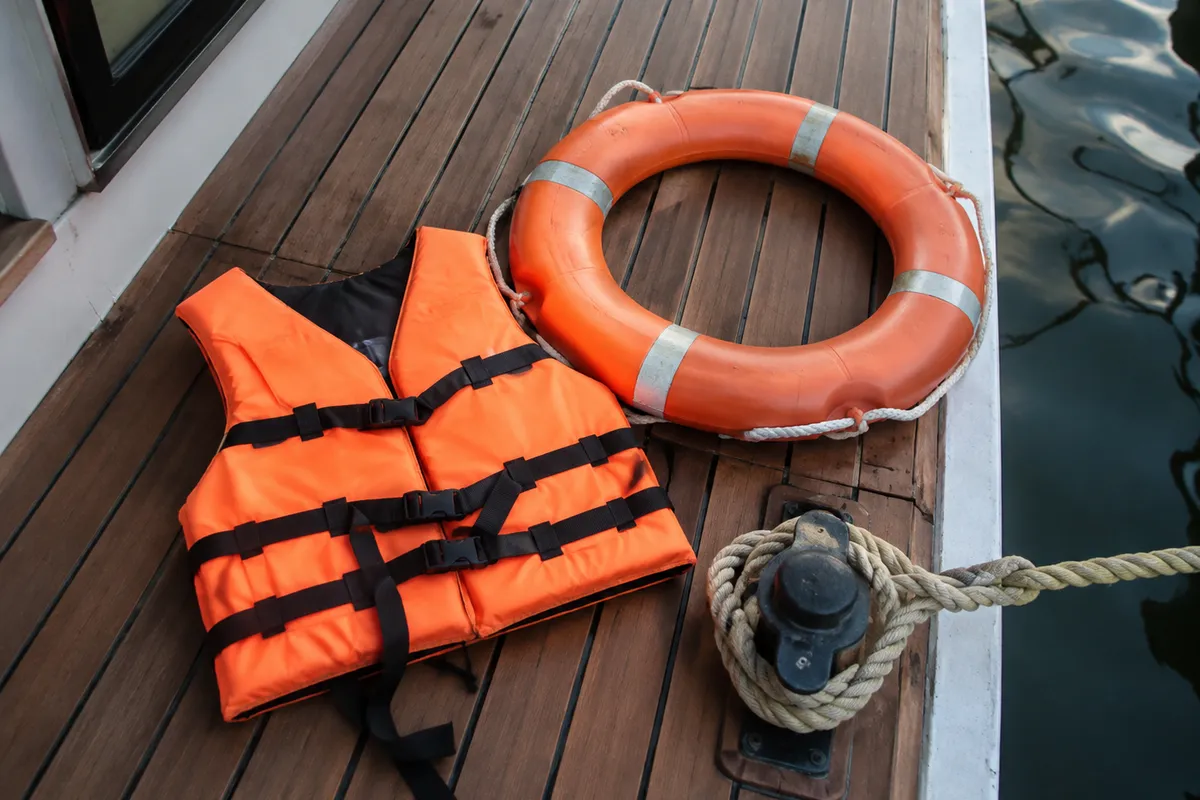
Federal maritime rules enforce zero tolerance regarding personal flotation devices. Under U.S. Coast Guard regulations (33 CFR Part 175 Subpart B), every recreational craft must carry at least one approved wearable life jacket per passenger, sized appropriately for each individual on board. Furthermore, vessels measuring 16 feet or longer must carry at least one immediately accessible Type IV throwable device, such as a buoyant ring buoy or square cushion, positioned right in the cockpit or main deck area.
As of 2026, maritime agencies enforce the harmonized labeling standard under ANSI/CAN/UL 12402, categorizing personal flotation gear into Performance Levels 50, 70, 100, and 150. While legacy Type I through Type V jackets remain legal if legible and fully serviceable, new rental inventories feature modern numeric labels. An offshore vest categorized as a Performance Level 100 life jacket provides reliable face-up turning capability in calm water, making it a common baseline on wide lakes and coastal channels.
| Legacy PFD Category | ANSI/CAN/UL 12402 Level | Inherent Minimum Buoyancy | Face-Up Turning Capability | Intended Operational Waterway |
|---|---|---|---|---|
| Type III Flotation Aid | Level 70 | 15.5 lbs (69 N) | No automatic face-up turn | Inland lakes, calm harbors, active water sports |
| Type II Near-Shore | Level 100 | 22.5 lbs (100 N) | Turns some unconscious wearers | Open bays, coastal lagoons, wide river basins |
| Type I Offshore Life Jacket | Level 150 | 33.7 lbs (150 N) | Reliable automatic face-up turn | Rough offshore swells, remote navigation routes |
| Type IV Throwable Device | Not graded by Level | 16.5–18.0 lbs (73–80 N) | None (manual grasp only) | Dockside retrieval, vessel-assist throw rescues |
Child safety carries strict federal mandates. Children under 13 years of age must wear an approved life jacket whenever a craft is underway on open decks, exempt only when resting inside fully enclosed cabins or below deck. When inspecting rental vests on a floating vessel, check that child units designed for users under 50 pounds feature intact crotch straps to prevent the vest from riding over the child's head during a fall. Detailed parental checks can be reviewed in our guide to renting houseboats with children.
Penalties for life jacket non-compliance are severe: in California, Harbors and Navigation Code § 668(a) establishes statutory infraction fines up to $250, while Arkansas under Ark. Code Ann. § 27-101-104(a) classifies missing or inaccessible life preservers as a misdemeanor carrying fines from $100 to $250. Check the USCG Recreational Boaters Life Jacket Standards before departing.
Charter Agreements, Safety Handover Protocols, and Security Deposit Risks
Chartering a self-drive houseboat introduces substantial financial liabilities that rarely apply to conventional boutique hotels. Rental operators routinely require a refundable security deposit between $500 and $2,000, or €500 to €1,500 across European canals. This bond protects the marina against torn cleat horns, chafed rigging, gelcoat gouges, or damaged drive assemblies caused by careless maneuvering.
Propeller strikes and holding tank misfills represent the most frequent sources of deposit forfeiture. Striking submerged obstacles or running aground in shallow shoals bent propeller blades that cost hundreds of dollars to replace. Similarly, pouring freshwater or fuel into the waste fitting triggers exorbitant decontamination charges from marina pump-out crews.
- Photograph the Entire Hull and Lower Unit: Capture high-resolution images of the pontoon noses, rub-rails, and propeller blades before signing the initial vessel manifest.
- Audit the Onboard Safety Manifest: Physically count wearable vests, sound devices, visual distress signals, and dock lines against the written inventory list.
- Inspect Statutory Certifications: Confirm the vessel displays an up-to-date state livery permit or inland waterways inspection decal, such as a valid Boat Safety Scheme Certificate for British waterways.
- Document Pre-Existing Line Chafe: Request that marina staff formally record frayed synthetic fibers or torn chafe guards on the checkout sheet to avoid paying replacement fees later.
- Verify Blackwater Valve Operations: Ensure the head macerator and holding tank intake valves are operational and free of clogs prior to departure.
Bilge Alarm in Boat Rental Operations: Hull Water Ingress and Electrical Integrity
Float Switch Mechanics, High-Water Bilge Alarms, and Testing Protocols
A functional bilge system protects the vessel from sinking silently at its slip. While primary submersible bilge pumps handle condensation and trivial shaft packing drips, a separate high-water bilge alarm sounds an alert before water levels touch vulnerable electrical wiring, battery banks, or cabin flooring. Operating at an ear-piercing 85 to 100 decibels, this standalone buzzer cuts through engine drone and insulated cabin bulkheads.
Mechanical float switches remain the most common trigger mechanism in recreational rental craft. Over months of use, oily sludge, dropped screws, and degraded engine insulation can accumulate in the bilge sump, jamming the mechanical float arm down or pinning it upright. During check-in, lift the inspection hatch and manually raise the automatic bilge pump float switch lever arm. Listen for the electric pump motor to whir into motion, then release the arm to confirm it drops smoothly by gravity without sticking.
| Alarm and Monitoring System Type | Retail Price Range | Telemetry or Monthly Fees | Acoustic Output | Primary Operational Advantage |
|---|---|---|---|---|
| Standard Mechanical Float Switch & Buzzer | $45 – $100 | None | 85 – 100 dB | Instant local cabin alert, low electrical standby draw |
| Solid-State Electronic Sensor Switch | $65 – $130 | None | 85 – 95 dB | No moving parts, immune to oil fouling and mechanical jams |
| Connected Cellular Remote System (e.g., Aqualarm) | ~$390 hardware | $9.50 / month | Local buzzer + SMS | Off-vessel phone alerts during quayside excursions |
If the boat's domestic freshwater pressure pump cycles every few minutes when all galley faucets and shower heads are tightly shut, you have an internal freshwater plumbing rupture. This drops pressurized tank water directly into the lower hull, masquerading as a catastrophic hull breach.
Seacocks, Through-Hull Fittings, and Battery Bank Amp-Hour Draw
Every hole drilled through a houseboat hull below the waterline represents a potential failure point. Modern plumbing relies on quarter-turn seacock and through-hull fittings made of marine bronze or reinforced composite materials. I regularly observe green verdigris corrosion on old brass ball valves, calcified valve stems, and brittle reinforced PVC hoses that have not been exercised by marina staff in months.
Dockside sinkings are rarely sudden, catastrophic impacts. Long-term insurance claim analysis by BoatUS indicates that 69 percent of boat sinkings occur while the vessel is unattended at the dock. The underlying progression is predictable: a persistent raw-water cooling hose leak or weeping propeller packing gland triggers the automatic bilge pump to cycle continuously throughout the day.
A typical 2,000-gallon-per-hour bilge pump draws roughly 8.4 amps at 12 volts DC. A standard house battery bank composed of two deep-cycle Group 27 batteries yields approximately 100 to 200 amp-hours of nominal reserve. Because deep-cycle lead-acid batteries suffer severe voltage collapse beyond a 50 percent depth of discharge, usable capacity sits around 50 to 100 amp-hours. That single pump will deplete the vessel's battery bank amp-hour draw limits within 6 to 12 hours of steady pumping, killing all float switches and letting incoming water submerge the hull overnight.
Houseboat Mooring Line Safety: Cleat Hitches, Spring Lines, and Load Distribution
Dock Line Sizing, Synthetic Fiber Properties, and the Classic Cleat Hitch
Mooring lines must secure a heavy, high-windage floating structure against tidal swings, storm fronts, and aggressive vessel wakes. As an engineering rule of thumb, dock line diameter should increase by 1/8 inch for every 9 feet of vessel length. A 25-foot canal cruiser functions safely on 1/2-inch lines, whereas a 35-to-40-foot widebeam houseboat requires minimum 5/8-inch lines to manage surging shock loads.
Material selection dictates whether lines stretch gently or snap violently under surge. Three-strand or double-braided nylon remains the marine standard due to its inherent 15 to 30 percent working elongation, which acts as a built-in shock absorber against harbor swell. Polyester lines offer far less stretch (5 to 10 percent), transmitting harsh jerks directly into deck fittings, while hollow polypropylene lines degrade rapidly under ultraviolet light and possess virtually zero abrasion tolerance.
- Lead to the Distant Horn: Pass the working line underneath the cleat horn furthest from the load source to establish maximum friction and prevent bind-up.
- Complete the Base Turn: Wrap the line smoothly around the cleat base beneath both horns, completing one full 360-degree circuit.
- Cross the Top Deck: Angle the line across the top of the cleat body toward the opposite horn, initiating a figure-eight pattern.
- Form the Locking Half-Hitch: Invert the working loop before dropping it over the final horn, so the free running end exits parallel underneath the top cross strand.
Avoid piling multiple crisscross wraps on top of a cleat hitch. Excess wraps do not increase holding strength; they trap moisture, stretch unpredictably under surge, and jam so tightly under extreme tension that you cannot release the line in an emergency.
Opposing Spring Lines, Breast Lines, and Chafing Mitigation
Securing a vessel solely with perpendicular bow and stern lines invites structural disaster. Perpendicular breast lines hold the hull tight against the pier face to ease boarding, but they provide zero control over forward-and-aft surging. Passing tour boats, tugs, and gusting winds will drive the houseboat forward and backward, shearing cleat fasteners right out of the deck laminate.
To stop this longitudinal motion, houseboats require opposing spring lines angled between 30 and 45 degrees to the dock. An after-bow spring leads aft from the vessel's bow to an amidships dock cleat, arresting forward momentum. A forward-quarter spring leads forward from the vessel's stern cleat to the dock, halting backward surge. When properly tensioned together, opposing spring lines dissipate surge loads by up to 60 percent, keeping the boat stable and preventing hull rub against pilings.
Friction kills dock lines faster than outright tension. At sharp deck chocks, rough concrete bullrails, and rusted steel pilings, constant surge motion abrades nylon fibers into powdered fluff within hours. Installing chafing gear and snubbers prevents this premature failure. Wrap heavy-duty Cordura sleeves, split heavy-gauge water hoses, or leather guards around contact zones, and rig inline elastomeric rubber snubbers to absorb cyclical wave shock before it stresses deck cleats.
Fire Safety on Botels and Floating Accommodations: Detection, Suppression, and Egress
Portable Extinguisher Ratings, Carriage Minimums, and the 12-Year Rule
Fighting a blaze aboard a floating hotel requires immediate, functioning suppression equipment, as there is nowhere to retreat except into the water. Under U.S. Coast Guard carriage rules for small craft (33 CFR 175 Subpart E), vessels measuring between 26 and 40 feet without fixed engine-room fire suppression systems must carry either two portable 5-B/10-B rated fire extinguishers or one larger 20-B unit. Carrying a single 10-B extinguisher on a 32-foot houseboat leaves the vessel legally non-compliant.
Under maritime safety updates in effect since April 2022, all disposable dry chemical extinguishers must be removed from service exactly 12 years after their stamped manufacturing year. When boarding a rental craft, locate the bottom or label edge of every canister to check the stamped four-digit date. A canister showing an operational green pressure gauge is legally invalid and physically untrustworthy if it exceeds this 12-year fire extinguisher expiration rule threshold.
| Vessel Length Overall (LOA) | Carriage Requirement (No Fixed System) | Carriage Requirement (With Fixed System) | Common USCG Mounting Locations |
|---|---|---|---|
| Under 26 feet | One 5-B or 10-B portable unit | None required by law (one recommended) | Helm station, immediate cabin companionway |
| 26 feet to under 40 feet | Two 5-B / 10-B or one 20-B unit | One 5-B or 10-B portable unit | Galley exit, aft engine hatch access, master berth |
| 40 feet to 65 feet | Three 5-B / 10-B or one 20-B plus one 10-B | Two 5-B / 10-B or one 20-B portable unit | Upper sundeck helm, galley corridor, each stateroom |
Unseat each portable extinguisher from its mounting bracket on your first walkthrough. Invert the canister and tap the base lightly with the heel of your hand; on older vessels, engine vibration packs the dry chemical powder into a solid brick at the base, rendering the unit useless when squeezed.
Engine Compartment Blowers and Fuel Vapor Purge Cycles
Gasoline vapors are roughly three times heavier than ambient air. Rather than dissipating into the sky, fuel vapors leak downward into the lowest troughs of the hull, settling around starter solenoids, battery selectors, and raw-water pump bases. Inboard gasoline houseboats represent an extreme explosion hazard if mechanical vapor purging is ignored before ignition.
Maritime fire safety codes dictate running the bilge blower for at least four full minutes prior to cranking any gasoline propulsion engine or onboard generator. The blower fan draws heavy vapors out of the enclosed engine compartment via flexible ducting and vents them topside. Never turn the ignition key or engage the battery bank until those four minutes have elapsed, and always lift the engine hatch to perform an olfactory sniff test for raw gasoline fumes.
Solid Fuel Stoves, Passive Louvred Vents, and Emergency Egress Hatches
European botels, Dutch barges, and widebeam cruisers frequently rely on solid-fuel cast-iron stoves or diesel drip heaters for cabin warmth during autumn stays. While atmospheric and effective, solid fuel heating appliances consume vast quantities of interior oxygen. The UK Boat Safety Scheme requires that cabins with solid fuel stoves maintain permanently unblocked passive louvred vents in doors, bulkheads, and deckheads to prevent fatal asphyxiation and flue backdrafts.
Emergency cabin egress hatch dimensions are strictly regulated under marine engineering standards. International safety standard ISO 9094 (BS EN ISO 9094:2022) requires sleeping cabin escape hatches to provide a minimum clear opening diameter of 450 mm for circular ports, or a minimum dimension of 380 mm with a total open area of at least 0.18 m² for rectangular hatches. The American Boat & Yacht Council enforces a matching 18-inch clearance standard under ABYC H-3.
- Clear Deck Obstructions: Check the top deck immediately above the berth; charter guests often stash deckchairs, coolers, or paddleboards right across escape hatch covers.
- Test Latches from the Inside: Disengage the interior dog-clamps and push the hatch fully open to verify hinges have not seized from salt air corrosion.
- Confirm Berth Step Access: Ensure built-in bunk steps or vertical ladder rungs leading up to the overhead hatch are completely clear of duffel bags and bedding.
Carbon Monoxide Mitigation: Marine Detector Standards and Exhaust Dynamics
ABYC A-24 and UK BSS Sensor Mandates vs. Domestic Alarms
Carbon monoxide (CO) is an odorless, colorless killer responsible for dozens of severe marine casualties each operating season. Domestic carbon monoxide alarms built for drywall living rooms fail quickly in marine environments. Household units cannot endure high relative humidity, constant diesel soot exposure, or the continuous structural vibration generated by waves and mechanical running gear.
On inland waterways across Great Britain, the Boat Safety Scheme mandates that every vessel with enclosed living spaces be fitted with a certified marine carbon monoxide detector BS EN 50291-2. In the United States, the American Boat & Yacht Council enforces the ABYC A-24 standard, requiring dedicated marine-grade CO alarms in every enclosed cabin compartment of craft powered by inboard gasoline engines or fuel-burning auxiliary generators.
| Detector Specification Category | Standard Domestic Alarm | Marine-Grade Standalone (BS EN 50291-2 / ABYC A-24) | Integrated Hardwired Marine System |
|---|---|---|---|
| Corrosion & Vibration Resistance | Unrated; prone to salt fouling | Salt-spray resistant housing, potted electronics | Hermetically sealed sensors, vibration damped |
| Average Hardware Cost | $20 – $35 (£15 – £25) | $40 – $75 (£25 – £60) | $130 – $180+ (£100 – £140+) |
| Power Delivery Method | Standard alkaline AA/9V | 10-year sealed lithium battery | Hardwired 12V DC ship bank with battery backup |
| Operating Temperature / Humidity Limits | 40°F – 100°F, up to 80% RH | -4°F – 122°F, up to 95% condensing RH | -40°F – 158°F, marine immersion rated casing |
Never rely on battery-operated domestic alarms brought from home as your primary protection on a boat. As outlined by the California Division of Boating and Waterways Carbon Monoxide Safety Guidelines, moisture and ambient salt air desensitize commercial domestic electrochemical sensors within weeks, causing them to remain silent during fatal gas buildup.
The Station Wagon Effect and Swim Platform Danger Zones
Carbon monoxide accumulation is dictated by vessel aerodynamics underway. When a houseboat cruises at low displacement speeds, or runs with an elevated bow angle, the vessel's blunt superstructure generates a powerful localized vacuum wake directly behind the aft transom. This vacuum phenomenon, widely known across the marine industry as the station wagon effect, literally suctions engine exhaust gases forward across the rear deck, dragging dangerous fumes into cabins through open rear sliding doors and companionway hatches.
The Centers for Disease Control and Prevention (CDC) warns that generator exhaust outlets exiting under the stern create fatal air pockets beneath the overhang of the swim platform. Concentrations can spike to thousands of parts per million in seconds. A single breath of this trapped gas can cause immediate unconsciousness, resulting in fatal drowning before crew members can respond. Never permit swimming anywhere near the transom while an auxiliary generator is operating, even when the boat is securely anchored.
Sleeping on Water Safety Checklist and Overnight Risk Protocols
Pre-Bedtime Hull, Mooring, and Gangway Inspection Protocol
Before settling into your berth for the night, a methodical exterior check eliminates surprises caused by changing weather systems, shifting tidal currents, or wakes from midnight tug traffic. A floating hull responds continuously to its surrounding water column, meaning that securing lines once during afternoon check-in does not guarantee safety eight hours later. Follow this five-minute physical walkdown before turning off cabin lights:
- Listen to the Bilge Sump: Stand quietly in the main companionway for sixty seconds. An automatic bilge pump kicking on every few minutes indicates progressive water ingress through through-hull fittings or packing glands.
- Adjust for Water-Level Changes: Check line tension across all bow, stern, and spring lines. On tidal rivers or reservoirs managed by hydroelectric dam discharges, falling water levels can suspend a tightly tied vessel by its cleats, while rising levels can swamp low-freeboard decks against high pilings.
- Inspect Chafing Gear and Line Leads: Confirm dock lines run straight through fairleads and chocks without binding across sharp concrete corners, and verify inline snubbers are unhindered.
- Secure the Boarding Gangway: Verify the shore gangway rests squarely on the dock rollers, that handrails are locked, and that gangway safety netting remains taut to catch slipping passengers.
- Isolate Auxiliary Seacocks: Close manual raw-water ball valves on marine heads, deck washdowns, and galley overboard discharges, leaving only dedicated electric bilge discharge lines open.
If you are staying at an inner-city harbor conversion or floating barge, review our detailed guide to European urban botels to understand municipal noise rules, commercial barge wake protocols, and local marina night-watch procedures.
Final Verdict: The 15-Minute Pre-Unpacking Safety Assessment
Never unpack personal luggage or hand over non-refundable check-in fees until you have conducted a comprehensive fifteen-minute inspection of the vessel's mechanical systems. Booking platforms and marina operators routinely stage attractive marketing photographs that hide missing safety equipment, expired certifications, and dangerously neglected mechanical sumps.
Treat critical safety equipment as non-negotiable. If the charter vessel lacks a functional bilge alarm in boat rental inventory, carries out-of-date dry chemical extinguishers under the 12-year rule, displays dead carbon monoxide alarms, or shows bilge water submerging internal bulkheads, refuse vessel occupancy immediately. Demanding on-site repair or walking away protects your life and preserves your security deposit before you ever step to sea.