
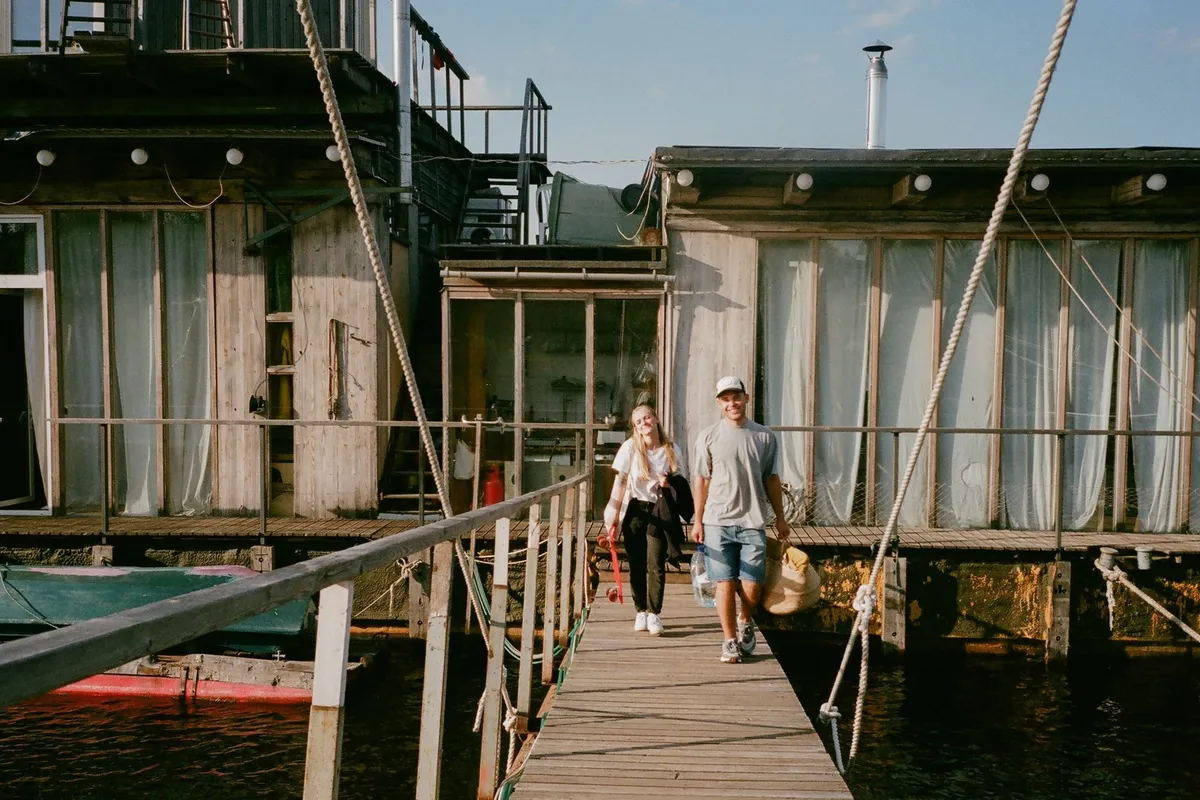
Recent updates to municipal waterfront living codes and international maritime standards have tightened the legal boundary between commercial passenger vessels and stationary floating lodging. For families booking a houseboat hotel with kids, these regulatory shifts reveal a troubling loophole: static floating homes and converted vintage barges are often legally exempt from terrestrial building safety codes, leaving toddlers protected by nothing more than decorative ropes or low gunwales over deep, moving water.
A modern pontoon chalet with rigid balustrades works well for families traveling with curious toddlers, whereas historic river barges and self-drive motor houseboats demand advanced swimming competence and constant vigilance. Navigating these waters safely requires looking past polished rental photographs and evaluating the physical barriers, gangway pitches, and hidden engine systems that dictate daily survival on board.
Structural Perimeter Safety: Boat Hotel Railing Safety for Toddlers and Balustrade Codes
Balustrade Spacing, the 4-Inch Sphere Rule, and the Ladder Effect
When I step onto a converted barge deck, the first tool I pull from my daypack is a standard mini tape measure. Architectural residential codes enforce a strict 4-inch (102 mm) maximum clear opening between vertical balusters, known widely as the 4-inch sphere rule in the International Residential Code. This dimension prevents a small child's torso from slipping through, which eliminates the catastrophic risk of positional asphyxiation where the body passes through the gap while the head remains trapped above the waterline.
Equally critical is the bottom clearance gap between the finished deck planks and the lowest horizontal rail. If this bottom gap exceeds 102 millimeters, a crawling toddler can slide under the barrier feet-first during a sudden wake surge. During a stay on an older canal vessel in central France, I measured a bottom gap of nearly 160 millimeters—ample room for a sleeping infant rolling off a low deck mat to drop straight into the river.
Horizontal infill cables and decorative rails introduce the dangerous ladder effect railing hazard. When horizontal crossbars sit between 200 millimeters and 700 millimeters from the deck, toddlers instinctively treat them as ladder rungs. The Dutch building code, specifically the Besluit bouwwerken leefomgeving (Bbl) Art. 4.23, strictly prohibits climbable footholds within this intermediate height bracket on new residential balustrades to prevent climbing accidents.
Pre-Booking Perimeter Audit: Message the host directly and request exact tape measurements: vertical spindle spacing must not exceed 102 mm (4 inches), bottom clearance must stay under 102 mm, and the railing must contain zero horizontal climbing rungs between 200 mm and 700 mm from the deck floor.
Regulatory Realities: Dutch Bbl Standards, Historic Barges, and Floating Hotel Exemptions
While the Dutch Omgevingswet and Bbl framework mandates a 1,000-millimeter railing height for standard new buildings, Article 4.10 of the Bbl applies older, existing-building thresholds (a minimum of 900 mm) to floating structures (drijvende bouwwerken). Worse, converted historic sailing hulls (schepen door functiewijziging) built before 2018 remain broadly exempt from Chapters 3 through 5 of these technical safety standards. They operate under a basic duty of care rather than rigid barrier codes.
Consequently, heritage steel barges and Parisian botels listed on European booking channels frequently feature waist-high bulwarks or slack wire lifelines standing merely 60 to 70 centimeters tall. These low perimeters were engineered for deckhands handling mooring lines, not for families with toddlers. To balance the comfort of water living with physical safety, consult our guide to what it is actually like sleeping on water before committing to an older vessel.
Because of these structural hazards, commercial hosts on specialized platforms like BookaHouseboat—where stationary suites generally run between €150 and €450 per night—routinely set strict age restrictions. Many outright prohibit children under 6 or 12 years old. Beyond low gunwales, these historic hulls conceal near-vertical companionway ladders, open chain lockers, and heavy steel hatch covers that can crush small fingers.
| Feature / Standard | Modern Residential Building Code | Historic Converted Barge / Botel |
|---|---|---|
| Minimum Railing Height | 1,000 mm to 1,100 mm (42 inches) | 600 mm to 750 mm (low gunwales/wires) |
| Maximum Balustrade Spacing | 102 mm (4-inch sphere rule) | 150 mm to 300 mm (or open wire spans) |
| Climbable Horizontal Elements | Prohibited between 200 mm and 700 mm | Common (horizontal wire lifelines) |
| Legal Safety Enforcement | Mandatory occupancy inspection | Exempt under heritage/transitional law |
Securing Cabin Access: Childproof Sliding Door Locks, Deck Gates, and Window Restrictors
A child who cannot access the open deck cannot fall into the water unobserved. The primary line of defense on any floating accommodation is absolute cabin containment, especially during the early morning hours before parents wake. Standard factory-installed patio sliding door latches sit at waist level, well within reach of an enterprising three-year-old.
I carry portable, heavy-duty sliding glass door locks that secure the upper track via thumbscrews at an elevation of at least 54 inches (137 cm) to 5 feet (150 cm). Exterior deck gates must adhere to the physical principles outlined in pool barrier standards: they must open inward toward the cockpit or interior deck space rather than out toward the water. An inward-swinging gate ensures that if a child trips or leans against the barrier, their forward body weight pushes the gate against its stop rather than swinging out into the void.
Low-slung cabin windows represent an overlooked escape route. On traditional Dutch vessels, hopper windows often open directly onto unrailed side gangways (gangboorden) no wider than 30 centimeters. Window restrictor cables limiting openings to no more than 100 millimeters must be mounted to prevent a toddler from squeezing onto an unguarded ledge over the canal.
Packable Containment Kit: Pack two non-destructive, thumbscrew-tightened aluminum sliding track locks, two adjustable cable window restrictors, and a battery-operated magnetic contact alarm to fix above the main cabin exit.
Gangway Safety for Children: Incline Limits, Handrails, and the Hull-to-Quay Gap
Gangway Incline Slopes, ISO 7061 Specifications, and Non-Slip Tread Tape
Boarding a floating hotel requires crossing a dynamic threshold that changes angle with every tide, wave, and ballast shift. Under maritime specifications set by ISO 7061 marine gangways, standard flat-surfaced gangways (Type A) are designed for a maximum operational angle of 30 degrees from the horizontal. When water levels drop and the walkway slope exceeds 30 degrees, specialized stepped treads (Type B) are mandatory to prevent severe fall injuries.
Commercial access standards under OSHA 29 CFR 1918.22 for vessel gangways require a minimum walking width of at least 20 inches (51 cm), along with handrails measuring no less than 33 inches (84 cm) in height equipped with midrails on both sides. Bare aluminum diamond plate or weathered timber planks become dangerously slick when coated with morning river mist, diesel residue, or surface algae.
I treat any gangway steeper than 20 degrees as a no-walk zone for children under five. At this pitch, a child lacks the ankle articulation and center-of-gravity control to counter the combined slope and wave motion. The child must be carried in a supportive chest carrier or guided step-by-step with an adult holding both hands.
Incline Action Protocol: Check the gangway pitch at extreme low water. If the ramp angle exceeds 30 degrees and lacks transverse wooden battens or high-grit non-slip tread tape, do not allow independent walking. Carry young children directly across to the main deck.
The Hull-to-Quay Crush Zone: Passerelle Safety Netting and Tidal Movement Risks
The space between a floating hull and a stone quay wall is an active pinch hazard. When commercial river traffic passes, the displacement wave pushes the vessel outward on its spring lines before slamming it back toward the dock. Any slip from an access ramp into this hull-to-quay crush zone risks catastrophic blunt-force trauma from the swinging hull.
International maritime rules under IMO SOLAS Regulation II-1/3-9 and OSHA 29 CFR 1918.22(e) mandate heavy-duty passerelle safety netting beneath suspended accommodation ladders and gangways whenever there is an open drop between the ship and the pier. Yet at commercial botels, these nets are frequently omitted to preserve clean aesthetic sightlines.
Tidal rivers present the most extreme transitions. In estuarine areas where tidal drops exceed 1.5 to 3.0 meters, an access ramp that sits perfectly level at high noon can pitch downward at an aggressive 45-degree angle by dusk. For a detailed breakdown of urban botel infrastructure and pier access, review our comprehensive survey of Amsterdam botels and mooring setups.
- Check Handrail Rigidity: Ensure shore-to-dock handrails stand at least 42 inches (107 cm) high and do not flex under a lateral force of 200 pounds (890 N).
- Inspect Kick-Plates: Verify that the foot of the gangway rests securely on the quay with an overlapping transition plate rather than leaving an open shoe-catching gap.
- Examine Fender Spacing: Ensure large cylindrical rubber bumpers keep the boat hull pushed at least 50 centimeters away from the stone wall, preventing a pinch point.
Invisible Water Hazards: Cold Shock, Stray Voltage, and Dockside Risks
Electric Shock Drowning (ESD) Hazards and Marina Basin Swimming Bans
One of the most lethal hazards around freshwater floating hotels leaves no visual trace. Electric Shock Drowning occurs when low-level alternating current (AC) leaks from faulty 120-volt or 230-volt shore-power pedestals, corroded hull wiring, or ungrounded battery chargers into the surrounding water. Because freshwater is less conductive than the human body, the stray current routes directly through any swimmer who enters the electrical field.
Current levels as miniscule as 10 to 15 milliamps cause instant involuntary muscular paralysis. A child swimming near an energized dock cannot stroke, tread water, or call for help; they instantly submerge. For this reason, professional marina regulations strictly prohibit recreational swimming inside mooring basins and around rental slips.
If a child falls from a dock into a marina basin, parents must fight their instinctive urge to dive in immediately. Entering an energized electrical field will paralyze the rescuer as well, leading to a double fatality. Immediate rescue protocol requires instantly cutting the shore-power breaker on the dock pedestal, casting a buoyant ring on a polypropylene line, or reaching out with a non-conductive fiberglass boat hook.
ESD Emergency Action: Never leap into freshwater marina basins to retrieve a victim. Immediately switch off the pedestal circuit breaker, dial local emergency services, and deploy a non-conductive reach pole or throw-bag from the wooden pier.
Cold Shock Response in Mountain Reservoirs and European Canals
Falling into calm water sounds manageable to parents whose children take regular swimming lessons. However, in alpine lakes like Lake Powell during spring run-off, or in Northern European canals throughout autumn, water temperatures consistently sit below 15°C (59°F). Water at this temperature triggers the violent, involuntary cold shock response the moment it hits the chest and face.
The human body reacts to cold shock with an immediate, uncontrollable gasp reflex, followed by hyperventilation. If a toddler's head is submerged during that initial reflexive gasp, they can inhale up to two liters of water within the first three seconds. Concurrently, peripheral blood vessels constrict rapidly, elevating cardiac workload and stripping finger dexterity within minutes.
This physiological reaction is governed by the 1-10-1 survival timeline established in cold-water search and rescue medicine. Understanding these distinct phases highlights why decorative railings must never be treated lightly near cold water.
- 1 Minute to Control Breathing: The initial shock and hyperventilation peak within sixty seconds. Flotation must keep the airway clear immediately, as conscious breath control is impossible.
- 10 Minutes of Meaningful Movement: Neuromuscular cooling disables fine motor coordination. A child rapidly loses the ability to climb swim ladders or grab thrown ropes.
- 1 Hour Before Hypothermic Collapse: True hypothermia takes up to an hour to induce unconsciousness, but without a life vest, drowning occurs during the first two phases.
Engine Exhaust and Navigation Risks on a Family Houseboat Vacation
Swim Platform Exhaust Hazards and Marine Carbon Monoxide Alarms
On motor-driven houseboats, the swim platform at the stern serves as the primary hub for water activities. Tragically, this exact location creates a lethal swim platform exhaust hazard. Testing by the CDC and NIOSH has demonstrated that gasoline auxiliary generators and idling inboard engines funnel exhaust directly beneath the stern overhang, where toxic carbon monoxide (CO) becomes trapped in concentrations exceeding 30,000 parts per million.
To put this in perspective, the Immediately Dangerous to Life and Health (IDLH) threshold is just 1,200 ppm. In the enclosed pocket under a transom, a child treading water or sitting on the boarding ladder can inhale a fatal dose of carbon monoxide, slipping into unconsciousness within seconds to minutes. Because carbon monoxide is colorless and odorless, it regularly goes unnoticed until a swimmer silently sinks beneath the surface.
Residential home carbon monoxide alarms are utterly unsuitable for marine environments. Floating vessels require hardwired marine carbon monoxide alarms certified to the UL 2034 Marine Standard or ABYC A-24, built to resist salt corrosion, engine vibration, and high humidity. Before swimming, families must observe a strict 20-minute cooldown rule: completely shut down the auxiliary generator and propulsion engines, allowing the stern airspace to ventilate before lowering the ladder.
Transom Safety Rule: Never run the generator while children are swimming, sitting on the stern swim platform, or climbing the boarding ladder. Wait a minimum of 20 minutes following complete engine shutdown before opening the transom gate.
Age Regulations, Boating Safety Certifications, and Lake Powell Rental Realities
Navigating a 50-foot houseboat requires specialized helm experience that commercial booking platforms often downplay. Under state boating regulations, minors aged 12 to 16 can legally pilot motorized boats after completing a course approved by the National Association of State Boating Law Administrators (NASBLA). However, commercial rental companies and their marine insurance underwriters universally mandate that the primary charter captain must be at least 21—and on waters like Lake Powell, frequently 25 years old.
Navigating steep canyon channels involves managing massive windage against sheer sandstone cliffs, anchoring in deep water, and backing twin stern outdrives onto sloping, unpaved sandbars. Handing the wheel over to an unlicensed teenager completely voids the marine hull insurance policy, exposing the family to severe liability if an accident occurs.
A week-long family houseboat vacation on Lake Powell or Lake Cumberland averages between $2,500 and $8,500 ($350 to $1,200 per night), excluding substantial fuel charges and security deposits. For additional context on mooring costs and harbor surcharges, consult our analysis of hidden fees and taxes on houseboat bookings.
| Operational Parameter | State Boating Law Framework | Commercial Rental Contract Reality |
|---|---|---|
| Minimum Legal Helm Age | 12–16 years old (with NASBLA card) | Strictly 21 to 25 years old |
| Insurance Liability Protection | Valid under parental supervision | Completely voided if a minor pilots vessel |
| Typical Fuel and Damage Deposit | Not regulated by state statute | $1,000 to $3,000 held on credit card |
Flotation Gear and Packing Protocols for Floating Hotel Child Safety
USCG 33 CFR § 175.15 Mandates vs. Marina Rental PFD Inventory Shortfalls
Federal maritime law under USCG 33 CFR § 175.15(c) mandates that children under 13 aboard recreational vessels must wear a USCG-approved personal flotation device (PFD) at all times on open decks while the vessel is underway. The legal loophole lies in the phrase "underway." The moment the vessel ties off to a mooring ball, locks into a slip, or functions as a static floating hotel, federal mandatory-wear laws no longer apply.
This creates a dangerous illusion of security. Statistically, dockside falls from stationary, moored vessels account for the vast majority of non-boating water fatalities involving children. On an unfamiliar, motion-sensitive deck surrounded by cold water, parental rules must exceed minimum federal statutes.
Commercial marina rental operations regularly fail families when it comes to on-site life jacket inventory. While they keep dozens of orange Type II adult keyhole vests on hand, they rarely supply properly sized life jackets for infants and toddlers under 30 pounds (13.6 kg). Relying on the marina to equip your toddler is an unacceptable gamble; pack a dedicated, certified vest in your luggage.
Deck Flotation Rule: Establish a non-negotiable rule before boarding: any child under ten must wear a fastened personal flotation device whenever stepping out of the enclosed cabin onto the gangway, open deck, or dock fingers.
Anatomy of a Compliant Type II Infant Life Jacket: Collars and Crotch Straps
Not all life vests provide the specialized physics required to save an unconscious infant or toddler. A standard pool vest or recreational ski vest simply keeps a child floating, frequently in a dangerous face-down position. For genuine floating hotel child safety, parents must choose an official USCG Type II infant life jacket or its equivalent international standard (ISO 12402-4).
A compliant infant life jacket is distinguished by a thick, buoyant head-support collar designed to roll an unconscious infant face-up in calm water within seconds. Behind the collar, look for a heavy-duty webbing grab handle that allows an adult standing on a high deck to haul a fallen child straight up out of the water.
The most critical structural element is the crotch strap. Without a secure, snug strap running between the legs, water displacement pushes the buoyant foam upward over the child's chin and head the moment they hit the water, leaving them submerged below the vest. For packing recommendations covering footwear and shore power gear, see our guide on what to pack for a floating hotel stay.
- Buckle and Zip: Fasten the main corrosion-resistant front zipper and secure the adjustable waist belt snugly against the child's torso.
- Fasten Crotch Straps: Thread and cinch down the dual under-leg crotch straps until you can slip no more than two fingers between the webbing and the skin.
- The Shoulder-Pull Test: Grab the life jacket firmly by its shoulder yokes and pull upward with moderate force. If the collar slides over the chin, mouth, or ears, the vest is dangerously oversized.
Global Destination Risks, Houseboat Hotel with Kids Realities, and Final Verdict
Destination Risk Profile: Amsterdam Canal Stays, Lake Powell, and Kerala Kettuvallams
Every major houseboat region carries a unique blend of structural and environmental hazards. In an Amsterdam canal houseboat stay, urban convenience masks low heritage railings (60–70 cm), slick cobblestone mooring slips, and water temperatures that rarely exceed 16°C outside midsummer. The main safety advantage in Amsterdam is medical logistics: municipal emergency services (EMS 112) generally respond within 8 to 12 minutes.
A Lake Powell houseboat vacation presents the opposite operational environment. Here, families operate massive 46- to 50-foot motor vessels across deep, remote desert reservoirs. Railings are generally modern and vertical, but families contend with lethal swim platform exhaust hazards, sudden 40-knot squalls, and deep isolation. Evacuation by National Park Service rangers or emergency medical helicopters can take anywhere from 1 to 3 hours.
In the Alleppey backwaters of Kerala, India, traditional wooden kettuvallams cost between ₹12,000 and ₹35,000 ($145 to $420) per night. These vessels offer exceptional local character, but dining lounges and viewing decks are often built wide open to the waterline without safety gates, midrails, or child-safe netting. In the event of an immersion accident in the backwaters, medical transfers require an emergency water ambulance to a road landing, stretching hospital transit times out to 45 to 90 minutes.
| Destination & Vessel Type | Average Rail Height | Water Temp (Summer) | Dynamic Mooring Risks | EMS Evacuation Time |
|---|---|---|---|---|
| Amsterdam Converted Barge | 600 mm – 750 mm | 15°C – 19°C | Commercial barge wakes, low quays | 8 – 12 minutes |
| Lake Powell Motor Houseboat | 900 mm – 1,050 mm | 21°C – 26°C | Transom exhaust pockets, squalls | 1 – 3 hours |
| Kerala Kettuvallam | 0 mm – 450 mm (open decks) | 27°C – 30°C | Low open gunwales, river currents | 45 – 90+ minutes |
Final Safety Audit and Go/No-Go Decision Framework for Parents
Staying on the water with children can be deeply rewarding, but it demands cold logistical realism. If a vessel lacks physical barriers to keep children out of the water, a parent's entire stay dissolves into high-stress guard duty. To evaluate static vessels in greater depth, review our complete guide to static houseboat hotel rentals.
Before confirming any non-refundable booking or unpacking your bags at the dock, run your accommodation through this strict pass/fail safety rubric. If the vessel fails even one of these non-negotiable points, look for a secure hotel on dry land instead.
The Go/No-Go Floating Rental Rubric:
1. Perimeter Enclosure: Are exterior rails at least 900 mm tall with no balustrade gaps or bottom clearances wider than 102 mm?
2. Cabin Lockout: Can the primary sliding door or deck exit be securely latched above 137 cm (54 inches)?
3. Gangway Stability: Does the access ramp feature dual handrails, high-traction tread tape, and a slope under 30 degrees?
4. Atmospheric Safety: Is there a functioning, marine-grade UL 2034 carbon monoxide alarm installed in every sleeping berth?
5. Water Isolation: Can family members reach the dock without stepping through unguarded hull-to-quay crush zones?