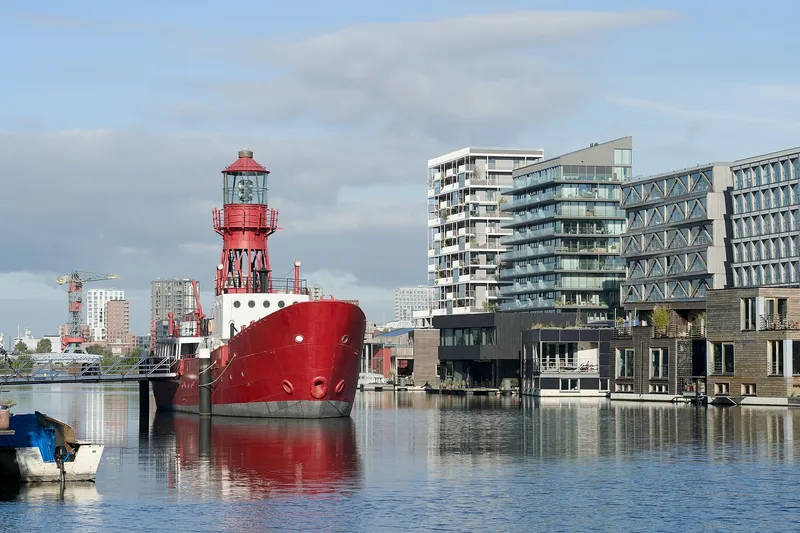
LV-12 is the genuine article: a welded-steel hull with a cast-iron engine room, built for Trinity House and withdrawn from service in 1988. The conversion left the machinery, the portholes and the light tower in place, and the steel carries rain and footsteps through the hull.
Two suites and two resident hosts is also a different operation from a 200-cabin botel. Alex and Dorris live aboard and hand over the keys in person, the ship is registered with the City of Amsterdam, and fire regulations limit the number of guests who can sleep on board at once. Two couples can take the whole vessel, deck included, by booking both rooms.
LV-12: a 1952 Trinity House lightvessel
From lightship to two suites
The vessel operating today as Lightship Amsterdam began service in 1952 as Trinity House Lightvessel No. 12 (LV-12). Built by Phillip & Son with a heavy welded-steel hull, the non-propelled ship was anchored at hazardous offshore navigational stations around the British coastline to guide maritime traffic. Trinity House decommissioned LV-12 in 1988, after which the hull was sold and eventually relocated across the North Sea to the Netherlands. The Dutch lighthouse register records the build year, the builder and the 1988 withdrawal, and lists Mariadistelkade 6 as the ship's present address; photographs from her working years survive on Lightphotos.net.
Bringing a decommissioned navigational vessel into compliance with Dutch building and hotel codes took the owners eleven years, a figure they repeat on their own site. Penetrating a historic hull means reinforcing each bulkhead so the vessel keeps its structural buoyancy while taking underfloor heating, plumbing and insulation. The suites opened for guests in December 2019, and the hosts still live in a separate compartment of the ship.
The same site and the ship's Booking.com listing both publish its municipal registration number, 0363 0586 8772 84FC 53E3, so the address and the registration can be checked before you pay anything. A defining exterior landmark is the original light tower amidships, which is still wired and illuminated at night and makes the red-painted hull easy to pick out along the northern waterfront.
Mariadistelkade and the canal
The lightship is permanently moored along the quay at Mariadistelkade 6 in the Amsterdam-Noord district. This waterway, the Johan van Hasseltkanaal, is an enclosed branch off the northern bank of the IJ. Because the canal does not serve as a primary throughway for deep-draft commercial tugs or large passenger ferries, the water surface remains calm and the relentless wake of the main river is absent, which keeps vessel roll to a bare minimum.
The surrounding area belongs to Buiksloterham, a former industrial shipyard and manufacturing sector undergoing comprehensive urban redevelopment. Directly across the canal sits Schoonschip, a sustainable floating neighbourhood of architect-designed water houses, and the circular cafe De Ceuvel is a five-minute walk along the canal path. Walking south toward the river brings you to the A'DAM Lookout observation tower and the EYE Filmmuseum, about 1.4 kilometres away and roughly 17 minutes on foot. The sprawling NDSM Wharf creative quarter, known for its street art murals, repurposed warehouses, and waterfront eateries, sits 1.5 kilometres to the west, an easy five-minute bike ride.
The two suites, measured
The two rooms differ more in daylight and noise than in floor area.
Upper Store: the bow hold
Positioned inside the vessel's forward hold, the Upper Store suite keeps the original sweep of the curved bow hull visible behind internal glass partitions. Daylight enters through reinforced hull portholes and forward-facing glazing. A king-size bed, a seating area, a dining table for two, a coffee pod machine, a kettle, a stocked minibar and a smart TV fill out the room, with the freestanding tub set to the side of the entrance.
The bathroom has a separate walk-in rain shower and an enclosed toilet, set into the white-painted steel. Because this suite sits at the forward end of the ship, the large front sun terrace is a few steps away, so you can carry breakfast outside without using a companionway.
Machinery Room: the engine hold
Located amidships over the former engine space, the Machinery Room is the larger of the two suites. The conversion kept the decommissioned machinery, cast-iron valve manifolds, pressure gauges, overhead pipework and steel structural ribs in the living area, with glass panel walls separating the room from the machinery.
Because this suite sits deep within the hull, light comes from high-level ports and lamps. There is no eye-level window, so it stays darker in the morning than its neighbour and needs the lights on during the day. It also holds the most metal in the ship, and metal is what you hear when rain starts on the deck above.
One thing a recent Booking.com guest flagged: the floor of their suite sloped noticeably towards the stern, an inheritance from the hull's original lines. It is a real sensation on the first night if you are sensitive to balance; test it before you unpack.
| Feature | Upper Store | Machinery Room |
|---|---|---|
| Location on the ship | Forward hold, closest to the bow deck | Amidships, over the old engine space |
| Listed floor area | About 60 m² | About 65 m² |
| Bed | King-size | King-size |
| Daylight | High: portholes and forward glazing | Low: high-level ports and lamps |
| Private entrance | Front deck | Front deck |
| Bathroom | Bath, walk-in rain shower, toilet | Bath, walk-in rain shower, toilet |
| Best suited to | Couples who want daylight and quick deck access | Guests who want the industrial interior and a dark room |
For two people I would take the Upper Store. Daylight changes the room, and the terrace is a few steps away. The Machinery Room suits anyone who wants the engine-room interior and near-total darkness.
The foredeck, the lantern and what steel does to sound
The forward deck is the reason to book this ship rather than a canal houseboat. From there you look across the Johan van Hasseltkanaal to the floating houses of Schoonschip and, at the right hour, the low sun on the industrial waterfront. Loungers and outdoor furniture sit on the terrace, and the original light tower rises above the foredeck.
North Sea weather decides how much of that you use. Wind and rain sweep across Amsterdam-Noord outside the summer months, and the exposed steel decks offer no lateral wind protection, so breakfast moves indoors when the weather turns. In summer the deck works as an outdoor dining room, and the operator supplies beach chairs and umbrellas.
Moving between deck sections means using the original narrow companionways and stepping over raised steel coamings. Lighting at dusk picks out the lantern housing without flooding the basin, and the quay goes quiet after the last ferry.
Rain on steel
There is no engine noise here: LV-12 has no working propulsion and no generator running at night, and power and water come from shore-side hookups on Mariadistelkade. The conversion also lined the interior steel plates with thermal and acoustic insulation, which deadens the traffic and workshop noise that carries across the quay.
Steel still conducts sound and vibration efficiently, so a mooring line creaking against a fender, someone on the ladder above your cabin, or heavy rain landing on the deck plates all reach you inside. The deck over the Machinery Room takes rain directly, which is why light sleepers tend to prefer the Upper Store in a wet week; earplugs do more than a white-noise app on this hull.
The ship itself hardly moves. Because the basin is enclosed and the hull is heavy, motion is minimal even when it blows, so rain and footsteps are the noise risk, and the hull does not roll enough to cause seasickness.
Ferry, metro and the last kilometre
Travelers arriving at Amsterdam Centraal station have two sensible routes across the IJ into Amsterdam-Noord.
- The Buiksloterweg ferry (line F3). Walk out the northern waterside exit of Centraal and board the free GVB ferry. The crossing takes about three minutes, and the GVB line F3 timetable shows a boat roughly every six minutes during the day. From the Buiksloterweg pontoon, the walk to Mariadistelkade 6 is about 1.3 kilometres, roughly fifteen minutes at a steady pace.
- Metro line 52 (Noord/Zuidlijn). Board underground at Centraal and ride one stop north beneath the river to Noorderpark. The walk west from Noorderpark along Papaverweg and Distelweg to the ship is about the same length. Contactless payment by credit or debit card (OVpay) works at the metro gates, and the ferry needs no ticket at all.
Neither route is closer than the other, which surprises people who assume the metro stop is the convenient one. With heavy rolling suitcases the walk is the deciding factor either way, so pack a bag you can roll over cobbles and towpaths, or take a taxi from the rank at Centraal straight to the quay.
I walked it once in steady rain with a wheeled case. The pavement is fine, but the wind funnelling along the exposed stretch of the Buiksloterweg is stronger than the distance suggests; a rain shell is more useful than an umbrella.
Bikes, parking and dinner nearby
Cycling is the most practical way to explore the surrounding creative districts, and the operator rents bikes to guests for an additional charge. A bicycle cuts the ride to the ferry terminal or the NDSM Wharf arts quarter to under five minutes on Amsterdam-Noord's separated bike paths.
For guests arriving by car, the operator offers private parking at a nearby garage for ≈ $22 (€20) per day, which has to be reserved in advance. Street parking on Mariadistelkade and the surrounding streets falls inside a paid zone; the municipality publishes current hourly rates on its parking tariff map, and rates in Noord sit well below those in the centre.
Dining is easier than you might expect. Restaurant Papa Thang sits about thirty metres from the gangway and Cafe de Ruimte about 120 metres further along the water, with De Ceuvel and the waterside terraces of the NDSM quarter a short ride away. Because you cannot cook aboard, book a table for your first evening.
What two nights actually cost
Rates have sat between roughly $330 (€300) and €450 a night depending on season, day of the week and how far ahead you book. Booking.com's listing has quoted from about $350 (€320), and peak dates push toward the top of that range.
Bookings go through Booking.com or by email to the hosts.
Tourist tax: one formula
On top of the room rate comes the mandatory City of Amsterdam tourist tax (toeristenbelasting), which the city sets at 12.5% of the overnight price excluding VAT. Accommodation has been at the standard 21% VAT rate since 1 January 2026, according to the Belastingdienst notice on logies, and the rates shown by Booking.com and the operator include that VAT. The tax therefore adds 10.33% to the figure you see: 12.5% of the net amount after dividing by 1.21.
On a ≈ $770 (€700) two-night booking at ≈ $390 (€350) a night, net accommodation is ≈ $640 (€578.51) (≈ $770 / €700 ÷ 1.21) and tourist tax is ≈ $80 (€72.31), for ≈ $850 (€772.31) payable. There is no cap and no short-stay exemption; the City of Amsterdam publishes the rate and registration rules.
| Item | Basis | Amount (EUR) |
|---|---|---|
| Suite rate, two nights | ≈ $390 (€350) per night, VAT included | ≈ $770 (€700) |
| Net accommodation | ≈ $770 (€700) ÷ 1.21 | ≈ $640 (€578.51) |
| Tourist tax | 12.5% of the net figure | ≈ $80 (€72.31) |
| Breakfast | Included in the rate | €0.00 |
| Minibar | Included in the rate | €0.00 |
| Total payable | Rate plus mandatory tax | ≈ $850 (€772.31) |
Breakfast, minibar and house rules
Every stay includes a continental breakfast, delivered to your suite at a time you agree with the hosts. Guests describe warm croissants, fresh fruit, hard-boiled eggs, juice and bread. The minibar (water, beer, soft drinks, wine and snacks) is included at no extra charge, and each suite has a coffee pod machine and a kettle.
Cooking is not possible. Under the ship's safety rules there are no hotplates, ovens or microwaves in the suites, and no barbecue on deck. The Booking.com listing does show a 'kitchenette' among the amenities, which refers to the coffee and tea corner.
Check-in is in person between 15:00 and 22:00 and check-out is by 11:00. Arrivals after 22:00 must be arranged in advance, because this is an owner-run B&B without a hotel night desk. The property is marketed as adults only, cribs and extra beds are not available, and no suite sleeps more than two. Pets and parties are not permitted. The city's fire rules treat the hull as one unit: four guests maximum across both suites. Direct bookings can be cancelled free of charge up to 72 hours before arrival; third-party bookings follow the channel's policy.
Wi-Fi is free throughout the ship, but a steel hull is a poor place for mobile signal. Ask the hosts which network works in your suite before you rely on it for a call.
Who should not book LV-12
LV-12 is an industrial artefact and its layout is unforgiving. Boarding from the quay means crossing an open steel gangway that shifts with the water, and moving between the deck and the suites means descending steep, narrow ship ladders that want both hands on the rails. Every watertight bulkhead has a raised steel sill at its foot. The listing states plainly that the upper floors are reached by stairs only, and there is no lift, no ramp and no wheelchair access anywhere on the ship.
Bring a duffel or a medium wheeled case. Oversized hard-shell suitcases are awkward in the companionway hatches and can scuff the restored paintwork. If either traveller has balance problems, knee trouble or a fear of heights, this is the wrong ship, and the walk from the ferry does not help.
There is also no reception desk, no gym, no pool, no room service and no restaurant on board: two suites, a terrace, breakfast and a host are the whole offer. What the rate buys is 60–65 square metres, a private deck and a berth fifteen minutes from Centraal. Booking.com's guest score in late October 2026 was 9.5 from more than 200 reviews, with value at 8.9 – the number to look at if you are comparing this ship with a conventional hotel at the same price.
If you want a lift, a concierge and a restaurant downstairs, the wider crop of Amsterdam botels and ship hotels shows what else floats in the city, and other converted lightship and houseboat stays trade some of this character for easier access.
When to go and how I would book
Late autumn and winter are the quietest and cheapest months aboard, and the heated cabins handle the cold well; the trade-off is that the deck is often unusable. Summer gives you the terrace and long evenings. The Amsterdam Dance Event is the exception to the seasonal pattern: ADE runs 20–24 October 2027, and those five nights sit at the top of the rate range.
Book two nights: single nights rarely open up. Confirm your arrival time when you reserve, because the 22:00 cut-off on check-in is easy to miss when a flight lands late, and the last stretch from the ferry is longer on foot than it looks on a map.