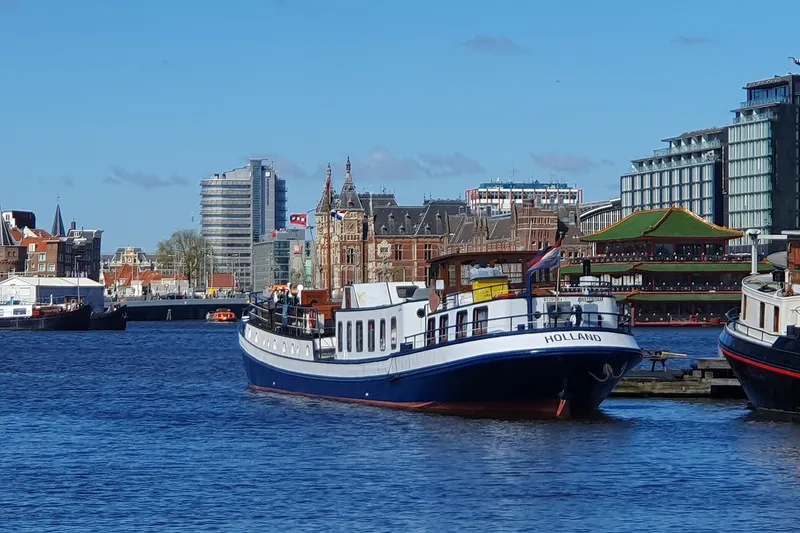
It is a small ship, the cabins are tight, and nobody staffs the pier around the clock. Knowing those three things before you book is most of what it takes to enjoy a night here.
Getting there and getting in
Walking from Centraal to Steiger 3
From Amsterdam Centraal the berth is roughly 900 metres on foot, which most people cover in ten to twelve minutes. Two routes work. The direct one runs southeast along Prins Hendrikkade past the Basilica of Saint Nicholas and then turns along Oosterdokskade; the quieter one continues behind the public library (the OBA) until the Mr. J.J. van der Veldebrug, a pedestrian and cycle bridge that lands you on the Oosterdok quay.
Steiger 3 is a working jetty, and several historic botels share it, among them AmicitiA and Vita Nova. Both are run by the same operator, HAM Tours, as MPS Holland. Read the name on the hull before you cross the gangway.
The quay is closed off by a gate at the embankment and there is no staffed reception on the jetty. Tell the boat your arrival window through your booking channel; without that message you may find yourself waiting on the quay while someone walks up from the cabins to let you in.
I arrived off a morning train with a rolling case and took the Prins Hendrikkade side. It works, but the paving on the last stretch is uneven enough that a hard-shell case keeps catching; on later trips I have crossed at the Veldebrug instead, a slightly longer line that is smoother underfoot.
Bags, cars, and the last 900 metres
No bus, tram or metro stops at the pier, and there is no lift anywhere on the quay, so the final stretch is always walked. The nearest metro station is Nieuwmarkt, about a kilometre away, so a ride from Centraal plus a walk rarely beats simply walking the whole way. A GVB 1-hour ticket costs ≈ $3.7 (€3.4), which makes the metro worth considering only in heavy rain. Taxis and ride-hail from the station are metered and short.
If you land at Schiphol, trains reach Centraal in about 15 to 20 minutes, and the walk from there is the same 900 metres. Drivers should not expect to park by the berth: the nearest garage is Parking Centrum Oosterdok at Oosterdoksstraat 140, roughly 600 metres away and open 24 hours. Its rate card lists ≈ $28 – $33 (€25 – €30) for a pre-booked day ticket and ≈ $8.8 (€8) per hour for a drive-in stay, capped at ≈ $50 (€45) per 24 hours.
| Option | From | Time | Cost | The catch |
|---|---|---|---|---|
| Walk | Centraal, via Prins Hendrikkade or Oosterdokskade | 10–12 min | €0 | Uneven paving, kerbs, cycle traffic |
| Metro plus walk | Centraal to Nieuwmarkt | About 20 min | ≈ $3.7 (€3.4) | Still a kilometre on foot |
| Taxi or ride-hail | Centraal taxi rank | 5–10 min | Metered | Only worth it with luggage or in rain |
| Car | A10 ring road to Oosterdoksstraat 140 | 15–25 min | ≈ $28 – $33 (€25 – €30) pre-booked day ticket; ≈ $50 (€45) drive-in maximum | 600 metres still to walk |
The twelve cabins and the shared spaces
What the operator lists
HAM Tours sells the ship as sleeping up to 28 people in twelve cabins across three layouts. There are eight twin cabins with stacked bunk beds, two four-berth cabins with bunks, and two double-bed cabins in the bow. Every one of the twelve has its own shower and toilet, which is not a given on this quay: several neighbouring botels still put guests on shared corridor bathrooms.
The details differ by type. All eight twins have heating, air conditioning and a porthole in the hull. The two four-berth cabins have heating and a window but no air conditioning listed. The two bow cabins have a double bed, heating and a window, and the only way in is across the open sun deck, in whatever weather is running. The operator's vessel description is where the current layout is set out.
Space, luggage, and air
These are compact cabins, and the layout says more about them than any measurement would: the floor between the bunk and the door is narrow, and two large rigid cases will not open side by side. Soft bags slide under the lower bunk; hard cases end up standing in the corner and stay in the way for the whole stay. If exact floor area decides your comfort, ask HAM Tours directly before booking.
Ventilation splits by cabin type. The twins cool themselves with individual air-conditioning units, while the four-berth and bow cabins rely on central heating in winter and an open window or porthole in summer. Opening a hull porthole at night does bring in cooler air, along with the odd insect off the water.
The salon and the sun deck
The salon is the social centre: fixed tables, corner benches and a painted mural along one wall, used for breakfast and for sitting out a wet afternoon. Above it, the sun deck has benches and a clear line of sight across the basin to NEMO and the Maritime Museum. Smoking is banned throughout the interior. There is no guest kitchen, no hob and no cooking equipment, so self-catering is off the table; guests do bring supermarket food into the lounge to eat, but there is nowhere to prepare it.
The salon sits directly above and beside several cabins, and guests report that sound carries through the timber joinery. If you are the one sitting up late with a book or a route map, keep the conversation low.
Booking: a retail berth or the whole boat
Two prices, two audiences
The ship sells in two ways, and confusing them is the main source of wasted effort. Individual cabins go through Booking.com and similar sites at dynamic nightly rates that move with the Amsterdam market. The whole vessel, by contrast, is chartered through HAM Tours at a fixed tariff: ≈ $99 (€90) per person per night including tax, breakfast, packed lunch, bed linen and towels, rising to ≈ $120 (€105) once a three-course dinner is added, with a minimum of 24 guests either way. Both tariffs are set out in the operator's price list.
For a group of 24 or more the charter is usually the better deal, because the same money buys breakfast and lunch that a retail rate leaves out. For a couple or a solo traveller the retail channel is the only door in, and if those dynamic rates sit above your budget, the cheaper botels in Amsterdam cover the boats that start under ≈ $110 (€100) a night.
What the rate covers, and what the city adds
A retail room comes with bed linen, towels, heating, Wi-Fi and a continental breakfast in the salon. It does not come with lunch or dinner, because the ship has no restaurant. On top of the room price, the City of Amsterdam's tourist tax (toeristenbelasting) adds 12.5% of the overnight price before VAT, collected by the property and passed on.
The tax picture changed at the start of 2026: VAT on Dutch overnight accommodation moved from the reduced 9% rate to the standard 21%, as the Dutch government's business portal confirms. Together with the 12.5% municipal levy, that works out at roughly a third more than the net room rate by the time you check out.
Deposits and the eight-person rule
Cancellation terms follow whichever retail rate you choose: flexible bookings can be cancelled free up to a stated deadline, while the cheapest non-refundable tiers are charged in full when you book. One condition catches groups. Reserve eight or more people through a retail channel and the property asks for a deposit equal to 100% of the first night, paid by bank transfer to the boat; if the transfer does not arrive in time, the reservation can be dropped.
Reviews are worth reading before you commit. On Booking.com the ship scores 7.6 out of 10 from 1,885 reviews, with location at 8.9 and value for money at 8.0, while comfort and facilities sit around 7.3, the compact cabins being the part guests notice most.
| Booking route | Who it suits | Price | What to watch |
|---|---|---|---|
| Retail cabin | Couples, solo travellers, small groups | Dynamic nightly rate plus municipal tourist tax | Calendar closes whenever the boat is chartered |
| Group charter, half board | Cycling and family groups of 24 or more | ≈ $99 (€90) per person per night, tax included | Minimum 24 guests; ≈ $2,400 (€2,160) per night |
| Group charter, full board | Private groups of 24 or more | ≈ $120 (€105) per person per night, tax included | Dinner included; ≈ $2,800 (€2,520) per night |
What a night on board is actually like
Movement and noise
Oosterdok is a sheltered inner basin, so there is no swell and the ship sits still in ordinary weather. What you get instead is a light lateral shift and the occasional fender squeak when a patrol boat, tug or canal-tour vessel passes, mostly in the middle of the day. City noise is the more persistent issue: the rail approach into Centraal is close enough to be heard in quiet hours, and the IJ-tunnel adds a low background hum. Reviews of the boat regularly mention sound carrying between cabins, so light sleepers should pack foam earplugs; noise-cancelling headphones do little against low rumble.
Heating, Wi-Fi, and the wet room
In autumn and winter the radiator circuit keeps the cabins and the salon warm, and the eight twin cabins can be topped up with their own air-conditioning units. Wi-Fi is free and reliable in the timber-lined salon, but it fades inside the steel hull, and the lowest cabins can lose the signal altogether.
The bathrooms follow the nautical wet-room pattern. The shower head is handheld and shares the floor with the toilet and basin, so the whole room gets wet and a squeegee is provided to push the water to the drain. Bring flip-flops if you dislike standing on a wet floor.
On a previous trip I took one of the two bow doubles, reached by walking the open deck from the salon. It is the only cabin on board with a proper double bed, and on a wet autumn morning the deck crossing was the least pleasant part of the trip; the room itself was the quietest on the ship, sitting furthest from the gangway and the salon.
Check-in and breakfast
Check-in starts at 14:00 and check-out is by 10:30, and both are fixed. Breakfast is served in the salon from 08:30 to 10:00, with sliced bread, cheese, cold cuts, boiled eggs, spreads, coffee and tea. Because the pier has no desk, the arrival-time message is not a courtesy but the thing that gets the gate opened; the Booking.com listing asks for your arrival time in advance for exactly that reason.
Who the boat does not suit
Age limits and group behaviour
For safety reasons the ship does not take guests aged 11 or younger, and there are no cots, cribs or extra beds. Open quays, low railings and the steep gangway are the stated reasons. Between that restriction and the 100% first-night deposit for parties of eight or more, the boat is a poor fit for stag and hen weekends.
Accessibility
The ship is not wheelchair accessible. Boarding means crossing an angled metal gangway that moves with the basin, stepping over raised steel coamings at the doors, and then climbing steep, narrow companionway steps with tight handrails to reach the twin and four-berth cabins. Bathroom doorways will not take a walking frame. Anyone with a knee injury or poor balance is better off in a land hotel.
Why the boat vanishes from booking sites
MPS Holland is not a full-time hotel. It takes individual bookings between charter contracts, which is why you can see rooms one week and a blank calendar the next; a blacked-out period almost always means the ship is sailing a multi-day cycling itinerary, and it is rarely closed for repairs. When your dates show no vacancy, ask HAM Tours whether they fall between charters, or look at another vessel on the same quay.
Timing matters more than rate-hunting. Charters are booked months ahead, so retail availability is concentrated in the winter low season and in the gaps between tours. A group travelling in summer should book the charter directly; waiting for cabins to appear rarely works. A couple should aim for the colder months and treat any summer vacancy as luck.
MPS Holland or a neighbour on the same quay
Value here is easy to judge. A retail cabin buys a private wet room, a bunk and breakfast within a twelve-minute walk of Centraal; the same money in a land hotel buys a larger room without the water, and less in a hostel buys a shared bathroom on the same quay. For a group of 24 or more, the charter tariff is the cheapest way on board, since the base rate already covers breakfast and lunch; that is worth pricing against a central hotel quote before you commit.
If MPS Holland is full, the same quay has alternatives. Hotelboot Zwaan sits on the same Oosterdok quay and suits travellers who prefer a barge to a converted passenger ship, while the wider survey of Amsterdam botels and ship hotels covers the other docks.
The best window for an individual cabin is the cold half of the year, when the cycling charters pause and the ship sells berths again. In summer, couples and solo travellers should expect to look elsewhere.