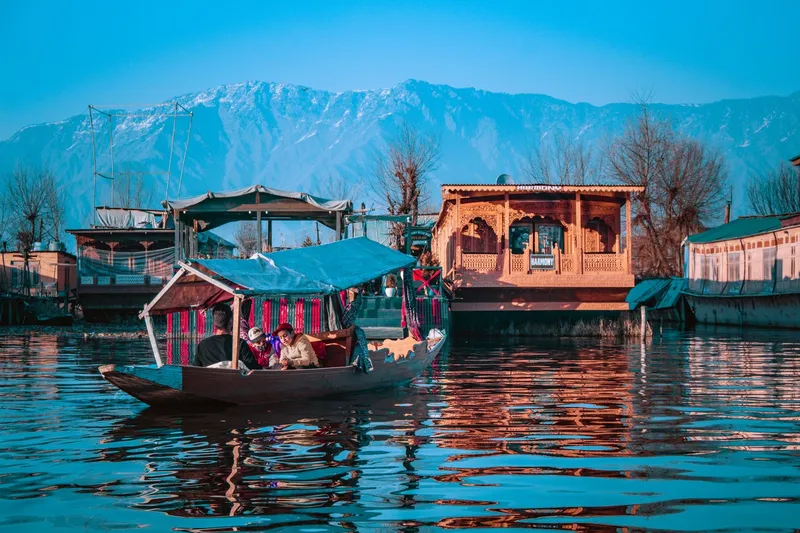
A hull that has taken water shows it in the floorboards before it shows anywhere else, so the bilge hatch is worth finding before unpacking. The mooring row matters as much as the room category: a front-row boat looks across open water, a third-row boat looks into the kitchen exhaust of the boat ahead.
New construction on Dal and Nigeen has been banned since 1988, so owners keep ageing hulls in service. The boat's maintenance record, its owner, and its mooring tell you more than the category on a booking site.
How a Kashmiri Houseboat Is Built
From cargo donga to colonial houseboat
The land ban that pushed the British onto the water dates from the reign of Maharaja Ranbir Singh in the late nineteenth century. British officers and travellers wanted to spend summers in the valley, but the Dogra court barred foreigners and non-Kashmiris from buying land or building brick houses. They moved onto the water instead.
Early visitors rented and modified the traditional Kashmiri donga, a flat-bottomed cargo and passenger boat with removable matting walls. In 1888 a British resident named M.T. Kennard commissioned the first purpose-built floating house, the Victory; local accounts also credit the trader Pandit Narain Das with an earlier boat, the Kashmir Princess. The hybrid that followed, a Kashmiri hull with a Victorian plan, became the template for both lakes.
These were not small craft. The working boats run from about 24 to 38 metres, with a sheltered front veranda, a formal drawing room, a dining saloon, and two to four bedrooms off a central corridor. Cooking was moved to a separate kitchen donga moored behind the main hull, which kept smoke and fire away from the bedrooms.
Deodar, khatamband, and walnut
The hull is Himalayan deodar cedar (Cedrus deodara), split into planks and caulked. Its resin and oils resist rot and boring insects in shallow water, but the wood still moves with the seasons. A hull lasts as long as its bilge is pumped and its planks are replaced; the construction ban made replacement impossible, which is why owners keep boats sound by changing individual planks during repairs.
Inside, the ceilings are khatamband, a Persian-influenced marquetry of thin pine facets fitted into polygonal webs without metal nails. Window frames and partitions use Pinjrakari, lattice screens joined by tongue-and-groove geometry that cuts the high-altitude glare while letting air through.
Walls and carved panels are walnut (Juglans regia); bedframes and dining tables are simpler softwood joinery. The best carving, khokerdar, is cut from seasoned slabs and shows tool marks, deep undercuts, and a matte finish. Stained pine and veneered MDF look uniform, feel slick, and often show glue lines where the panels meet. A hand drawn across the panel often reveals more about the material than the listing photographs do.
Repairs are a legal obstacle course. In July 2023 the High Court of Jammu & Kashmir and Ladakh allowed conditional timber repairs and renovations on registered boats, subject to inspection by the Lake Conservation and Management Authority. Owners still complain that approval and money arrive slowly, and every replacement deodar plank has to pass inspection so that a repair does not become a hidden extension.
The Fleet, the Ghats, and What a Mooring Row Means
The 1988 ban stopped the fleet from growing, and repairs were tightly restricted until the 2023 court order, so the stock aged in place. A Houseboat Owners Association estimate reported by Greater Kashmir on 23 December 2025 put the remaining fleet at about 750. That is an estimate of boats still operating; a 2023 LCMA registration list cited in the 2024 study Solid Waste Management–Mismanagement from Houseboats of Dal Lake recorded 950 registered hulls on Dal Lake alone. Fire, rot, and the cost of repair explain the attrition, because a condemned boat cannot be replaced with a new one.
Most Dal boats are now plumbed into shore treatment, though some still rely on onboard bio-digesters. A statement by LCMA vice-chairman Sajjad Hussain Qadri, reported on 16 April 2026, put Dal houseboats connected to sewage-treatment systems at nearly 95%. The earlier baseline comes from a J&K government document reported by Kashmir News Observer in March 2025: 570 connections on Dal and 148 on Nigeen. These figures describe connections, not the condition of an individual bathroom.
Access is through numbered ghats along Boulevard Road. Srinagar boats are listed at Ghat 9, 12, 14, 15, 17, and 19A, among others; Ghat 17 sits at Nehru Park, and the Dalgate end is the busiest stretch, with vendor boats working the channel with carpets and saffron. The ghat number gets your taxi and shikara to the right landing, but it says nothing about noise once you are aboard.
Rows work like terraces: the first faces open water, the second looks at the first boat's stern, and the third can sit behind the second boat's kitchen pipe and, at the Dalgate end, a generator. Front-row boats get morning light and breeze; the rows behind get less of both. The difference rarely appears in the room rate.
Published addresses provide useful landmarks. Howrah Houseboat lists itself opposite Ghat 9 on Golden Dal; Swan Group and Amina give Ghat 12 on Boulevard Road; Moustache and Harmony list Ghat 17 at Nehru Park. Golden Dal around Ghats 9 and 12 is convenient for the Boulevard but densely moored, so an unspecified lake view may be another hull. Nehru Park is an easy landmark for a driver, although the row still determines the outlook. Royal Dandoo Palace at Nehru Park advertises central heating, which makes it a useful winter inquiry.
Nigeen is the quieter alternative. The District Srinagar administration describes it as deeper and less crowded than Dal, with clearer water, and the shoreline is certainly calmer. It is connected to Dal by a narrow strait, and the Nallah Amir Khan channel links it to Khushal Sar and Gil Sar. Restaurants and taxis along the Boulevard are farther away, which matters on a short stay. For a Nigeen property with a named ghat and a family history, our notes on WelcomHeritage Gurkha Houseboats are a useful comparison. The rest of the Nigeen fleet is small and reached through the same strait.
What a Night Costs and How Booking Goes Wrong
There is no single fleet tariff. The cards below come from different years; they show how meal plans and heating are priced, and they are not a quote for this winter.
| Rate card | Year | Room and meal basis | Rate | Heating terms |
|---|---|---|---|---|
| Howrah Houseboat | 2022 | Deluxe double, room-only to full board | ≈ $42 – $69 (₹3,900 – ₹6,500) | ≈ $7.5 (₹700) per bedroom per night, 15 October–15 April |
| Swan Group | 2023 | Superior double, breakfast or half-board | ≈ $100 – $160 (₹9,500 – ₹15,000) | Not stated on the card |
| Royal Dandoo Palace | 2024–25 | Deluxe, suite, and family, room-only to half-board | ≈ $91 – $200 (₹8,500 – ₹18,500) | Central heating advertised; hours and inclusion not stated |
The three cards span four years, so the rupee figures are not a ladder. Inflation and category changes make the 2022 and 2023 rates historical; only the 2024–25 card is close enough to use as a rough benchmark. What transfers across all three is the way heating is charged separately and the way meal codes change the total. Book My Houseboats' 2025 guide lists budget and standard rooms at ≈ $16 – $43 (₹1,500 – ₹4,000), usually without breakfast and with heating extra, but it does not name the boats or their terms, so treat it separately from the operator cards.
Meal codes matter when comparing those figures: EP is room-only, CP includes breakfast, MAP usually means breakfast plus one major meal, and AP covers all meals. On MAP and AP rates, food is often the largest included item. Heating causes more checkout disputes. Howrah's card uses the paid period above, while SrinagarHouseboats.co.in publishes complimentary heating from 15 November to 15 March.
At Sheikh ul-Alam International Airport (SXR), the prepaid counter inside arrivals is the boring, reliable option. Check the fare on its current rate card for your vehicle and ghat, and do not count on finding an Uber or Ola at arrivals. Drivers outside the terminal will offer a package that includes a boat; the prepaid counter is cheaper and the driver has no claim on your booking.
At SXR arrivals a driver once told me the boat I had booked had been flooded and offered to take me to a 'better' one. I messaged the owner from the hall; he replied that the boat was at Ghat 12 and a shikara would meet me. The boat was dry, and the driver had wanted cash before we left the terminal.
The J&K Tourism Department notifies shikara fares: ≈ $7.5 (₹700) for the first hour (up to 3 km), ≈ $4.3 (₹400) for each additional hour, and ≈ $29 (₹2,700) for a six-hour day. The notified tariff is what you quote when a boatman opens at double. Your host's arrival and departure crossing is normally included in the room rate; independent crossings are agreed at the ghat before you step in.
At Ghat 17, on a spring morning, a boatman quoted ≈ $16 (₹1,500) for two hours. The notified tariff is ≈ $7.5 (₹700) for the first hour and ≈ $4.3 (₹400) for the second, so we agreed ≈ $12 (₹1,100). He pulled into a carpet workshop twenty minutes later, said it would take five minutes, and we lost forty minutes of morning light.
The High Court of Jammu & Kashmir and Ladakh's interim order bars fuel-powered motorboats, motorised shikaras, and jet skis on Dal Lake until further orders. Paddled shikaras, which most houseboats use for transfers, are not covered; official boats used for emergencies, law and order, disaster management, and safety are exempt. Because the order is interim, confirm with the operator that a motorised lake tour is still running.
Life jackets have been mandatory on shikaras on Dal and Nigeen since the J&K government's May 2023 directive.
Agents who approach you at the airport or on the road work on commission; you pay the same or more, and the boat may not be the one in the photograph.
Winter on the Water: Bukharis, Frozen Pipes, and Power Cuts
Chillai Kalan and the plumbing
Chillai Kalan, the core of the Kashmir winter, runs for 40 days from 21 December. Traditional calendars then count Chillai Khurd, about 20 days, and Chillai Bachha, about 10. Srinagar's January nights are below freezing on the long-term average, and cold waves push well lower. A cedar wall with no insulation does little to keep that out.
| Month | Mean daily maximum / minimum | What to expect aboard |
|---|---|---|
| November | 15.9°C / 1.2°C | Daily stove; slow geysers and sluggish morning pipes |
| December | 9.9°C / -1.6°C | Continuous evening and night heating; bed warmer useful |
| January | 7.1°C / -1.9°C | Frozen external pipes are likely in hard spells; bucket service |
| February | 10.5°C / 0.7°C | Freezing remains possible; heating and backup power still matter |
| March | 15.5°C / 4.3°C | Intermittent stove, normal plumbing more often, rain |
The temperature figures are 1991–2020 normals from the India Meteorological Department's Srinagar climatological table. They describe the city station, not a thermometer inside your cabin; wind, an uninsulated hull, and the time of the last stove refill determine how the room feels.
Water pipes run along the outside of the hull. In a hard freeze they can be solid by midnight and stay that way until the sun reaches the boat, which is why the attendant arrives with a bucket of hot water and a dipper. An afternoon shower may be possible once the pipes thaw, while early-morning washing often means using that bucket.
One winter the bukhari in my room was lit at nine and out by two. The attendant stacked deodar offcuts beside it and refilled at six; by then the water in the wash bucket had a skin of ice. I had paid the heating surcharge, which buys wood but not an all-night fire.
The stove, the flue, and the generator
The bukhari is a cylindrical iron firebox with a flue through the roof. Dry deodar offcuts burn hot and last roughly three to four hours per load, then embers. Cracked seams, soot on the ceiling, or a pipe passing through bare wood are reasons to change rooms.
Carbon monoxide is the risk nobody mentions at check-in. A battery-powered detector takes less space than a paperback. If the flame pulls backwards when the wind shifts, open a window and let the stove go out. The houseboat safety inspection guide explains what to look for.
On family-run boats, the attendant normally lights and refills the fire for you. The refill time decides whether the room is warm at three in the morning; the stove size matters less.
The Kashmir Power Distribution Corporation Limited (KPDCL) ties scheduled daily curtailment to feeder losses in its Load Curtailment Plan: 30 minutes for feeders up to 15%, three hours at 15–40.5%, six hours at 40.5–65%, and eight hours above 65%. The applicable band depends on the feeder serving the boat's shore connection; a neighbouring locality can be on a different schedule, and unscheduled outages can add to the published curtailment. KPDCL revises the plan periodically, so the bands describe its published schedule; your dates may differ.
An electric bed warmer works only while the inverter or generator runs. On the budget boats I have stayed on, the generator usually stopped around 11 p.m. and restarted at breakfast.
Living on Board: Water, Damp, Food, and Safety
Old deodar burns fast. Find the extinguishers, check whether the gauge is in the green, and work out which door you would use at night. The exit is usually the front veranda or the rear kitchen deck. Corridors are narrow, so check them for stored mattresses, carpets, and luggage.
Walk the corridor and watch the floor. A slope toward one side, a soft plank, or a bilge smell means water below. Ask to see the bilge pump run and the water level in the hatch.
Water pressure comes from a small tank on the roof, so showers are weaker than in a city hotel. Storage geysers are small; allow half an hour between showers. In winter, hot water may arrive in a bucket regardless of what the bathroom promises.
Damp is constant. The lower timbers absorb lake water, which keeps the carved walnut from splitting but makes wool and cotton feel clammy. Airing the room in the afternoon helps; drying clothes indoors does not.
Wi-Fi on the boats is usually good only for messaging. Mobile data on Jio or Airtel is faster on the Boulevard, and the signal holds over much of Dal. Prepaid SIMs issued outside Jammu & Kashmir do not work in the region. A postpaid Indian connection is the safer option; visitors relying on data can also install a roaming travel eSIM before arrival.
An onboard bio-digester relies on living bacteria. Do not pour bleach or strong disinfectant into its toilet, and put wet wipes in a bin. Either mistake can cause a backup and a smell that no amount of cedar hides.
Each boat usually has a live-in attendant, often a member of the owner's family. He carries luggage, lights the stove, serves meals, and solves the problems that appear at two in the morning. Tip him directly rather than leaving money at a desk.
Kahwa is the welcome: green tea with saffron, cardamom, cinnamon, and slivered almonds, poured from a samovar. It is also the fastest way to warm up before the stove catches.
Meals on half-board and full-board are family-style Kashmiri: rice, dal, haakh, dum aloo, chicken or mutton curry. Wazwan is a different meal, cooked by a waza and ordered ahead. Mantana Houseboats' published tariff quotes a supplement of ≈ $21 (₹2,000) per person, but the charge varies by boat. If the boat's cook is not a waza, wazwan is better eaten at a restaurant in town, with breakfast kept for the boat.
When a Houseboat Beats a Hotel
April and May are the easiest months: tulips, mild days, cool evenings. June to August is hot on land and cooler on the water, with the lotus beds at their best. Late September and October bring clear light and the chinar turn, but nights drop toward freezing by late October, and some tariff cards start the heating surcharge on 15 October. December to February is the hard season. March is variable, with rain and a mix of stove and sun.
| Month range | Mean day / night air temperature | Heating | Plumbing | Practicality |
|---|---|---|---|---|
| April–May | 21.1–24.7°C / 7.7–11.2°C | Optional evening stove | Normal flow | Easy |
| June–August | 28.5–30.0°C / 15.0–18.4°C | None | Normal flow | Easy; breezy on the water |
| September–October | 23.0–27.8°C / 6.2–12.8°C | Evening stove from mid-October | Normal flow | Best light; cool nights |
These ranges also use the IMD's 1991–2020 Srinagar normals. November through March appears separately in the winter table because frozen plumbing changes the stay as much as the air temperature does.
Late September is the window I would choose: calm water, good light, and no heating surcharge yet. March is the second choice, with rain and a stove in the evening.
Houseboat or land hotel: the trade-off
The choice comes down to which inconvenience you can live with. A houseboat gives you the carving, the veranda, and usually a cook; a land hotel gives you heat, plumbing, and a door a taxi can reach.
| Criterion | Houseboat | Land hotel on Boulevard Road or in Rajbagh |
|---|---|---|
| Price | Rate cards vary by year and category; heating is a separate line | Room rate is usually one figure; breakfast and taxes are itemised |
| Heat | Bukhari and paid wood; generator may stop around 11 p.m. | Central heating or split AC; backup depends on the hotel |
| Bathroom | Roof tank and small geyser; pipes can freeze in January | Pressurised hot water and an indoor bathroom |
| Food | MAP or AP often includes home-style Kashmiri meals | Restaurant menu and room service |
| Access | Ghat steps and a shikara crossing; no vehicle at the door | Taxi to the entrance; lifts in larger hotels |
| Noise | Generator, kitchen boat, neighbours, and the call to prayer | Road traffic, but better-insulated rooms |
| Power and Wi-Fi | Inverter hours; mobile data usually faster | Backup generator; Wi-Fi usually stronger |
Choose the boat if the carving and the veranda are the reason for the trip and you can accept a bucket of hot water in January. Choose land if you need steady heat, a shower at 6 a.m., or step-free access. A split stay works well: two nights on Nigeen for the quiet, then a hotel in Rajbagh for the rest of the week.
Before you book: the questions that matter
A short list decides most of the stay: which boat, which row, what heating costs, when the power runs, how the bathroom works, and what the meal code covers. The answers belong in one message before you pay a deposit.
- Which boat, which ghat, and which row? Ask for the boat name, the ghat number, and the row, plus a current photo from the bedroom veranda.
- Is heating included, and at what charge? Confirm whether it is per room or per person, the dates it applies, whether wood is unlimited, and the usual time of the last refill.
- When does the generator run, and what does the inverter carry? Ask whether a bed warmer will last the night and where the torch is kept.
- What is the bathroom arrangement? Ask whether the room is on a shore sewage line or an onboard digester, and whether hot water is available before 7 a.m.
- What is included in the meal code? Confirm EP, CP, MAP, or AP, and whether wazwan is available or ordered ahead.
- Who meets you, and at what price? Book direct or through a registered operator, and keep the owner's WhatsApp and the ghat number on your phone.
- Are shikara stops included in the agreed route? Say no to unscheduled workshop visits at the ghat, before the boat leaves.
If any answer is vague, the safe assumption is that heating and late-night electricity are excluded.