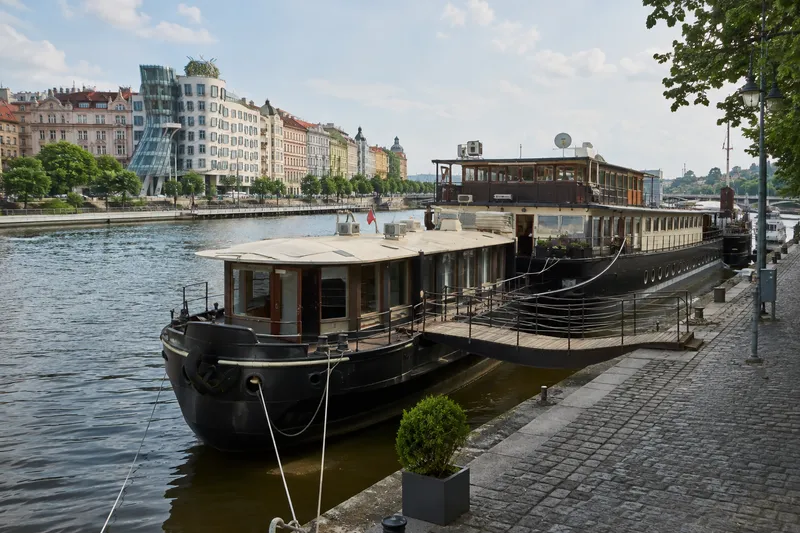
That division decides most of what you will like about staying here. The six Standard Doubles sit below the barge's deck, directly under the restaurant, with waterline windows and no air conditioning. Everything on Klotylda is a step up: small singles at the bottom of the range, then superior and executive doubles with real windows and climate control, then two grades of suite. Booking "a room at Botel Matylda" without checking which hull you have been assigned is the usual way people end up in a hot cabin above a kitchen in August.
The address is the other half of the story. The gangway puts you two minutes from a tram stop on lines 5 and 17, five minutes from the metro at Karlovo náměstí and inside a twenty-minute walk of the Old Town. What you give up is space, a lift and any real sound insulation. For a river view and a central Prague 1 location at boat prices, that trade is hard to beat; for a large bathroom and a guaranteed silent night, it is the wrong building.
Arriving with a rolling duffel in the rain, the awkward part turned out to be the last thirty metres: cobblestones on the quay, a steel gangway whose painted treads went slick, and a raised sill at the cabin door that the bag had to be lifted over. Packing light is not a cliché on a boat this size; it is the difference between one trip down the steps and three.
Where the Boats Are Moored, and How to Reach Them
Between the Mánes Gallery and the Dancing House
Botel Matylda is moored on the right bank of the Vltava at Masarykovo nábřeží in Prague 1, between the Mánes exhibition hall at the tip of Slovanský ostrov and Frank Gehry's Dancing House, just south of the Jiráskův bridge. Both hulls lie against the stone embankment wall, joined to it by a pontoon gangway. Cabins on the river side of each boat look west across the water towards Smíchov and up to Petřín; cabins on the other side look at the quay wall and the traffic on Masarykovo nábřeží. That orientation, more than the boat itself, decides how quiet your night will be.
Distances on foot from the gangway:
| Destination | Distance | Time | Route |
|---|---|---|---|
| Dancing House (Tančící dům) | 110 m | 2 min | Level crossing over Jiráskovo náměstí |
| Mánes gallery | 100 m | 2 min | Flat path along the quay |
| Karlovo náměstí (metro B) | 380 m | 5 min | Resslova street, uphill out of the river basin |
| Charles Bridge (Karlův most) | about 1.3 km | 15–20 min | Cobbled pavement along Smetanovo nábřeží |
| Old Town Square | about 1.6 km | 20 min | Via Národní třída and the lower end of Wenceslas Square |
The National Theatre and the start of the Old Town lie on the same embankment to the north, so the whole centre is walkable if the weather holds. The one thing worth knowing about the address is which bank you are on: Masarykovo nábřeží is the right bank, the Dancing House side. Malá Strana, the castle and Letná all sit across the water, and reaching them means a bridge or a tram rather than a stroll. The boat looks central on the map, and it is, but it is central on the far side of the river from the castle.
Trams, Metro and the Route to the Station
The Jiráskovo náměstí stop is beside the gangway – you can see the platforms from the deck. Line 17 is the one to remember for sightseeing: it runs north along the embankment through Národní divadlo and Staroměstská, the stop for the Old Town and Charles Bridge, then continues to Čechův most and the Výstaviště exhibition grounds. Line 5 heads inland to Václavské náměstí and Hlavní nádraží, Prague's main railway station, without a change, which is the practical option if you arrive by train. Prague Integrated Transport (PID) runs the network; daytime trams stop around midnight and night lines take over at longer intervals.
| Stop | Lines | Distance from the gangway | Where it takes you |
|---|---|---|---|
| Jiráskovo náměstí | Tram 17 | 70 m | Národní divadlo, Staroměstská (Old Town), Čechův most, Výstaviště |
| Jiráskovo náměstí | Tram 5 | 70 m | Václavské náměstí, Hlavní nádraží (main station) |
| Karlovo náměstí | Metro B | 380 m | Můstek, Florenc bus station, Smíchov |
For the metro, walk to Karlovo náměstí on line B. The last stretch climbs Resslova street out of the river basin, which you notice with a suitcase. Line B reaches Florenc bus station in four stops and Můstek, at the bottom of Wenceslas Square, in two. Václav Havel Airport is about 15 km west; the public route involves a bus and a change, so most guests take the hotel's paid airport transfer or a taxi.
The Quay, the Galleries and the River Path
The stretch of embankment outside the cabins is one of the better parts of central Prague to walk, and it rewards a morning spent on foot. The Mánes gallery, a Functionalist building at the tip of Slovanský ostrov, runs temporary art exhibitions two minutes from the gangway; behind it, Slovanský ostrov itself is a park with the neo-Renaissance Žofín Palace, which hosts concerts and balls. On the other side of the boat, the Dancing House has a rooftop restaurant and bar looking straight down at the two hulls, which is the best vantage point for photographing the botel from above.
Walking north along Masarykovo nábřeží takes you past the National Theatre to the foot of Charles Bridge. Walking south along the same bank brings you to Palackého náměstí and then to Výtoň and Vyšehrad. The lower quay beneath the street, reached by the same stone steps that lead down to the boat, is the náplavka – a long riverside promenade with bars and moored vessels that fills up on warm evenings. Guests who complain about noise at Botel Matylda are usually describing this stretch on a summer weekend rather than the boat itself.
Matylda and Klotylda: What You Actually Book
An Old Barge and a Purpose-Built Sister
Check-in happens on Klotylda whatever your reservation says: guests assigned to the barge collect their key on the newer hull and cross a short pontoon bridge to reach their cabins. Klotylda was built in the Czech Republic with the same profile as Matylda, so from the quay the pair reads as one installation. Inside, they do not match. The newer hull has wider stairs and modern service runs; the barge keeps its original dimensions, with low ceilings, heavy steel bulkheads and raised sills at every doorway.
Reception is staffed around the clock, and luggage storage is available before check-in and after check-out. That matters more than it sounds on a boat with an 11:00 checkout and a late train home.
Cabin by Cabin: Sizes, Windows and Air Conditioning
Floor areas below are the hotel's own figures, and the categories are not just a price ladder – they change what is in the room.
| Category | Floor area | Hull | Air conditioning | Window |
|---|---|---|---|---|
| Single | 10 m² | Klotylda, lower deck | No | One small window over the water |
| Standard Double | 11 m² | Matylda, below deck | No | Waterline window, river or quay side |
| Superior Double | 13 m² | Klotylda, main deck | Yes | Full-height French windows |
| Executive Double | 20 m² | Klotylda, below deck | Yes | Two large windows facing the river |
| Junior Suite | 30 m² | Klotylda, below deck | Yes | Multiple windows, sitting area |
| Deluxe Junior Suite | 25 m² | Klotylda, deck level | Yes | Glass wall and a private terrace |
All categories come with a private shower room, minibar, satellite TV and free Wi-Fi. The singles are the cheapest way in and the tightest, with just enough floor between the berth and the bulkhead to stand and turn; the Standard Doubles on the barge are the only cabins with a porthole at waterline height rather than a proper window. From the Superior upwards you get individually controlled air conditioning, a safe and far more glazing, and the Executive adds two leather armchairs and a desk. The two suites are the only rooms with a separate sitting corner; only the Deluxe version has outdoor space of its own, a private terrace over the water, while the larger Junior Suite sits under the deck and is therefore darker.
Which side you ask for is the most consequential choice in the booking form. River-side cabins look across the channel to Smíchov and up to Petřín; quay-side cabins face the embankment wall a few metres away, with the tram track on the road above. The suites sit at the bow and the stern, so they get some river outlook either way, and the Deluxe version adds the terrace on top of it.
Storage is the other constraint to plan for. No category has a wardrobe deep enough for a large hard-shell case laid flat, and the minibar and television eat into the floor space of the smaller rooms; a soft bag that slides under the berth is worth more here than a rigid suitcase. The suites are the exception, with room for two full-size bags and somewhere to put them.
Cabins of this size are normal on converted boats, and the details that make them work – the berth pushed against the bulkhead, the wet-room shower, the storage under the bed – repeat across the fleet. If you want to see how the space compares with other moored vessels before you book, this breakdown of cabin sizes and low ceilings on floating hotels puts the numbers in context.
One booking detail is worth more than the marketing copy. The reservation form on the hotel's own site carries this line: "the selection of the specific room in the booking form is for guidance only. For operational reasons, you may also be located elsewhere." The hull, the side of the boat and occasionally the category can change at check-in, so if you chose a cabin for the river view or the air conditioning, ask reception for written confirmation. The portals also sell river-view and town-view versions of the same category, and the two are not the same room.
Noise, Movement and Summer Heat on a Static Hull
Nothing here rolls. The boats sit in the sheltered right-bank arm above the Šítkovský weir, behind Slovanský ostrov, so there is no tide, no swell and no engine running through the night. The only movement you will feel is a faint tremor when a sightseeing boat passes the far side of the island, or a short list when a delivery trolley comes down the gangway. Travellers who worry about motion sickness on floating hotels are worrying about the wrong thing at this berth.
Noise is a different matter, and it is decided by which side of the hull you are on. Cabins facing the quay look across a few metres of water at Masarykovo nábřeží, where tram lines 5 and 17 pass the Dancing House from early morning until around midnight; the track sits almost directly above the mooring, so the low-frequency rumble arrives through the quay wall and the steel rather than through the glass. Cabins on the river side trade that for water slap and the distant hum of passing boats. Inside, the barge's wooden partitions transmit more sound than the modern hull, and the six Standard Doubles sit under the restaurant, so late dinner service and chairs moving on the deck above are audible in them. Booking terms set quiet hours from midnight to 07:00 and refuse stag and hen parties, which helps with the neighbours but not with the trams.
In the hottest week of one summer I took a Standard Double on the barge because it was the last cabin available, and spent the evening with the porthole open and the fan running while trams crossed the switch above the mooring. The next morning I moved to a river-facing Superior on Klotylda with its own air conditioning, and the difference was not subtle. The hotel lists climate control only from the Superior category upwards, and a steel hull parked in the sun holds the afternoon heat well into the evening; opening the porthole lets in air, and also noise and spray. Between June and August, the small premium for a Klotylda cabin with air conditioning buys a comfortable night.
Winter changes the balance. The boats are heated through shore connections, every category has heating, and guests who stayed in the cold months describe warm cabins; the dining room and the covered part of the terrace keep working. What you lose is the pontoon garden and the open deck, which is where much of the appeal sits in summer. Spring and autumn are the sweet spot: mild enough to use the deck, cool enough that the missing air conditioning in the cheaper cabins does not matter.
Wi-Fi is free in the cabins and guests rate it at 9.0 out of 10 in the booking-site breakdown, which is better than most metal-hull boats manage; the signal is strongest near reception on Klotylda and weaker in the lower-deck cabins of the barge. If you plan to work, the restaurant during its off-peak hours is a better desk than the cabin.
Ristorante Matylda: Breakfast, the Menu and the Pontoon Terrace
The restaurant occupies the upper deck of the barge, with dark timber panelling, brass fittings and windows on both sides, and it is the reason the boat is known beyond its cabins. It is run by chef Miroslav Jahelka and the seasonal menu leans Italian and Mediterranean: seafood, pasta and grilled meat, with a tiramisù that regulars mention by name. The current menu lists a soup of the day at ≈ $6.8 (Kč 150), lasagne alla Bolognese at ≈ $16 (Kč 345), spaghetti with seafood at ≈ $18 (Kč 395), grilled octopus at ≈ $34 (Kč 745) and the tiramisù at ≈ $8.3 (Kč 185), so a two-course dinner without wine lands in the region of $23 – $27 (Kč 500–600) per person. The wine list is longer than you would expect on a boat this size, and the kitchen changes the menu often enough that the printed card is only a guide.
Opening hours, from the hotel's contact page, are Monday to Thursday 11:30–23:15, Friday and Saturday 11:30–23:30 and Sunday 11:30–23:00. Breakfast is a continental buffet served in the same room on the Matylda boat, and recent guests single out the buffet and the omelette station in reviews. Whether it is included depends on the rate you choose – booking engines mark it clearly, and the two rate types are often listed side by side.
In summer the operation spreads outdoors: the hotel describes a garden on the pontoon and a terrace on the stern, both open to non-residents. That is why the gangway and the main-deck windows see a steady flow of people in the evening, and why the tables by the window need reserving. The hotel asks for restaurant bookings at least 24 hours ahead and confirms them by email; an unconfirmed reservation does not hold a table.
On one visit I took a late table on the stern terrace, ordered the soup and the lasagne, and watched a paddle steamer come up the channel with its lights on. The only annoyance was the breeze off the water, which cools a plate of pasta faster than you expect; if the weather looks uncertain, the tables inside by the window give you the same view without the wind.
Rates, the Prague Stay Tax and Check-In Rules
Prices swing widely with the season, and the rack rates published by the hotel are rarely the cheapest numbers you will see. Booking portals list a Single or Standard Double from around $77 – $130 (€70 – €115) a night outside peak weeks, with river-view Superiors above that band and everything higher in July and August and over the Christmas markets. The hotel's reservation page publishes a room price list of its own, and the portals often undercut it on quiet dates. Treat any single figure you find as a starting point rather than a rate.
One charge always sits outside the room rate. Prague's municipal stay fee is ≈ $2.3 (Kč 50) per person per night for guests aged 18 and over, charged for a stay of up to 60 consecutive nights and collected by the accommodation provider, which is why it appears on the bill at the desk rather than in the online total. The rate is set by Prague City Hall and is currently the maximum Czech law permits. Levies of this kind, along with port charges and cleaning fees, are usually settled at the property rather than through the booking platform, which is a common pattern on floating accommodation and one reason the headline rate is never quite the final bill.
Parking is the second extra, and here the honest answer is that the boat has none. Booking listings state clearly that no parking is available at the property, and street parking in Prague 1 is a residents' permit zone, so anyone arriving by car should reserve a garage in advance and walk the last few minutes. That is the price of a mooring a hundred metres from the Dancing House.
Check-in runs from 14:00 to midnight and check-out is by 11:00; the desk on Klotylda is staffed around the clock, so a late arrival off an evening flight is straightforward. Pets are not allowed, stag and hen groups are refused, quiet hours run from midnight to 07:00, and the property is entirely non-smoking. Booking direct through the hotel's engine is the easiest way to get a written confirmation of the hull and the cabin side; if you book through a portal, email reception afterwards with your reservation number and ask them to note the request.
Four things to settle before you pay:
- Pick the season first. From June to August, choose a category with air conditioning – Superior or above on Klotylda – or accept that a Matylda Standard Double will be hot.
- Pick the side. River-facing cabins are the quiet ones; quay-facing cabins take the tram noise. Put "river side" in writing.
- Read the rate. Breakfast is included in some rates and not in others, and portals mix both on the same page.
- Budget the ≈ $2.3 (Kč 50) per person per night stay fee, and a garage if you are driving.
Gangways, Stairs and Luggage
There is no lift on either boat and no step-free route from the street to the cabins. You come down stone steps from Masarykovo nábřeží to the quay, cross a steel gangway that rises and falls with the river level, then use narrow companionway stairs with low handrails and raised sills at the cabin doors. When the river runs high the gangway angle steepens, and in rain the painted treads become slippery. Two people travelling with hard-shell suitcases will carry them one at a time, and the corridors down to the lower-deck cabins are narrow enough that a large case has to be lifted rather than wheeled.
For anyone who needs level thresholds, a lift or wheelchair access, the answer is a clear no: this is a pair of converted boats, not a hotel with an accessible wing, and no member of staff can improvise a ramp over a stone staircase. The same layout makes the boat a poor fit for very young children in pushchairs and for anyone with knee or balance problems. Travellers with one soft bag and ordinary mobility will barely register it.
Who Should Book Here, and What to Skip
Matylda and Klotylda suit couples who want a river view and a five-minute walk to the centre, solo travellers who value the address more than the floor area, and anyone who wants to sleep on the water without paying superyacht prices. They do not suit light sleepers who cannot secure a river-side cabin, travellers with heavy luggage or limited mobility, or anyone who needs a quiet room and a real desk for a working week – the indoor lounges are limited to the reception area and the restaurant.
Prague has several botels and the berth matters as much as the cabin: the Matylda, Racek and Florentina moorings sit in quite different parts of the river, with different noise, views and walking distances to the centre.
Two things I would skip. The Standard Double cabins on the barge in high summer: no air conditioning, a hot steel hull and the restaurant directly overhead. And the town-side versions of any category if you are sensitive to noise, since you pay the same money for the noisier half of the boat.
Land Alternatives Within a Ten-Minute Walk
If the stairs, the noise or the size rule the boat out, the nearest conventional hotels are minutes away. Dancing House Hotel occupies the Gehry building across Jiráskovo náměstí, with lifts, step-free access and a rooftop restaurant, at roughly double the boat's rates. Eurostars David on Náplavní street and Hotel Caesar Prague on Myslíkova are both standard four-star buildings with lifts and air conditioning in every room; neither has a river view, but both deliver a quiet room and a larger bathroom for similar money.
Choosing between them comes down to what you value. A conventional hotel gives you reliable sound insulation, a lift and a bigger floor plan. All three alternatives sit within a ten-minute walk of the boat's gangway, which makes them easy to fall back on if the cabin you want is already taken.