
Prague botel reviews frequently sell a romantic illusion: sipping coffee while morning mist drifts over the water, swan feathers brushing against your hull, and quiet evenings gazing up at medieval spires. What promotional brochures leave out are the 25-centimeter raised steel door sills, the relentless clatter of morning commuter trams echoing across the embankment, and the harsh realities of electric macerator pumps. Over twelve years of boarding converted cargo barges and moored passenger vessels across Europe, I have learned that life on the river is defined by practical engineering, not fairy tales.
Sleeping while staying on Vltava river Prague offers a genuinely distinct perspective on the Czech capital, placing you directly on active commercial shipping routes beneath historic embankments. However, choosing between central, intimate vessels like Botel Matylda and larger suburban conversions like Botel Racek requires balancing location against cabin ergonomics, gangway accessibility, and nighttime noise exposure. Below is my unvarnished, field-tested inspection of Prague's permanent river moorings, detailing technical layouts, onboard logistics, and transit connections as of 2026.
The Reality of Staying on Vltava River Prague: Nautical Architecture vs. Daily Comfort
Cabin Ergonomics: Gangway Incline, Watertight Bulkheads, and Mobility Limits
Moored vessels rise and fall with river displacement, even though the Vltava's water level through central Prague is largely regulated by upstream reservoirs managed by Povodí Vltavy. Access from street embankments down to hotel decks relies entirely on floating metal gangways. These gangways feature open-grate non-slip treads or ribbed aluminum plates, and depending on local water levels, they can slope at awkward angles of twenty degrees or more.
None of Prague's stationary botels provide ADA wheelchair accessibility, passenger elevators, or hydraulic luggage lifts. Once across the gangway, you step over raised watertight coamings—transverse steel bulkheads protruding 20 to 30 centimeters up from the floorboards. Internal companionways are steep, frequently approaching a 60-degree pitch, making it impossible to roll wheeled luggage or push strollers through the corridors.
Physical Accessibility Reality: Every piece of luggage must be lifted manually over high bulkheads and down steep companionway stairs. Narrow corridors frequently measure under 70 centimeters wide. If you have mobility limitations or cannot lift your own suitcases, land-based accommodation is mandatory.
Before confirming a reservation at any floating hotel, evaluate four strict physical layout factors:
- Cabin doorway clearance: Internal cabin door frames on converted river hulls rarely exceed 65 to 70 centimeters in clear width.
- Companionway stairs: Below-deck cabin access requires descending steep, ship-style ladder stairs without intermediate rest landings.
- Door thresholds: Raised weather coamings at exterior doors require stepping high up and over to avoid tripping, especially in the dark.
- Baggage handling: You will carry your bags unassisted from the embankment road, down the gangway, and into your berth.
Living with Marine Infrastructure: Plumbing Pumps, Wi-Fi Attenuation, and River Swell
Every botel cabin relies on a dedicated marine macerator pump unit, universally known across the industry as a Sanibroyeur. Because waste lines sit below the municipal sewer grade running under the street, toilets cannot operate by standard household gravity drainage. Every flush triggers an electric motor fitted with rotating blades that pulverizes waste and pumps it under pressure through narrow flexible lines up to embankment mains.
Flushing wet wipes, facial tissues, tampons, or excessive toilet paper jams these macerator impellers instantly. When a pump seizes, the motor overheats and trips out, immediately taking both your toilet and shower drain out of service until an engineer dismantles the unit. To avoid plumbing disasters, read our operational breakdown on what to pack for a floating hotel to handle marine environments with the right footwear and gear.
Macerator Operation Protocol: Use single-ply tissue sparingly and place all sanitary products in the provided waste bin. Never flush anything foreign down a marine toilet, as a jammed macerator creates an immediate cabin lockout with no gravity fallback.
Connectivity poses another distinct engineering challenge. Botel hulls are welded steel boxes floating in an aqueous grounding plane, effectively creating an electromagnetic Faraday cage below the waterline. Wi-Fi router signals degrade sharply as they pass through dense bulkheads, and 4G/5G mobile data signals drop noticeably once you descend to lower-deck berths. For an in-depth look at signal loss, read our technical report on Wi-Fi and cellular reception on metal hull ships.
Commercial sightseeing catamarans and diesel excursion craft generate steady river wake from 08:00 until 22:00. This traffic creates recurring wake motion and boat swell, causing the hull to rock gently against its mooring arms and fenders. Single-pane portholes along lower hulls can accumulate condensation on chilly autumn mornings when river water temperatures drop below ambient cabin heat. To safeguard sleep quality against continuous low-frequency water lap and hull groans, high-attenuation silicone earplugs are indispensable.
Botel Matylda Review: Central Moorings Opposite the Dancing House
Dual-Vessel Layout: Historic Matylda vs. Sister Ship Klotylda
Botel Matylda occupies a premium location along Masarykovo nábřeží in Prague 1, moored directly on the riverbank opposite Frank Gehry's iconic Dancing House (Tančící dům). The complex does not consist of a single hull, but rather two distinct vessels berthed end-to-end: the original dark-wood barge *Matylda* and the purpose-built modern steel sister ship *Klotylda*. Together, the two vessels offer 24 guest cabins, with 6 standard cabins located on *Matylda* and 18 rooms arranged across *Klotylda*.
Standard rooms on the original wooden *Matylda* measure roughly 13 square meters. These berths feature dark timber cladding and authentic nautical brass fittings, but they sit right at the waterline with small portholes that let in limited daylight. Space around the bed is tight, leaving minimal clearance for open suitcases. By comparison, the modern *Klotylda* provides rooms ranging from 13-square-meter Superior doubles up to 20-square-meter Executive rooms and 25 to 30-square-meter Junior Suites fitted with private open-air sun terraces.
| Vessel | Cabins | Room Size (m²) | Hull Material | Primary Trade-Off |
|---|---|---|---|---|
| Matylda | 6 Standard | 13 m² | Timber-clad barge | Darker interiors, low portholes, tighter clearances |
| Klotylda | 18 mixed | 13 – 30 m² | Modern steel pontoon | Higher nightly rate, more modern aesthetic |
Nightly cabin rates at the complex generally range from 1,800 CZK to 4,200 CZK ($80 to $185 USD), depending on the season, room grade, and vessel assignment, according to booking terms on the Botel Matylda official site. For a closer look at room amenities and onboard layouts on this specific vessel, consult my standalone Botel Matylda detailed review.
Waterfront Gastronomy, Noise Exposure, and Streetfront Dynamics
The culinary anchor of the complex is Ristorante Matylda, an Italian dining room whose open deck stretches along the outer river edge of the hull. This open deck draws heavy foot traffic from outside diners and strolling pedestrians from afternoon into late evening. For hotel guests whose cabins face the boarding gangway, this creates a steady stream of dining patrons walking past cabin windows.
Acoustic insulation is where your berth selection matters most. Cabins facing toward the open river pick up the sound of passing sightseeing boats, low-frequency diesel engine vibrations, and recurring water slaps against the hull plates. Conversely, cabins facing the quay catch the rumbling vibration of city trams screeching along the Masarykovo nábřeží tracks above, which begin scheduled runs around 05:00.
Room Selection Strategy: When booking at Matylda, request an upper-deck cabin on *Klotylda* facing the water if you want natural light and privacy from restaurant visitors, or choose river-facing berths on *Matylda* to escape street-level tram noise.
Dining directly on the open deck yields striking sights of Prague Castle across the water, but non-resident patrons mean the upper decks rarely feel private during lunch or dinner hours. If absolute silence is your priority, you will need to close your windows and rely on cabin ventilation, particularly on warm summer evenings when outdoor riverside dining lingers.
Botel Racek Prague: Budget Living Along Podolské Nábřeží
The Mělník Heritage and the 2022 Post-Renovation Cabin Reality
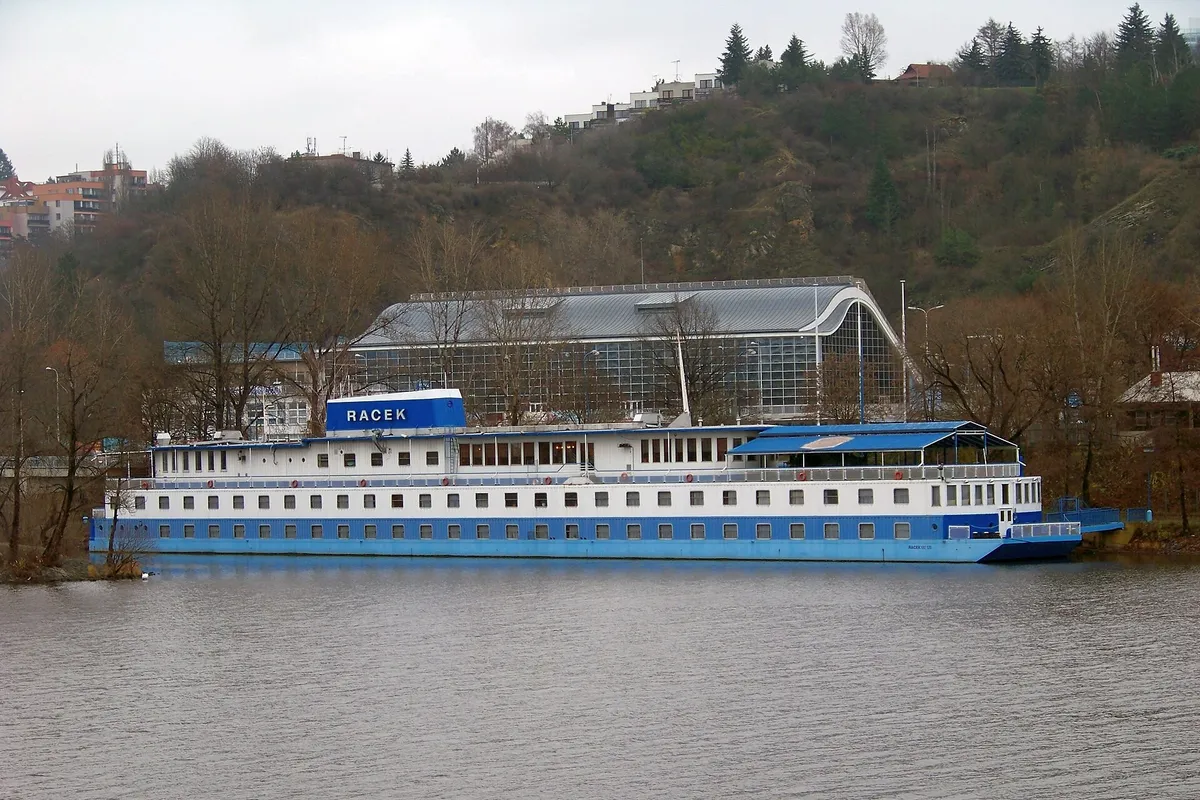
Heading south away from the dense city center brings you to Botel Racek, moored along Podolské nábřeží in Prague 4. The vessel rests in the shadow of the historic Vyšehrad Fortress rocky promontory, roughly 3.5 kilometers south of Old Town. Built between 1969 and 1971 at the Czech shipyard in Mělník, Racek is one of three historic sister ships engineered specifically as stationary floating hotels for the Vltava; its two sibling vessels are Botel Albatros near Štefánik Bridge and Botel Admirál along Hořejší nábřeží.
For decades, Racek retained its heavy, dark communist-era veneer paneling. That changed with an extensive stem-to-stern interior renovation completed in 2022, transforming its former state-era cabins into bright, Scandinavian-style rooms finished with white laminate walls, maritime navy upholstery, and blonde wood trim. As documented on the Botel Racek rooms portal, the ship offers 72 to 86 refurbished cabins.
| Cabin Category | Floor Area | Bed Configuration | Target Guest |
|---|---|---|---|
| Standard Double / Twin | 14 m² | Two twins or one double | Solo travelers, budget couples |
| Family Apartment | 24 m² | Double bed + bunk/sofa | Small families, long weekends |
Standard double and twin berths measure an efficient 14 square meters, while four-person Family Apartments provide 24 square meters of living space. Cabin rates start from approximately 1,100 CZK ($48 USD) per night during quiet winter months and rise to around 2,500 CZK ($110 USD) on peak summer weekends. This pricing positions Racek as Prague's premier budget botel, offering clean private en-suite berths at rates substantially below central brick-and-mortar hotels.
Podolí Neighborhood Dynamics, Tram 17 Transit, and Quiet Hours
The atmosphere along Podolské nábřeží is residential and relaxed, noticeably calmer than the bustling embankments of Prague 1. The botel sits across the roadway from the historic Podolská vodárna waterworks complex and just down the footpath from the massive Podolí Olympic swimming stadium. The surrounding quay is popular with local runners, cyclists, and families rather than crowds of pub-crawlers.
Botel Racek maintains a strict house policy barring stag parties, hen groups, and raucous pre-wedding gatherings. On-site staff enforce quiet hours from 22:00, and smoking or open flames are banned throughout all cabin levels under Czech inland navigation regulations. Violating this rule incurs an immediate 5,000 CZK fine alongside eviction from the property without refund.
Connecting to the historic core is straightforward. The Kublov tram stop sits roughly 300 meters away—an easy four-minute walk along the sidewalk. From Kublov, riverfront Tram Line 17 runs along the bank, delivering passengers directly to the Staroměstská transit hub in Old Town in 10 to 12 minutes without requiring a single line transfer.
Quiet Berth Selection: Ask for a cabin on the western river side of the hull. These berths look out across the broad expanse of the Vltava toward Císařská louka island, shielding you from the road noise of Podolské nábřeží.
Florentina Boat at Dvořákovo Nábřeží: The Pivot from Botel to Active River Cruising
Operational Repositioning: Why Standalone Hotel Stays Ended at Pier 7
For years, guidebooks and budget aggregators listed the Florentina Boat as a central stationary botel moored at Dvořákovo nábřeží Pier 7 in Prague 1, placed along the northern perimeter of the Josefov Jewish Quarter. From this berth, travelers enjoyed an easy walk to the Old Town Square and the Staroměstská metro station. However, travelers searching for individual room bookings here today are running into brick walls.
The vessel has undergone an operational repositioning. Operating as the active river ship *MS Florentina*, the craft is now chartered out for multi-day "Bike & Boat" river tours across the Vltava and Elbe rivers between Prague, Mělník, and Litoměřice. European tour operators including SE-Tours GmbH operate these seasonal active travel itineraries.
Booking Update: MS Florentina has discontinued regular standalone, night-by-night stationary botel reservations. Attempting to book single overnight hotel stays at Pier 7 is no longer viable; the ship serves passengers booked on multi-day cycling and cruising packages.
The boat returns to Pier 7 primarily to embark and disembark tour groups on fixed weekly turnarounds. If your goal is a standalone room on the water in central Prague, focus your search on Matylda, Racek, or other dedicated stationary moorings rather than Florentina's cruising schedule.
Riverboat Cabin Standards and Onboard Realities for Active Tour Guests
Because the 80-meter *MS Florentina* is an active cruising riverboat rather than a stationary barge, internal space is optimized for passage navigation. The ship houses between 49 and 54 twin and single air-conditioned cabins, each averaging a compact 9 to 11 square meters. En-suite bathrooms feature combined wet-cell layouts where the shower shares floor space with the marine toilet and basin.
Cabins on the main lower deck feature small, sealed picture windows or portholes positioned near the waterline that cannot be opened for safety reasons. Upper-deck cabins offer windows that open, providing fresh air while cruising. Crucially, berths are built with fixed, separate twin beds arranged parallel or perpendicular to each other; they cannot be pushed together to form a double bed due to underlying storage boxes and electrical bulkheads.
The open top sun deck is dedicated to active logistics, equipped with bike racks and charging stations for tour participants' rental bicycles. For broader context on how converted cruise hulls compare to stationary barges, check our guide to European urban botels and converted ships before booking an inland waterway holiday.
Urban Waterfront Logistics: Fares, Local Taxes, and Riverbank Safety
Prague Integrated Transport: Tram Line 17 Navigation and 2026 PID Tariffs
Public transit along the river embankment is run by Pražská integrovaná doprava (PID). Tram Line 17 serves as the primary transit spine for riverside accommodations, tracing the bank from deep in Prague 4 through New Town and Old Town before continuing north across the river. Tram Line 17 operates as a trunk route (páteřní linka), running every 4 to 5 minutes during weekday peak hours and every 8 to 10 minutes off-peak.
Under the updated PID fare structure, tickets can be purchased digitally through the official PID Lítačka mobile app or via contactless payment terminals aboard each vehicle. Buying via the PID Lítačka app provides slight discounts over paper tickets:
| Ticket Duration | Digital (PID Lítačka App) | Paper Ticket Price | Practical Best Use |
|---|---|---|---|
| 30 Minutes | 36 CZK | 39 CZK | Single run from Kublov to Staroměstská |
| 90 Minutes | 46 CZK | 50 CZK | Cross-city transit with metro line transfers |
| 24 Hours | 140 CZK | 150 CZK | Multi-stop city sightseeing days |
Inside every Prague tram car, orange contactless payment machines issue tickets on card stock with validity timestamps already printed on them. These pre-validated tickets do not need to be stamped in the yellow mechanical validator boxes; running them through a second time will invalidate the ticket and result in a transit fine.
Municipal Stay Fees, Zero-Tolerance Laws, and Late-Night Water Safety
Under Prague municipal regulations, every visitor staying in paid accommodation must pay a local tourist tax (místní poplatek z pobytu). As confirmed by the Prague City Hall portal, this fee is set at 50 CZK (approximately $2.20 USD) per person per night for guests aged 18 and older. This municipal fee is collected separately by the botel reception at check-in or check-out and cannot be bundled into prepaid third-party platform bookings.
When walking back along the embankments after an evening in town, keep Czech transport safety laws in mind. Czech traffic laws enforce a strict 0.0% blood alcohol concentration (BAC) limit with zero tolerance. This absolute zero-alcohol law applies not just to automobile drivers, but equally to operators of shared electric scooters, Segways, and bicycles along designated riverfront cycling paths like Náplavka.
Embankment Safety Warning: Paved riverside walkways along the Vltava frequently lack safety barriers or railings. Combined with damp cobblestones, slick gangway steel, and a strict 0.0% alcohol limit on personal e-scooters, walking back to your botel after dark demands careful attention.
Prague Floating Hotels Compared: Final Inspection Verdict and Alternatives
Direct Comparison Matrix: Matylda vs. Racek vs. Land-Based Competitors
Choosing between Prague's operational botels comes down to a clear trade-off: paying more for historic charm in the city center, or saving money in a quiet neighborhood with a short, direct tram commute. Understanding these practical differences prevents booking regret once you arrive at the riverbank.
| Feature / Property | Botel Matylda & Klotylda | Botel Racek | Standard Land-Based Hotel |
|---|---|---|---|
| District & Mooring | Prague 1 (Masarykovo nábřeží) | Prague 4 (Podolské nábřeží) | Varies (Prague 1 / Prague 2) |
| Nightly Price Range | 1,800 – 4,200 CZK ($80–$185) | 1,100 – 2,500 CZK ($48–$110) | 2,800 – 6,500 CZK ($120–$280) |
| Cabin Floor Space | 13 to 30 m² | 14 to 24 m² | 18 to 35 m² |
| Old Town Transit | Direct walking access (0 min) | 10–12 min via Tram Line 17 | Direct walking or metro access |
| Accessibility | Gangway steps, high bulkheads | Gangway slope, tight stairwells | Ground-level lobbies, elevators |
| Nighttime Acoustic Profile | Street trams and restaurant guests | Quiet riverbank, occasional wake lap | Double-glazed street insulation |
For visitors who need complete barrier-free accessibility or broad floor layouts, book land-based hotels nearby. Directly across the street from Matylda on Jiráskovo náměstí, the Dancing House Hotel provides elevators, step-free access, and larger rooms, as does the nearby Mosaic House Design Hotel in Nové Město.
Final Booking Decision Tree: Matching Traveler Profiles to Waterfront Properties
Sleeping on the Vltava is an appealing adventure for travelers who understand shipboard practicalities, but it can frustrate those expecting standard hotel amenities. Use this clear checklist to decide where to stay:
- Choose Botel Matylda if you want historic atmosphere, direct walking access to Old Town and Malá Strana, and you do not mind paying up to 4,200 CZK for an upper-deck terrace suite with views of Prague Castle.
- Choose Botel Racek if you are traveling on a budget (rates from 1,100 CZK), prefer calm residential nights away from bar crowds, need practical family cabins, or plan to use the Podolí swimming complex.
- Skip MS Florentina entirely for overnight stays, unless you are booking an all-inclusive, multi-day guided cycling cruise down the Vltava and Elbe river valleys.
Avoid booking any botel on the Vltava if you travel with heavy, rigid luggage you cannot lift alone, require wheelchair access, suffer from claustrophobia in compact wet-cell bathrooms, or wake easily from low-frequency engine vibrations and passing boat wakes. For a wider view on managing wake-induced movement aboard moored vessels, see our guide on motion sickness on moored floating hotels. If you pack light and appreciate maritime engineering, waking up on the Vltava provides a memorable stay that land-based hotels cannot duplicate.