 Floating Hotel
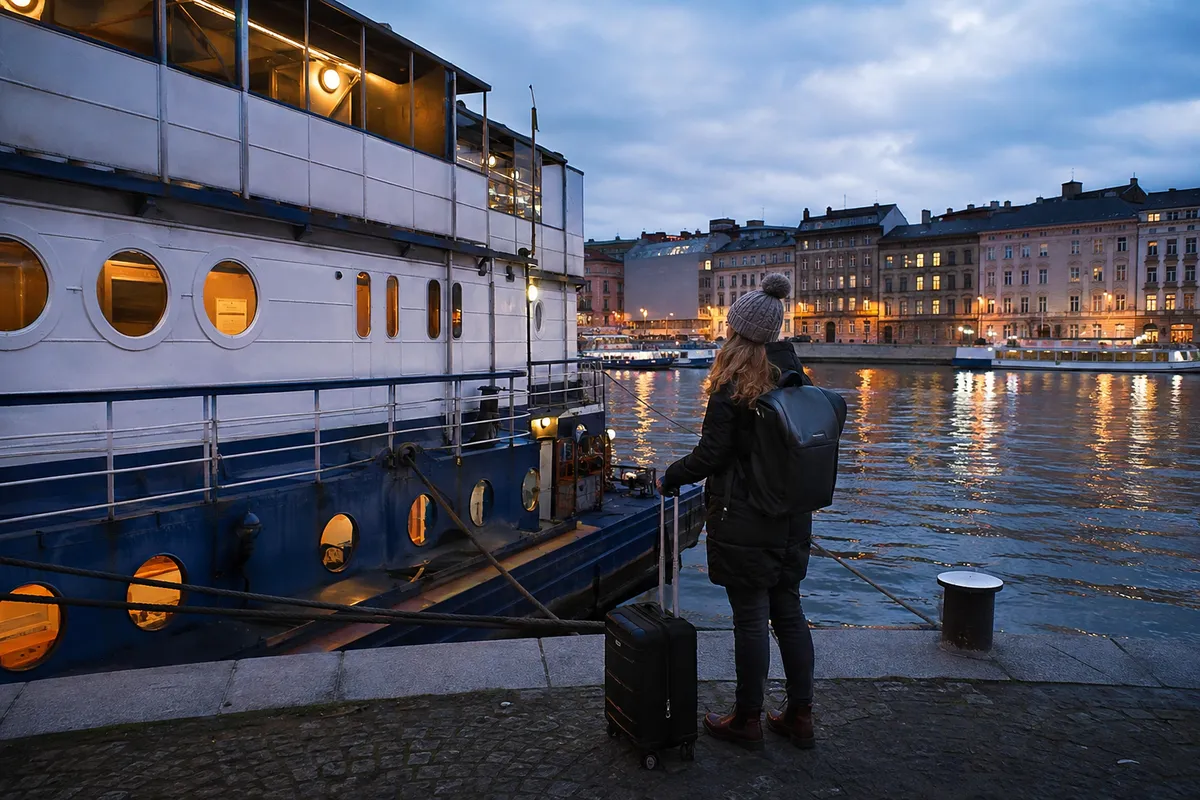
A river berth in central Prague or London often shows up on booking portals at half the price of a neighboring three-star room on land. Over twelve years and more than seventy stays on moored vessels across Europe and the Americas, I have learned that evaluating a floating hotel vs regular hotel requires stripping away romantic marketing images of misty morning water views and looking directly at the engineering, usable floor dimensions, and local municipal charges.
Moored botels and floating catamaran hotels can offer substantial savings on base room rates, but the living conditions diverge sharply from conventional brick-and-mortar hospitality. Understanding the real cost balance requires measuring the usable cabin floor, factoring in local lodging taxes, and weighing the structural trade-offs of marine plumbing and steel hulls.
Floating Hotel vs Regular Hotel: Spatial Efficiency and Price per Square Meter
Berth vs Hotel Room Footprint: The Space Trade-Off in Historic Centers
Stepping into a botel cabin immediately reveals how naval architecture dictates room dimensions. In historic European city centers, standard land hotel rooms in three-star and four-star properties typically span 18 to 25 m², providing dedicated wardrobe alcoves and clearance around double beds. By contrast, a standard botel berth offers significantly more restricted boundaries. At the historic Mälardrottningen Yacht Hotel on Stockholm's Riddarholmen, standard double cabins measure just 8 to 10 m², utilizing 90 cm bunk beds to preserve floor passage, while their economy cabins drop to 6 to 8 m².
This tight footprint alters everyday luggage management. Vintage mid-century conversions rarely possess passenger elevators, and companionway stairwells frequently measure under 80 cm in width. Carrying a standard 23 kg hard-shell suitcase down narrow bulkheads requires physical effort, and once inside, the luggage often blocks the entryway or must sit directly on the floor. On the historic converted ships I have lodged on, structural steel stiffeners and raised door sills further reduce usable walking space.
Under official French hospitality standards from Atout France, standard four-star hotel double rooms on land must provide at least 16 m² including the bathroom. Meanwhile, budget business hotels across European capitals average 18 to 24 m². When a botel cabin measures 13 to 14 m² and includes a compact wet room marine bathroom, non-structural bulkheads and service shafts shrink the net usable living area to roughly 5 to 7 m² of open space.
Calculating the True Price per Square Meter Across Key Capitals
Evaluating floating accommodations solely by the total nightly bill obscures spatial reality. A lower room rate frequently conceals a dramatically higher density per square meter. The price per square meter comparison demonstrates that botels primarily yield total cash savings rather than space-adjusted value for travelers who require open floor space.
| City & Property | Category | Cabin / Room Area | Starting Nightly Rate | Effective Rate per m² |
|---|---|---|---|---|
| Prague: Botel Albatros | 3-Star Botel | 14 m² | €60 ($65 USD) | €4.29 / m² |
| Prague: District 1 Land Hotel | 3-Star Hotel | 22 m² | €110 ($119 USD) | €5.00 / m² |
| Stockholm: Mälardrottningen | Yacht Hotel | 9 m² | €55 ($60 USD) | €6.11 / m² |
| Stockholm: Central Land Hotel | 3-Star Hotel | 20 m² | €123 ($134 USD) | €6.15 / m² |
| London: Good Hotel | Floating Hotel | 13 m² | €75 (£65 / $81 USD) | €5.77 / m² |
| London: Docklands Land Hotel | Budget Chain | 20 m² | €150 (£130 / $162 USD) | €7.50 / m² |
| Paris: OFF Paris Seine | 4-Star Catamaran | 14 m² | €145 ($157 USD) | €10.35 / m² |
| Paris: 5th Arr. Boutique Hotel | 4-Star Hotel | 17 m² | €210 ($228 USD) | €12.35 / m² |
As the calculations illustrate, the value-to-money accommodation ratio of botels lies in limiting baseline cash expenditure. In Prague, choosing a 14 m² berth yields an absolute nightly saving of roughly €50 compared to a standard land hotel room, even though the rate per square meter narrows down to €4.29 versus €5.00. Travelers prioritizing low out-of-pocket expenses benefit, but those needing generous floor area pay a comparable rate per unit of actual space.
Calculate your trip budget based on net usable floor area if you travel with multiple bags. Subtract 2.5 m² for the en-suite marine wet room and entrance vestibule to find the real floor space available for luggage and movement.
Botel Price Comparison: Amsterdam, Prague, Stockholm, and London
Central Europe Head-to-Head: Vltava River Botels in Prague vs Old Town Land Hotels
Along the Vltava River, botels represent an entrenched segment of the city's hospitality market. As detailed in our overview of Prague botels along the Vltava River, floating lodging provides an alternative to the crowded cobblestone alleys of Old Town. At Botel Albatros, standard 14 m² cabins start between €56 and €67 (approximately 1,400 to 1,700 CZK) per night, whereas three-star land hotels in the surrounding Prague 1 district average between €90 and €140 per night.
Botel Albatros completed extensive fleet renovations, retrofitting all 84 guest cabins into 1930s ocean liner Art Deco styling with integrated air conditioning while preserving its 1969 steel hull. These cabin updates improve interior climate stability, which historic vessels often struggle to maintain during midsummer heatwaves.
Acoustic reality on the river requires tempered expectations. Moored along Nábřeží Ludvíka Svobody, the vessel sits roughly 30 meters from active street tram lines, transmitting low-frequency rail rumbles through the embarkation gangways. While guests bypass the noisy late-night foot traffic of Old Town square, passing diesel excursion boats and embankment traffic generate continuous background sound.
Northern and Western Hubs: Amsterdam NDSM Wharf, Stockholm Söder Mälarstrand, and London Docks
Waterfront hubs across Northern Europe reveal stark differences in vessel placement and urban access. At Stockholm's Söder Mälarstrand, the Rygerfjord hotel ship features economy cabins starting from 556 SEK (approximately $55 USD) per night, compared to Stockholm's citywide land hotel average of $134 USD. Moored against the granite quays of Södermalm and Riddarholmen, these vessels sit within a ten-minute walk of Gamla Stan metro stations, offering solid transit access alongside basic shipboard berths.
In the Netherlands, botel price comparison Amsterdam Prague metrics highlight stark urban geography differences. Moored permanently at Pier 3 of the NDSM Wharf, Botel Amsterdam operates 175 cabins across the IJ river from the historic core. The property relies on the free municipal NDSM ferry connection Amsterdam runs directly to Amsterdam Centraal, operating every 10 to 15 minutes during daylight hours. Detailed cabin assessments appear in our Botel Amsterdam NDSM review, though night travelers must account for ferry intervals widening to 30 or 45 minutes after midnight.
In London's Royal Victoria Dock, Good Hotel London offers compact 13 m² 'Good Room' cabins starting from £55 to £75 (€64 to €85 / $70 to $95 USD). This rate undercuts nearby Docklands land hotels, which routinely exceed £130 ($170 USD). For higher-tier lodging, Sunborn London Yacht Hotel provides Executive rooms spanning 19 to 23 m² with 6 m² private balconies, with starting rates between £99 and £180 ($125 to $230 USD).
Luxury on the Water: Catamaran Floating Hotel Paris Seine vs Boutique Land Properties
At the Quai d'Austerlitz on the Seine, floating accommodation shifts toward design-led architecture. Operating as a purpose-built 4-star catamaran floating hotel Paris Seine, Hotel OFF Paris Seine features 54 guest rooms of 14 m² and four designer suites of 28 m². Nightly standard room rates range from €120 to €175 ($130 to $190 USD), positioning it below typical four-star Left Bank land boutiques that charge €200 to €300.
The catamaran footprint incurs spatial compromises compared to terrestrial regulations. Standard land-based four-star double rooms in France must measure at least 16 m² under Atout France guidelines, giving land boutiques two extra square meters of interior circulation. Furthermore, OFF Paris Seine strictly reserves its central plunge pool for resident hotel guests, prohibiting external visitors and enforcing strict pool attire rules that bar swimsuits outside the designated pool zone.
The river location introduces an urban acoustic profile that contrasts with quiet residential courtyards. Moored adjacent to the Gare d'Austerlitz rail tracks and the Pont Charles-de-Gaulle, guest cabins face regular rumbling from RER C commuter trains, elevated metro crossings, and bridge vehicular traffic that water surfaces reflect toward the cabin windows.
Bathing areas on floating boutique vessels often enforce strict guest verification. Check vessel rules beforehand, as properties like OFF Paris Seine prohibit external guests from entering the plunge deck and ban wet swimwear in public lounge areas.
The Hidden Bill: Municipal Tourist Tax Surcharges and Maritime House Penalties
Municipal Tourist Tax Surcharges and City-Specific Mooring Levies
Moored vessels do not operate in tax-exempt international waters. Guests staying aboard floating properties face the same local hospitality taxes applied to land buildings, and in port cities these fees can alter the final invoice. Municipal tourist tax surcharge structures require careful review before booking non-refundable rates on aggregator platforms.
- Amsterdam: The city imposes a 12.5% municipal tourist tax on net nightly room rates for all tourist stays, including botels and floating houseboats. Combined with the Netherlands standard 21% VAT on lodging, the cumulative tax burden on Amsterdam floating and land stays reaches approximately 33.5%.
- Paris: The municipal accommodation tax (taxe de séjour) for four-star floating hotels like OFF Paris Seine is €8.45 per adult per night, including regional transit surcharges. The maximum statutory cap of €15.93 applies exclusively to Palace-category luxury properties.
- Prague: The local municipal tourist tax is 50 CZK (approximately €2.00 / $2.20 USD) per person per night for guests aged 18 and older, collected at reception upon arrival.
Online travel agencies frequently omit municipal tourist levies from upfront headline rates, displaying them only in final payment disclaimers. When checking in at vessel reception desks, guests must settle these city fees directly via credit card before boarding cards or cabin keys are issued.
Vessel Onboard Regulations: Smoking Fines, Pet Cleaning Surcharges, and Facility Access
Maritime safety protocols establish strict operating environments aboard botels. While land hotels enforce non-smoking guidelines with administrative fees, vessels operate under harbor fire safety codes where optical smoke detectors connect directly to bridge monitoring panels. On vessels where I have inspected posted notices, violation penalties carry rapid operational consequences.
At Prague's Botel Albatros, the vessel enforces a strict ship-wide non-smoking policy with a penalty fee of 5,000 CZK (approximately $220 USD) alongside immediate cancellation of accommodation without refund. Maritime port regulations grant ship management authority to evict offending passengers immediately without recourse to dispute processes common in terrestrial lodging.
Biological and electrical restrictions remain equally strict across older hulls. Unauthorized pets brought aboard Botel Albatros trigger a mandatory €100 cleaning fine due to cabin allergy maintenance protocols. Furthermore, because older ship distribution switchboards rely on limited shore-power hookups, guest cabins routinely prohibit high-wattage personal heating equipment to prevent thermal overload on branch circuits.
Maritime Engineering Realities: Acoustic, Plumbing, and Connectivity Compromises
Compact Wet Room Marine Bathrooms and Macerator Toilet Flushing Rules
Living aboard a moored vessel requires adapting to marine sanitary engineering. Instead of gravity-fed drainage lines measuring 100 mm in diameter, botels utilize specialized marine macerating toilets equipped with electric chopper blades discharging through narrow pipework spanning just 25 to 38 mm.
Adhering to strict macerator toilet flushing rules is necessary to prevent severe equipment failure. According to marine sanitation operating standards documented by technical suppliers like Upflushers, flushing foreign materials—including wet wipes, facial tissues, tampons, cotton pads, or cooking grease—jams the rotating motor blades. An impeller jam halts the pump motor instantly, generating plumbing blockages that take branch cabins out of service until certified marine mechanics clear the system.
The compact wet room marine bathroom design also alters everyday bathing routines. In a 1.5 to 2.0 m² wet compartment, the shower spray drenching area sits directly adjacent to the toilet basin, requiring guests to use rubber squeegees to dry the composite floor. During nighttime hours, macerator pump motors generate mechanical grinding sounds reaching 60 to 75 dBA that transmit through thin interior bulkhead panels into neighboring berths.
Mooring Rope Creak Noise, Hull Motion Wake Sway, and Steel Hull Wi-Fi Attenuation
Moored hulls remain subject to hydraulic dynamics. Passing river barges, commercial ferries, and harbor patrol craft generate wake displacement that creates hull motion wake sway. In tidal locations like London's Royal Victoria Dock or river channels in Prague and Paris, changing draft levels generate distinct acoustic signatures, including sharp mooring rope creak noise and rubber fender squeaks against quay walls as lines tension.
Wireless connectivity presents another structural obstacle. Standard terrestrial hotels utilize drywall or plasterboard partitions that allow Wi-Fi signals to pass freely down corridors. Moored vessels, however, feature dense iron and steel superstructures. Marine communications engineering data demonstrates that steel bulkheads and armored deckheads introduce radio signal attenuation exceeding 50 dB.
This steel hull Wi-Fi attenuation causes lower-deck waterline cabins to function as partial Faraday cages. Handheld devices frequently lose cellular carrier connections, and centralized hallway Wi-Fi routers cannot penetrate closed steel cabin doors. Reliable high-speed data transmission generally requires modern botels to install localized wireless access points directly inside each individual compartment.
Never flush sanitary napkins, facial wipes, or trash down a marine toilet. A jammed macerator blade can shut down the bathroom drainage system for hours and result in repair charges from vessel operators.
Strategic Booking Advice: Securing Value and Overcoming Land-Link Logistics
Direct Booking vs OTAs: Securing River Views and Upper Deck Elevations
Room assignment distribution on botels differs substantially from land properties. When booking through third-party travel aggregators, reservations generally fall under unassigned "run-of-house" categories. On a ship, this allocation frequently places guests on the lowest passenger deck, where cabin portholes sit near the waterline facing concrete quay walls or floating service pontoons.
Booking directly through vessel reservation engines allows guests to choose specific deck tiers and verify orientation. Securing an unobstructed water view often incurs a river view supplement on third-party sites, but direct booking engines frequently provide clear choices between port and starboard berths.
Understanding vessel layout terminology ensures proper cabin placement before arrival. Upper deck cabins avoid the dark water-level aspect of bilge compartments, capture natural airflow during warm seasons, and keep windows clear of shore-side public pedestrian walkways.
Gangway Tidal Slope and Land-Link Logistics: Commute Friction vs Waterfront Atmosphere
Accessing a floating hotel requires crossing articulated gangway ramps that adjust with shifting water levels. Under static conditions, accessible floating dock ramps are engineered around a 1:12 slope (roughly 4.76°), aligning with standard accessibility regulations. However, seasonal river draft shifts and harbor tides alter ramp inclination.
When low tides or seasonal dry spells drop harbor levels, the gangway tidal slope can steepen beyond 15° to 20° on shorter shore ramps. Wheeling heavy luggage or maneuvering mobility equipment up these inclines requires physical exertion, and perforated steel gangway grating can catch luggage wheels or pose slip risks during wet or frosty weather.
Daily transit timing also demands realistic calculation. While the NDSM ferry connection Amsterdam operates efficient 10 to 15-minute daytime cycles, missing a late-night departure across the IJ river introduces a 30 to 45-minute delay on an open wharf. Weighing whether €40 in nightly accommodation savings justifies an hour of round-trip transit overhead is essential when booking peripheral berths.
When reserving a botel cabin, verify whether the entrance features a step-free boarding ramp or narrow companionway stairs. If traveling with heavy roll-aboard luggage, request an upper-deck cabin near the main reception desk.
Floating Accommodation Cost Analysis: Is a Botel Cheaper Than a Regular Hotel?
When a Botel Delivers Superior Value for Money
Conducting a rigorous floating accommodation cost analysis proves that moored vessels deliver strong boat hotel value for money under specific travel conditions. Solo travelers, couples carrying lightweight luggage, and short-stay visitors can save 30% to 50% compared to three-star and four-star land hotels in central Prague, Stockholm, or London Docklands.
The value proposition works best when travelers spend their days exploring the city and view the cabin primarily as an efficient sleeping berth. Botel Albatros in Prague (€56 to €67) and Rygerfjord in Stockholm (from 556 SEK / ~$55 USD) position guests in historic urban cores at price points otherwise limited to shared hostel dormitories.
The financial benefit is maximized when staying during moderate shoulder seasons, such as autumn or spring. During these months, cabin climate systems face manageable outdoor temperatures, gangway ramps remain clear of ice, and river tourist traffic subsides, reducing wake wash against the hull.
When Traditional Land Hotels Remain the Smarter Investment
Terrestrial hotels remain the superior option for travelers with specific physical, logistical, or professional requirements. The spatial constraints of an 8 to 14 m² cabin create daily friction for families needing extra floor space, while companionway stairs and shifting gangway slopes create hurdles for travelers with limited mobility or pushchairs.
Business travelers requiring stable video-conferencing connections should lean toward land properties. Standard business chain hotels, such as Premier Inn (offering 18 to 24 m² rooms) or Motel One (averaging 16 m²), provide dry-wall acoustic dampening, elevator access to all floors, and gravity-fed plumbing systems that eliminate macerator noise.
Light sleepers who react to subtle sensory shifts should also consider land-based rooms. River swells from passing commercial traffic, nocturnal mooring line friction, and close bulkhead walls can disturb sleep patterns far more than the steady street ambiance of an insulated land hotel room.
Objective Decision Matrix and Final Booking Framework
Selecting between floating and land accommodation requires aligning your physical needs, budget tolerances, and spatial expectations. Use this decision framework to match your trip profile with the appropriate lodging style:
| Traveler Profile | Primary Priority | Space Tolerance | Physical Mobility | Recommended Choice | Operational Reason |
|---|---|---|---|---|---|
| Solo City Explorer | Lowest Room Cost | Low (8–13 m² acceptable) | Full mobility; light luggage | Budget Botel | Saves 30–50% on central city accommodation with minimal room time. |
| Business Traveler | Fast Wi-Fi & Quiet Desk | High (Needs 18+ m²) | Standard | Land Business Hotel | Avoids steel hull signal attenuation and macerator pump noise. |
| Couple on Weekend Trip | Waterfront Scenery | Moderate (14–16 m²) | Full mobility; rolling bags | Upper-Deck Botel | Direct booking secures riverfront portholes without land luxury premiums. |
| Mobility-Impaired Guest | Step-Free Access | High (Needs clearance) | Wheelchair / Cane user | Accessible Land Hotel | Avoids steep gangway slopes, high door coamings, and lack of ship elevators. |
| Family with Children | Storage & Floor Space | High (Multiple bags) | Pram / Stroller transit | Land Hotel / Apartment | Botel companionways and 14 m² layouts restrict stroller and luggage movement. |
- Access Audit: Confirm whether the vessel provides step-free gangways and elevator access or relies on narrow maritime companionways.
- Deck Tier Check: Ensure your booking tier specifies an upper-deck cabin rather than an unassigned waterline cabin facing dock bulkheads.
- Plumbing Awareness: Confirm that you and your travel companions can adhere to strict macerator toilet flushing rules.
- Complete Fiscal Review: Add local municipal tourist taxes (from €2.00 in Prague to €8.45 in Paris) and national VAT (up to 21% in the Netherlands) to calculate the final invoice.
- Data Confirmation: Verify that your assigned cabin includes an in-room wireless access point to bypass steel bulkhead signal shielding.