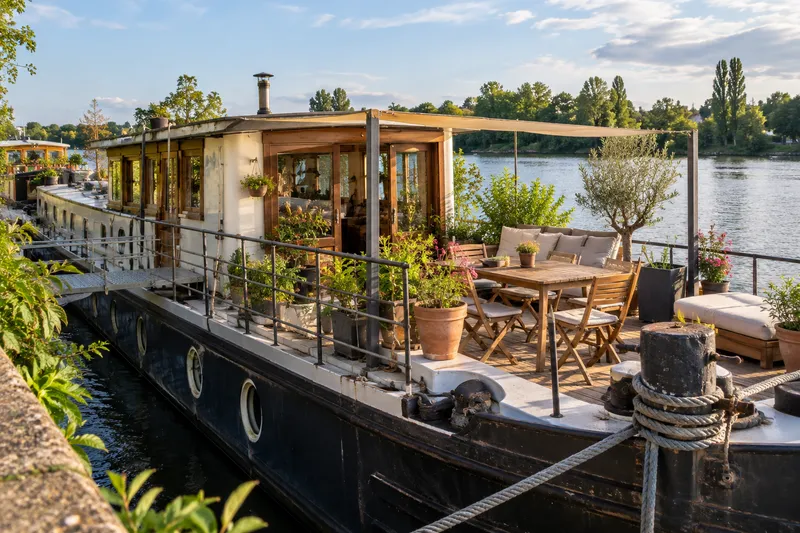
Three numbers decide whether it suits you: the 18:00 check-in cutoff, the last direct train back from Paris, and cabin floors of 9 to 20 m².
A private port in Vigneux-sur-Seine
Port Premier is a darse – a basin cut off the Seine, sheltered from the wash of the main channel, with direct access to the river. Six pontoon ramps lead down to the berths, one of them out of use; each berth has a water point and a waste-water valve, and power comes from a quay terminal with an individual meter. Four car parks with more than 95 spaces serve the port at 17, 23, 27 and 29 Rue Henri Rossignol.
The boat sits at the quiet end of a residential street, next to the regional leisure base at Port aux Cerises: 150 hectares of park with a bathing area 240 m from the mooring. The base opens at 07:00 and closes at 20:00 from October to March and at 21:00 from April to September. Paid activities there run on Wednesdays, weekends and every day during Zone C school holidays, and stop over Christmas. Barbecues are banned inside the park, which matters only because the boat has one. The town centre is 1.7 km away.
There is nothing at the pontoon itself: no shop, no bar, no reception on the quay. You arrive with what you need for the first night.
Getting to Paris and back
The walk to Vigneux-sur-Seine station is about 900 m along Rue Henri Rossignol and Avenue Henri Charon. The booking card times it at 20 minutes, which is realistic with a suitcase; without one it is 11 or 12. The route is flat.
Trains run four to six times an hour during the day and take 22 to 24 minutes to Gare de Lyon, where you can change to metro lines 1 and 14 without going outside. Take a train bound for Corbeil-Essonnes: the Melun trains use the other branch and do not stop at Vigneux. After 21:00 departures thin to every 15 to 30 minutes.
A single Metro-Train-RER ticket costs ≈ $2.8 (€2.55) at the 2026 tariff (≈ $1.4 / €1.3 reduced), up from ≈ $2.8 (€2.5) in 2025. Île-de-France Mobilités resets the fare every January, so check it before you build a daily budget. The ticket is valid for two hours and covers metro-to-train transfers as long as you stay inside the network; load it on a Navigo Easy card or a phone.
Orly is the convenient airport: metro line 14 runs to Gare de Lyon in 23 minutes. The airport ticket costs ≈ $15 (€14) (≈ $7.7 / €7 reduced), and the standard ticket is not valid to or from either airport.
The last train back
On Sundays the last train leaves Gare de Lyon for Vigneux at 00:45. Weekday evenings are less reliable. The southern branch is a regular target for track work, and when it closes the last direct train can leave as early as 22:45, with replacement buses running until about 00:20 and reaching Vigneux around 00:59. Check the RER D line status on the day rather than a printed timetable.
I cut it fine once: the 22:45 went out while I was still coming up from the metro at Gare de Lyon, and the next option was the 23:00 bus, which put me at Vigneux at 23:39. Thirty-nine minutes instead of 24 is not dramatic; the walk at that hour is the part you remember.
The cabins
Three categories are sold. The Standard Cabin on Boat is 9 m² with two single beds for two guests. The family room has a river view, a king bed and two futons, and is listed at 10 m² for three. The Double Room is 20 m² with two single beds and a futon, also for three. Those figures come from the booking card, and the family room is the one that does not add up: 10 m² for three people with luggage is optimistic.
| Room | Floor area | Beds | Sleeps |
|---|---|---|---|
| Standard Cabin on Boat | 9 m² | 2 single beds | 2 |
| Family room, river view | 10 m² | 1 king bed + 2 futons | 3 |
| Double Room | 20 m² | 2 single beds + 1 futon | 3 |
All three share one bathroom with a shower and a hairdryer, which is the bottleneck when the boat is full: three cabins can sleep eight. Every room has air conditioning, heating, a flat-screen TV, a kettle, a fridge, a microwave and kitchenware; linen and towels are provided, and there are laundry facilities. Doorways have raised sills and the companionway steps are steep. Rollaway beds are not allowed; a cot can be added on request, though a cot in a 9 m² cabin leaves little floor. The packing list for floating hotels is worth reading before you bring a hard-shell case aboard.
I booked the standard cabin for two of us with a bag each and spent the weekend stepping around them. The 20 m² double is what I would take now; it is the only category where two people can both open a suitcase.
The deck, the kitchen and the pool
Guests share a lounge, a dining area, a kitchen with a stovetop, fridge, microwave and cookware, a garden, a sun terrace and a barbecue. There is also a games room with billiards and table tennis, and luggage storage if you arrive before check-in.
The pool is outdoors and open in season only. Ask the host for this season's dates; outside summer, plan as if it is not there. The barbecue is on the boat's terrace rather than in the park next door, where it would be against the rules.
Cooking is the difference between this boat and a cheap hotel room. Breakfast and a simple dinner for two out of the shared kitchen cost less than one restaurant meal, and the fridge means one shop lasts three days.
What the boat sounds like at night
The basin does most of the work. Port Premier was dug as a darse to be out of the wash, so the long rolling that a quay mooring gets from passing freight is much reduced. You feel movement when someone comes aboard or when a loaded barge passes the mouth of the basin; it is not a night-long rock.
Each berth also has its own electricity meter and quay socket, which means no generator running beside the cabins. That removes the diesel hum that is the usual soundtrack of a moored barge.
What you do hear is the leisure base in summer and the other guests. The weak point is the shared kitchen and lounge, where a kettle at 06:30 or a conversation at the table reaches the cabins. Ask for the cabin furthest from the kitchen if you are a light sleeper, and pack earplugs.
The air conditioning copes with August and the heating takes the damp off October. Wi-Fi is free throughout the property, with no speed claim attached; on a steel hull I would test a video call in the lounge before scheduling one.
Check-in, keys and the 18:00 cutoff
Check-in runs from 15:00 to 18:00, and check-out from 08:00 to 11:00. The property is managed by a private host, and the listing says self check-in instructions are provided after booking; it also asks you to contact the host in advance if you will arrive outside the window. Port Premier has no published gate hours – you reach the pontoon with a key, and the key is the thing to arrange, not the gate.
An arrival at Charles de Gaulle at 16:30 will not get you to Vigneux in time: the airport is 35 km away, and the RER B plus metro plus RER D takes over an hour. Take an earlier flight or arrange a late handover in writing before you fly.
Rules, parking and access
The minimum age for check-in is 18. Pets are not allowed, hen and stag parties are not accepted, and rollaway beds are not provided. Children are welcome, with guests aged 18 and over counted as adults for occupancy.
Parking is the one thing to sort before you drive: there is none for guests at the boat. Booking's card says no parking available, and the four lots inside Port Premier belong to the berth holders. The nearest bookable garage is the Zenpark/Yespark space at 2 avenue Henri Charon, beside the RER station, about 900 m away; reserve it in the app before you drive down.
Access is not step-free. You cross an inclined gangway, step over a coaming and go down steep steps into the hull; wheelchairs and heavy rigid suitcases do not work here.
What a night costs
The standard cabin is the cheapest way in, from about $100 (€95); the double costs more, and summer weekends more again. The calendar on the Peniche refuge Seine listingad is the only number worth budgeting from. The rate includes linen, towels, air conditioning, Wi-Fi, the kitchen, the lounge and the games room. The taxe de séjour is charged separately.
To check the value, compare like with like. The ibis Paris Gare de Lyon Diderot, three minutes from the station, was quoting ≈ $180 (€163) for a double on Hotels.com and ≈ $180 (€168) on Booking for the night of 27–28 October; Expedia's double rate was ≈ $210 (€195). The boat's rate plus ≈ $11 (€10.2) in RER fares for two comes to ≈ $120 (€105.2). That is a saving of about $64 (€58) to ≈ $99 (€90) a night.
Time is the other half of the bill. Door to door it is 40 to 50 minutes: 12 minutes' walk, 5 to 10 minutes on the platform, 23 minutes on the train. Over four days that is six to seven hours of the trip spent in transit. For a four-day stay with one cooked meal a day, the saving is real; for a two-night trip built around dinners in Paris, the transit time eats it.
Who it suits, and who should skip it
Skip the boat if you are arriving by car, if one shared bathroom for three cabins is a deal-breaker, or if your evenings in Paris routinely end after the last direct train. Skip the family room if you are three adults with luggage: it is the tightest per-person space on board, and there is nowhere to put three bags. The double is the one to book for two people.
Skip the pool outside summer. It is seasonal, and the deck, the kitchen and the river view are what you are paying for the rest of the year.
If you want a private bathroom on the Seine, OFF Paris Seine has one in every room. If you want the same idea with a shorter commute, Chambres sur Seine Megalight2 in Sèvres and Une péniche insolite sur la Seine in Asnières both sit closer to the centre.
Book it if you want a kitchen, a deck and a bed for about $66 (€60) less than a chain hotel at Gare de Lyon, and you are prepared to plan the evening around the timetable.