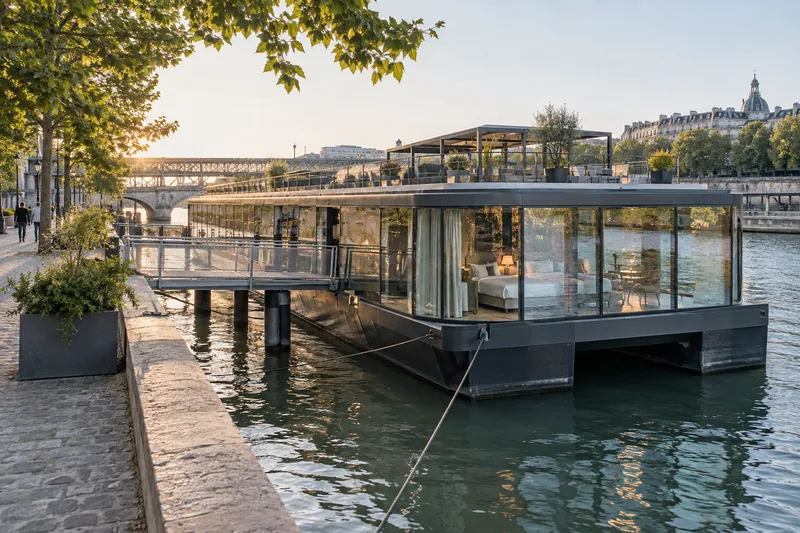
OFF Paris Seine: A Catamaran Moored to the Left Bank
The hotel floats about ten metres off the Left Bank at the foot of the Gare d'Austerlitz, held in place by its own gangways. There is no engine, no rudder and no wheelhouse. OFF Paris Seine is a building that happens to float, and almost everything a guest notices on board follows from that, from the narrow corridors to the way the floor lifts when a loaded barge pushes past.
Twelve years of reviewing floating hotels and converted barges taught me to read the hull before the décor. This one is unusually well resolved. Most of the grumbling I hear about the place traces back to the bar deck, not the boat.
What Gérard Ronzatti's Twin Hulls Do for Sleep
Naval architect Gérard Ronzatti, of the Paris firm Seine Design, drew the vessel as two parallel hulls joined by a central deck, with an interior street running between them. The published numbers are 80 metres of length, 18 metres of beam, 54 rooms of roughly 14 square metres, four suites, a dining bar seating 80, a pool and a 400-square-metre terrace on the quay. The architect's project notes on Architizer fill in the parts guests never see: prefabricated room modules built in a factory, zinc roofs, a glass roof over the central spine, a 6-metre height limit above the waterline, vacuum toilets that flush on 1.2 litres, and heat pumps that take warmth from the Seine.
Two engineering choices shape the night you get. The hulls are articulated, so the structure keeps a little of a boat's natural movement while cancelling most of the side-to-side roll a single hull would produce. And nothing is fixed to the riverbed: no pilings were driven into the Seine. The gangways do the mooring instead, as a scissor pair of bridges. At ordinary water levels you cross on the upper bridge; when the river is high, staff switch you to the lower one to keep the slope walkable. The whole structure was designed to sit through a flood the size of 1910's, when the Seine reached 8.62 metres.
Those factory-built modules are also why the rooms feel better insulated than a cabin cut into an old cargo hull: sealed boxes hold heat more predictably than a refitted hold.
OFF also offers larger rooms with adapted bathrooms. The accessible floating hotel comparison separates that room allocation from the quay approach and the route aboard.
Getting There: Quai d'Austerlitz, Two Stations and a Barrier
The mooring sits between the Pont Charles de Gaulle and the Austerlitz rail viaduct, the steel span that carries metro line 5 across the river. Gare d'Austerlitz is four to five minutes on foot (metro 5 and 10, RER C). Gare de Lyon is eight to ten minutes across the Pont Charles de Gaulle (metro 1 and 14, RER A and D). Small boats can come alongside at the hotel's own dock, and the hotel will send a shuttle if you arrange it in advance.
Road access is the awkward part. The quay in front of the gangway is closed to cars by a barrier, and the hotel's official FAQ says a drop-off at the boat needs an access code requested at least 24 hours before arrival, for a stop of a few minutes only. Without that code, taxis and ride-shares set you down at the station's drop-off area under the Viaduc d'Austerlitz, which leaves a walk down the public ramps with your bags. There is no hotel car park; the closest is Parking Indigo at the Cité de la Mode, about five minutes away.
Request the barrier code when you book, not on the day. The quay sits below street level, and that last hundred metres is fine with a backpack and unpleasant with a large hard case.
I learned that the hard way on a first visit. The driver left me at the station's taxi rank in steady November rain, and I wheeled a case down the ramp and along the quay to a gangway that was steeper than it looked in photographs. On later stays I have emailed reception the day before; the car came down to the boat and the drop-off took about two minutes.
The address is also a small gift for sightseeing. The Jardin des Plantes is a five-minute walk, the Cité de la Mode et du Design is next door, Bastille is about seventeen minutes on foot and the Accor Arena around twelve, with the cafés of the 13th and the Gare de Lyon area within easy reach. Guests planning the classical circuit should note that Notre-Dame is roughly two kilometres away and the Louvre about three.
Cabins: 54 Rooms, Four Suites, and One Decision That Matters
Before anything else, you choose a side. Both standard categories measure 14 square metres and both come with air conditioning, a safe, a flat-screen television, free Wi-Fi, a walk-in Italian shower and a hair dryer. What changes is the window.
Quay-view rooms look out on the quay walkway, the Gare d'Austerlitz and the viaduct. They are the cheapest way to sleep on the Seine, and the reason the hotel turns up in budget round-ups; they are also the reason some guests feel they paid for water and got a station forecourt. Seine-view rooms face the navigation channel, where barges, cruise boats and the river police keep a parade going from first light.
| Room | Size | View | Sleeps | Worth knowing |
|---|---|---|---|---|
| Quay-view double | 14 m² | Quay walkway, Gare d'Austerlitz, metro viaduct | 2 | Cheapest category; trains and foot traffic outside the glass |
| Seine-view double | 14 m² | River and passing craft | 2 | Book this side if the view is the reason for the trip |
| Horizon Suite (two of them) | 30 m² | River or dock, at the bow | 3 (double plus single) | Only rooms that officially take a third person; walk-in shower |
| Designer Sunset Suite | 28 m² | River | 2 | Bathtub in the bedroom; Galante and Lancman interior |
| Designer Silver Suite | 28 m² | River | 2 | Bathtub in the bedroom, mirrors and a yellow tub |
Fourteen square metres is generous for a ship's cabin and tight for a Paris four-star. Two adults with hard-shell suitcases will be opening them on the bed, and the standard-room equipment list has no wardrobe, so a soft bag and a short stay work better than a week's packing. The bathrooms are compact but proper, with a rainfall shower doing the work of the tub there is no room for.
I book the Seine view every time now. The premium buys the only thing here you cannot get elsewhere in the 13th, and a quay-view room at a winter midweek rate is the better value in the hotel if the water is not the point of the trip.
Two suites at the bow are the practical ones: 30 square metres, a double and a single bed, and the only rooms that officially sleep three, which makes them the answer for a family with a child over three. The two designer suites, Sunset and Silver, were fitted out by Maurizio Galante and Tal Lancman at 28 square metres each and both put the bathtub in the middle of the bedroom, the Silver version in bright yellow and wrapped in mirrors. Romantic for a couple; an odd layout if you want to shower in private, and priced well above the standard rooms for the privilege.
Sleeping Just Above the Water Line
The lower deck sits a hand's width above the river. The architect describes the pool's water line as merging with the Seine's and the aft terrace as a balcony built just above the water, and the effect in the lower rooms is what guests come for: ducks and drifting leaves at eye level, ripples throwing light across the ceiling in the morning, and the knock of water against the hull all night. Sortir à Paris, in its feature on the hotel, described the windows of these hull-level rooms as sitting just inches above the water.
That proximity has a cost. Excursion boats and freight barges pass close enough for people on their upper decks to look straight across at the hotel's lower windows, so the sheers do real work in daylight. Lower rooms also mean the shortest walk to the pool deck and the dock.
Space on a floating platform is dictated by buoyancy and bulkheads rather than by marketing, which I have written about in the guide to cabin sizes and layouts on floating hotels. OFF is a fair example: well planned for a boat, honest about its limits, and no substitute for a suite if you travel with a lot of luggage.
The Deck: A Narrow Heated Pool and a Bar the City Uses
The centre of the hotel is an open deck with the basin in it, and the basin is not a swimming pool in the hotel-gym sense: 10 metres by 2 metres, shallow, heated to 28 °C, reserved for guests, open to the sky in summer and covered in winter. Towels are stacked beside the water and slippers come from reception if you ask. With two metres of width, three or four people swimming already feel like traffic, and the hotel's own photographs show it half-occupied by inflatable floats.
The timetable catches first-timers. The basin closes every day from 18:00 to 23:00 while the dining bar takes over the deck, and on Saturdays and Sundays it closes again from 12:30 to 16:00 for brunch. A weekend afternoon here is brunch service with a pool as decoration; a weekday morning or a late swim after 23:00 is the version where the water is actually yours.
From 16:00, or 17:00 on Sundays, the deck and the indoor lounge become the Bar Dinatoire, open to Parisians who are not staying, serving tapas plates, cocktails, mocktails, champagne and wine by the glass. It closes at 23:30, or midnight on Fridays and Saturdays, and the hotel posts a weekly events programme. Guests heading for their cabins cross that crowd and pass the tables set around the water.
One Saturday in late summer I came back from dinner planning a swim and found the basin under cocktail tables, exactly as the schedule says it will be. I swam the next morning instead, before breakfast, with an empty deck and a barge sliding past at eye level, which was the better swim of the two.
If you want a table by the water rather than a stool at the rail, reserve it through the hotel or the bar when you check in; the poolside tables go first at weekends.
The season changes the deck more than it changes the rooms. In summer the pool is open to the sky, the quay terrace fills and the bar crowd spills outdoors; in winter the basin is covered and heated, which makes a January swim possible while the Seine runs grey beside you.
Breakfast, Brunch, and the One Item I Would Skip
Breakfast runs from 07:00 to 10:00 on weekdays and 07:00 to 11:00 at weekends, in the dining room or delivered to your room if you ask in advance. The buffet costs ≈ $26 (€24) and is open to non-guests as well, with a gluten-free version available if you flag it at booking or check-in. There is also an express formula at ≈ $11 (€10), which is one hot drink, one fruit juice and two mini pastries.
That express basket is the thing I would skip. Two viennoiseries and a coffee will not hold anyone through a morning of walking, and the ≈ $26 (€24) buffet is the meal you are actually comparing it with. The cheap version makes sense only if you are leaving before seven and eating it on the train.
The weekend brunch is the biggest fixture on the hotel's calendar: Saturday and Sunday from 12:30 to 16:00, an all-you-can-eat buffet at ≈ $57 (€52) per person, open to the public and popular enough that the hotel asks you to reserve. It is also the reason the pool disappears for the afternoon, which is worth knowing before you book a weekend in the hope of swimming.
Motion, Noise, and What a Night Really Feels Like
Two things decide whether you sleep: whether the boat moves, and what you can hear.
On movement, the hotel's own answer is the accurate one: movement stays light and becomes more noticeable when another boat passes. The twin hull and the fixed gangways mean wind alone will not roll you, and a quay in central Paris has no swell. The displacement wave from a loaded barge or a fast river launch still arrives as a short, distinct lift you feel through the mattress, and the gangway and fenders answer with a knock. I do not sleep well on any hull the first night, and here it was a barge passing before dawn that woke me, with the curtain open and quay lights striping the ceiling. Freight traffic on the Seine starts early; light sleepers should plan around that.
Noise depends on the side you book. Rooms over the deck sit above the bar, which runs to midnight on Fridays and Saturdays, and the bass carries through the floor until service ends. Quay-view rooms face the quay, the station and the Austerlitz viaduct, where metro line 5 crosses the river on steel, and the trains are audible. Seine-view rooms take engine noise and wake slap from passing craft, mostly in the morning.
My own habit is to ask for a Seine-view room towards the bow, as far from the bar deck as the plan allows, and to treat the creaks as part of the water rather than a fault. The physics of moored hulls and vibration is the same everywhere, which is why the note on river currents, vibration and sleep quality applies here as much as on any harbour pontoon. What is specific to OFF is that the loudest noise comes from the bar and the viaduct rather than from the river itself.
Rates, the Tourist Tax and the Booking Rules That Cost Money
Prices here move with demand rather than following a fixed seasonal table. On booking-site listings for a quiet midweek in November, quay-view doubles were quoted at roughly $115 to $130 a night, around $110 (€100) to ≈ $130 (€120); summer weekends and the four suites sit in a different bracket, and the hotel's own site is the place to check the dates you want. Any neat seasonal price grid you find for this property is guesswork.
The tax, by contrast, is fixed. Paris charges a four-star hotel ≈ $9.3 (€8.45) per adult per night, and the hotel's booking terms state the same amount. The figure comes from the City of Paris: a base rate of ≈ $2.9 (€2.6) for four-star accommodation in 2026, plus a 10% departmental add-on, a 15% regional add-on and a 200% Île-de-France Mobilités levy, as set out in the 2026 Paris tourist-tax scale published by Service-Public Entreprendre. Budget also for the ≈ $170 (€150) damage deposit the booking conditions take by card on arrival and release at check-out. Those two lines are the hidden part of the bill when you compare this hotel with a land one, a pattern I have set out in the piece on port taxes and extra fees on floating stays.
The rest is ordinary but worth reading before you pay. Check-in is from 16:00 and check-out by 12:00, with early check-in from 12:00 at ≈ $33 (€30) and late check-out to 15:00 at ≈ $55 (€50), both subject to availability and best requested in advance. Reception is staffed around the clock and luggage storage is free before check-in and after check-out, which matters if you have an evening train from Austerlitz. Pets are not allowed on board. Families need a plan: a cot is available for children under three, and older children mean a Horizon Suite, which sleeps three, or two connecting rooms, because no extra beds go into the standard rooms. Cancellation follows the fare you choose: free until 24 hours before arrival on a flexible rate, free until seven days on a semi-flexible one, and nothing back on the non-refundable rate.
Final Verdict: Who It Suits
OFF Paris Seine is the rare floating hotel whose engineering is better than its marketing. As a place to sleep on water in central Paris it works: the hull is stable, the walk from a mainline station is short, and a Seine-facing window gives you something no land hotel in the 13th can. Booking guests score it 8.7 out of 10 overall, with location at 9.2 and value for money as the weakest mark at 8.4, which is roughly the trade you are making: you pay for the water and the design, not for space.
Book it if you are a couple who wants a design-forward weekend on the river, you like the idea of a bar deck that outsiders come to, you arrive by train, and you would rather watch barges than traffic.
Skip it if you need a gym, a sauna or treatment rooms, since the hotel lists none of them and the basin is the whole wellness offer; if you are a family with children over three on a budget, because the standard rooms take no extra beds and the suites are the only three-person option; if you want a quiet pool on a weekend afternoon, which brunch rules out; if you are a light sleeper who cannot handle bass until midnight or a train rumble; or if you are arriving by car, with no parking and no quay access without the code.
If the point of the trip is to sail rather than to moor, the VIP Paris Yacht Hôtel across the river on the Quai de la Rapée is the only yacht-hotel in Paris that leaves the quay, with in-room jacuzzis, saunas and a dinner cruise. If you want a larger room and a lift that does not change angle with the river, a conventional Left Bank four-star will cost less and give you more floor space.
One last thing worth knowing before you book: the hotel has 58 keys in all, and only the two Horizon Suites officially sleep three, so family dates and the suites go first.