 Floating Hotel
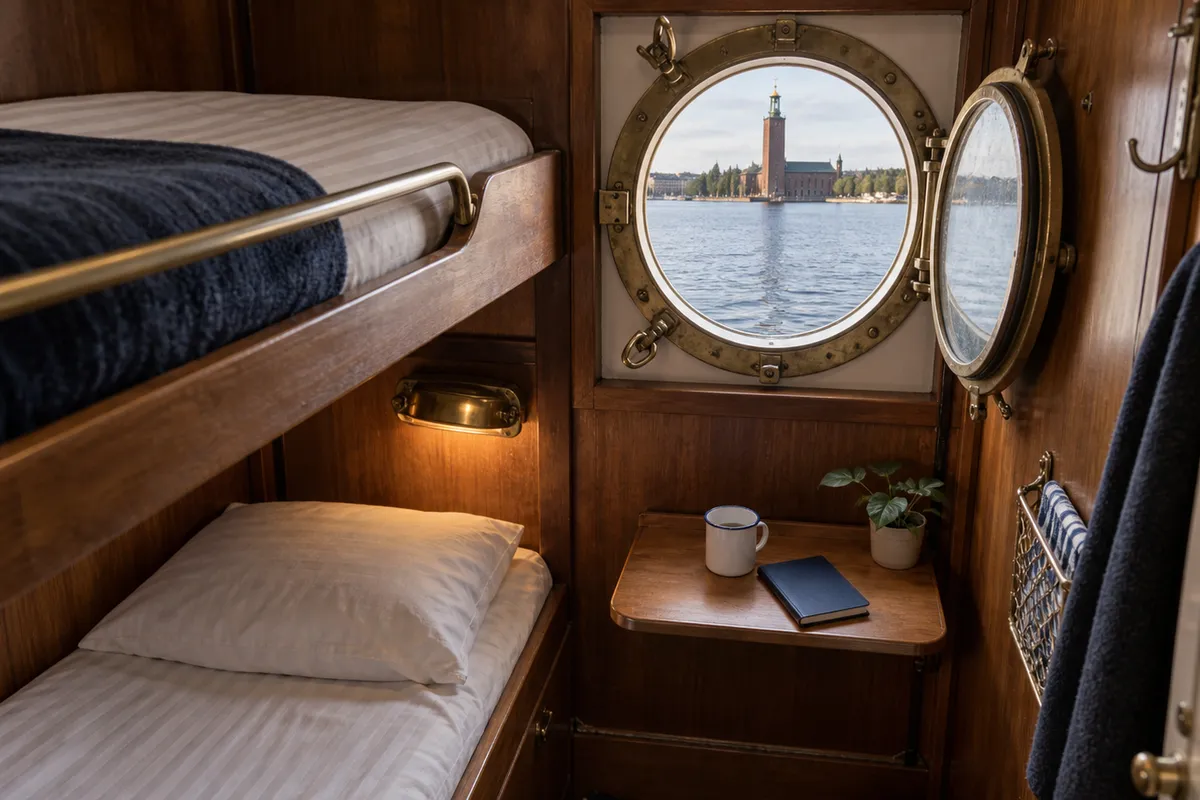
Stepping onto the gangway at Söder Mälarstrand, the first thing I noticed was the solid lack of dockside sway. In this Rygerfjord Stockholm review, I evaluate how three interconnected vintage vessels handle daily guest operations, from real bulkhead acoustics to exact cabin footprints. Moored permanently on the freshwater Riddarfjärden waterfront, this floating complex delivers direct vistas of Stockholm City Hall alongside strict maritime living constraints that every traveler should weigh before booking.
Location and Maritime Setup: A Rygerfjord Stockholm Review of Södermalm Mooring
Quayside Mooring, Historic Vessel Heritage, and Riddarfjärden Panorama
Rygerfjord Hotel & Hostel is permanently moored along the southern shore of Lake Mälaren at Söder Mälarstrand, Kajplats 12–14, with the reception desk and gangway anchored at berth 13. This prime quayside position places guests directly on the Riddarfjärden waterfront, providing an unobstructed Stockholm City Hall view across the sheltered freshwater channel. Looking out across the water at dusk, the illuminated brick tower of the Stadshus reflects directly onto the lake.
The floating property consists of three converted passenger ships linked together by fixed metal walkways: Rygerfjord I, Rygerfjord II, and Rygerfjord III. Combined, the three hulls house 90 guest cabins and accommodate up to 183 beds. The flagship vessel, Rygerfjord I, is a historic Norwegian vessel built in 1950 at the Mjellem & Karlsen shipyard in Bergen under the original name Kvinnherad. After decades of passenger service along the Norwegian fjords, it was relocated to Sweden and opened as a converted passenger ship hotel in 1995, as detailed on the Rygerfjord about page.
Unlike floating properties moored in commercial freight basins, this Lake Mälaren botel sits flush against a paved pedestrian boulevard. The ships remain tied with heavy braided mooring lines and steel shore-arms to fixed quayside bollards. For visitors exploring our wider comparative notes on Stockholm historic hotel ships, Rygerfjord represents one of the capital’s most recognizable nautical landmarks along the Södermalm embankment.
Public Transit Access: Walking Routes from Mariatorget, Gamla Stan, and Slussen
Reaching the ship by public transit is straightforward, provided you understand the topography of the Södermalm ridge. The closest metro connection is Mariatorget metro station on the Red Line (T-Bana lines 13 and 14). Taking the northern Torkel Knutssongatan exit puts you exactly 570 meters away, which takes roughly 7 minutes walking down a steady gradient. Note that this specific station exit has an escalator and stairs but lacks a street elevator; step-free lift access requires exiting at Swedenborgsgatan and navigating slightly further around the block.
For visitors traveling light, the stroll from Gamla Stan walking distance is roughly 800 meters and takes 10 minutes. The path leads across the Centralbron pedestrian bridge and directly down to the waterfront promenade, offering clear sightlines of the ships the entire way. Arriving from the eastern end of Södermalm, the Slussen transport hub sits 1.1 to 1.2 kilometers away, translating to an easy 13-minute flat walk along the paved water’s edge.
Stockholm’s regional transit system (SL) operates entirely cashless across all subways, buses, and ferries. You can validate rides via contactless EMV tap-and-go with any bank card or purchase digital single tickets through the official SL app, as outlined on the SL public transport ticketing page. A single ticket covers 75 minutes of unlimited transfers across the regional network.
| Station / Hub | Transit Line | Walking Distance | Walking Time | Accessibility Route |
|---|---|---|---|---|
| Mariatorget | Red Line (13, 14) | 570 m | 7 min | Torkel Knutssongatan exit (stairs/escalator down slope) |
| Gamla Stan | Red & Green Lines | 800 m | 10 min | Flat walk via Centralbron pedestrian walkway |
| Slussen | Metro, Bus & Ferry Hub | 1.1–1.2 km | 13 min | Paved sidewalk along Söder Mälarstrand promenade |
Arrival Logistics: Quayside Parking, Gangways, and Nearby Viewpoints
Driving to Söder Mälarstrand requires advance planning due to municipal street parking restrictions. Pay-and-display parking bays along the embankment run under municipal parking zone Taxa 3, costing approximately 200 SEK per day. Drivers must register and pay using the municipal app through Stockholm Betala P or third-party parking platforms like EasyPark and Parkster. Pay close attention to street-cleaning signs (servicedagar); parking during designated maintenance hours triggers immediate municipal fines or towing.
Boarding the vessel involves crossing raised steel gangways with non-slip mesh decking. While stable and fitted with double waist-height handrails, the gangway angle shifts slightly depending on seasonal lake water levels. Dragging heavy wheeled suitcases over the ridged entrance ramps requires some lifting effort, especially when stepping across the threshold sills into Boat 1.
Directly behind the quayside mooring rises the steep cliff of Mariaberget. Guests can ascend the wooden staircase directly opposite Kajplats 13 up to Bastugatan to access the famous Monteliusvägen cliff path. This walking trail provides an elevated vantage point over Riddarfjärden, Lake Mälaren, and the islands of Kungsholmen and Riddarholmen, reachable on foot in less than five minutes from the gangway.
Cabin Architecture and Living Quarters: What to Expect from a Boat Hotel in Södermalm, Stockholm
Economy Single and Seaside Bunk Cabins: Dimensions and Layout Realities
Booking a boat hotel in Södermalm, Stockholm means adjusting your spatial expectations to authentic mid-century maritime proportions. Standard and economy cabin footprints across Rygerfjord measure between 4 and 5 square meters (43 to 53 square feet). These rooms are compact sleeping cells designed purely for resting rather than lounging. Stepping inside, floor space is limited to a narrow corridor strip next to the berth, leaving just enough room to stand and change clothes.
The Economy Single cabin features a single mattress measuring 70 cm in width, set against the bulkhead. While narrow, the berth includes an openable porthole that pulls in fresh air from the lake. Storage consists of a short run of wall-mounted coat hooks and a mirror; there are no standing wardrobes or clothing drawers. The vertical clearance under the lower bunk provides 30 to 35 cm of space, which accommodates medium soft-sided luggage.
The Double Cabin Standard Seaside quarters located on Rygerfjord II and Rygerfjord III utilize a nautical bunk-bed configuration. The lower mattress measures 120 cm wide—suitable for an intimate couple or a solo traveler wanting extra space—while the upper bunk holds a 90 cm mattress. These rooms feature an openable porthole lake view looking out toward City Hall or the waterfront canal. Similar to the layout trade-offs we analyze in our guide to managing compact ship quarters, every piece of baggage must remain stored under the bed frame to keep the entryway clear.
| Cabin Category | Footprint | Bed Dimensions | Window Type | Bathroom Type |
|---|---|---|---|---|
| Economy Single | 4–5 m² | Single: 70 cm | Openable porthole | Shared corridor facilities |
| Double Cabin Seaside | 4–5 m² | Bunk: 120 cm lower / 90 cm upper | Openable rectangular window / porthole | Shared corridor facilities |
| Captain’s Cabin | ~10 m² | Standard double: 140–160 cm | Dual panoramic windows | Private en-suite wet room |
| Förpiken (Bow Cabin) | ~18 m² | 1 Double, 2 Bunk beds, 2 Sofa beds | Multiple forward portholes | Private en-suite bathroom |
Upgraded Cabins: The Captain’s Cabin and Multi-Bed Bow Quarters (Förpiken)
Travelers who require an en-suite private bathroom cabin or additional floor area can select from Rygerfjord’s upgraded berths. The Captain’s Cabin expands the footprint to approximately 10 square meters (107 square feet). It offers a standard double bed, an integrated writing desk, a flat-screen television, and dual windows facing the Riddarfjärden basin. Having extra walking space makes a noticeable difference during longer multiday stays.
The largest room on the property is Förpiken, situated in the bow of Rygerfjord I. This specialized bow cabin spans approximately 18 square meters and can sleep up to 6 guests. The interior features one double bed, two single bunk berths, and two convertible sofa beds. Unlike the standard cabins, Förpiken includes a dedicated split-system air conditioning unit, a wall-mounted television, an in-room security safe, and its own private en-suite bathroom.
Because Förpiken sits directly in the nose of the hull, its outward-sloping walls and low-level bow portholes sit close to the lake surface. This layout works well for families with older children or small travel groups who want to stay together without booking multiple separate corridor units. However, standard cabin restrictions on baby cribs still apply due to maritime safety rules.
Julian's Cabin Tip: If you book a Double Seaside cabin on Boat 2 or Boat 3, request an upper-deck room facing north toward Riddarfjärden. You gain the City Hall view without the foot traffic noise of guests passing along the land-facing gangway deck.
Included Amenities, Bedding Standards, and Sanitary Facilities
All cabin reservations at Rygerfjord include freshly laundered bed linen, one bath towel per guest, end-of-stay cleaning, and complimentary Wi-Fi across all three vessels. In standard economy cabins, beds are made up prior to arrival with crisp Scandinavian duvets. The complimentary Wi-Fi functions reliably in the central lounge spaces aboard Boat 1, though signal strength can drop inside lower-deck cabins surrounded by riveted steel bulkheads.
For guests in economy and standard rooms, shared corridor bathroom facilities are distributed across every accommodation deck. Each corridor section features separate lockable water closets and dedicated private shower stalls. The hotel maintains clean facilities with frequent daily cleaning cycles. Early morning waits are rare because the facilities are decentralized across the three hulls.
Private en-suite bathrooms in upgraded cabins follow typical maritime wet-room design: the shower head drains directly through a floor grate adjacent to the toilet and basin, without a segregated glass enclosure. If you are staying in a shared-bathroom cabin, packing a pair of rubber slip-on sandals and a compact hanging toiletry bag is essential for making trips along the linoleum corridor.
Acoustic, Motion, and Seasonal Comfort: Assessing Rygerfjord Cabin Noise and Lake Mälaren Stability
Bulkhead Acoustic Realities: Hallway Footfall, Engine Spaces, and Quiet Hours
Evaluating rygerfjord cabin noise lake malaren requires a frank understanding of 1950s naval construction. The ships feature vintage steel structural frames, metal bulkheads, and thin wooden interior partitions. Acoustic dampening between adjacent cabins is minimal; normal conversational tones, vibrations from dropped items, and television audio from neighboring rooms transmit easily through the walls.
Corridor foot traffic creates distinct overhead thumps and metallic clatter, particularly when guests drag wheeled bags past cabin doors or traverse the steel stairs. Heavy fire doors and brass latch mechanisms shut with a solid clank that reverberates through the living quarters. I strongly advise packing high-grade silicone or foam earplugs (rated SNR 32 or higher); they are indispensable for uninterrupted sleep.
To keep the vessels peaceful, management enforces mandatory quiet hours across all corridors and open decks between 22:00 and 06:00. Bachelor and bachelorette parties are strictly banned, and the night staff monitors common corridors to prevent disruptive socializing after hours.
Acoustic Warning: Cabins located on the main deck of Rygerfjord I sit directly adjacent to the reception desk and the primary entrance gangway. If you are sensitive to late arrivals checking in or door latches clicking at night, avoid cabins 101–108.
Lake Mälaren Water Movement, Wake Currents, and Motion Sickness Risks
A primary concern for first-time botel guests is ship roll and motion sickness. At Rygerfjord, water movement is practically imperceptible under normal conditions. Lake Mälaren is an inland freshwater basin isolated from ocean swell, and the three ships are held firmly against the quayside by taut industrial mooring lines, heavy chains, and rigid gangway brackets.
The only detectable motion occurs when public commuter ferries, such as SL Commuter Ferry Line 89 (Ekerölinjen), or commercial sightseeing boats cruise past on Riddarfjärden. Their wake causes a gentle, rhythmic bob that lasts between 15 and 30 seconds before settling. The motion feels like a faint vertical sway rather than a sideways roll, creating no noticeable nausea even for travelers prone to seasickness.
For travelers comparing this mooring with our field notes on the waterfront minimalism of Hotel CPH Living in Copenhagen, Rygerfjord feels noticeably more grounded. The weight of the three interconnected hulls acts as a natural stabilizer against surface ripples.
Seasonal Climate: Summer Porthole Airflow vs. Winter Radiator Heating
Indoor climate management changes significantly between seasons. Standard and economy cabins do not have central air conditioning units; only Förpiken features dedicated climate control. During hot summer spells in July and August, interior cabins can warm up considerably. Ventilation relies on opening your porthole or window to draw in the evening lake breeze. Keep in mind that open freshwater windows can attract occasional lake midges or mosquitoes at night, as the portholes do not have insect screens.
Winter climate performance is substantially cozier. All three vessels connect to central heating systems backed by hot-water radiator heating winter loops running along the hull baseboards. Radiators in the cabins keep the small spaces warm even when outside temperatures drop well below freezing across Stockholm.
During sub-zero winter spells, condensation can accumulate on the interior brass fittings and glass panes of exterior-facing portholes. The heavy duvets provided by the hotel provide adequate warmth, but keeping small personal items away from cold exterior steel plates prevents dampness.
Onboard Facilities and Daily Life: Dining, Self-Catering, and Guest Operations
Scandinavian Breakfast Buffet and Communal Kitchen Access
A cold Scandinavian breakfast buffet is served daily in the dining room aboard Boat 1 (Rygerfjord I). The meal costs 120 SEK ($11.50 USD) per person when booked directly at the property, though some third-party booking sites charge up to 130 SEK. Breakfast runs from 07:00 to 09:30 on weekdays and from 07:30 to 10:30 on weekends. The selection includes hard-boiled eggs, sliced cheeses, ham, crispbread, sandwich rolls, muesli, yogurt, filtered coffee, tea, and fruit juices.
In the evening, Boat 1 hosts the SQ 13 Thai Restaurant & Bar, which serves hot Thai curries and Swedish pub classics between 15:00 and 22:00, with details on the Rygerfjord restaurant page. It provides a convenient dinner option if you prefer to avoid the walk into central Södermalm on cold or rainy evenings.
For cost-conscious travelers, a standout asset is the guest self-catering kitchen located on the lower deck of Boat 3 (Rygerfjord III). This communal facility contains an electric range, microwave oven, electric kettles, a shared refrigerator, cookware, and dishwashing stations. Guests can purchase groceries at the Willys or ICA supermarkets near Mariatorget (a 10-minute walk away) and prepare their own hot meals at a fraction of local restaurant prices.
The Port Deck Terrace: Summer Panoramic Drinks in Vintage Lifeboats
During the summer season, the open top deck of Rygerfjord I transforms into The Port Deck terrace and open-air bar. Operating daily from 15:00 to 22:00 (weather permitting), the terrace offers front-row seats overlooking the Riddarfjärden waterfront and City Hall. The bar features draught Swedish lagers, bottled craft beers, ciders, and wines by the glass, averaging between 75 and 95 SEK per drink.
A unique structural detail of the terrace is its seating arrangement: several original wooden lifeboats mounted along the boat deck have been gutted, restored, and outfitted with perimeter bench seating and custom cocktail tables. Sitting inside a repurposed lifeboat while watching the evening sun set over Kungsholmen is a highlight of staying aboard.
Because the bar closes promptly at 22:00, exterior noise from the terrace does not disrupt guests sleeping below during the enforced quiet hours. During periods of rain, retractable canvas awnings provide partial overhead cover for the central seating tables.
Check-in, Luggage Storage, and House Rules on Age Restrictions
Guest check-in begins at 15:00, while check-out must be completed by 11:00 on the day of departure. The front reception desk aboard Boat 1 is staffed 24 hours a day, allowing for late-night arrivals. If you reach the property before check-in or wish to explore the city after checking out, there is a dedicated luggage storage reception area near the entrance lobby where bags can be left free of charge.
The hotel enforces strict safety and operational policies derived from maritime codes:
- Guests under 18 years of age are not permitted to stay without an accompanying parent or legal guardian.
- Baby cots and portable cribs cannot be placed in standard or economy cabins due to corridor clearance and fire safety rules.
- Extra rollaway beds cannot be added to standard cabins due to strict maritime evacuation limits.
- Smoking is strictly prohibited in all interior cabins, corridors, and bathrooms, permitted only in marked open-deck zones.
Seasonal Rates, Inclusions, and Booking a Budget Boat Stay in Stockholm
Seasonal Pricing Shifts: Low-Season Winter vs. Peak Summer Rates
Securing a budget boat stay in Stockholm requires navigating distinct seasonal rate changes. During the winter low season (running from November through March, excluding New Year’s week), base nightly rates for an Economy Single with a shared bathroom drop to roughly 550 to 650 SEK ($53 to $63 USD). Standard doubles during this off-peak window generally hover between 700 and 850 SEK ($68 to $82 USD).
During peak summer (June through August), rates rise across all categories. Private double cabins with en-suite facilities and openable lake views reach between 1,100 and 1,600 SEK ($105 to $155 USD) per night. Even with these peak rates, Rygerfjord remains 30% to 50% cheaper than traditional brick-and-mortar 3-star hotels in Gamla Stan and central Norrmalm.
For visitors interested in how water-based accommodation pricing operates across Europe, check our broader analysis in the guide to European urban botels, which contrasts Stockholm ship pricing against barge hotels in the Netherlands and France.
| Cabin Category | Low Season (Nov–Mar) | Peak Summer (Jun–Aug) | Bathroom Type |
|---|---|---|---|
| Economy Single | 550–650 SEK ($53–$63) | 850–1,050 SEK ($82–$101) | Shared corridor |
| Double Cabin Seaside | 700–850 SEK ($68–$82) | 1,100–1,350 SEK ($105–$130) | Shared corridor |
| Captain’s Cabin (Double) | 950–1,200 SEK ($92–$116) | 1,400–1,600 SEK ($135–$155) | Private en-suite |
| Förpiken (Up to 6 guests) | 1,600–2,100 SEK ($155–$203) | 2,600–3,400 SEK ($250–$328) | Private en-suite |
Booking Channels, Rate Tiers, and Flexible Cancellation Policies
Rygerfjord accepts reservations through its official website as well as major online booking portals like Booking.com, Agoda, and Hostelworld. When reserving through dedicated hostel channels like Hostelworld, standard flexible rates generally permit free cancellation up to 1 day (24 hours) prior to arrival. In contrast, direct website tariffs and mainstream hotel portals offer cancellation windows between 24 and 48 hours depending on whether you choose a non-refundable or fully flexible tier.
Reserving directly through the hotel website occasionally provides bundled breakfast discounts (120 SEK direct vs. 130 SEK on third-party aggregators). If you require specific cabin placements—such as requesting Rygerfjord II over Boat 1 to avoid lobby footfall—booking directly allows you to add specific hull preferences to your notes.
Comparative Budget Benchmark: Rygerfjord vs. Stockholm Land-Based Hostels and Hotels
When comparing Rygerfjord to mainland alternatives in Södermalm, such as STF Zinkensdamm, Mosebacke Hostel, or the neighboring hotel-ship Den Röda Båten, key differences emerge. Many Swedish mainland hostels quote a low initial bed rate but charge an additional mandatory or optional 50 to 100 SEK fee per person for bed linens and bath towels. At Rygerfjord, bed linens and towels are fully included in the base room price, eliminating that hidden arrival expense.
Compared to budget-focused micro-hotels like Motel L Hammarby Sjöstad or Scandic Go on Sankt Eriksgatan, Rygerfjord trades room volume and soundproofing for character and location. A standard Scandic Go room includes modern acoustic insulation and central AC, but costs noticeably more and lacks a waterfront setting. For similar Prague-based water comparisons, see our Botel Albatros review.
Non-Negotiable Trade-Offs and Physical Inaccessibility Constraints
Physical Barriers: Companionway Stairs, High Sills, and Inaccessibility
The historical authenticity of Rygerfjord creates significant physical hurdles for travelers with mobility limitations. The ships retain their original marine companionways: steep, narrow staircases that resemble ship ladders more than hotel stairs, fitted with polished brass handrails. Carrying a 20 kg suitcase up or down these companionways requires both hands and deliberate balance.
Throughout the corridors and deck thresholds, guests must step over raised metal door sills (coamings) measuring 15 to 25 cm in height. These watertight barriers are a standard fixture of vintage steel vessels but represent trip hazards for anyone not used to maritime architecture. There are no elevators, chairlifts, or sloped ramps on any of the three ships.
Because of these architectural realities, the botel is completely inaccessible for wheelchair users, travelers relying on walkers, or families managing large wheeled strollers. Navigating the boarding gangways and companionways requires unassisted balance and regular mobility.
Accessibility Notice: Rygerfjord Hotel & Hostel lacks elevator infrastructure and level door sills. If you have mobility impairments, knee issues, or travel with a heavy wheelchair, you must book an accessible mainland hotel.
Confined Dimensions, Storage Deficits, and In-Room Media Limits
The physical footprint of standard cabins (4–5 square meters) leaves zero surplus space. In a Double Cabin Seaside room, two adults cannot unpack simultaneously while standing. Routine tasks require coordination: one person rests on the berth while the other moves about the cabin. Travelers who experience claustrophobia will find these compact quarters challenging.
Storage is strictly minimal. There are no closets, bedside tables, or personal refrigerators in economy rooms. If you bring hard-sided suitcases thicker than 35 cm, they will not slide under the bed frame, leaving them upright in the narrow walkway and blocking the cabin door. Using collapsible duffle bags or soft backpacks is the most practical packing approach.
In-room entertainment is also sparse. Economy and Standard cabins do not contain televisions; TV sets are installed only in Förpiken, the Captain’s Cabin, and the communal guest lounge aboard Boat 1. Electrical outlets are limited to one or two wall plugs near the head of the bed, so bringing an international travel adapter with multiple USB ports is recommended.
Rygerfjord Stockholm Review Verdict: Who Should Book and Who Should Avoid
Ideal Guest Profiles: Solo Travelers, Maritime Buffs, and Romantic Budgeteers
Rygerfjord is well-suited for specific traveler profiles. Solo travelers looking for an affordable private room will appreciate the Economy Single cabins, which cost roughly the same as a dorm bed in a central hostel while providing complete personal privacy. The presence of the guest self-catering kitchen on Boat 3 makes it particularly appealing for backpackers on extended Scandinavian itineraries.
Maritime enthusiasts and history buffs will enjoy the ship’s preserved details: the 1950 Bergen shipyard plaques, exposed riveted steel bulkheads, and vintage nautical fittings. Budget-conscious couples who prioritize scenic waterfront evenings over expansive room dimensions will find the summer Port Deck terrace and the sweeping City Hall panorama well worth the tight living quarters.
Travelers Who Should Choose a Mainland Hotel Instead
Conversely, certain guests should avoid booking Rygerfjord and seek conventional land-based accommodation:
- Light sleepers: Thin steel bulkheads and echoing corridor floors transmit footfalls, talking, and closing doors directly into your room.
- Travelers with limited mobility: Steep stairs, high doorway sills, and an absence of elevators make movement across the hulls physically demanding.
- Families with toddlers: Maritime regulations prohibit baby cots in standard cabins, and companionway stairs present safety hazards for young children.
- Remote workers: Economy cabins lack work desks, ergonomic chairs, and reliable in-cabin cellular/Wi-Fi signal penetration through the steel plates.
Definitive Rating, Cost-to-Experience Balance, and Final Practical Advice
Overall, Rygerfjord Hotel & Hostel delivers solid budget utility in central Stockholm. What the botel lacks in soundproofing, floor space, and elevator access, it counters with low nightly rates, clean communal facilities, and views across the water. Paying 550 to 850 SEK for a private waterfront cabin within 10 minutes of Gamla Stan and Mariatorget represents good value in an otherwise expensive Nordic capital.
If you choose to stay aboard, aim for an upper-deck cabin on Rygerfjord II or III facing north toward the lake, pack a pair of earplugs and soft luggage, and take advantage of the self-catering kitchen. For travelers who embrace the realities of historic ship life, Rygerfjord offers a practical, atmospheric Stockholm base.