
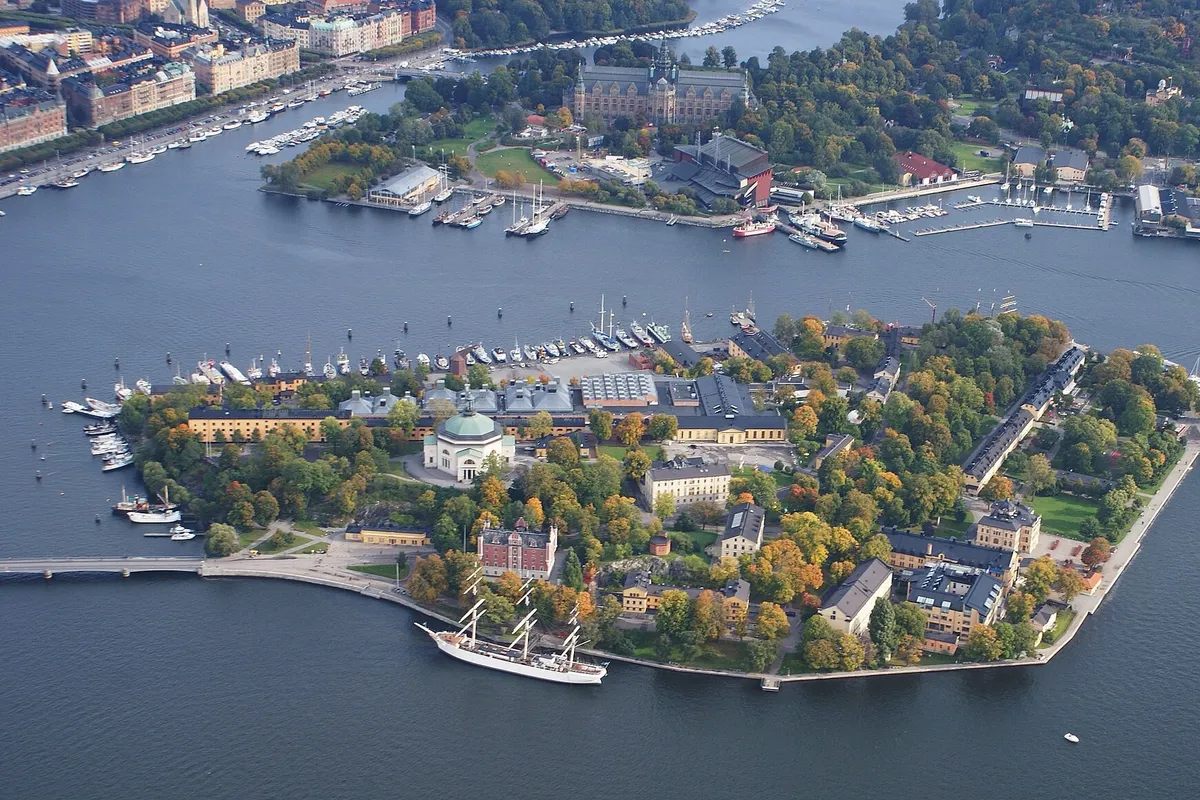
When you look across the water from Gamla Stan toward Skeppsholmen, the towering masts of a full-rigged steel windjammer dominate the skyline, leading thousands of travelers every year to search for Stockholm boat hotels. But before you plan your trip around sleeping inside that legendary iron hull, you need to know what actually happened to the city’s historic moorings: as of 2026, you cannot sleep inside the hull of af Chapman. The vessel’s cabins have ceased operations for hostel guests, meaning overnight stays booked under the hostel’s banner place you exclusively on solid ground inside the adjacent naval barracks, leaving Rygerfjord across the bay as the primary historic vessel where you still spend the night directly on the water.
Stockholm spans fourteen islands, and staying along its quays offers an immediate view of maritime traffic, granite embankments, and historic spires. However, a floating botel brings distinct physical realities that landlocked properties never face, including narrow gangways, vibrating deck plates, acoustic bleed, and tight cabin dimensions. Comparing the shoreside naval quarters beside af Chapman against the three connected hulls of Rygerfjord reveals two fundamentally different concepts of waterfront accommodation in the Swedish capital.
Historic Windjammer vs. Classic Motorship: The Landscape of Stockholm Boat Hotels
Understanding the Urban Botel: Living Heritage on Lake Mälaren and the Baltic Harbor
Stockholm’s waterfront divides naturally between the brackish currents of the Baltic archipelago and the freshwater expanse of Lake Mälaren, meeting right at Riddarfjärden. Both af Chapman and Rygerfjord are preserved vessels of maritime engineering, yet they were built for entirely different eras and waters. The full-rigged steel windjammer af Chapman was launched in 1888 as Dunboyne in Whitehaven, England, sailing global merchant routes before the Swedish Navy acquired her as a training vessel and Svenska Turistföreningen converted her into an iconic youth hostel in 1949.
By contrast, the flagship vessel of the Rygerfjord Hotel & Hostel began life in 1950 at the Mjellem & Karlsen shipyard in Bergen, Norway, serving coastal passenger routes as the motor vessel Kvinnherad. Moored permanently along Söder Mälarstrand since June 23, 1995, this diesel motorship sits in calm freshwater directly facing the red-brick facade of Stockholm City Hall (Stadshuset). While one vessel embodies the age of transatlantic sail beneath tall spars on Skeppsholmen, the other serves as a classic mid-century urban botel on the southern shore, connected by footbridges and floating pontoons.
Historic Vessel Profiles:
• af Chapman: Built 1888 in Whitehaven, England; 3 masts, full steel rig; moored in Baltic harbor waters at Skeppsholmen.
• M/S Rygerfjord: Built 1950 in Bergen, Norway (ex-Kvinnherad); diesel motorship; moored in freshwater Lake Mälaren at Söder Mälarstrand.
Critical 2026 Status Update: Where You Actually Sleep at STF Skeppsholmen and Rygerfjord
Outdated travel guides and old booking reviews still claim that reserving a bed with STF Skeppsholmen puts you inside the lower decks of af Chapman. That is no longer true. Following the vessel’s extensive dry-dock restoration at Beckholmen—where the rigging was overhauled between 2021 and 2022 and the hull and deck were restored through 2023—the City of Stockholm and Svenska Turistföreningen failed to reach an agreement on new lease terms after the city proposed a doubled rental fee. STF formally ended its 75-year tenancy of the ship, vacating the vessel entirely to avoid unsustainable losses.
In late May 2026, the City of Stockholm reopened the ship’s upper deck to the public as a seasonal pop-up café and cultural space operated by an independent third party, while the interior hull cabins remain closed to overnight hostel accommodation. Today, all overnight guests booking through STF sleep on land inside Hantverkshuset, the 19th-century naval barracks located roughly thirty meters from the gangway. If your goal is to experience sleeping on the water, only Rygerfjord and its companion hulls on Söder Mälarstrand maintain active, operational guest berths in their lower decks.
Booking with STF Stockholm Skeppsholmen reserves a room inside the shoreside masonry barracks Hantverkshuset, not aboard the sailing ship. The interior hull of af Chapman is closed for overnight stays, and its deck operates independently as a municipal seasonal venue.
STF Stockholm Skeppsholmen Review: Naval Barracks Living Beside af Chapman
The Overnight Experience: Rooms, Inclusions, and Pet Policies Inside Hantverkshuset
Lodging at STF Skeppsholmen takes place entirely inside Hantverkshuset, a sturdy 19th-century brick naval building that originally housed military workshops. The property operates with nine guest rooms ranging from multi-bed dormitory layouts to private twins and family quads. While some configurations feature shared wet facilities along the wide corridors, guests looking for total privacy can reserve Superior rooms fitted with a compact ensuite pod containing an integrated shower, toilet, and sink basin.
Unlike many bare-bones Scandinavian budget facilities, bed linen, bath towels, and end-of-stay cleaning are automatically included in every reservation, eliminating extra charges at check-in. The reception desk inside Hantverkshuset operates 24 hours a day, providing secure, staffed access for late maritime arrivals. Standard check-in starts at 15:00, and check-out is required by 11:00 on the day of departure.
Dog owners should take note of the strict property guidelines: pets are permitted exclusively in the Superior category rooms and require advance confirmation from management. The hostel charges a flat, one-time pet cleaning fee of 250 SEK per stay. Service animals are exempt, but regular pets are barred from dormitory and standard shared-bathroom quarters to maintain allergen standards.
On-Deck Access, Hull Restoration, and Communal Self-Catering
Staying at Hantverkshuset allows you to wander right past the restored black-and-white hull of af Chapman on your way out the door. The municipal maintenance at Beckholmen returned the windjammer’s towering spars and timber decks to pristine condition, making the dockside promenade along the western shore of Skeppsholmen quiet and scenic. While you do not sleep aboard, the seasonal summer deck café lets you sit beneath the rigging for an afternoon coffee while watching ferry traffic cross the harbor.
Inside the barracks, independent travelers have access to a spacious, fully equipped self-catering communal kitchen featuring commercial-grade stainless steel surfaces, multiple induction cooktops, refrigeration, and cookware. For those who prefer prepared meals, the on-site Café Skeppsholmen serves fresh Swedish pastries, light lunch plates, and a Scandinavian breakfast buffet year-round. This setup provides far more meal flexibility than typical central city hotels.
Two logistical elements catch unprepared travelers off guard. First, STF Skeppsholmen is a strictly cashless accommodation; the property accepts only Visa, Mastercard, Maestro, and American Express. Second, there is zero dedicated hotel parking on the island. Guests arriving by car must rely on public municipal parking bays along Flaggmansvägen, which charge expensive hourly street rates around the clock with strict maximum stay limitations.
Rygerfjord Hotel Ship: Navigating the Three-Vessel Complex on Söder Mälarstrand
The Three-Hull Layout: From Economy Bunks to the Captain's Cabin
Positioned at Kajplats 13 along Söder Mälarstrand, the complete network of European urban botels finds a distinctive representative in Rygerfjord. The establishment consists of three permanently moored vessels connected to the quay and to each other by narrow steel gangways. In total, the three-ship complex houses 90 cabins and 183 beds, dividing its inventory between basic bunk configurations and private quarters with en-suite bathrooms.
Vessel 1 serves as the primary flagship, containing the main reception desk, the indoor restaurant, and the upper-deck outdoor lounge. Vessel 2 is dedicated purely to sleeping cabins, while Vessel 3 holds lower-deck accommodations along with the communal guest kitchen. Economy cabins are compact, functional berths with narrow beds—frequently measuring just 120 cm wide—with a basic washbasin and shared wet facilities located down the narrow hallway.
For greater comfort, the property offers private en-suite options, most notably the Captain's Cabin and Superior Seaside doubles. These private quarters range from roughly 900 to 2,400 SEK per night depending on seasonal demand and vista orientation. When I stayed aboard in an outboard cabin, watching morning light filter through a heavy brass porthole onto Lake Mälaren made up for the narrow floor space around the bed frame.
| Cabin Category | Bed Configuration | Bathroom Type | Approximate Rate Range |
|---|---|---|---|
| Economy Shared | Single / 120 cm Bunk | Shared corridor | 450 – 650 SEK (low season) |
| Standard Twin / Double | Twin bunks or small double | Shared or private pod | 700 – 1,300 SEK |
| Superior Seaside | Standard double bed | Private ensuite | 1,100 – 1,900 SEK |
| Captain’s Cabin | Double bed + lounge area | Private ensuite | 1,400 – 2,400 SEK (peak season) |
Onboard Life: Lifeboat Sundowners, Thai-Swedish Dining, and Night Curfews
Onboard atmosphere on the flagship hull revolves around The Port Deck, an open-air summer terrace operating during the warmer months. Its most distinctive seating consists of repurposed vintage wooden lifeboats mounted to the top deck, letting guests have an evening drink directly above the waterline with an uninterrupted panorama of Stockholm City Hall across the channel. Below deck, the interior restaurant and lounge serves a mixed menu of Swedish classics and authentic Thai dishes daily from 15:00 to 22:00.
A traditional Scandinavian breakfast buffet is served daily in the dining salon, running from 07:00 to 09:30 on weekdays and from 07:30 to 10:30 on weekends. If not bundled into your initial cabin booking, the breakfast costs 120 to 130 SEK per person. Guests wishing to prepare their own food face a logistical hurdle: the self-catering guest kitchen is situated exclusively inside Boat #3. If your cabin is assigned to Boat 1 or Boat 2, retrieving milk or cooking a meal requires crossing open gangways in whatever weather the Stockholm skies produce.
Operational parameters on Rygerfjord are tighter than on land. The reception desk is manned from 15:00 until 23:00; arriving past 23:00 requires strict advance notification to arrange key pickup, with mandatory check-out set for 11:00. To preserve rest across thin maritime bulkheads, management enforces strict onboard quiet hours between 22:00 and 06:00. On the financial side, Rygerfjord accepts major cards (Visa, Mastercard, Maestro) as well as cash. Unlike STF, pets are strictly prohibited anywhere across all three hulls.
Practical Logistics: Access, Transit, and Waterfront Architecture
Arriving by Water and Metro: SL Transit Connections and Ferry Crossings
Reaching Skeppsholmen from central Stockholm is scenic when done by water. The standard SL passenger ferry Line 82 (Djurgårdsfärjan) departs regularly from Slussen, stopping at Skeppsholmen before continuing across to Djurgården. A critical detail about landing at Skeppsholmen: this is an on-demand stop. If you are waiting on the Skeppsholmen quay to board, you must turn the manual semaphore signal lever on the dock to alert the approaching captain; if you are already on board leaving Slussen, you must inform the deck crew that you wish to disembark at Skeppsholmen.
Alternatively, the SL Bus Line 65 runs from the city center straight onto the island, terminating at Östasiatiska Museet, a flat walk of roughly 100 to 150 meters from Hantverkshuset. Both public transport options use the regional contactless payment system. Tapping a contactless bank card or smartphone at the turnstile or on-board reader costs 43 SEK per adult fare, valid for 75 minutes of unlimited transfers across buses, metro lines, and Ferry 82. Note that each passenger must use their own unique physical or digital payment card, as the system does not permit multiple taps on a single card for different riders.
For Rygerfjord, the closest rapid transit link is the Mariatorget metro station on the Red Line, situated roughly 650 to 750 meters away (an 8- to 10-minute walk). However, the terrain between the Södermalm ridge and the Söder Mälarstrand waterfront is steep, requiring either navigating long sets of concrete stairs or taking a winding cobblestone descent. Gamla Stan and Slussen metro stations are approximately 900 to 1,000 meters away; while further in distance, the path follows the flat water’s edge, making it significantly easier if you are pulling wheeled bags.
Maritime Architecture Realities: Steep Companionways, Hull Moisture, and Sound Drift
Both af Chapman and the converted motorships of Rygerfjord reflect their original industrial and naval purposes rather than modern hotel accessibility codes. Gangways leading from the stone quay to the deck incline with changing harbor water levels. Inside the hulls of Rygerfjord, vertical companionway stairs replace standard domestic staircases, featuring steep risers, narrow treads, and raised watertight door coamings designed to keep flooding contained at sea.
Neither vessel complex features elevator infrastructure to the passenger cabins below the waterline. Consequently, lower-deck cabins are completely inaccessible to wheelchair users and present substantial obstacles for anyone traveling with large, rigid suitcases. Travelers who pack modular rucksacks or soft duffel bags manage these companionways far more safely than those hauling heavy 30-inch hard-shell luggage across steel thresholds, as detailed in our guide to what to pack for a floating hotel stay.
Acoustic insulation is another physical reality of genuine botels. Cabins inside steel hulls carry engine room hums, harbor wave slap against the exterior plates, and the heavy footfalls of guests walking along timber decks above. The internal partitions separating berths are lightweight bulkheads that transfer conversational noise and door latches easily. While Rygerfjord strictly polices quiet hours after 22:00, bringing high-density foam earplugs is mandatory if you are a light sleeper.
Direct Comparison: STF Skeppsholmen vs. Rygerfjord Head-to-Head
Accommodation Matrix: Rates, Booking Terms, and Guest Amenities
Choosing between these two historic waterfront properties comes down to whether you prioritize the authentic novelty of sleeping inside a floating steel hull or the comfort, space, and dependable heating of a shoreside masonry building. This side-by-side breakdown compares their exact operational terms.
| Feature / Policy | STF Stockholm Skeppsholmen | Rygerfjord Hotel & Hostel |
|---|---|---|
| Location | Skeppsholmen (Baltic inlet) | Söder Mälarstrand, Kajplats 13 (Lake Mälaren) |
| Sleeping Structure | Shoreside masonry barracks (Hantverkshuset) | Interconnected ship hulls (Boats 1, 2, & 3) |
| Capacity | 9 rooms (dorms and privates) | 90 cabins / 183 berths |
| Private En-Suite | Superior category rooms only | Captain’s Cabin, Superior Seaside doubles |
| Linens & Towels | Included in all room rates | Included in all cabin bookings |
| Guest Kitchen | Equipped kitchen in main building | Guest kitchen located only aboard Boat #3 |
| Dining Options | Café Skeppsholmen (daytime / breakfast) | Restaurant & bar (15:00–22:00), buffet 120–130 SEK |
| Front Desk Hours | 24 hours manned | 15:00 to 23:00 (lockout risk after 23:00) |
| Payment Methods | Strictly cashless (Visa, MC, Amex, Maestro) | Cards accepted; Cash accepted on arrival |
| Pet Policy | Allowed in Superior rooms only (250 SEK fee) | Pets strictly prohibited on all vessels |
| Nightly Pricing | Mid-range hostel and private room rates | 450–650 SEK (budget bunk) to 2,400 SEK (Captain’s) |
| Accessibility | Ground-floor access possible; limited steps | Not wheelchair accessible; steep companionways |
Mobility, Sensory, and Seasonal Trade-offs: Winter Freezes to Midsummer Lights
Seasonality radically changes how these two properties function. Freshwater Lake Mälaren freezes solid during colder Scandinavian winters. When temperatures plummet, the water surrounding Rygerfjord turns to ice, drawing local ice skaters onto Riddarfjärden. However, sub-zero ice causes the steel plates of lower-hull cabins to bleed cold rapidly, making the air feel crisp despite internal radiator heating, while gangways can become slick with frost.
In contrast, Hantverkshuset at Skeppsholmen benefits from thick brick masonry and municipal district heating, ensuring constant room temperatures through deep winter frosts. Come summer, the balance shifts: Rygerfjord bursts into life with its open-air rooftop bar, where patrons watch the late sunset from lifeboat benches until the 22:00 curfew. On Skeppsholmen, summer remains peaceful, with park trails and museum lawns staying relatively quiet once daytime ferry crowds depart.
The Verdict: Selecting the Right Stockholm Vessel for Your Stay
When to Book Hantverkshuset Beside af Chapman
Choose STF Skeppsholmen if you value sleep quality, reliable warmth, easy museum access, and predictable logistics over the romantic notion of sleeping on the water. Because you stay inside the brick-walled Hantverkshuset, you bypass the hull humidity, cramped companionways, and creaking bulkheads common to active botels. The location is an ideal base for culture lovers: both the Moderna Museet and the ArkDes architecture and design center are situated just 200 to 300 meters uphill on Exercisplan.
The facility is also the only viable choice of the two if you are traveling with a dog (provided you secure a Superior room in advance) or arriving on late-night flights, thanks to the 24-hour manned reception. You give up an authentic berth on the water, but you gain full-sized rooms, bundled linens, a spacious communal kitchen, and immediate access to the quiet walking paths of Skeppsholmen Island.
When to Choose the Cabins of Rygerfjord
Book a cabin aboard Rygerfjord if you insist on sleeping afloat and want a classic botel stay right in the center of Stockholm. It is tailored for budget travelers who do not mind narrow 120 cm bunks, travelers who appreciate an evening beer inside a converted lifeboat watching the lights of Stockholm City Hall, and anyone planning to spend their evenings among the restaurants, cocktail lounges, and vintage shops of Södermalm.
Just ensure you arrive before the front desk closes at 23:00, bring soft luggage that fits through narrow companionways, and pack earplugs for quiet hours. If you want a full sense of genuine maritime life on the water, booking the Captain's Cabin delivers classic porthole views of Lake Mälaren that no shoreside room can replicate.
Viable Floating Alternatives Along the Central Waterfront
If Rygerfjord is sold out or you are exploring other harbor botels across Europe to benchmark your expectations, two other historic vessels sit permanently moored around Stockholm’s core waterways:
- Den Röda Båten (The Red Boat): Located just 200 meters west along Söder Mälarstrand at Kajplats 10. This botel spans two smaller red-painted vessels offering budget cabins and sunny deck areas, functioning as a direct overflow option when Rygerfjord reaches capacity.
- Mälardrottningen Yacht Hotel: Permanently berthed at Riddarholmen, this 73-meter motor yacht was built in 1924 and once belonged to American heiress Barbara Hutton. Operating as an upscale 3-star property, it features 65 private cabins—all equipped with private ensuite bathrooms—alongside the Art Deco Brasserie Hutton and a guest sauna, making it the premier choice for travelers who demand private bathrooms and a more refined yacht pedigree.