

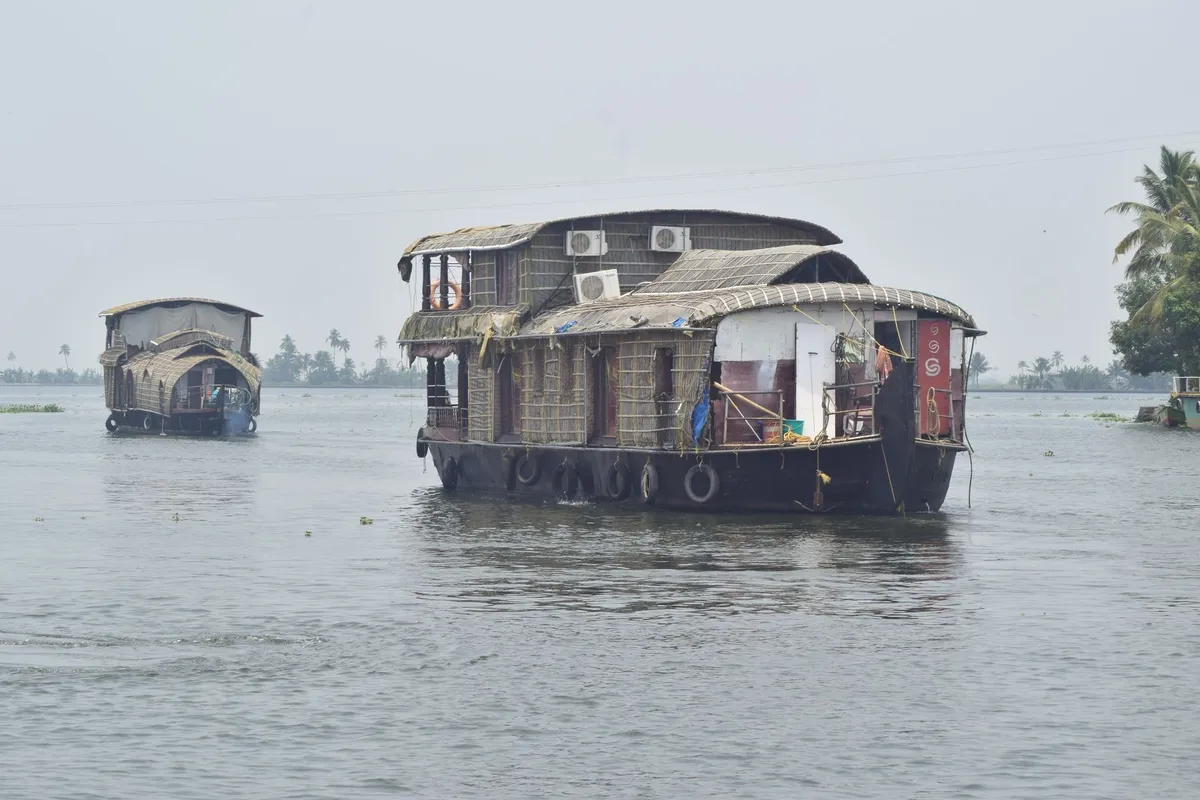
Vembanad Lake covers over two thousand square kilometers of brackish wetlands, but the commercial houseboat hub at Alleppey often feels like a floating traffic jam. Over eight hundred licensed and unlicensed vessels idle along narrow feeder canals, sending diesel fumes into the water and humming generators into the evening quiet. In this Spice Coast Cruises review, I evaluate CGH Earth's conservation-led alternative: seven handcrafted wooden barges operating out of a secluded village landing on the lake's western shore.
A night on a floating hotel reveals construction shortcuts faster than any brochure admits, from thin hull insulation to shaking generator mounts. CGH Earth built this small fleet to prove that an overnight backwater stay can exist without coating the water in petroleum slick. Assessing the trade-offs between zero-emission slow cruising and modern hotel conveniences requires looking past romantic marketing at actual cabin dimensions, electrical schedules, and regional river laws.
What Is Spice Coast Cruises? CGH Earth Kettuvallam Craft and Philosophy
Traditional Anjili Hull Construction Without Nails
Every vessel in the seven-boat fleet of Spice Coast Cruises is a repurposed or newly commissioned kettuvallam–a traditional freight barge once used to transport harvested rice and spices through the shallow wetlands of Kerala. The construction follows centuries-old naval architecture that avoids metallic fasteners entirely. Local shipwrights join thick planks of wild jackfruit wood, known locally as anjili, edge to edge using hand-twisted coir cords spun from coconut husks. The joints are caulked and sealed with a black, aromatic resin boiled from crushed cashew nut shells and sardine oil, creating a flexible, watertight hull that flexes naturally against wave actions without springing leaks.
Walking across the curved timber planks of the bow deck, I noticed the complete absence of metal screw heads and modern synthetic sealants. The superstructure resting above the cargo hold is woven entirely from split bamboo poles, woven palm fronds, and coir matting lashed over arched timber ribs. According to fleet documentation on the CGH Earth Spice Coast Cruises official page, limiting the fleet to seven boats prevents overtourism at rural moorings and preserves artisanal boatbuilding guilds that would otherwise disappear in favor of fiberglass mass production.
This design creates an open-sided living platform that breathes continuously with the outdoor climate. Because the woven bamboo canopy does not trap radiant heat the way metal roofs do, the central lounge stays noticeably cooler during midday cruising than the cabins of modern commercial vessels.
Solar Propulsion, Biofuels, and Wetland Conservation Standards
The environmental contrast between standard commercial houseboats in Kerala and these seven craft comes down to propulsion and waste containment. Most commercial houseboats in Alleppey rely on continuous diesel or kerosene outboard engines, which frequently leak unburned fuel residues directly into shallow canal beds where fish spawn. Spice Coast Cruises uses modified propulsion units powered by vegetable-oil and biofuel blends to minimize hydrocarbon discharge into the delicate aquatic biome of Vembanad Lake.
Roof-mounted solar photovoltaic panels collect energy during cruising hours to charge an onboard battery bank. This clean solar reservoir powers low-voltage daytime ventilation fans, reading lights, and navigation gear, eliminating the need to run an auxiliary generator while gliding across open water. On conventional tour boats, an auxiliary generator hums continuously just to power a galley refrigerator, drowning out waterbirds and scenting the observation deck with exhaust.
Sanitation on inland waterways requires strict technical controls, especially across fragile freshwater estuaries. Standard boats along the backwaters often bypass environmental rules, but these kettuvallams route all domestic blackwater and greywater into sealed biological containment tanks. These closed containment systems are pumped out directly into a land-based septic treatment plant at the company's private landing, preventing raw bacterial discharge into the Ramsar-protected wetland ecosystem.
Vessel inspection detail: If you want to check how cleanly an inland houseboat runs, check the water line directly below the stern exhaust pipe. On standard diesel houseboats, you will see an iridescent oil slick trailing the rudder; on biofuel-assisted solar hulls, the wake remains clear.
Boarding Logistics: Puthenangadi Jetty vs. Alleppey Punnamada Jetty
Location, Transit Times, and Road Access from Cochin and Alleppey
Spice Coast Cruises does not depart from the central docks of Alleppey. Instead, check-in and boarding take place at the private Puthenangadi jetty in the quiet village of Muhamma, positioned along the northwestern shore of Vembanad Lake. The physical road address sits roughly 16 kilometers north of the Alleppey railway station, requiring a 30 to 40-minute drive by private taxi or local auto-rickshaw through rural coastal roads lined with coconut groves.
Travelers arriving from Cochin International Airport (COK) must cover approximately 85 kilometers southbound along National Highway 66 (NH66). The journey takes between 2 and 2.5 hours depending on highway construction and township bottlenecks around Cherthala. CGH Earth arranges one-way private air-conditioned car transfers between Cochin Airport and Puthenangadi jetty for 5,500 INR (~$66 USD) per vehicle.
| Origin Point | Distance | Transit Duration | Approximate Transfer Cost | Primary Transport Mode |
|---|---|---|---|---|
| Cochin Airport (COK) | 85 km | 2 to 2.5 hours | 5,500 INR (~$66 USD) | Pre-arranged private taxi via NH66 |
| Alleppey Railway Station | 16 km | 30 to 40 mins | 600–900 INR (~$7–$11 USD) | Prepaid auto-rickshaw or local taxi |
| Kumarakom Resorts | Direct water access | 30 to 45 mins | Coordinated on booking | Private hotel motor launch crossing |
For travelers driving a personal or rental vehicle, the secure Puthenangadi base provides free private parking behind monitored gates, complete with shaded parking bays and rest facilities for drivers. The operational schedule requires strict time management: passenger embarkation runs strictly between 13:00 and 14:00, while disembarkation the following morning concludes between 07:30 and 10:00.
Why Starting at Muhamma Beats Crowded Alleppey Docks
The boarding experience at Muhamma differs completely from the noisy chaos of Alleppey's primary departure dock at Punnamada Jetty (Finishing Point). At Punnamada, hundreds of commercial houseboats tie up three to four hulls deep against concrete seawalls. Boarding there often involves dragging rolling luggage across the slippery gunwales and open living decks of competing boats while breathing in idling diesel fumes and dodging touts selling plastic souvenirs.
At Puthenangadi jetty, the company maintains a private manicured lawn and a single timber boarding pontoon exclusively reserved for its seven kettuvallams. When arriving during the midday check-in window, the boat is already tied alongside with its wooden boarding ramp secured. Because the dock sits directly on the open expanse of Vembanad Lake rather than inside narrow industrial canals, the boat casts off immediately into open water without queuing behind commercial day-trip barges or navigating around plastic trash snags.
CGH Earth also permits alternative embarkation and drop-off points along the eastern shore for guests staying at sister properties. With advance coordination during reservation, passengers can check in or disembark directly at resort jetties around Kumarakom, such as Coconut Lagoon, avoiding road transfers entirely by crossing the lake directly aboard the kettuvallam.
Strict boarding cutoff: Because the boat heads directly into open lake channels to reach rural moorings before sunset, late arrivals after 14:30 cannot be transferred to the vessel. Shore boarding access closes firmly at 14:30.
Life Onboard: Cabin Comfort, Overnight Backwater Cruise Routine, and Dining
Single vs. Double Cabin Dimensions, Safety, and Timed Air Conditioning Reality
Accommodations aboard these traditional crafts are configured into either Private Single Cabin Houseboats or Private Double Cabin Houseboats. The single-cabin vessels feature a master sleeping berth measuring roughly 100 square feet (9.3 square meters). The double-cabin kettuvallams offer two isolated sleeping quarters measuring roughly 120 square feet (11 square meters) each, separated by the central lounge. Each bedroom contains an ensuite bathroom fitted with a modern western-style flush toilet, a wash basin, and an enclosed shower with running hot water supplied by an efficient solar water heater.
Berth dimensions require realistic expectations from anyone accustomed to land-based luxury suites. Cabins are intentionally compact, designed around a raised double bed with natural coir and cotton mattresses, surrounded by hand-planed timber paneling and wide screened windows with roll-down cane blinds. Floor clearance around the bed is limited to narrow side walkways, leaving space for only one or two duffel bags; hard-shell suitcases must be stowed under the bed frame.
Under the operational guidelines detailed in the CGH Earth guest FAQ, bedroom air conditioning operates strictly from 19:00 (7:00 PM) to 07:00 (7:00 AM). During daytime cruising and afternoon tea, the cabin air conditioning remains off. The living quarters rely entirely on natural lake breezes passing through wide bamboo lattice windows and low-draw ceiling fans powered by the solar battery bank. This scheduled cooling minimizes fuel consumption and ensures the boat stays quiet during evening hours.
Safety parameters reflect the historic nature of the hull. Low wooden gunwales border the open observation deck with minimal rope railings. Families traveling with young children must maintain active vigilance. Children aged 5 and under stay free of charge when sharing existing bedding with parents, but the vessel's tight architectural footprint means extra beds or rollaway cots cannot be placed inside the cabins. If you are comparing backwater options with young travelers, read my guide to renting houseboats with children for safety advice regarding open decks and water hazards.
Culinary Journey: Full-Board Feasts Prepared by a Private Onboard Chef
Every private kettuvallam sails with a dedicated crew of three experienced mariners: a licensed navigator who steers from the forward deck, an engine driver handling lines and mechanics at the stern, and a dedicated private chef operating an enclosed galley at the rear of the vessel. This three-to-one or three-to-two crew-to-guest ratio ensures personalized service and immediate assistance throughout the voyage.
The cruise package operates on a full-board basis, starting with an authentic Keralan lunch served shortly after casting off at 13:30. Meals are served on the covered forward observation deck at an open-air teak dining table. The midday meal is served family-style on fresh banana leaves, highlighting regional harvest recipes: fragrant local red rice (matta), vegetable avial cooked in grated coconut and curd, seasonal vegetable thoran, spiced lentil sambar, and a freshly prepared portion of local lake fish spiced with crushed black pepper and turmeric.
Around 16:30, as the vessel drifts past palm-lined river bends, the chef serves freshly brewed masala chai or South Indian filter coffee alongside a plate of hot pazham pori–ripe plantain slices dipped in a light batter and fried in coconut oil. Dinner is served under soft lanterns at 20:00 after the boat anchors for the night. The centerpiece of the evening meal is authentic Karimeen Pollichathu: fresh pearl spot fish marinated in a thick paste of shallots, crushed garlic, ginger, green chilies, and curry leaves, wrapped tightly inside a wilted banana leaf and slowly pan-roasted over a griddle until tender and smoky.
Breakfast at 08:00 offers soft steamed rice hoppers (appam) paired with a mild, aromatic vegetable stew made with fresh coconut milk, alongside made-to-order eggs, seasonal tropical fruits like sweet papaya and small local bananas, and fresh juice. The galley team accommodates vegan, lactose-free, and mild-spice dietary requests when noted during the Puthenangadi check-in briefing.
Vembanad Lake Houseboat Cruise Itinerary and Village Life
Daytime Navigation, Village Visits, and Toddy Tapping
Casting off from Muhamma at 13:30, the kettuvallam sails into the wide, calm expanse of central Vembanad Lake. Unlike typical day cruises that pack into narrow channels, this route follows wide open waters along the western margins of the Kumarakom wetlands. For broad context on regional routes, rates, and seasonal conditions across Kerala, look through my detailed Kerala backwaters houseboat hotels guide.
The afternoon itinerary balances open-water cruising with intimate cultural stops along rural shores inaccessible to commercial tour buses. Around 15:00, the boat edges into a quiet canal bank to let guests step ashore with the deckhand for a short walk through a traditional coir-making settlement. Here, village women soak coconut husks in brackish pools before spinning golden fibers into heavy-duty marine ropes using manually rotated wooden wheels. These village stops are low-key and respectful, avoiding aggressive sales pitches.
The route also incorporates stops near rural waterside shrines and small palm groves where local toddy tappers work. Guests can watch tappers climb tall coconut palms using simple ankle straps to lower clay pots filled with freshly tapped sweet sap (madhura kallu). This mild, sweet sap ferments into pungent palm wine within hours, providing an authentic glimpse into everyday backwater life. As the boat returns to deeper water, you can spot egrets, cormorants, and kingfishers diving along the reeds framing the Kumarakom bird sanctuary boundary.
Mandatory Dusk Anchoring Under Kerala Inland Fisheries Regulations
By 17:30, the navigator begins scanning the shoreline for a sheltered bay. Under strict regulations set by the Kerala Inland Waterways and Fisheries authorities, all motorized houseboat cruising must stop completely by 18:00. This mandatory curfew is strictly enforced across the state to protect artisanal gillnet fishermen, who lay out extensive monofilament nets across the shallow lake beds at sunset.
Running a propeller after dusk risks cutting local fishing lines, tangling boat running gear, and destroying the night's catch. To comply with environmental rules and support local fishing communities, the crew cuts the engine before 18:00 and sets heavy anchors in designated open-water shallows, well away from commercial docks and diesel-powered party barges.
Once the anchors drop, the boat stays stationary until sunrise. The boarding ramp is pulled in, and passengers cannot leave the vessel between 14:30 and 07:00. This mandatory night anchoring cuts you off from shoreside nightlife, leaving you surrounded by the open water of the lake, distant village lanterns, and stars reflected across the dark surface.
Pre-anchoring preparation: If you need extra drinking water, specialty snacks, or personal toiletries, buy them before boarding at Muhamma. Once the kettuvallam drops anchor in open water at 18:00, there is no way to reach a shop or pharmacy until the boat returns to the dock the next morning.
Realistic Drawbacks, Noise Levels, and Digital Disconnection
Connectivity Realities: Cellular Modems, 4G Dead Zones, and Power Trade-Offs
While marketing listings often state that Wi-Fi is available on board, connectivity is limited. The houseboats do not carry satellite links or dedicated fiber lines; internet access depends entirely on small, portable 4G cellular modems running on regional Airtel or Reliance Jio SIM cards. As the vessel sails through the wide open middle of Vembanad Lake, cellular reception drops frequently. Data speeds fluctuate widely, making video conferencing, streaming, or sending large files difficult.
Spice Coast Cruises does not install televisions or multimedia systems in the cabins or lounges, following CGH Earth's focus on digital disconnection. The audio atmosphere comes from the gentle splash of water against the timber hull, the calls of evening waterfowl, and the distant hum of night crickets. Travelers needing constant digital entertainment or uninterrupted work connections will find this setup challenging.
The electrical system uses smart energy trade-offs to keep the boat quiet. Daytime electricity relies on solar batteries that run silent ceiling fans and LED lighting. The generator only runs during the permitted air conditioning hours between 19:00 and 07:00. The vessel's generator sits inside an insulated soundbox with a submerged exhaust muffler, keeping low-frequency engine rumble much quieter than on standard commercial houseboats.
Insects, Confinement, Medical Access, and Physical Accessibility
Staying on open tropical wetlands means encountering active insect life, particularly during the humid dusk window from 17:30 to 19:00. When the sun sets and the engine cuts out, lake midges, tiny river flies, and mosquitoes gather around reading lamps and unshaded bulbs on the open dining deck. The crew lights organic citronella incense and sets up herbal repellent coils, and the beds are fitted with protective mosquito nets. However, anyone sensitive to bites should pack reliable high-strength DEET or Picaridin sprays and wear loose, long-sleeved linen clothing in the evening.
The physical isolation of night anchoring also presents clear safety and mobility considerations:
- Emergency Medical Response Times: Because the kettuvallam anchors out in open lake shallows, rapid medical evacuation takes time. In an emergency, the crew must radio the Puthenangadi base to dispatch a motorized rescue skiff, which takes 40 to 60 minutes to reach the boat and transfer a patient back to shore.
- Zero Wheelchair Accessibility: Traditional kettuvallams are not accessible for travelers with limited mobility. Boarding requires walking across a narrow, hand-planed timber plank without sturdy handrails, and moving around the boat involves stepping over high, 30-centimeter wooden thresholds designed to keep water out of the cabin hulls.
- Strict Physical Confinement: Once anchored at dusk, you cannot step off the boat. Travelers who feel restless without walkable streets or access to local cafes may find twelve continuous hours aboard a small wooden craft confining.
Safety check: Before the boat leaves the jetty, ask the crew to show you the location of adult life vests and emergency fire extinguishers. For a broader look at onboard marine safety checks, read my guide to houseboat hotel safety inspection.
Pricing, Seasonal Rates, and Cancellation Rules
Rate Breakdown: Monsoon vs. Peak Winter Seasons
Pricing for Spice Coast Cruises follows clear seasonal tiers based on weather patterns and traveler demand across South India. Rates cover the entire private boat charter for approximately 21 hours, including the three-person crew, all meals and afternoon tea, guided village excursions, dockage fees, and state luxury taxes. These figures were confirmed for the 2026 operating season.
During the low monsoon season (running from May through September), a private single-cabin kettuvallam costs between 16,000 INR and 22,000 INR (~$190 to $265 USD) per night. This period brings heavy afternoon rains and cooler breezes, making it an appealing option for travelers who enjoy rainy landscapes and quiet waterways. During the peak winter season (running from October through March), rates for the same single-cabin vessel increase to between 27,500 INR and 38,000 INR (~$330 to $455 USD) per night due to dry, sunny weather and high international demand.
Families or small groups booking a private two-cabin kettuvallam for up to four adults should expect rates between 32,000 INR and 52,000 INR (~$385 to $625 USD) per night, depending on the season. While these rates sit roughly thirty to fifty percent higher than unbranded boats booked on the spot at Alleppey's public docks, the price difference pays for private docking at Muhamma, verified mechanical maintenance, and reliable culinary standards.
Booking Channels and CGH Earth Cancellation Windows
Reserving directly through the official CGH Earth central reservations platform offers the most flexible booking conditions, especially if you plan to combine your cruise with stays at nearby heritage properties like Coconut Lagoon in Kumarakom or Marari Beach Resort in Mararikulam. Third-party travel platforms often carry smaller room allocations and charge higher non-refundable deposits for peak winter dates.
According to the official CGH Earth booking terms and conditions, cancellation policies are applied in clear tiers based on the season:
- Summer and Monsoon Season (May to September): You can cancel without penalty up to 14 days before your scheduled check-in date. Cancellations made inside 14 days incur a 100% cancellation charge.
- Standard High Season (October to April, excluding holiday peaks): Penalty-free cancellations are permitted up to 30 days before arrival. Cancellations made inside this 30-day window forfeit the full reservation deposit.
- Peak Holiday Period (December 20 to January 10): All bookings are fully non-refundable, and reservations must be confirmed at least 45 days in advance with full payment.
Final Verdict: Who Should Book Spice Coast Cruises and Who Should Skip It?
Who It Is Ideal For: Nature Purists, Couples, and Slow-Travel Seekers
Spice Coast Cruises is built for travelers who value traditional naval craftsmanship, natural materials, and quiet waterways over standardized luxury amenities. If the idea of drifting down palm-fringed channels without the smell of diesel exhaust appeals to you, this operation provides an authentic, low-impact way to experience Vembanad Lake. It is particularly well-suited for couples, birdwatchers, and eco-conscious travelers looking for a calm backwater journey.
The culinary experience is another strong reason to book. Having a dedicated chef prepare traditional Keralan recipes to your taste right on board outclasses the buffet dining found on larger commercial tour vessels. If you appreciate the craft of hand-stitched wooden boats, quiet night moorings, and watching lake life unfold from an open wicker lounge chair, this cruise offers genuine value.
Who Should Skip It and Practical Backwater Alternatives
Travelers who require 24-hour daytime air conditioning, powerful Wi-Fi for remote work, and television entertainment should look elsewhere. The midday heat inside a traditional bamboo canopy can feel intense during humid summer afternoons, and scheduled overnight cooling may frustrate guests expecting standard resort-style climate control. Families with very active toddlers or individuals with limited mobility should also reconsider due to open gunwales, narrow boarding planks, and steep cabin thresholds.
If Spice Coast Cruises does not match your travel plans or budget, several practical alternatives are available:
- Budget Day Excursions: The Kerala State Water Transport Department (SWTD) runs regular public commuter ferries connecting Alleppey and Kottayam. Tickets cost between 15 INR and 50 INR per passenger, offering an authentic, inexpensive view of backwater life alongside daily commuters.
- Short Private Day Cruises: For travelers short on time or seeking lower costs, local two-to-four-hour wooden shikara boat rentals cost roughly 600 INR to 1,000 INR per hour from Alleppey or Kumarakom, navigating narrow village canals that larger houseboats cannot enter.
- Land-Based Luxury Resorts: If you want constant air conditioning, deep soaking tubs, and swimming pools with views across the water, book a cottage at Coconut Lagoon or Kumarakom Lake Resort. You can then arrange a simple two-hour sunset cruise without sleeping aboard a boat.