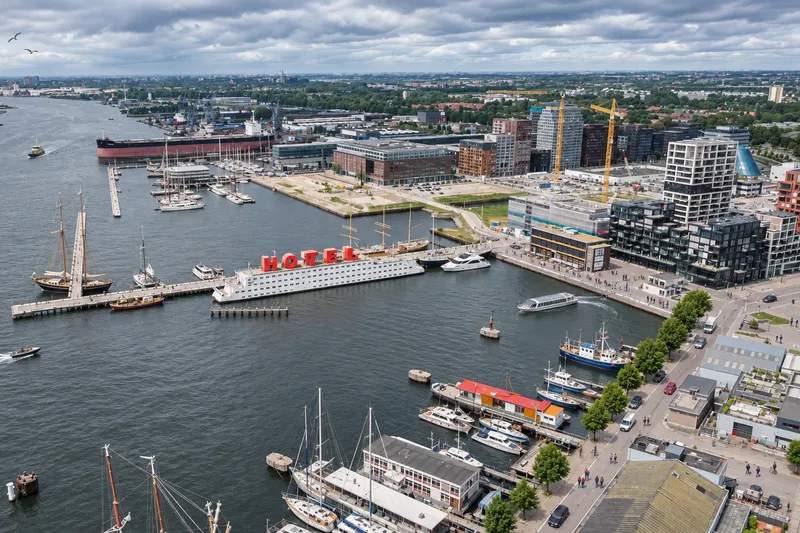
Six Amsterdam properties anchor this comparison: Botel Amsterdam, AmicitiA, Hotelboot Zwaan, Hotel Asile Flottant, Houseboat Little Amstel and Lightship Amsterdam. Between them they cover an en-suite botel cabin, a budget boat with shared bathrooms, a winter-only hotel boat, a whole historic ship, a studio and a converted lightship. Other botels exist; these six are the ones I can describe cabin by cabin.
What Decides the Stay
Start with the door. A botel cabin closes on a bed, a bathroom and a corridor shared with strangers. A studio closes on its own entrance and bathroom, even when the boat carries a second studio. A whole ship closes on the hull. That difference decides how a group sleeps, how often you meet other guests, and whether a late night feels private.
Then the berth. Oosterdok puts NEMO and Centraal within a walk. NDSM puts you across the IJ, a short ferry ride from Centraal. De Ceuvel, where Asile Flottant sits, is a former shipyard in Noord with a jetty, a café and a five-minute bike ride to the centre. The Amstel mooring at Little Amstel is different again: a residential river with a busy bridge beside the boat.
What the Bill Actually Contains
Since 1 January 2026 the Dutch VAT rate on short-stay accommodation is 21%, up from 9%. It covers hotels, pensions, holiday homes and boat cabins. A private landlord letting a furnished flat outside tourist accommodation can fall under different rules. Amsterdam's tourist tax is separate and stays at 12.5% of the net room price in 2026.
Breakfast is the line that moves most between the six. Botel Amsterdam charges ≈ $13 (€12) per person for its buffet, served 07:00–10:30, and some rates fold it in. AmicitiA includes a Dutch breakfast of cheese, bread, sweet pastries and hot drinks in the bar. Zwaan includes breakfast. Asile Flottant has no breakfast room, Little Amstel's studios have a fridge and tea/coffee, and Lightship includes breakfast and the minibar. Those differences are worth more than the few euros that separate two headline rates.
A ≈ $110 (€100) net cabin becomes ≈ $130 (€121) with VAT and ≈ $150 (€133.5) with the 12.5% tourist tax on the net room. A ≈ $110 (€100) quote that already includes VAT contains ≈ $91 (€82.64) of net room, so the tourist tax on it is ≈ $11 (€10.33), not ≈ $14 (€12.5). Compare the two and the same cabin can look ≈ $25 (€23) cheaper or ≈ $25 (€23) dearer without a single rate changing.
Two breakfasts at Botel add ≈ $26 (€24) a day, which turns a small headline gap to AmicitiA into a much larger one once the included breakfast is counted. On a three-night stay the breakfast line alone is ≈ $79 (€72).
Arriving by car adds another line to the comparison. For Little Amstel, AMSTEL HouseBoats lists a secured garage space at ≈ $55 (€50) per day or part-day, requiring advance reservation and a handover of physical keys. Confirm the parking period and total alongside your room quote rather than treating a central river berth as including parking.
Floating Hotel Types in Amsterdam
Three formats, three different purchases. A botel sells a cabin inside a floating hotel, with a reception, a breakfast room and a corridor. A houseboat hotel or studio sells a self-contained unit, sometimes with its own front door on the water. A historic ship or lightship sells either a named vessel or a suite inside one.
'Botel' tells you the building floats, not what is in the room. Botel Amsterdam's cabins all have their own bathroom and toilet, and the cheapest are small enough that the bathroom doubles as the place you dry off. AmicitiA's cabins are about 3 m² with a hand basin, and the showers are shared down the corridor. Both call themselves botels, and the gap between them is wider than the gap between some botels and some houseboats.
Privacy sorts the rest. A private cabin is your room, possibly with a shared bathroom and corridor. A studio is your entrance and bathroom attached to a larger boat. A whole ship or large suite is the vessel, or a suite big enough to act as one. Little Amstel's Studio A and B are compact, each with its own entrance and en-suite; the boat is two studios, not a house. Asile Flottant is the other end: six named ships, each with a private sundeck, sleeping up to six.
Bathroom details decide more mornings than the view. A 15 m² studio with the shower inside the count is a compact room; a 25 m² ship cabin with a bathroom down a companionway is a different kind of compact. At Asile the smallest ship, Anneliese, is 25 m² for two with a bathtub facing the engine room; the largest, Holland VII, is 80 m² for six. Those numbers move together with the guest count, which is why square metres per person is the figure to compare.
Photographs are the worst guide to a cabin. A wide-angle shot from the doorway makes 15 m² look like a suite; the give-away is the bed-to-wall gap and whether the bathroom door opens inward. The category name and bed count are more reliable than the room name, and on a ship the vessel name matters because the smallest and largest boats at Asile share one booking page.
The view is not a category you can rely on. At Botel, cabins face the NDSM harbour or the IJ; at Lightship, the terrace faces the water and the industrial bank; at Asile, the sundeck is the view. If the view is the reason for the trip, the named unit matters more than the property.
The Six Properties at a Glance
Every row uses the same basis: a November date, one unit, one night, before VAT and tourist tax.
| Property | Unit | Guide from, November, per unit/night, before VAT and tourist tax | Main trade-off |
|---|---|---|---|
| Botel Amsterdam | Cabin | ≈ $100 (€95) | Ferry commute; compact bathroom |
| AmicitiA | Cabin | ≈ $77 (€70) | Shared bathroom; tight cabin |
| Hotelboot Zwaan | Cabin (2–3) | ≈ $110 (€100) | October–March only |
| Hotel Asile Flottant | Whole ship (2–6) | ≈ $180 (€165) | Bond and deposit; De Ceuvel |
| Houseboat Little Amstel | Studio (max 2) | ≈ $200 (€180) | Compact; max two |
| Lightship Amsterdam | Suite (2) | ≈ $390 (€350) | Two units only |
Amsterdam Botel Stays: Cabins, Berths and Commutes
The lift, the bar and the pool table are Botel Amsterdam's answer to a ferry commute at NDSM-pier 3. All 175 cabins have a private bathroom and toilet, but 'small but fully equipped' is the honest description, and reviews mention the bathroom before the view. The deluxe double gets extra windows and a queen bed; the quad packs four bunks into a double's footprint. On my last stay the cabin was warm before I found the thermostat, and the ferry's engine was a low note through the closed window.
Three square metres is the whole cabin at AmicitiA: a bed, a hand basin at the foot of it, and just enough floor for one bag. The showers are shared down the corridor, with a hairdryer, and the Dutch breakfast is included in the bar. Wi-Fi is in the common areas, so the cabin is not a workspace. The boat sits opposite NEMO at Oosterdok steiger 3, about a kilometre from Centraal. The cabin I had was barely wider than the bed; NEMO's copper roof filled the window.
Winter is the only season Zwaan sells. From early October to the end of March it runs as a hotel at Oosterdok; from April to September the same boat runs bike-and-barge cruises, so a summer booking does not exist. Six cabins, each with its own hot shower and toilet, are sold as two- or three-person rooms, and breakfast is included. The covered roof terrace is the shared space, and the cabins are compact enough that the bed count is a better guide than a square-metre figure.
Berths, Seasons and Door-to-Door Time
Where the boat sits shapes the day more than the cabin. Oosterdok is the walkable cluster, with several boats within a short walk of Centraal. NDSM is the ferry cluster. De Ceuvel is the quiet one, and the Amstel is the residential one. Noise follows the same pattern: the F4's engine at NDSM, the street behind Oosterdok, the bridge at Little Amstel, and the café crowd at De Ceuvel. Ferry wash reaches the NDSM hull; Oosterdok is enclosed and calmer; the Amstel gets the tour boats.
Door-to-door means the mooring address, not the neighbourhood. The F4 from Centraal to NDSM runs every 15 minutes and takes about ten minutes; the return trip adds the walk and the wait before every city outing. The free GVB ferry across the IJ is part of the public transport network, and the 9292 journey planner is the way to check a specific address on a specific date.
Luggage is the other physical test. A pier, a gangway and a companionway are three different surfaces, and a large case is fine on the first and awkward on the third. A lift helps; on the historic ships, a bag you can carry is easier than a wheeled one.
If you need step-free access, check the route to the actual studio before booking. The published walking directions from both Weesperplein and the tram stop to Little Amstel include stairs down from street level. AMSTEL HouseBoats also describes Studio A's entrance as opening directly from a floating terrace. Ask whether an alternative approach meets your needs; these directions do not establish a step-free route.
At NDSM the ferry leaves you about 250 m from Botel's gangway. With a wheeled case that is five minutes of flat pier; with a sleeping child and two bags it is longer, and you do it twice a day.
Houseboat Hotels: Privacy, Space and Limits
Renting a whole boat fixes something a cabin cannot: the group stays together, the bathroom count is yours, and nobody is on the other side of a thin bulkhead. In Amsterdam you can buy that in two sizes – a full historic ship, or a studio that happens to float.
A whole ship also changes the work. There is no reception or breakfast room; you are living in someone's vessel, with a galley, a deck and a set of house rules. Asile's ships have private sundecks and living space, which is the point; they also have steel hulls that hold the cold and companionways that are steep after a long dinner. That is the difference between a hotel cabin and a boat you call yours for a few nights.
House rules matter more on a boat than in a hotel: shoes off below deck, nothing extra down the toilet, no parties on the jetty, and a bilge alarm you should recognise. A blocked pump is the one problem that turns a boat stay into a service call.
Six historic ships sit at Korte Papaverweg 2 on De Ceuvel, sleeping two to six, each with a private sundeck. Anneliese is the romantic one, 25 m² for two with a bathtub facing the engine room; Holland VII is the big one, 80 m² for six; De La Soul has a red velvet cinema, and UK85 has two separate bedrooms for a family. There is no breakfast room, so the guide is a self-catering rate, and the ≈ $220 (€200) refundable bond plus 50% deposit is the cash-flow catch. The jetty is a five-minute bike ride from the centre; the ride into town is a bike or a bus.
Two studios, 15 m² each, sit on the Amstel at Amsteldijk 700 with their own entrances and en-suite bathrooms, maximum two guests. The door opens with an app, check-in is from 14:00 and check-out by 10:30, and there is a fridge and tea/coffee instead of a breakfast room. Guests mention the bridge next to the boat and the vibration from heavier vehicles, which is the honest trade for a central river mooring. I stayed in one of the two studios and watched a tour boat push a wash against the hull; the water glass moved, then the boat settled. Earplugs stayed in the drawer.
Little Amstel also requires a security deposit. AMSTEL HouseBoats specifies a ≈ $170 (€150) credit-card authorisation per studio, rather than an immediate payment, and says admission requires a digital receipt confirming it. Allow that amount in your available card limit as well as the accommodation bill.
The 1952 British lightship on the Johan van Hasseltkanaal holds two glass suites of 60 and 65 m², each with a private bathroom, its own entrance and a terrace at the bow. Breakfast and the minibar are included, Wi-Fi is free, and cooking is not possible. The walk from the Buiksloterweg ferry is about 1.4 km, which is a bike ride or a bus; with two units, availability decides more than price.
Space, Occupancy and the Cost of Privacy
Privacy has a price beyond the nightly rate, and it usually arrives as cash flow. A bond is not a fee, but it is a hold; on a five-night stay it can tie up more cash than the room rate itself. A bond can be charged or pre-authorised, and the release date depends on the operator's inspection; that difference decides how much of your budget is available on the trip.
Check cancellation terms before committing to a whole ship. Hotel Asile Flottant publishes cancellation charges of 1% for cancellations at least 60 days before arrival, 50% between 60 and 30 days, and the full reservation price at 30 days or less. A booking made inside that final window therefore carries a potential loss of the entire stay price, not just the booking deposit.
Occupancy is where quotes go wrong. A base rate built for two adults, a child who counts toward the maximum, and a fourth bed that is a sofa rather than a bunk all change the total. On a ship the square metres are split between cabins and living space, so the per-person figure matters more than the total; on a botel, a quad packs more beds into a double's footprint. At Asile the ships take 2–6 guests, and the largest and smallest are priced for different groups.
Family-friendly does not mean the waterfront can be left unsupervised. AMSTEL HouseBoats explicitly requires parental supervision at all times because its accommodation is on the water. Before choosing a studio for an adult and child, ask about the terrace edge and the route between the entrance and shore.
Seasonal Prices and Alternatives
When the Rates Move
Those guide rates are low-season figures. Amsterdam's quiet months run from November through February, with a bump around the holidays; tulip season from late March to mid-May fills the cheap cabins first. Zwaan disappears from April to September because the boat goes cruising, so its guide is a winter rate with no summer equivalent. Botel Amsterdam, AmicitiA, Asile Flottant, Little Amstel and Lightship run year-round, which means their November guide is the floor rather than the whole story.
The taxes do not move with the season; only the room rate does. The cheapest rows – AmicitiA and Botel – are the ones that sell out first when the tulips bring the first big wave. If your dates are fixed to that window, book the cabin before the flight.
Winter has its own logic. Zwaan's covered roof terrace keeps the shared space usable in rain; Little Amstel's heating is strong enough that a winter guest review mentions being warm once the controls were understood; Asile's steel hulls and living rooms give you space to dry wet coats. Daylight is the other cost: by late November the sun is gone before five, and a boat's windows are dark by the time you come back from dinner.
Oosterdok and Amstel Alternatives
If the six are full, Oosterdok has more depth than any other mooring in the city. Anna Maria II at Oosterdok 51 is a small budget boat with 11 cabins; Hotelschip Gandalf at Oosterdok 2 has 10 simple cabins and a 15-minute walk to Centraal; Botel Elodie at Oosterdok steiger 5 has eight air-conditioned rooms with private bathrooms. All three put NEMO, the library and Centraal within a walk, and all three trade space for location.
The Amstel is thinner. Little Amstel's two studios are the short-stay exception on a river of private houseboats, so availability decides; if both are gone, the practical fallback is back at Oosterdok. The view from the studio window is why people book it; the thin availability is the reason to have a second choice ready.
Botel or Houseboat: The Decision
A two-night first visit and a family week pull in opposite directions.
| Scenario | Book | Why | Catch |
|---|---|---|---|
| Two nights, first visit | Botel Amsterdam | En-suite cabin, lift, short ferry | Ferry twice a day; compact bathroom |
| Two nights, budget | AmicitiA | Cheapest cabin here, central Oosterdok | Tight cabin; shared shower |
| Family or group of 4–6 | Asile Flottant | Whole ship, private sundeck, living space | Bond and deposit; De Ceuvel |
| Winter city break | Hotelboot Zwaan | Seasonal boat with private facilities | Winter only; booking window |
| Couple, privacy | Little Amstel | Studio with own entrance and bathroom | Max two; compact |
| Special occasion | Lightship Amsterdam | Glass suite, two units | Books out early |
For a short trip with a private room, Botel Amsterdam; for a family or group, one of Asile Flottant's ships.