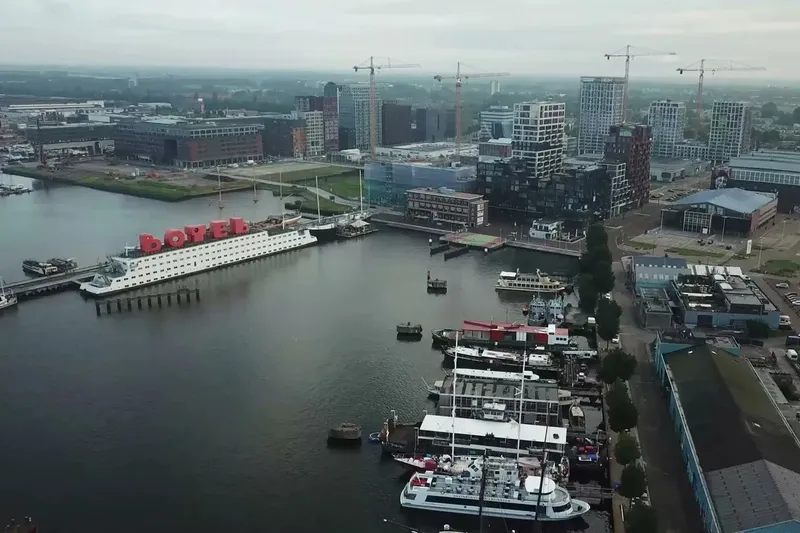
My Amsterdam floating hotel guide starts with the berth, not the romance of the hull. For a first-time botel stay in Amsterdam, I would take a short, flat walk over a prettier ship that leaves me dependent on a ferry timetable.
An Amsterdam floating hotel guide to hulls, bathrooms and harbour geography
What I compared–and what I left out
I only compared accommodation in Amsterdam, not similarly named botels in Prague or hotel ships elsewhere. I chose seven stationary stays that show the main trade-offs: central Oosterdok barges, ferry-connected NDSM, a winter hotel boat, and two higher-priced options with much more private space.
My main criteria were the last-mile route, bathroom privacy, boarding difficulty, likely noise, and the full cost rather than the teaser rate. A ship being old is neither an automatic advantage nor a flaw. The useful question is whether its conversion works for sleeping, washing, and getting your bag inside without a small wrestling match.
Many budget botels began as Dutch freight barges, or vrachtschepen. Their steel cargo holds create curved walls, limited headroom in places, narrow doors, and no lift. A private wet room gives you privacy but not necessarily elbow room; a shared bathroom usually means a corridor trip and more dependence on your neighbours’ schedules.
- Find out whether the cabin has a private toilet and shower or shared corridor facilities.
- Look for cabin floor area, bed layout, headroom, and ventilation–not just wide-angle photographs.
- Expect stairs or a gangway, and ask for step-free access if you need it.
- Get a dated price showing VAT, Amsterdam tourist tax, deposits, and payment terms.
Oosterdok, NDSM and De Ceuvel: three different arrivals
Oosterdok is the easy first-timer option. Its numbered piers, including Oosterdok Steiger 2 and Steiger 3, sit roughly 10–15 minutes on foot from Amsterdam Centraal, depending on the ship. You can walk from the station with no ticket, no ferry queue, and no awkward late-night connection.
The catch is that a waterfront address does not always mean an obvious entrance. A public quay can lead to a gated private steiger, and two ships may share nearly identical directions. I would save the vessel name, pier number, gate instructions, and phone number offline rather than relying on a map pin alone. The wider choices are covered in the guide to Amsterdam harbour basin stays.
NDSM Wharf sits across the IJ in Amsterdam Noord. Botel Amsterdam is about 250 metres from the ferry pontoon, so the boat-to-bed part is simple; the ferry is the part you have to plan. De Ceuvel, home to Hotel Asile Flottant at Korte Papaverweg 2, is also in Noord but has a very different arrival through a former industrial site rather than a central hotel quay.
For any of these areas, 9292 is useful for the full route rather than just the transit leg. It will not tell you which unmarked gate squeaks or which pontoon looks closed, but it will stop you optimistically walking toward the wrong stretch of water.
Comparing Amsterdam botels from Oosterdok barges to Noord suites
The practical comparison table
The from-prices below are planning references, not live quotes for particular 2026 dates. I use them only to place the properties in rough budget bands. Your checkout total can look quite different after 21% accommodation VAT, Amsterdam’s 12.5% tourist tax, and any deposit.
The biggest dividing line is not old versus new. It is whether you want a cheap berth within walking distance of Centraal, or more privacy and space in exchange for a longer arrival and a higher bill. On a short city break, I would pay for location before paying for nautical character.
| Name | City | Type | From-price reference | Main advantage | Main drawback |
|---|---|---|---|---|---|
| Botel Amsterdam | Amsterdam | Botel and rooftop letter suites | ≈ $100 (€95) | NDSM location about 250 metres from the free ferry | Ferry dependence and a busier large-ship feel |
| Hotel Asile Flottant | Amsterdam | Heritage converted houseboats | ≈ $180 (€165) | Six restored historic ships with individual layouts | ≈ $220 (€200) deposit, credit-card requirement, and a less central arrival |
| Hotelboot Zwaan | Amsterdam | Seasonal botel | ≈ $110 (€100) | Private hot shower and toilet in every cabin | Amsterdam hotel season runs only from early October to late March |
| Lightship Amsterdam | Amsterdam | Converted lightship | ≈ $390 (€350) | Two large suites of 60 and 65 m² | High price and only two suites |
| AmicitiA | Amsterdam | Historic freight barge botel | ≈ $77 (€70) | Oosterdok berth facing NEMO | Compact vintage cabins and shared bathrooms |
| Vita Nova | Amsterdam | Botel | ≈ $72 (€65) | About 1.0 km, or 12–15 minutes, from Centraal | Shared facilities and limited sound separation |
| MPS Holland | Amsterdam | Stationary botel | ≈ $83 (€75) | Oosterdok berth about 900 metres from Centraal | Compact cabins and narrow internal passages |
Noord, seasonal and higher-space profiles
Botel Amsterdam suits a trip built around NDSM as much as one built around the old centre. The free ferry makes Centraal reachable without buying transit tickets, but returning late still needs thought. I would choose it for the location and onboard choice of cabins, not for a secluded-ship fantasy.
Hotel Asile Flottant is the more interesting pick if individual restoration matters more than a standard hotel corridor. Its six ships at De Ceuvel have distinct layouts, so room choice matters. The financial side is less relaxed: a ≈ $220 (€200) damage deposit, photo ID and a credit card at check-in, and staged payment terms.
Hotelboot Zwaan is stationed in Amsterdam from early October until late March and works on the water as a touring vessel in the other part of the year. Its eight cabins each have a private hot shower and toilet, a real advantage over the budget Oosterdok barges. Payment is cash on arrival, credit cards are not accepted, and there is a ≈ $22 (€20) room or entrance-key deposit.
Lightship Amsterdam occupies a converted 1952 British lightvessel and contains just two suites, measuring 60 and 65 m². That is a completely different proposition from a bunk cabin: separate space, privacy, and no shared corridor bathroom. If all you need is a bed between museum visits, though, I do not think the premium earns its keep.
The three Oosterdok budget profiles
AmicitiA is an 1897 freight barge moored at Oosterdok Steiger 3, facing NEMO. Its appeal is the combination of a low entry band and a walkable berth, not cabin spaciousness. Shared corridor bathrooms and a vintage bunk layout are part of the deal, so I would book it as an atmospheric budget base rather than a small conventional hotel room.
Vita Nova is at Oosterdok Steiger 2, about 1.0 km or 12–15 minutes from Centraal. That walk is the feature I would value most after a late train arrival. Shared facilities and limited acoustic separation between cabins make it a better fit for heavy sleepers who pack earplugs than for anyone expecting hotel-grade silence.
MPS Holland sits at Steiger 3, roughly 900 metres or 10–12 minutes from Centraal. It has the same basic bargain: a sheltered central berth in exchange for compact cabins and narrow passages. If a private bathroom is non-negotiable, skip this cluster and use the comparison of Amsterdam botels with private bathrooms.
How I compared motion, noise and boarding
Water movement, hull noise and winter damp
I judged comfort by berth exposure first. Oosterdok is an enclosed inner basin and is generally the calmer option. NDSM faces the working IJ, where wind and passing ferries or commercial vessels can produce more movement; most of the time it is a gentle reminder that you are afloat, not a fairground ride.
Noise deserves more attention than motion. Steel carries footsteps, doors can thud through a deck, and water tapping against a hull sounds much closer at night than it did during check-in. Mooring lines may creak as the boat shifts. On an old barge, a talking neighbour can be more annoying than the water itself.
Temperature and moisture also change the experience. Heating may come from electric convectors or the ship’s own heating system rather than building-style climate control. When a cold steel hull meets a warm cabin, condensation can collect around portholes and cold wall sections, especially in cool weather. A slightly stuffy cabin is easier to fix than a damp one, so ventilation matters.
I would pack earplugs even in a sheltered basin. For a cool-season stay, favour a cabin with controllable heat and ventilation over one with decorative portholes but no useful airflow; the seasonal issues are covered in the guide to Amsterdam winter botel stays.
Gangways, companionways, bags, sockets and Wi-Fi
Boarding equipment is where glossy photographs become unhelpful. A hinged gangway can change its slope with water levels, while a vintage companionway may feel closer to a ladder than a household staircase. Go down facing the steps, keep both hands free, and use both rails. Carrying coffee while doing this is not a charming maritime ritual.
A soft duffel is easier to lift, bend, and stash than a rigid spinner suitcase. Large hard cases are awkward on narrow stairs and can consume much of the usable floor once opened. I would rather make two light trips than pretend one oversized case will magically fit through a barge doorway.
Inside, look at outlet placement rather than assuming there will be one beside the bed. A high-draw hair dryer can also trip a limited onboard circuit, so the ship’s equipment is the safer option. Wi-Fi has its own steel problem: a good signal in the salon says little about a cabin behind several metal bulkheads.
For a one- or two-night stay, bring a small soft bag and leave the main luggage elsewhere if your route allows it. The convenience gain is larger than upgrading from one compact historic cabin to another.
Harbour navigation, free ferries and pier etiquette
Using the IJ ferries without getting stranded
GVB’s F1–F7 ferries across the IJ are free for pedestrians and cyclists. There is no ticket to buy and no tap-in barrier; you walk or roll on. The network is part of the city transport system, and GVB’s IJ ferry ticket rules explain which crossings are covered.
For NDSM, F4 runs between Centraal Station and NDSM-werf, with a scheduled crossing of 14 minutes. From the NDSM pontoon, Botel Amsterdam is about 250 metres away. The GVB F4 timetable is the one to use for your actual day, because frequency and operating hours vary.
Late evening is where an otherwise easy stay can turn annoying. Do not assume F4 keeps the same pattern all night. F5 via Pontsteiger can be the useful NDSM night connection, but it does not drop you at Centraal, so the onward route needs planning too. The GVB app gives live departure countdowns, while 9292 handles the combined ferry, bus, tram, and walking route.
I would screenshot the return options before going out, especially if mobile data is unreliable. NDSM is worth the crossing when its venues and waterfront are part of your trip; the surrounding choices are covered in the guide to floating accommodation around NDSM and Amsterdam North. For a centre-heavy itinerary, Oosterdok is less work.
The pier rules that keep you popular
Sound travels cleanly across still water, and a metal pontoon can act like a drum. I treat 22:00 as a sensible quiet cutoff on the dock, whether or not a sign spells it out. Carry wheeled luggage over wooden or metal decking instead of dragging it; those wheel vibrations travel straight toward sleeping cabins.
The rest is basic harbour safety rather than old-fashioned politeness. Other vessels may be homes, and the gangway is their front path, not a photo platform.
- Carry suitcase wheels over resonant decking and keep voices down on the pontoon.
- Never step on mooring lines, spring lines, or shore-power cables.
- Do not untie, move, or lean heavily on anything securing a vessel.
- Keep the gangway clear and descend steep steps facing them.
- Close and latch the pier gate behind you, including when someone is waiting nearby.
Real prices, deposits and international traveller requirements
Calculate the total before calling a cabin cheap
From 1 January 2026, Dutch VAT on short-term accommodation, including boat cabins, is 21%. Amsterdam’s 2026 tourist tax is 12.5% of the nightly accommodation price excluding VAT. The Dutch accommodation VAT rules and Amsterdam tourist-tax rules use different bases, so do not simply stack tax on top of tax.
Starting from a net room rate, the calculation is: total = net rate + net rate × 21% VAT + net rate × 12.5% tourist tax. In shorter form, total = net rate × 1.335. A ≈ $110 (€100) net room therefore costs ≈ $150 (€133.5): ≈ $23 (€21) VAT and ≈ $14 (€12.5) city tax. If your quoted room price already includes VAT, do not add that 21% a second time.
Deposits are separate from the stay total. At Hotel Asile Flottant, the ≈ $220 (€200) damage deposit is returned after departure once the accommodation has been inspected. With deposit payment, 50% is paid at booking and the remaining 50% is charged 30 days before arrival; inside 30 days, full payment applies. Its booking and deposit terms also require photo ID and a credit card at check-in.
This is why I compare the final payable amount and cash-flow requirements, not just nightly rates. A cheap shared-bath cabin can be good value, while a higher room rate plus a deposit can be inconvenient even when it is refundable. The wider fee checklist is in the floating hotel booking and pricing guide.
Visa, insurance and card points for Russian travellers
A Dutch tourist Schengen visa application needs proof of accommodation for every night of the stay. A botel booking works as travel documentation only when it covers the relevant dates like any other lodging reservation. Medical insurance must cover the entire Schengen area for the full trip, provide at least ≈ $33,000 (€30,000) in medical coverage, and include repatriation.
Application jurisdiction is a specific trap: Russian citizens residing outside the Russian Federation cannot apply for a Dutch Schengen tourist visa under the Dutch rule for applicants outside Russia. Sort that out before paying for a non-refundable cabin, especially when the ship also has staged billing.
Since 1 October 2026, the Netherlands does not recognise Russian non-biometric passports. An existing valid Schengen visa in such a passport can be used for travel to the Netherlands no later than 31 December 2026. That is a document-validity issue, not something a hotel receptionist can waive at check-in.
On payment, make sure the card you intend to use works with the booking platform and any deposit requirement. Carry photo ID, and for Asile Flottant bring a physical credit card rather than relying on a phone wallet. If the only workable option is a cash-payment ship such as Zwaan, plan the withdrawal and key deposit before you reach the pier.
Which Amsterdam boat stay I would book–and when I would stay on land
Choose by transit tolerance, space and bathroom privacy
For a car-free first visit, I would book Vita Nova, AmicitiA, or MPS Holland. The Oosterdok walk removes the ferry variable, and the saving matters more than a stylish lounge if you plan to be out all day. Among them, I would choose by the actual dated total and cabin layout rather than trying to rank their vintage character.
For NDSM concerts, art, and waterfront time, Botel Amsterdam is the logical base. The 14-minute F4 crossing is simple in the daytime and the hotel is close to the pontoon. I would not choose it for repeated early starts across the city unless the room price clearly beats a walkable Oosterdok option.
For design and private space, Hotel Asile Flottant and Lightship Amsterdam are the stronger fits. Asile gives you an individual historic conversion; Lightship gives you a suite measured like an apartment rather than a ship cabin. Neither is my idea of a sensible place to book and then use only for sleeping.
For privacy on a smaller budget, Zwaan’s private shower and toilet make it easier to recommend than a shared-bathroom barge, provided its October-to-March Amsterdam season matches your trip. Its cash payment and key deposit are old-school, but at least the bathroom arrangement is straightforward.
When a land hotel is the better decision
I would skip a vintage barge if you use a wheelchair, have limited knee mobility, or cannot manage ladder-like steps with a bag. Unless the operator has given you a genuinely step-free route, a ramp at the quay does not solve the companionway inside. The same goes for several large hard-shell suitcases: the problem is geometry, not packing skill.
Severe motion sensitivity calls for a sheltered berth or a land hotel, particularly in windy weather on the open IJ. Families with toddlers should also think hard about open deck edges, steep hatches, and the need for continuous supervision. A boat stay is not automatically a bad family choice, but the cheapest historic cabin is rarely the relaxed version.
My simplest first-timer choice is Oosterdok with earplugs, a soft bag, and eyes open about the bathroom. Pay more only when it buys something you will use: a private toilet, real floor space, or a location that fits the trip.
What to sort out before the trip:
- Reprice every property for your dates, including VAT, tourist tax, and deposits; the table’s from-prices are only comparison references.
- Get the exact berth, pier or gate instructions, and walking route for Oosterdok and De Ceuvel.
- Check late-night F4 and F5 options in the GVB app and 9292 before an evening across the IJ.
- For Zwaan, confirm cabin availability within its October-to-March Amsterdam season and bring cash plus the ≈ $22 (€20) key deposit.
- Make sure your payment card works for the booking and deposit, and carry the required photo ID and physical credit card.