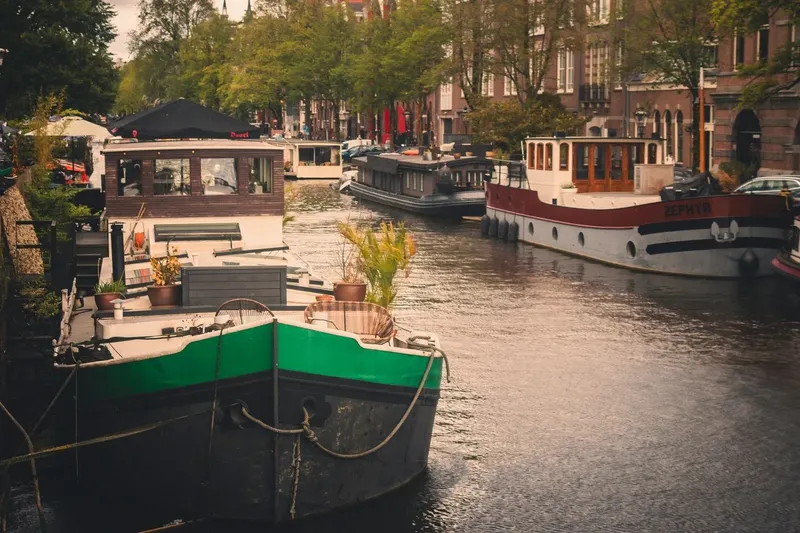
A sensible berth in this bracket has to deliver private living space, a dedicated en-suite bathroom, and manageable access without surprise fees at check-in. The water changes how a room functions: steel hulls conduct cold, harbor basins collect chop on blustery afternoons, and ferry schedules dictate your commute back from dinner. The five boats below meet that test without tipping into suite territory.
What counts as mid-range here
A berth at ≈ $110 (€100) or more should buy three things: a door you can close, a bathroom inside it, and heat that works in October. Dorms and corridor showers are out, and so are novelty suites that cost more than a return flight. The filter was simple enough to apply to every hull:
- Dedicated private quarters: No multi-bed dorms, no shared living lounges with strangers, and an independent private entrance.
- En-suite plumbing: A private, fully partitioned bathroom with a hot shower and toilet inside your own unit. The jump from a shared barge bathroom to this is the biggest price step on the water.
- Predictable nightly cost: An entry rate between roughly $110 (€100) and €200 before the city tax and VAT, taken from the operator's own page or the lowest listed rate on a booking channel.
Those entry rates are not live quotes. Both residential houseboats and historic barges run on dynamic calendars, so a quoted rate can move higher during a festival weekend. Run your dates through the operator's booking page and add the two statutory charges before you compare totals; the tax arithmetic is below.
The checks that matter on board
Comparing boats requires different checks than standard hotel rooms. Wide-angle photos taken on sunny afternoons hide the two things that decide a stay: the floor area once the bags are down, and the angle of the gangway at low water. Published layouts, floor areas, seasonal calendars and house rules are a better starting point than the gallery.
Floor space is the biggest separator. A 15 m² studio is fine for two light packers on a weekend; with two large cases it becomes a corridor. A 50 m² captain's lodge gives residential freedom, but its rate may require a seven-night commitment. Companionway hatches are the other physical limit: on the historic hulls they are narrower than a hard-shell suitcase, which is why a soft duffel is the practical bag.
Mooring stability matters just as much. A vessel inside a dead-end canal basin takes no wash, while a berth on the open IJ feels every ferry and tour boat. Hull insulation varies too: thick wood-and-concrete houseboats stay warm effortlessly, while converted steel freight hulls need radiators to counter damp harbor air on a cold night.
Five mid-range berths compared
The table gives the entry rate for each hull, the mooring, and the trade-off that matters most. Zwaan's ≈ $110 (€100) and Asile's ≈ $210 (€193) are published by the operators; Botel's ≈ $100 (€95) is the lowest listed rate on the booking channels, Gandalf's low-season twins list around $110 (€100), and Little Amstel does not publish a fixed rate. None is a live quote, and the 12.5% city tax sits on top; whether VAT is already inside the quoted rate depends on the operator, so check the breakdown.
| Name | Mooring | Type and space | Entry rate | What it does well | Main trade-off |
|---|---|---|---|---|---|
| Hotelschip Gandalf | Amsterdam (Oosterdok, Steiger 3) | 10 en-suite cabins | ≈ $110 (€100) (low-season listed rate) | Quiet ten-cabin ship; 12–15 minutes on foot from Centraal | Wi-Fi only in public areas; cash deposit; early check-out |
| Botel Amsterdam | Amsterdam (NDSM-pier 3) | 175 cabins, 12–14 m²; five letter lofts | ≈ $100 (€95) | 24-hour desk; card payment; private bathrooms | 14-minute ferry; thin cabin walls; wharf noise |
| Hotelboot Zwaan | Amsterdam (Oosterdok, pier 2/3) | 8 en-suite cabins; 50 m² lodge | ≈ $110 (€100) (lodge, 7-night minimum) | Central winter berth; breakfast; private bathrooms | Winter only; cash only; steep companionways |
| Houseboat Little Amstel | Amsterdam (Amsteldijk 700, by the Torontobrug) | 2 studios, 15 m² | ≈ $200 (€180) | Private terrace on the Amstel; en-suite | 15 m²; no kitchen; check-out split |
| Hotel Asile Flottant | Amsterdam (De Ceuvel, Korte Papaverweg 2) | 6 whole boats, 25–80 m² | ≈ $210 (€193) (to ≈ $430 / €393) | Whole historic ship; private deck; flat basin | No reception; fixed arrival window; no cooking |
The ≈ $110 (€100) in the title is Zwaan's published rate for the 50 m² Captains Lodge, not a starting teaser; Botel's ≈ $100 (€95) is a smaller cabin that meets the same private-bathroom test. These five represent different ways to stay on the water. Hotelboot Zwaan is a Dutch passenger ship that winters as an urban botel in the Oosterdok basin. Hotel Asile Flottant is a collection of six historic working boats kept afloat in the Johan van Hasseltkanaal at De Ceuvel; the houseboats hoisted onto land at De Ceuvel are a separate set, not the hotel. Houseboat Little Amstel is a static residential barge divided into two studios. Botel Amsterdam is a purpose-built 175-cabin ship at NDSM, and Hotelschip Gandalf is a ten-cabin converted inland vessel on the same Oosterdok quay as Zwaan.
No operator paid for inclusion in this comparison, and there are no affiliate links on this page. The stays described here were paid at the public rate.
What the entry rates actually buy
Zwaan's ≈ $110 (€100) is the operator's published daily rate for the 50 m² Captains Lodge, with a seven-night minimum and winter-only availability. Seven nights at ≈ $110 (€100) is ≈ $770 (€700), or ≈ $2.2 (€2) per m² per night, which is the cheapest space in this comparison. The catch is the commitment: for a two-night weekend the lodge is unavailable, and the standard 10 m² cabins run ≈ $110 – $140 (€100 – €130) on the booking channels, which works out at ≈ $11 – $14 (€10 – €13) per m².
Asile Flottant inverts the arithmetic. You rent a whole boat, not a room: the 25 m² Anneliese for two starts at ≈ $210 (€193), or ≈ $8.5 (€7.72) per m², and the 65–80 m² group boats run to ≈ $430 (€393), or about $5.5 – $6.6 (€5 – €6) per m². Little Amstel's 15 m² studio at ≈ $200 (€180) is ≈ $13 (€12) per m², and an autumn midweek quote of around $280 (€250) is ≈ $18 (€16.7) per m². Botel's standard cabin at ≈ $100 (€95) for 12–14 m² lands near ≈ $7.7 – $8.8 (€7 – €8) per m², while its letter lofts at ≈ $240 – $420 (€220 – €380) buy a shape rather than a floor plan. Gandalf's ten cabins list around $110 (€100) in low season.
Security holds matter more than the nightly rate. On a two-night stay at the entry rate plus tax, Asile's bond is roughly 39% of the bill, Little Amstel's hold about 31%, and Zwaan's key deposit under 8%. The amounts sit with each boat below; the point is that a ≈ $220 (€200) hold is real money even when it comes back.
The boats in detail
Hotel Asile Flottant: six historic boats at De Ceuvel
Tucked into the former shipyard basin of De Ceuvel at Korte Papaverweg 2 in Amsterdam-Noord, Hotel Asile Flottant is unlike any standard hotel corridor. The property consists of six individually converted historic ships, each operating as an independent suite. Instead of a uniform hotel hallway, you walk down wooden boardwalks past remediation gardens to reach your private gangway. It gives you the atmosphere of Amsterdam's post-industrial creative fringe, while staying connected to the center via local transit.
Every ship has its own architectural layout, retaining original iron bulkheads, reclaimed woodwork, and standalone deck seating. You have full private access to your vessel, giving you privacy that standard multi-cabin hotel ships cannot match. The fleet runs from the 25 m² cutter Anneliese for two to the 80 m² Holland VII for six; the group boats have the space for a friends' weekend, the small ones for a couple. There is no reception desk: the manager meets you on the pier between 15:00 and 18:00, and check-out is by 11:00. Asile's reservation page sets out the payment: 50% at booking, the balance 30 days before arrival, and a ≈ $220 (€200) security bond at check-in. Photo ID and a credit card are required.
The galleys have a fridge, sink, kettle and Nespresso machine but no hob, so self-catering stops at cold breakfast and sandwiches. Wi-Fi is free aboard and guests rate it 8.3 out of 10, though a steel hull is still a steel hull. The basin is the Johan van Hasseltkanaal, an inland former shipyard with managed water, so the hulls do not roll; the motion you notice is none at all. What you do hear is the Café de Ceuvel terrace, which sits at the head of the same pier. On a warm autumn evening the manager met me at the gate because there is no lobby, and by the second night I could follow the café playlist through the hatch until closing. The boats at the far end of the row are the quieter ones; ask for one when you book.
The trade-offs are physical. Steel hulls need sensible heating on a cold snap, and the gangways turn slick in rain. The companionway ladders are steep enough that you descend backwards with a hand on each rail, and the hatch openings are narrower than a hard-shell case. It is an exceptional pick for design enthusiasts, but travelers wanting a conventional front desk experience with room service should look elsewhere.
Hotelboot Zwaan: winter berths and the 50 m² Captain's Lodge
Hotelboot Zwaan is an operational Dutch passenger vessel with a split personality. From April through September, the ship operates week-long bike-and-barge tours across the Netherlands. From early October through late March, it moors at Oosterdok, pier 2/3, 120 meters from the NEMO Science Museum and a 10–12 minute flat walk from Amsterdam Centraal Station. The pier number varies between listings, so confirm it when you book.
The standout mid-range accommodation on board is the Captains Lodge. Measuring 50 m², this unit covers a large living area, a fully equipped private kitchen, two separate bedrooms, an additional child's bed, a private bathroom, a washing machine, and panoramic views from the wheelhouse. The operator's rooms page publishes it at ≈ $110 (€100) per day with a seven-night minimum, winter season only. Alongside the lodge, the ship holds seven smaller en-suite cabins, including family and twin layouts, plus the compact Lovers Nest tucked into the bow with four portholes. Standard cabins are about 10 m² and usually listed at ≈ $110 – $140 (€100 – €130) for winter dates; breakfast is included in the rate.
The limitations are firm. The property does not accept credit cards; your stay is settled in cash on arrival, along with a cash deposit for the room key. Smoking is banned inside all cabins, though a covered deck space is available. Zwaan's rooms-and-prices page directs guests to the public library two minutes away for free internet rather than promising cabin Wi-Fi; Booking.com lists Wi-Fi as free, and guests rate it 7.1 out of 10, so treat it as a public-area connection at best. Check-in runs from 15:00 to 20:00, check-out is by 10:30, and there is nobody on the gangway outside those hours. The Lovers Nest is reached down a steep stair from the foredeck, which makes it a poor choice with a heavy case or a bad knee.
Houseboat Little Amstel: two 15 m² studios on the Amstel
If you prefer an authentic residential neighborhood over a commercial dock, Houseboat Little Amstel sits moored at Amsteldijk 700, by the Torontobrug. This static barge contains two identical, self-contained units: Studio A and Studio B. Each space measures 15 m² and accommodates a maximum of two guests, featuring an en-suite bathroom, a private entrance directly off a floating deck, and two single beds that the operator says can be separated. Some booking sites show a double or queen; if you need one large bed, confirm the setup for your dates rather than trusting the photo.
The location on the Amstel River offers a calm, scenic atmosphere. Sitting on the private floating terrace with your morning coffee while rowers, grebes and cormorants pass is the reason to book here. You get modern fixtures, heating, air conditioning and Wi-Fi, avoiding the draughty conditions common on older converted cargo hulls. There is no kitchen, so breakfast and dinner happen in De Pijp. Entry is keyless: the operator sends a Bluetooth app key before arrival, which means a dead phone is a lockout, and a ≈ $170 (€150) card authorization is required for the security deposit.
The compact footprint means space management is mandatory. With just 15 m² to share, two large suitcases will quickly dominate your floor area. Check-in starts at 14:00. Check-out is 10:00 on the house-rules page and 10:30 on the homepage FAQ and Booking.com, so confirm the time on your voucher and plan for the earlier one if you have a flight. Little Amstel's house-rules page also requires guests to carry out their own trash and leave the studio tidy before departure. The terrace sits at water level, so any stay with children demands constant attention. Pets are not allowed, and the no-smoking policy carries a specialist cleaning penalty if breached.
On a wet spring afternoon the gangway to the pontoon sat at a steep angle, and the stone steps down from Amsteldijk were slick. I carried the bags one at a time, and with two open cases on the floor of the 15 m² studio there was no clear path to the bathroom door. A single soft bag each is the difference between a workable cabin and a cramped one.
Botel Amsterdam: 175 cabins at NDSM Wharf
When Hotelboot Zwaan departs on its summer cruising tours, or if you need a flexible one-night stay without cash payments or weekly commitments, Botel Amsterdam is the year-round fallback. Berthed at NDSM-pier 3, this large, purpose-built floating hotel offers 175 cabins across several categories, ranging from standard twins and doubles to four-bed family units and oversized design suites built inside the red rooftop lettering.
Unlike private houseboats, this vessel functions like a standard hotel on the water. It offers a 24-hour reception desk, an on-site bar, an optional breakfast buffet, and bicycle rental services directly on the quay. Every cabin features its own private bathroom. Standard cabins are 12–14 m² and list from ≈ $100 (€95) in low season, rising to ≈ $180 – $280 (€160 – €250) in peak periods; the five letter lofts run ≈ $240 – $420 (€220 – €380). A ≈ $55 (€50) card deposit is taken at arrival, check-in starts at 15:00, and check-out is by 11:00.
Reaching the city center is straightforward. The free municipal ferry dock sits just 250 meters from the gangway. The GVB ferry route F4 crosses the IJ directly to the rear of Amsterdam Centraal Station in about 14 minutes. The location puts you in the middle of the creative NDSM shipyard quarter, surrounded by street art, waterfront cafes, and performance venues. The trade-off is acoustic: cabin walls are thin prefabricated bulkheads, and the wharf hosts open-air events, so a festival weekend is not the time to book if you want silence.
Hotelschip Gandalf: ten cabins on the Oosterdok quay
Hotelschip Gandalf is the quietest of the Oosterdok options: ten cabins on a converted inland vessel at Steiger 3, a 12–15 minute walk from Centraal. Every cabin has a private wet-room pod with shower, toilet and basin, which is unusual at this price; the trade-off is size. Beds are fixed twins or triples, there is no desk and no wardrobe, and a hard case will live in the doorway. Low-season twins usually list around $110 (€100).
Wi-Fi is listed for the public areas only, and the steel hull does a good job of blocking it in the cabins. Breakfast depends on the rate you choose, so check the voucher. The ship takes a ≈ $22 (€20) cash deposit at check-in, check-in runs from 14:00 to 22:00, and check-out is 08:00–10:00. Guests score it 8.6 out of 10 on Booking.com, with location the strongest category and cabin comfort the weakest. If you want a central berth with private plumbing and no lobby theatre, this is the one; if you need to work from the room, book elsewhere.
What each mooring does to sleep
Where a boat is tied up dictates how well you sleep. Amsterdam's waterways look placid on tourist maps, but the physical forces acting on a hull differ across the city's four water zones.
| Mooring | Movement | Noise | Best for |
|---|---|---|---|
| Open IJ waterfront (NDSM-pier 3) | Ferry wash and wind; the hull shifts, but guest complaints are about noise rather than rolling | Thin cabin walls, wharf events, bass on festival weekends | Short city breaks, late arrivals, card payments |
| Sheltered inner harbor (Oosterdok, pier 2/3) | Almost none; the basin is behind locks and the water level is managed | Quay foot traffic on weekend evenings; tour-boat wash during the day | Light sleepers who want to walk to Centraal |
| Side-canal basin (De Ceuvel) | None; inland former shipyard with managed water | Café de Ceuvel terrace until closing on warm nights | Design-minded couples and groups who want a whole boat |
| Urban riverfront (Amsteldijk 700) | Brief ripples from tour boats and sloops | Traffic hum from the Torontobrug; birds and rowers in the morning | Couples who want a terrace on the Amstel |
If you are prone to motion sickness, an enclosed basin such as Oosterdok or the Johan van Hasseltkanaal is the safer choice; the hull itself is stationary, and the movement comes from other vessels. If you are sensitive to street noise, avoid berths beside major traffic bridges and take earplugs for the Oosterdok quay. The NDSM wharf is the one to check against the event calendar: the bass from a festival travels through the hull more than the water does.
Taxes, payment and the last mile
The tax line on a ≈ $110 (€100) berth
Two mandatory charges sit on top of every quote. Since 1 January 2026, the standard Dutch VAT rate on short-stay accommodation is 21%, as the Belastingdienst states; the old 9% rate is gone. Amsterdam adds a tourist tax of 12.5% on the net overnight rate, published by the City of Amsterdam. The city tax is calculated before VAT, so on a VAT-inclusive quote the extra is a little under 12.5% of the number you see, and on a net rate the two charges add 33.5%.
On my last winter booking at Zwaan the net room rate was ≈ $110 (€100) and the folio came to ≈ $150 (€133.5): ≈ $110 (€100) base, ≈ $14 (€12.5) city tax, ≈ $23 (€21) VAT. I had a ≈ $22 (€20) note for the key deposit, and the same note came back at check-out. If the ≈ $110 (€100) you see on a booking page already includes VAT, do not add another 21%; the city tax is the only line still to come. Ask whether the quote is net or gross before you compare two boats.
Paying at the desk
Payment methods split three ways. Zwaan and Gandalf are cash territory: both want the stay or the deposit settled in notes at the desk. Asile, Botel and Little Amstel take cards; Asile splits the bill 50/50, Botel swipes a card deposit, and Little Amstel sends a payment link before arrival. Bookings made through Booking.com may be prepaid through the platform, so the desk only needs cash for extras. None of the Oosterdok ships has an ATM on the quay; the nearest is at Centraal.
Ferries, walks and the gangway
Getting around Amsterdam from the water is fast if you understand the public transport network. Crossing the IJ between Amsterdam-Centraal and the northern waterfront is free. Under GVB ferry rules, the ferries carry pedestrians, cyclists, mopeds, and mobility devices without tickets or transit cards. Ferry F4 links the central station with NDSM Wharf in about 14 minutes, with departures every 15 minutes through most of the day and every 30 minutes in the evening; it runs late, but check the last boat before a late dinner in the centre. The Buiksloterweg ferry behind Centraal reaches the De Ceuvel side in about three minutes, which is the route for Asile Flottant. Live departures are in the GVB Gappie app.
Reaching the other moorings is mostly walking. Oosterdok, pier 2/3 sits about a kilometre east of Amsterdam Centraal, a flat 10–12 minute walk along the harbor path past the public library; Gandalf is on the same quay at Steiger 3, 12–15 minutes from the station. Little Amstel is a metro ride: lines 51, 53 and 54 run from Centraal to Weesperplein in four to five minutes, followed by a 10-minute walk south along the Amstel, or tram 4 to Stadhouderskade and a short walk down the stone steps. Asile Flottant is the ferry plus a 6-minute cycle or 18-minute walk along Papaverweg from the Buiksloterweg landing.
Accessibility is a major hurdle across all five. None offers step-free access or a wheelchair-adapted wet room. Gangways sit at different angles depending on the water level, and boarding means stepping across the gap between quay and deck. Each hull has its own version of the same problem: a steep stair on Zwaan, a narrow hatch on Asile, a flight of stone steps at Little Amstel, a one-person gangway on Gandalf. If you travel with bulky hard-shell suitcases or have reduced mobility, a land hotel is the practical choice.
Which boat fits which trip
Every boat in this guide suits a specific type of traveler. Match your group size, travel dates, and daily routine to the right deck:
- Longer winter family stays (October through March): Pick the Captains Lodge on Hotelboot Zwaan. For trips of seven nights or more, the 50 m² lodge works out at ≈ $2.2 (€2) per m² per night, with a full kitchen and a central harbor location. The seven-night minimum is the price of admission.
- Design-focused couples in Amsterdam-Noord: Choose Hotel Asile Flottant. The smallest hull is a 25 m² cutter for two, and the group boats go to 80 m²; you get a whole ship and a private deck in a basin that does not move. The entry rate is the top of this bracket, so it only makes sense if the boat itself is the reason for the trip.
- Quiet weekend city breaks: Book Studio A or B at Houseboat Little Amstel. It suits couples traveling light who want a terrace on the Amstel away from the downtown crowds; 15 m² is the hard limit.
- Flexible short trips or summer visits: Reserve Botel Amsterdam. It is the only one of the five with a staffed desk at midnight and no minimum stay, and it takes cards, which matters when a flight lands late or the seasonal boats are away.
- The bottom edge of the bracket: Hotelschip Gandalf has ten cabins, private wet rooms, and a quiet quay; the walk from Centraal is 12–15 minutes. It is the one to take if you want a quiet berth and do not need space to work.
Two bookings I would leave alone
The Lovers Nest on Zwaan is the first. It is charming in the photos, with four portholes and its own entrance from the foredeck, but you reach it down a steep stair and the cabin narrows toward the bedhead. With a hard case or a bad knee, take a standard twin instead; the view is not worth the descent.
The rooftop letter lofts at Botel are the second. They are genuine design pieces, and the B has a skate ramp inside, but at two to four times the standard cabin rate you are paying for a room shaped like a letter; space and quiet are the same as in the cabin below. The standard cabin has the same private bathroom and the same ferry, and the wharf noise does not change with the rate. If the letter is the reason for the trip, book it; if you want a comfortable base, save the difference.