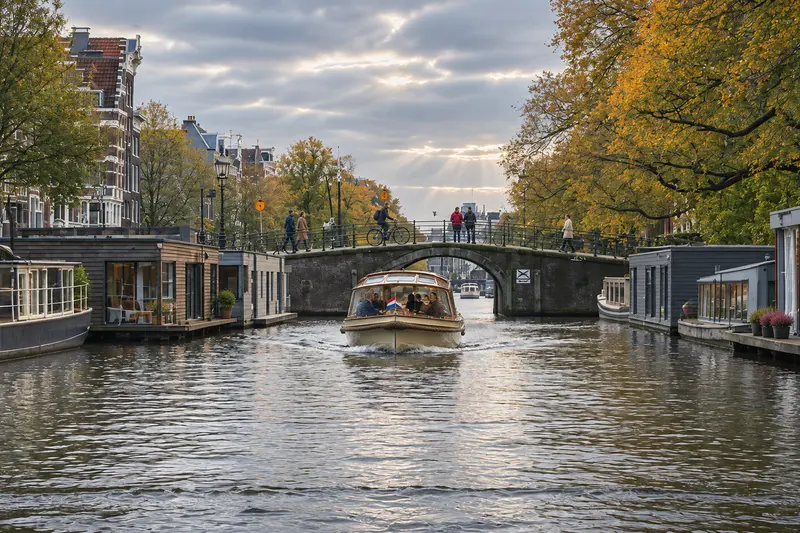
The failures repeat often enough to list: a deck hatch left open, a timber gangway slick with rain, a cash deposit nobody mentioned at booking. A good autumn stay on the water comes down to where the boat sits, what heats it, and how the city taxes it.
How to Judge an Autumn Botel
Evaluating a floating stay in damp weather needs a different checklist from picking a room in the Jordaan. Steel hulls, harbor chop and moving water levels expose every weakness in a vessel once the outside temperature drops toward single digits. Four things matter more than the photos.
- Heat: hydronic radiators fed by a central boiler, or at least oil-filled panels. Wall-mounted fan heaters dry the air and leave the floor cold.
- Ventilation: a mechanical extract fan in the bathroom. A passive mushroom vent in the ceiling will not clear shower steam.
- Bathroom position: an en-suite inside the heated envelope beats a shared block at the end of a cold companionway.
- Berth exposure: the walled Oosterdok basin against the open piers at NDSM across the IJ.
The bill is the fifth check, and most people leave it until the gangway.
What Cold Does to a Steel Hull
Amsterdam in October averages about 7°C at night and 14°C by day. On the water, wind across the IJ makes it feel colder, and an uninsulated single-skin steel plate is a direct thermal bridge. Warm cabin air meets the cold hull below the waterline, and the moisture in it condenses on the steel, then runs down to the floorboards or into the carpet beside the bed.
The heating system decides how bad that gets. Wet radiator loops fed by a continuous central boiler give an even warmth and keep the steel closer to room temperature. Electric convection panels cycle on and off, dry the air, and leave the floor cold; a cabin can feel warm at head height and freezing at the ankles. On a converted barge I look for radiators under the windows and a boiler that runs overnight, not a timer that cuts out at midnight.
Portholes are the second weak point. Brass-rimmed single-pane ports look right on a historic hull and run with water all night in autumn rain. Cabins with raised superstructures and sealed double glazing hold their heat and keep the condensation off your clothes.
Bathroom extraction matters as much as the radiator. A hot shower in a small wet room fills the cabin with steam; if the only vent is a passive mushroom in the ceiling, the humidity stays for hours. A mechanical fan that runs continuously is the difference between dry sheets and a damp duvet at bedtime.
Most guests make the same mistake: they seal every window and vent and turn the radiator to maximum. A sleeping adult adds a steady trickle of water vapor to a small cabin, and in a sealed box that vapor finds the coldest surface, usually the steel frame above the bed. On a wet autumn stay in a converted barge I shut the porthole against the rain and woke with water running down the frame onto the foot of the duvet. Now I leave the vent cracked and keep my bag a hand's width away from the outer wall, because the decorative plywood lining on older hulls hides only a thin layer of insulation, sometimes none at all.
VAT, Tourist Tax and the Bill at the Gangway
Booking an off-season floating room in the Netherlands needs arithmetic, because the headline rate is rarely what you pay at the counter. Since 1 January 2026, short-stay accommodation across the country, hotel ships and houseboat cabins included, carries the standard 21% VAT rate set by the Belastingdienst; the old 9% rate for logies, the Dutch term for short-stay lodging, is gone. The Belastingdienst also counts the services that come with the room, such as gas, electricity, water and sanitary facilities, in the same 21% treatment.
On top of VAT comes the municipal tourist tax. For 2026 the City of Amsterdam sets it at 12.5% of the overnight price excluding VAT, collected by the accommodation and passed on to the municipality. If your rate already includes 21% VAT, that 12.5% works out at roughly 10.33% of the headline figure; if you are quoted a net rate, add the full 12.5%. Together they add roughly a third to the net room rate, which is why an Amsterdam bed now sits among the most expensive in Europe.
Tax calculation: a room quoted at ≈ $130 (€121) including 21% VAT has a net rate of ≈ $110 (€100). The 12.5% city tax applies to that ≈ $110 (€100), adding ≈ $14 (€12.5) at checkout. Some booking platforms collect the city tax for the property and some leave it to the desk, so check which before you budget. Sites that still advertise the old 9% VAT are out of date; the statutory rate on the bill is 21%.
The rate is also moving. The coalition agreement presented on 3 June 2026 proposes raising the city tax to 16% in 2027 and by one percentage point a year after that, reaching 20% by 2031. Those steps still have to pass the city's annual budget, so treat the 16% figure as a plan that needs approval before it becomes a line on your confirmation. For an autumn booking made now, 12.5% is the rate that applies.
The Boats, Side by Side
Amsterdam's floating stock splits into purpose-built hotel ships and converted Dutch cargo barges, and the hull type decides whether you get a lift and a keycard or a ladder and a shared shower. The table gives the off-season bands the booking channels show for each property; rates move with dates and events, and VAT and the city tax sit on top.
| Property | Mooring | Vessel | Typical off-season rate | What it does well | What to watch |
|---|---|---|---|---|---|
| Botel Amsterdam | NDSM-pier 3 (Noord) | Purpose-built ship, 175 cabins, lift | ≈ $100 – $150 (€95 – €135) per cabin | En-suite in every room, lift, radiators | Exposed pier, event noise, ferry crossing |
| Hotelboot Zwaan | Oosterdok Steiger 2/3 (Center) | Passenger barge, 8 cabins, winter only | ≈ $110 – $140 (€100 – €130) | Private shower and WC, breakfast, sheltered basin | Cash only, ≈ $22 (€20) key deposit, steep stairs |
| Hotel Asile Flottant | De Ceuvel, Johan van Hasseltkanaal (Noord) | Six historic boats, let whole | ≈ $180 – $430 (€165 – €393) per boat | Private boat, sundeck, space | No cooking, ≈ $220 (€200) bond, steep ladders |
| Lightship Amsterdam | Mariadistelkade 6 (Noord) | Converted lightvessel | ≈ $350 – $500 (€320 – €450) | Large suites, underfloor heating, breakfast | Two-night minimum, adults only, no lift |
| AmicitiA | Oosterdok Steiger 3 (Center) | Converted freight barge, 18 twin cabins | ≈ $50 – $83 (€45 – €75) | Cheapest central berth, breakfast | 3 m² cabins, shared bathrooms, thin walls |
| Vita Nova | Oosterdok Steiger 2 (Center) | Cargo vessel, 24 cabins | ≈ $61 – $94 (€55 – €85) | Central walk, breakfast, bag storage | Shared bathrooms, desk closes 22:30 |
Rates are date-specific bands from the operators' booking channels, not fixed tariffs; VAT and the city tax are extra. Confirm the figure for your dates before booking.
Converted Barges and Purpose-Built Ships
Converted iron and steel freight barges such as AmicitiA and Vita Nova keep the shape of Dutch maritime commerce, and they come with structural trade-offs in cold weather. Their holds have been cut into cabins of roughly 3 to 6 square meters on the Oosterdok boats, enough for bunks and a washbasin and not much else. Sound insulation between cabins is minimal; you hear a neighbor's door latch, the shower pump and a phone charger going into the socket.
Budget barges also put the washrooms at the end of a narrow central companionway. When the night temperature drops toward single digits, a trip down a drafty metal corridor in socks to brush your teeth loses its charm quickly. Purpose-built ships such as Botel Amsterdam avoid that: their modular cabins have their own fiberglass wet rooms, hot water on demand, and doors that close on a heated space.
Space is the other difference. A standard Botel cabin is several times the size of an Oosterdok twin, which is the practical difference between the two models: a private bathroom and room to open a case, or a central address at hostel money.
Oosterdok or NDSM?
Mooring geography matters as much as hull construction. Oosterdok is an enclosed harbor basin positioned directly behind the NEMO Science Museum, ten to fifteen minutes on foot from Amsterdam Centraal Station. Its high stone quays, surrounding commercial buildings and calm freshwater basin shield moored hulls from western storm gusts. You get virtually zero wave motion here, which makes it ideal if you are prone to seasickness or want quick pedestrian access to the city without relying on public transit.
Across the open water of the IJ, NDSM Wharf offers an entirely different atmosphere. The former shipyard is now a bustling creative hub, but its piers jut straight out into the broad river channel. During autumn squalls, moored vessels work against their heavy mooring ropes and rubber fender bumpers. The sound of wind in rigging, waves slapping against steel chines and the creak of spring lines can keep light sleepers awake. Pick NDSM for the harbor views and the post-industrial architecture, and accept that you trade the wind-buffered calm of central Oosterdok for it.
The Boats in Detail
Each property below is a different bargain: a private bathroom and a lift, a cash-only cabin in the center, a whole boat with a sundeck, or a converted lightship. The figures are in the table above; what follows is how each one behaves in the rain.
Botel Amsterdam: The Big Ship at NDSM
Moored at NDSM-pier 3, Botel Amsterdam is the heavyweight of the local floating scene: a converted river cruiser that has been a hotel since the early 1990s, with five rooftop rooms built into giant letters. It runs like a budget city hotel on a stationary hull. A lift reaches the accommodation decks, every room has its own bathroom and toilet, and the cabins have radiators and windows that open.
Standard cabins measure 12 to 14 square meters. The river-facing doubles are worth the upgrade over the wharf-side rooms, where the view is of workshops and mooring gear. Wi-Fi is free but guests rate it 7.6 out of 10, the weakest score on the property. Breakfast depends on the rate, check-in starts at 15:00, and a ≈ $55 (€50) credit-card deposit is taken at arrival.
The location is the trade-off. The pier is a few hundred meters of flat, unsheltered concrete from the ferry pontoon, and it feels longer in sideways rain. NDSM also hosts open-air events through the year, and on those weekends bass travels through the hull and the morning ferries fill with people heading home. Check the wharf calendar before you book a quiet autumn night.
Two things are worth skipping. The letter lofts are charming but cramped, with internal level changes that punish a hard-shell case; if you want space, a standard river-facing double is the better buy. The onboard bar is the quietest room on the ship, and Pllek and IJ-Kantine are minutes away with the water in front of them.
Hotelboot Zwaan: A Winter-Only Barge
From the beginning of October to the end of March, Hotelboot Zwaan ties up at Oosterdok Steiger 2/3 and rents cabins by the night; from April to September the barge sails bike-and-barge charters and there is no room to book. Every cabin has a private hot shower and toilet, breakfast is included, and the whole boat holds about 18 guests. Standard cabins are compact at roughly 10 square meters.
The operation is old-fashioned in ways that matter at the gangway. The boat takes no credit or debit cards: the balance, the city tax and a cash key deposit are settled in euros on arrival. Check-in runs from 15:00 to 20:00 and there is no reception desk outside those hours, so a late train means a taxi or a night elsewhere. The pier number is printed as Steiger 2 by some platforms and Steiger 3 by others, so confirm it when you book.
The Lovers Nest sits in the bow with its own entrance and a steep stair down to a small double bed; with a heavy case or a bad knee, skip it and take a standard cabin. What you get for the cash is a sheltered central berth, a private bathroom, a hot breakfast with pancakes cooked on board, and a covered veranda that stays usable in February rain. Smoking is banned inside; the covered deck is the only place for it. The Captain's Lodge, a 50-square-meter apartment with two bedrooms and a wheelhouse, is let only in winter from ≈ $110 (€100) a day with a seven-night minimum.
Hotel Asile Flottant and Lightship Amsterdam
In Amsterdam-Noord, two conversions sit at the expensive end. Hotel Asile Flottant is a fleet of historic working boats in the Johan van Hasseltkanaal at De Ceuvel, rented as whole units. The smallest, the cutter Anneliese, takes two guests in 25 square meters; the largest, Holland VII, takes six in 80. Each boat has its own galley corner with a fridge, kettle and coffee machine, but no hob or oven: fire rules for the historic hulls forbid cooking. There is no reception, the key is handed over on the pier between 15:00 and 18:00 by arrangement, and the operator's cancellation terms forfeit 50% between 30 and 59 days out and 100% inside 30 days.
Lightship Amsterdam is the other end of the scale: a 1952 Trinity House lightvessel, LV-12, converted over eleven years into two architect-designed suites of roughly 60 and 65 square meters. Both have a king bed, a private bathroom with a freestanding tub, underfloor heating, a minibar and their own entrance; breakfast arrives in the suite. The booking carries a two-night minimum, the ship is adults only with two guests per suite, and the Machinery Room sits deep in the hull at the foot of a steep companionway.
Both are quiet, sheltered moorings, and both are wrong for anyone who needs a lift or a step-free route. Asile Flottant also sits beside Café de Ceuvel, whose terrace carries music on warm evenings; ask for a boat at the far end of the row if sleep matters. The site's permit runs to early 2028, so the mooring has a horizon.
AmicitiA and Vita Nova: The Cheapest Berths
The two budget barges on the Oosterdok are the cheapest way onto the water in the center, and they are honest about what they are. AmicitiA is an 1897 freight barge at Steiger 3 with the smallest cabins on the quay, an in-room washbasin, four shared toilets and four shared showers; check-in is self-service until 23:59, and the boat is adults-only. Vita Nova, at Steiger 2, has larger cabins of 4–6 square meters, shared bathrooms, breakfast and free same-day luggage storage, but reception closes at 22:30 and there is no late check-in.
Neither has a lift. Both have steep companionway ladders, thin partitions and a morning queue for the showers. At these prices the shared bathrooms are the compromise; if you need quiet, a private shower or a lift, look elsewhere.
Gangways, Ladders and Luggage
Rain is a constant in autumn, and as leaves rot on the wooden pontoons the gangways turn slick. Most floating hotels use steel ramps with expanded metal grating or ribbed timber decking. Rubber-soled boots with real tread are the right footwear; smooth leather soles slide on a wet ramp, especially when the water level is low and the incline steepens.
Luggage and mobility: converted barges have authentic marine companionways, with narrow treads, tight turns and raised steel coamings at the doorways. A heavy four-wheel case is the wrong bag for these stairs. If you cannot carry your luggage in one hand while holding the rail with the other, leave the case in the lockers at Amsterdam Centraal and bring a soft duffel aboard.
Apart from Botel Amsterdam, which has a lift to its accommodation decks, almost none of the historic barges meet modern accessibility standards. Narrow corridors, raised watertight coamings and steep ladders make them unsuitable for wheelchair users or travelers with severe mobility limits. Ask about the specific cabin as well as the boat: an upper-deck cabin reached from the salon can be far easier than one down a ladder in the hull.
Crossing the IJ and Settling the Bill
If you stay at NDSM, the daily link to the center is the GVB ferry. The IJ crossings are free for pedestrians, cyclists and mopeds, and no ticket or OV-chipkaart tap is needed. F4 runs between Amsterdam Centraal and NDSM-werf in about 14 minutes, with departures every 15 minutes through most of the day and every 30 minutes in the evening. F7 links NDSM with Pontsteiger on the west side in under seven minutes, the better route if you are coming from the Houthaven or the western canal ring. F3, the Buiksloterweg crossing, runs day and night and serves the northern waterfront and the lightship.
Sailings continue past midnight, thin out in the small hours and start again around 07:00, so check the last departure before a late dinner in the center. I once reached the NDSM pontoon just as the F4 pulled out; the next boat was half an hour later, and the pier has no shelter worth the name. The timetable lives in the GVB app, which also carries a ferry countdown clock, and on the GVB journey planner. Cross-river docking can also run late in an autumn gale, so leave margin on the way back.
Payment is the other logistical trap. At Hotelboot Zwaan, bring physical euro notes for the balance, the city tax and the key deposit; a credit card or phone wallet will not help you at the gangway. My first winter stay began with a card and a single ≈ $22 (€20) note; the note covered the deposit and left nothing for the tax. Now I stop at an ATM at Centraal before walking over. At Asile Flottant, the security bond is taken on a card and released after an inspection that checks for blocked macerator toilets and damaged woodwork.
Entry paperwork is straightforward for most visitors. US passport holders do not need an advance tourist visa for a short stay, and the Schengen rule limits visa-free visitors to 90 days in any rolling 180. ETIAS, the EU's planned pre-travel authorisation, is not in force yet, so there is no form to complete for a 2026 trip. Travelers on other passports should check the Dutch embassy's requirements for their dates.
Which Boat Fits Your Trip
Compare the boats on three things: what a night costs with tax, how the cabin is heated, and how much of the city you can reach on foot. The rest depends on what you want from the trip.
For a Tight Budget
If you want a central address and a private bathroom, Hotelboot Zwaan is the best value from October to March: a handful of en-suite cabins, electric heating, an included breakfast and a sheltered Oosterdok berth within walking distance of Centraal. Bring cash and arrive before 20:00. If Zwaan is full, AmicitiA and Vita Nova sit on the same quay at the bottom of the price table, with the compromises that implies.
For a budget stay on the water in a purpose-built ship, Botel Amsterdam's standard cabins sit in the middle band and give you a private bathroom, radiators and a lift, at the cost of the ferry crossing and an exposed pier.
For Comfort and a Lift
Botel Amsterdam is the only boat here with a lift to the accommodation decks, and every room has its own bathroom. That makes it the practical choice for anyone traveling with a heavy bag, a child or a bad knee, provided you accept the NDSM location and the event weekends. Ask for a river-facing cabin, check the wharf calendar, and treat the ferry as part of the day.
For Space and Character
Hotel Asile Flottant gives you a whole boat, a sundeck and a kitchen corner, with space and privacy no cabin can match; the trade-offs are the galley rules and the ladders. Lightship Amsterdam trades the deck for two large suites with underfloor heating and a bathtub, at the top of the price table and with a two-night minimum. Both are quiet, both are in Noord, and neither works for anyone who needs level access.
Ask for a cabin away from the pier gate and the café terrace; on a moored hull the noise arrives through the water and the steel, and the far end of the boat is usually quieter. Confirm too who collects the city tax and whether the rate includes VAT; the city tax adds about a tenth on top of a VAT-inclusive headline.