
Municipal port charges, mandatory heritage surcharges, and escalating berth leases in 2026 have shifted the economics of staying on an ocean liner converted to hotel. When commercial operators inherit mid-century steel tonnage, regular hotel pricing structures vanish, replaced by non-negotiable harbor fees, strict acoustic house rules, and separate utility tariffs. Anyone booking an accommodation berth without verifying docking surcharges or cabin insulation risks paying modern five-star rates for constrained naval architecture.
Heritage maritime enthusiasts and architecture purists will appreciate the intact teak promenades, brass portholes, and authentic mid-century woodwork preserved across these hulls. Mainstream tourists who demand total nighttime silence, expansive modern elevator banks, and step-free access throughout the vessel will find land-based waterfront hotels far more practical. Choosing between an active floating museum and a shoreside lodging comes down to balancing historic authenticity against the rigid spatial realities of maritime engineering.
The New Wave of Harbor Ship Hotel Conversions: Preservation vs. Repurposing
Maritime Heritage Tourism: Why Vintage Liners Are Moving from Sea to Shore
Preserving an intact 20th-century ocean liner requires capital reserves that traditional maritime museums cannot generate through walk-up ticket sales alone. Commercial harbor ship hotel conversions have emerged as the primary operational model to keep historic passenger tonnage afloat, funding ongoing hull maintenance through nightly stateroom bookings. Transitioning a vessel from passenger service to a static harbor hotel avoids the scrap yard, but it introduces brutal commercial real estate pressures along urban waterfronts.
The financial barrier to static cruise hotel projects centers on quayside berth rental agreements and structural renovation costs. When a ship stops generating cruise revenue, long-term dockage contracts must be underwritten entirely by hotel occupancy and event catering. The scale of this financial burden was demonstrated by the historic 1952 ocean liner SS United States, which faced eviction from Philadelphia's Pier 82 in 2024 after docking fees escalated beyond the conservancy's capacity, while full hotel conversion estimates exceeded $500 million.
Capital stagnation creates similar deadlocks in European waters. The 1961 vintage passenger liner MV Funchal was acquired in 2021 with the intent to establish a floating hotel in Lisbon, yet it remains laid up and inactive on the Tagus River due to multimillion-euro refurbishment overhead, as documented in the MV Funchal ship history. Without sustained capital, static vessels quickly deteriorate into harbor liabilities.
Berth eviction is a constant commercial hazard for uncapitalized maritime projects. If a converted ship cannot clear its monthly pier access lease through cabin bookings, port authorities can legally impound the vessel or force its removal from the harbor.
Beyond Tourism: The Rise of Industrial Workforce Floatels
While public heritage tourism captures headlines, industrial operators have quietly developed a parallel commercial market for the decommissioned cruise ship hotel. Coastal megaprojects and deepwater terminals frequently require rapid housing for hundreds of skilled tradespeople in remote fjords where shoreside accommodation does not exist. Repurposing retired passenger vessels into self-contained floatels solves municipal housing shortages without altering permanent land zoning.
A notable technical benchmark is the industrial deployment by Bridgemans Services Group for the Woodfibre LNG construction site in Howe Sound, British Columbia. The operator acquired and retrofitted the 1989 Baltic cruise ferry Tallink Isabelle into the 650-room accommodation ship Isabelle X, followed by the deployment of MV Saga X. Instead of catering to leisure travelers, these vessels operate as closed-loop, high-density residential facilities engineered for minimal environmental impact in delicate marine ecosystems.
The engineering retrofits on modern workforce floatels differ sharply from vintage museum ships. Isabelle X eliminated diesel boiler exhaust by installing six industrial heat pumps and connecting directly to the regional BC Hydro electric grid via a high-voltage marine shore power connection. Its onboard wastewater treatment plant uses mechanical screening, ultrafiltration, and ultraviolet disinfection to ensure zero untreated blackwater reaches the harbor, with solid sludge collected and trucked off-site from shoreside transfer points.
| Operational Parameter | Commercial Heritage Ship Hotel | Industrial Workforce Floatel |
|---|---|---|
| Primary Occupants | Leisure tourists, heritage enthusiasts | Industrial construction and engineering crews |
| Average Length of Stay | 1 to 3 nights | 14 to 60 days (rotation-based) |
| Public Amenities | Museum exhibits, public bars, ballrooms | Industrial mess halls, fitness centers, medical clinics |
| Power Infrastructure | Commercial shore power or diesel gen-sets | High-voltage marine shore power with automated backup |
| Wastewater Handling | Direct municipal sewer pump-out connections | Multi-stage ultrafiltration with shoreside sludge transfer |
Premier Ocean Liner Converted to Hotel Destinations: Long Beach, Dubai, and Rotterdam
RMS Queen Mary (Long Beach): Vintage Art Deco Cabins and Operational Realities
Permanently moored in Long Beach, California, the RMS Queen Mary represents the longest-running ocean liner hotel conversion in existence. Standard and deluxe cabins range between $95 and $250 USD per night, while preserved original first-class staterooms and suites exceed $315 USD per night depending on seasonal demand. When I checked in at the Art Deco purser's counter, the registration sheet explicitly confirmed check-in starting at 4:00 PM and departure strictly by 11:00 AM.
Every overnight booking carries a mandatory daily Historic Preservation & Improvement Fee of $23.00 USD per room per night, detailed on the RMS Queen Mary Hotel Amenities schedule. This surcharge covers cabin Wi-Fi, two bottles of water, fitness center entry, and admission to the ship's walking exhibits. Guests traveling with pets pay a non-refundable pet fee of $125 USD per stay, with accommodations restricted to a maximum of two dogs per cabin weighing up to 40 pounds each.
Sleeping inside the Queen Mary's riveted hull reveals the acoustic realities of vintage naval design. The ship's boilers and reduction gears have been silent for decades, eliminating the deep mechanical vibrations that once masked passenger activity at sea. Sound carries easily through the original steel bulkheads between adjoining staterooms, which has prompted hotel management to enforce nightly courtesy quiet hours and distribute complimentary foam earplugs at the front desk.
When reserving a room on the Queen Mary, inspect the floor plan category closely. Windowless inside staterooms offer total darkness for sleeping, but exterior deluxe rooms retain original operable brass portholes that let in morning sea air and daylight across the harbor.
Queen Elizabeth 2 (Port Rashid): Modern Hospitality Under Accor’s Flag
Berthed at Mina Rashid in Dubai, the Queen Elizabeth 2 operates as a static harbor hotel managed under Accor's MGallery brand. Room rates fluctuate dramatically based on Gulf weather patterns, with entry-level Classic cabins priced between 140 AED and 200 AED (~$38 to $55 USD) during the intense summer heat, rising to 350 AED to 500 AED (~$95 to $136 USD) during the peak winter tourist season. Stays can be booked directly through Accor's ALL (Accor Live Limitless) program to accumulate reward nights and access member pricing.
Operational schedules on the QE2 align with international hotel standards, featuring a 3:00 PM check-in and an extended 12:00 PM check-out. At check-in, guests must provide a refundable security deposit of 500 AED (~$136 USD) per room and pay the statutory municipal Tourism Dirham fee of 15 AED (~$4.10 USD) per bedroom per night, as outlined in the Queen Elizabeth 2 Official FAQ.
The vessel maintains an authentic maritime layout, which introduces notable physical restrictions. The daily QE2 Heritage Legacy Tour costs 85 AED (~$23 USD) per adult and leads visitors through preserved bridge wings, engine monitoring stations, and original 1960s first-class lounges. The hotel explicitly designates this heritage tour as inaccessible to wheelchairs and strollers because the route requires ascending steep maritime companionways and navigating narrow steel thresholds.
SS Rotterdam (Katendrecht): Authentic 1950s Design and Urban Water Connectivity
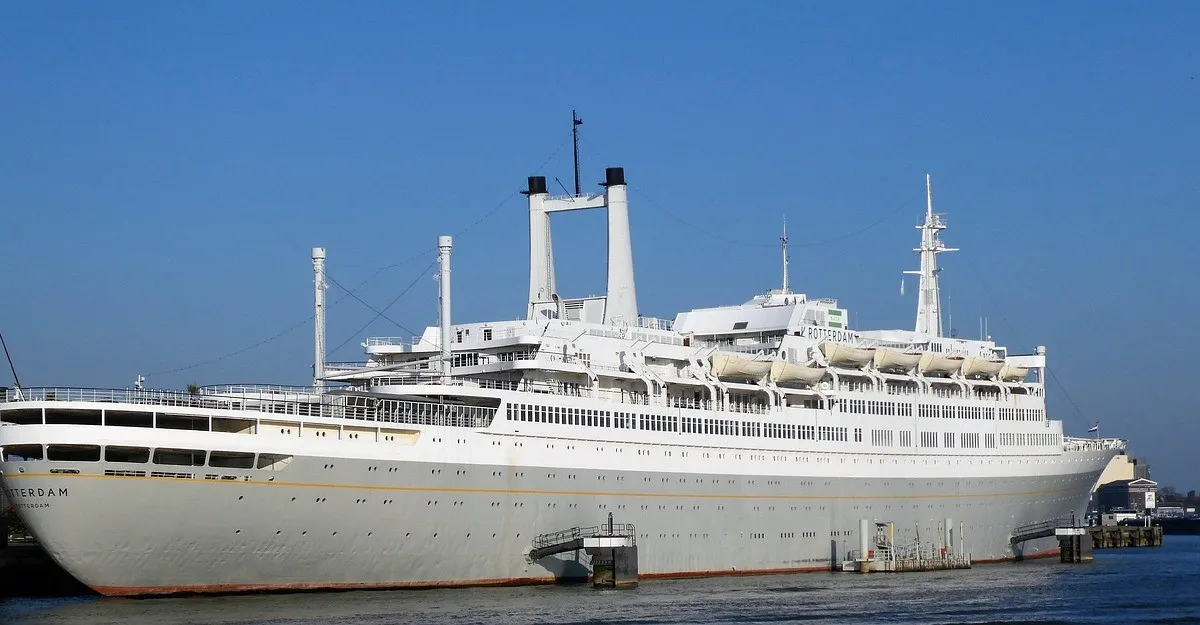
Moored at the Katendrecht peninsula in Rotterdam, the 1959 flagship of the Holland America Line operates under the management of WestCord Hotels. Standard and superior original ocean-liner cabins typically price between €60 and €110 EUR (~$65 to $120 USD) per night room-only. The vessel maintains a strict check-in schedule of 3:00 PM and check-out at 11:00 AM, though luggage storage is readily available before room access. Every stay is subject to Rotterdam's municipal tourist tax of 6.5%, calculated directly on the net nightly room rate.
Reaching the city center from the Katendrecht mooring is straightforward thanks to local transit links. Guests can step off the accommodation gangway directly onto the dock to board the Watertaxi Rotterdam network at Berth / Steiger 56, which operates fast transfers on demand via phone or mobile application, as confirmed on the SS Rotterdam Directions and Public Transit portal. Alternatively, the municipal RET Bus line 77 stops directly at the quayside, connecting passengers to the Rijnhaven Metro Station in under ten minutes.
Unlike its American counterpart in California, the SS Rotterdam enforces an absolute prohibition on domestic pets. Dogs and other companion animals are barred from staying overnight in hotel staterooms, with exemptions granted exclusively to certified assistance and guide dogs. The ship preserves its mid-century European interior architecture, featuring restored linoleum decks, low ceilings, and period light fixtures throughout the accommodations.
If you are exploring European port cities with converted river tonnage and industrial botels, review my guide to European urban botels and converted ships to compare quay access standards across Dutch and German waterways.
Alternate Adaptive Reuse Models: Dry Berthing and the Limits of Flotation
Land-Based Dry Berthing: Doulos Phos at Bintan Resorts
Floating hotels moored in saltwater face an inevitable maintenance requirement: recurring drydocking to scrape marine growth, inspect sea chests, and repair cathodic hull protection. To bypass these perpetual marine costs entirely, developers of the 1914 passenger liner Doulos Phos (originally launched as the SS Medina) chose an alternative engineering approach. Recognized by Guinness World Records as the world's oldest active ocean-going passenger ship before its retirement, the vessel was permanently lifted onto dry land at Bintan Resorts in Indonesia.
Engineers excavated and cast a massive 130-by-16-meter reinforced concrete platform to support the ship's entire keel, anchoring the foundation with deep structural piles driven up to 40 meters into coastal bedrock. Positioned adjacent to the Bandar Bentan Telani Ferry Terminal—a 60-minute ride from Singapore's Tanah Merah terminal—the vessel operates as a 104-room stationary resort hotel. Nightly cabin rates range between SGD 100 and SGD 175 (~$75 to $130 USD).
By permanently dry-berthing the vessel on an engineered slab, the operators eliminated underwater hull plate inspections, marine insurance risks, and gangway movement caused by open water swells. Guests walk into the ship via level shoreside ramps without experiencing floating gangway inclines. The project demonstrates that removing a century-old vessel from water entirely offers the most secure structural defense against steel hull perforation.
When Conversion Fails: SS United States and the Lisbon Stagnation
Converting a massive ocean liner into a stationary hotel requires commercial capital that often collapses under real-world scrutiny. The 1952 transatlantic record-holder SS United States spent three decades tied up at Pier 82 in Philadelphia while successive developers proposed mixed-use hotel, dining, and retail retrofits. The estimated construction budget of $500 million to $1 billion proved impossible to finance alongside mounting quayside berth rent and port security overhead.
The conversion proposals terminated in 2024 when a federal court issued an eviction order requiring the ship to vacate its Philadelphia pier. Unable to secure an alternate commercial berth, the conservancy finalized an agreement with Okaloosa County, Florida, for up to $9 million to acquire and prepare the vessel for intentional sinking as an artificial reef, as documented by Okaloosa County SS United States FAQs. The ship was towed to Mobile, Alabama, where both of its signature 65-foot funnels and a propeller were unbolted for display in an onshore museum prior to scuttling.
A similar economic freeze stalled the 1961 vintage liner MV Funchal in Lisbon. After being purchased at auction by an investment syndicate to create a static waterfront hotel, the vessel encountered severe shipyard restoration deficits and Portuguese regulatory delays. The vessel remains tied to a cargo pier on the Tagus River, racking up dockage charges while interior work sits abandoned.
| Historic Vessel | Initial Hotel Vision | Financial & Structural Hurdle | Final Outcome |
|---|---|---|---|
| SS United States | 500+ room static hotel & retail complex | $500M+ conversion cost, quayside rent eviction | Sold for up to $9M to become Florida artificial reef |
| MV Funchal | Lisbon harbor floating boutique hotel | Refurbishment capital shortfall and port permits | Laid up inactive on Tagus River |
| Doulos Phos | 104-room heritage hotel on land | High initial civil engineering foundation cost | Operational dry-berthed hotel in Bintan, Indonesia |
| RMS Queen Mary | Art Deco hotel and museum complex | Multi-million dollar ongoing steel restoration | Operational static city-owned hotel in Long Beach |
Realities of Living Aboard: Cabin Architecture, Acoustics, and Preserved Hardware
Inside Stateroom vs. Porthole Cabin: Spatial Layouts and Preserved Brass Hardware
Booking a stateroom inside a converted passenger ship is fundamentally different from selecting a room in a standard hotel chain. On vessels like the RMS Queen Mary and SS Rotterdam, original structural bulkheads dictate the floor plans. Travelers must choose between windowless inside staterooms buried deep within the hull and exterior staterooms running along the outer plating. Understanding this spatial distinction is critical before confirming a non-refundable booking.
Inside staterooms offer absolute light blockage, which can benefit light-sensitive sleepers, but they lack any visual connection to the outside world. The ventilation relies entirely on retrofitted air conditioning ducts, and ceilings often sit lower due to overhead piping runs. For travelers susceptible to claustrophobia, sleeping inside a windowless steel enclosure can feel suffocating after two nights.
Exterior porthole cabins preserve the genuine atmosphere of transatlantic travel. On the Queen Mary, exterior rooms retain heavy, operable brass portholes fitted with authentic wing nuts. Opening these fittings requires physical effort, but it allows fresh ocean breezes and harbor sounds directly into the living space. Exterior cabins command higher nightly rates, but the natural daylight and exterior views justify the price difference for most travelers.
If you want to understand how metal bulkheads and marine framing impact daily connectivity on board, review my technical field report on Wi-Fi and cellular reception on metal hull ships.
Bulkhead Sound Transmission and Preserved Structural Realities
The primary complaint among first-time guests on vintage cruise ship hotels centers on cabin sound transmission. Modern land-based hotels use multi-layered drywall systems with acoustic batt insulation to dampen noise between rooms. Converted ocean liners rely on riveted or welded structural steel bulkheads that were engineered for watertight integrity rather than acoustic isolation.
Without the constant background hum of propulsion engines and auxiliary steam turbines, sound waves travel through metal plates with minimal resistance. Footsteps in adjacent corridors, closing cabin doors, and normal speaking voices resonate through the steel superstructure. On the Queen Mary, I could distinctly hear my neighbor adjusting their desk lamp and walking across the uncarpeted entryway floor, confirming why the front desk keeps a basket of earplugs on the counter.
Navigating these vessels also presents physical mobility hurdles. While main elevators serve primary stateroom decks on the QE2 and SS Rotterdam, public tours and specialty venues often require stepping over raised watertight door coamings and climbing steep steel companionways. The QE2 Heritage Legacy Tour excludes wheelchairs precisely because mid-century passenger liners were built with utilitarian, high-angle stairs rather than accessible ramps.
Guests with limited mobility should request accommodations near the central elevator banks when booking. Navigating long, narrow historic corridors to reach distant forward or aft staterooms can require walking hundreds of paces along cambered decks.
Complete Booking and Financial Breakdown: Hidden Surcharges, Parking, and Port Logistics
Municipal Levies, Preservation Surcharges, and Onboard Surcharges
Checkout totals on floating ship hotels rarely match the initial nightly rate displayed on travel aggregators. Converted vessels carry a unique blend of municipal hospitality taxes and non-negotiable shipboard preservation levies designed to fund ongoing structural repairs. Calculating these fees in advance prevents unexpected charges when closing your folio.
On the RMS Queen Mary, the $23.00 USD daily Historic Preservation & Improvement Fee is mandatory across all stateroom tiers. This charge is collected in addition to standard California state and municipal lodging taxes. In Dubai, guests aboard the Queen Elizabeth 2 are charged the statutory Tourism Dirham fee of 15 AED (~$4.10 USD) per bedroom per night and must clear a 500 AED (~$136 USD) security deposit hold upon arrival. In the Netherlands, the SS Rotterdam adds the city's 6.5% municipal tourist tax directly onto the net room price.
The key difference lies in how these fees are allocated. Municipal taxes in Rotterdam and Dubai fund city infrastructure, providing zero direct benefit to the ship's maintenance budget. Conversely, the Queen Mary's preservation fee directly subsidizes on-site restoration projects and includes general admission to the ship's historic exhibits, offsetting the need to purchase separate museum passes.
| Ship Hotel & Port | Base Cabin Rate (USD) | Mandatory Daily Surcharges | Security Deposit at Check-in | Included Surcharge Benefits |
|---|---|---|---|---|
| RMS Queen Mary (Long Beach) | $95 – $250+ | $23.00 USD Preservation Fee | Credit card pre-authorization | In-room Wi-Fi, bottled water, gym, exhibit access |
| Queen Elizabeth 2 (Dubai) | $38 – $136+ | 15 AED (~$4.10 USD) Tourism Dirham | 500 AED (~$136 USD) refundable | Standard hotel amenities and Wi-Fi |
| SS Rotterdam (Rotterdam) | $65 – $120+ | 6.5% Municipal Tourist Tax | Credit card authorization | Basic Wi-Fi and audio tour discounts |
| Doulos Phos (Bintan) | $75 – $130+ | Local service and resort tax (10-21%) | Credit card or cash deposit | Resort grounds access and hotel Wi-Fi |
Harbor Access, Parking Comparison, and Arrival Logistics
Vehicle parking near passenger shipping berths can quickly inflate the total cost of an overnight stay. At the Queen Mary in Long Beach, registered overnight hotel guests pay $39 USD per night for self-parking in the quayside lot, while day visitors pay a maximum of $25 USD. Cruisers taking a voyage out of the adjacent Carnival Long Beach Cruise Terminal should note that the official cruise parking garage charges $23 USD per day, making it significantly cheaper than the Queen Mary hotel parking rate.
Pet policies also vary dramatically across these vessels. Travelers planning to board with dogs can utilize the Queen Mary by paying the non-refundable $125 USD pet fee, keeping in mind the strict two-dog, 40-pound weight ceiling. The SS Rotterdam maintains a strict zero-pet policy for domestic animals, turning away any dogs that are not certified service animals.
Reaching the SS Rotterdam without a car is straightforward and avoids expensive garage fees. Taking the RET Bus 77 from Rijnhaven Metro Station deposits passengers right at the ship's gangway. Alternatively, hailing a fast water taxi to Berth / Steiger 56 provides direct access to the ship's entrance while delivering an authentic harbor approach.
For a detailed breakdown of quayside tariffs, regional lodging taxes, and cleaning add-ons across floating lodgings, read our guide to port taxes and tourism levies on houseboat bookings.
Strategic Traveler Verdict: When to Book a Static Cruise Hotel (and When to Walk Away)
Trade-Off Analysis: Maritime Authenticity vs. Contemporary Ergonomics
Deciding to sleep aboard an ocean liner converted to hotel involves accepting architectural compromises that do not exist in modern steel-and-glass properties. Converted liners provide a tactile connection to mid-20th-century maritime travel, complete with polished teak decking, nickel-plated fixtures, and authentic hull framing. However, these historic features come paired with real physical constraints.
Acoustic privacy remains the most persistent trade-off across vintage hulls. Travelers who wake up at the slightest sound will struggle with bulkhead sound transmission on the Queen Mary or SS Rotterdam. Similarly, anyone who relies on expansive, walk-in zero-threshold showers will find original shipboard bathrooms cramped, with narrow shower stalls and raised steel sills.
Mainstream tourists seeking a standardized, predictable resort stay should opt for a traditional waterfront hotel on land. However, if your goal is to experience authentic maritime engineering, observe how historic steel hulls are adapted for modern use, and sleep inside living maritime history, booking an exterior cabin on an operational ocean liner is well worth the logistical quirks.
| Evaluation Criterion | Converted Historic Ocean Liner | Modern Harbor Waterfront Hotel |
|---|---|---|
| Acoustic Soundproofing | Low; sounds transmit through steel bulkheads | High; insulated drywall and concrete floors |
| Cabin Natural Light | Varies; exterior portholes or windowless inside | Standard; large exterior windows or balconies |
| Step-Free Tour Accessibility | Restricted; steep companionways on tours | Universal; ADA-compliant elevators and ramps |
| Historic Character | Exceptional; authentic mid-century naval design | Generic contemporary commercial finishes |
| Pet Friendliness | Limited (Queen Mary only; banned on Rotterdam) | Standard pet-friendly hotel policies common |
Final Selection Checklist: Matching Your Profile to the Right Berth
To choose the right vessel for your trip, match your specific travel requirements against the operational profile of each ship:
- Choose Queen Elizabeth 2 (Dubai) if you hold Accor ALL loyalty status, want warm-weather winter resort amenities, or wish to secure affordable off-peak summer room rates starting from 140 AED (~$38 USD).
- Choose RMS Queen Mary (Long Beach) if you are focused on 1930s Art Deco architecture, want on-board museum exhibits covered by your daily $23.00 USD preservation fee, or plan to travel with a dog under 40 pounds.
- Choose SS Rotterdam (Katendrecht) if you appreciate 1950s design aesthetics, want affordable European room rates between €60 and €110 EUR, and plan to use fast urban water taxis from Steiger 56.
- Choose Doulos Phos (Bintan) if you want to explore the world's oldest passenger ship but prefer a tropical resort setting on an engineered dry land berth completely free of water motion.
Before confirming your non-refundable reservation, run through this final five-point verification sequence:
- Confirm the window category: Verify whether your quote is for a windowless inside stateroom or an exterior porthole cabin to avoid claustrophobia.
- Tally mandatory surcharges: Factor in the $23.00 USD fee on Queen Mary, the 15 AED municipal tax on QE2, or the 6.5% tourist tax on SS Rotterdam.
- Review the pet policy: Do not bring domestic animals to the SS Rotterdam, and verify that dogs heading to the Queen Mary weigh under 40 pounds.
- Compare parking rates: If boarding a cruise from Long Beach, park at the Carnival cruise terminal garage for $23 USD instead of the Queen Mary's $39 USD overnight lot.
- Evaluate companionway mobility: Check whether your traveling party can navigate steep stairs if you plan to book guided tours like the QE2 Heritage Legacy Tour.
If you are planning an extended trip sleeping on historic watercraft, consult our field-tested recommendations for what to pack for a floating hotel stay and check our analysis of what living in a water cabin is actually like.