
The Promise vs. Reality of Autonomous Floating Hotel Pod Openings
Autonomous floating hotel rooms were marketed to travelers as self-navigating, off-grid suites capable of anchoring in pristine coastal waters, yet maritime regulatory boundaries and mechanical vulnerabilities have forced these units into stationary marina moorings. Booking one of these futuristic pods under the impression that you will drift freely across open water leads to immediate disappointment, as you will find yourself tethered to a commercial pontoon alongside standard motor cruisers and trawlers. In 2026, operational insolvencies and system failures have further restricted availability, leaving consumers to navigate sudden cancellations and compromised amenities.
Moored saucer pods suit design enthusiasts and maritime curious travelers who prioritize architectural novelty and close proximity to harbor dining over deep-water solitude. Conversely, anyone seeking genuine offshore independence, silent unmoored anchorages, or complete mechanical isolation will find current pod offerings inadequate, making professionally crewed catamarans or established static water lodges a more dependable lodging choice.
The Seasteading Hospitality Dream: From Sci-Fi Render to Working Prototype
The concept of standalone, self-sufficient floating suites emerged from the intersection of naval biomimicry and the wider seasteading hospitality movement. French naval architect Jean-Michel Ducancelle spent roughly twenty-five years developing circular living pods, drawing direct inspiration from the submerged marine base and spherical rescue craft featured in the 1977 James Bond film The Spy Who Loved Me. His vision culminated in saucer-shaped units engineered to minimize hull drag while offering panoramic surface views and sub-surface observation windows.
On the other side of the Atlantic, Ocean Builders approached oceanic accommodation from a libertarian seasteading perspective off the Caribbean coast of Panama. Rather than building a conventional vessel or a flat-bottomed floating home, their design team aimed to elevate private living quarters above sea surface chop using vertical spar buoys. Both concepts promised an ambitious floating eco-resort concept where guests could inhabit remote bays without laying a single concrete foundation on land.
A critical architectural distinction separates an autonomous floating pod from traditional houseboats and pile-supported overwater bungalows. Traditional houseboats, or bateaux-logements, rely on standard displacement hulls with heavy displacement hulls, while overwater bungalows are permanently pinned to seabed pilings. Autonomous floating pods were engineered to exist between these categories: buoyant, repositionable, and self-contained living systems equipped with solar generation, localized water treatment, and independent propulsion.
Understanding hull classification is essential: autonomous pods are engineered as buoyant micro-structures, but without certified maritime navigation equipment or human helm stations, port authorities treat them strictly as non-propelled floating establishments.
The Pivot to Marina Docks: Why True Autonomous Floating Pods Stay Tethered
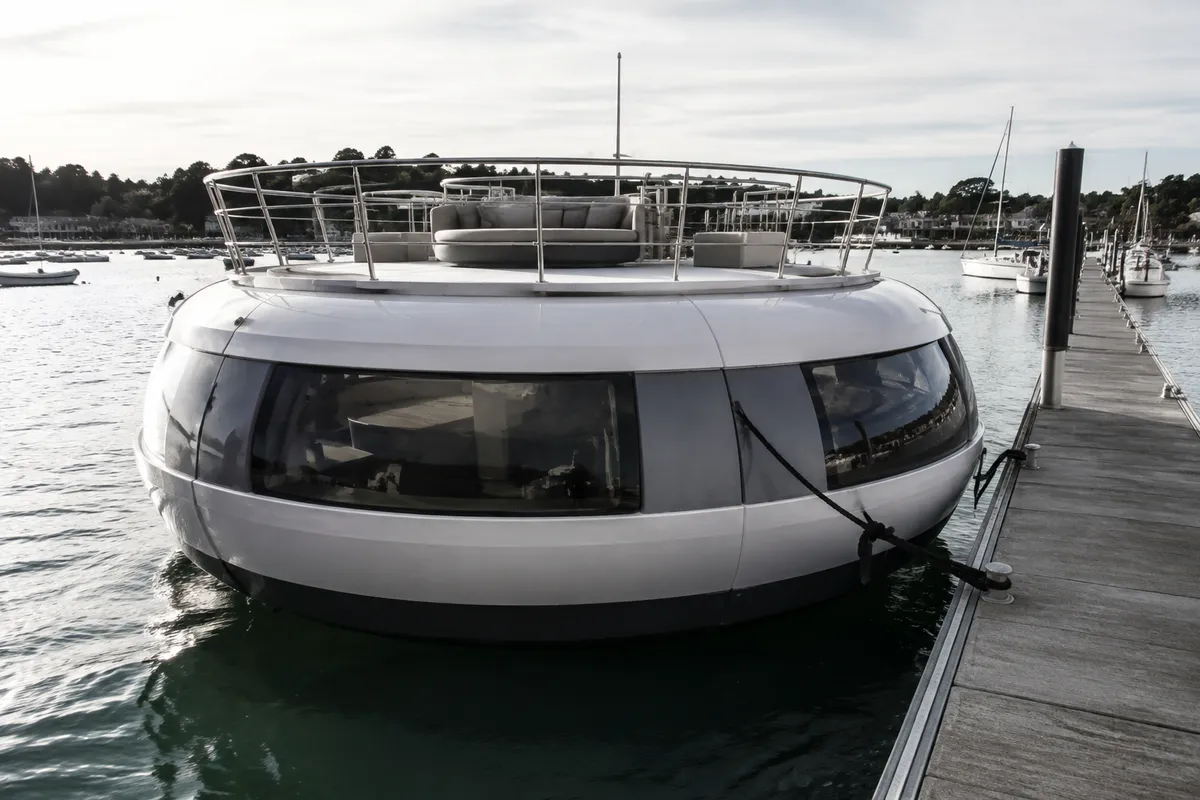
Glossy promotional renders routinely depicted autonomous floating pods drifting across turquoise lagoons, completely detached from civilized infrastructure. When I visited operational pods along the European coast, the real-world operational deployment presented an entirely different visual. Each guest unit sat firmly secured inside an active commercial harbor, held in place by heavy braided mooring lines and rubber dock fenders, tied directly to concrete pontoon slips.
The shift from mobile ocean suite to static marina rental is driven by legal and insurance mandates. Maritime administrative bodies refuse to classify uncrewed autonomous floating pods as commercial passenger vessels if paying guests lack master marine licenses. Coastal authorities prohibit unmonitored floating objects from anchoring or drifting across territorial channels due to collision hazards. Furthermore, marine protection and indemnity (P&I) underwriters will not insure structural hull integrity unless the pod is tethered within a designated harbor breakwater.
This operational transition fundamentally alters the guest environment. Instead of hearing lapping open-sea currents in total isolation, guests listen to harbor halyards clanking against aluminum sailboat masts, diesel tenders idling at dawn, and foot traffic traversing timber dock fingers. True unmoored ocean living reality requires complex support infrastructure, forcing operators to rely on a fixed shore power umbilical cord, municipal water hoses, and gated pier security to function reliably.
Anthénea Floating Pod Hotel: Architecture, Guest Experience, and Corporate Reality
Inside the Saucer: Circular Design, Underwater Views, and Daily Guest Protocols
The commercial Anthénea floating pod hotel currently provides 50 square meters (538 square feet) of circular interior living space. Stepping through the curved entrance door reveals a central 2.15-meter circular bed positioned directly opposite curved panoramic acrylic windows. The primary living lounge features a recessed submerged observation well built into the hull floor, while an exterior spiral staircase leads up to a rooftop solarium designed to seat up to 12 people beneath an adjustable sunshade canopy.
Daily operations on board require guests to adhere to specific maritime protocols. Outdoor footwear must be removed upon crossing the threshold, mirroring private yacht etiquette to protect the delicate curved gelcoat flooring and prevent grit from scratching the bottom observation acrylic. Operators retain mechanical override controls over the solarium roof structure, locking access hatches when harbor wind sensors detect gale-force gusts or turbulent chop inside the basin.
Submerged observation wells in coastal harbors rarely match warm-water marketing photographs. In northern tidal ports like Perros-Guirec, localized silt churning and dense kelp can reduce underwater visibility to less than one meter, particularly during mid-tide cycles.
Operational units in Brittany are moored at Port de Perros-Guirec and the nearby port of Trébeurden. While each pod integrates five rooftop solar panels and two electric propulsion thrusters intended for slow coastal cruising, commercial guest suites operate entirely as stationary pontoons. Nightly pricing runs between €330 and €380 ($360 to $415 USD) depending on seasonal demand, with reservations handled through mainstream travel platforms.
| Metric / Feature | Manufacturer Design Specification | Commercial Marina Reality |
|---|---|---|
| Interior Usable Space | 50 m² (538 sq ft) | 50 m² open circular studio layout |
| Primary Bed Dimension | 2.15-meter circular berth | 2.15-meter custom circular mattress |
| Rooftop Solarium Capacity | Up to 12 persons seated | Mechanically locked during gale winds |
| Mobility / Propulsion | Twin electric motors (off-grid cruise) | Stationary mooring, motors deactivated |
| Submerged Observation Well | Direct marine ecosystem viewing | Visibility limited by local water turbidity |
| Shoe Policy on Board | Barefoot / soft indoor footwear only | Strictly enforced to preserve gelcoat |
Commercial Viability and Turmoil: From $535k Price Tag to Redressement Judiciaire in Lannion
Anthénea marketed commercial sale units to private buyers and boutique resort operators at a baseline price of $535,000 (€490,000) for a fully outfitted capsule. The underlying unit economics, however, presented steep hurdles for hospitality investors. In temperate zones like Brittany, a pod generating an average daily rate of €350 across a 110-day summer operating window yields approximately €38,500 in gross annual revenue. After factoring in marina slip rental fees, specialized marine insurance, pump-out charges, and professional turnover cleaning, amortizing a half-million-euro initial capital outlay stretches past 15 years.
These harsh financial fundamentals caught up with the manufacturer. On June 10, 2026, the Commercial Court of Saint-Brieuc placed Anthénea SAS, headquartered in nearby Lannion (SIREN 841532997), into judicial receivership, known under French commercial law as redressement judiciaire. The court initiated an observation period to stabilize cash flow and identify potential corporate acquirers capable of refinancing manufacturing debt.
For travelers and hospitality developers, this legal status introduces tangible operational exposure. When a boutique marine manufacturer enters court administration, factory warranties on custom composite hulls become precarious, and replacement components for proprietary hydraulic roof lifts or curved glazing face indefinite delays. Travelers booking future calendar dates must monitor whether the managing operator maintains independent financial standing from the insolvent production entity.
Ocean Builders SeaPod: Engineering Ambition, Linton Bay Launch, and Subsea Pivot
Spar Buoy Architecture vs. Structural Balance: The Anatomy of the Linton Bay Incident
Ocean Builders envisioned a completely different structural form factor with its SeaPod floating suite. Built upon a spar buoy floating foundation, the flagship SeaPod provided approximately 830 square feet (77 square meters) of interior living space divided across three split half-levels. The living capsule was elevated 7.5 feet (roughly 2.2 to 2.3 meters) above the ocean surface on a single vertical steel spar, supported beneath the waterline by 1,688 cubic feet of air-filled steel ballast tubes designed to provide buoyancy and counteract wave impact.
Purchase options were categorized into distinct tiers, beginning at $295,000 for the entry-level SeaPod Eco model and climbing to $1.5 million for fully automated flagship units. The platform promised advanced smart-home integrations, automated environmental management, and unobstructed sea views from its elevated deck. Yet placing living accommodations high on an elevated spar introduces extreme hydrodynamic sensitivity, making the structure completely reliant on active ballast trimming to maintain equilibrium.
On September 22, 2022, during an official unveiling at Linton Bay Marina in Panama attended by the country's president, the SeaPod prototype suffered a ballast tank malfunction and marine bilge pump failure inside the spar column. The structure listed heavily and capsized onto its side, as detailed in Dornob's engineering report.
The Linton Bay accident laid bare the engineering liabilities inherent to single-spar elevated living quarters. Unlike traditional catamarans or wide-beam displacement barges that possess high natural form stability, a vertical spar relies on precise mechanical fluid distribution. When internal bilge pumps fail or balance valves jam during ballasting procedures, the tall center of gravity quickly overcomes buoyancy forces, causing a rapid structural list that leaves occupants vulnerable to uncontrolled water ingress.
From Elevated Over-Water Suites to AlphaDeep Underwater Habitat
Following the public prototype failure in Linton Bay, Ocean Builders dramatically altered its strategic trajectory. Prospective guests who joined waitlists had paid initial refundable deposits of $199, with prospective buyers committing 30% construction milestone payments. However, planned consumer pod hotel rollouts and short-term hospitality bookings were shelved, leaving reservation requests restricted to offline email communication via dedicated guest support addresses rather than dynamic booking engines.
Between 2024 and 2025, the company diverted core operational resources toward deep subsea engineering. Company president Rüdiger Koch relocated his research base beneath the water, completing a 120-consecutive-day saturation mission inside the AlphaDeep underwater habitat off the coast of Panama through January 2025. This project signaled a fundamental shift away from commercial floating hotel suites toward hyper-specialized sub-surface life-support enclosures.
During this pivot, earlier marketing assertions regarding autonomous daily operations fell away. The automated aerial delivery drones originally showcased to drop groceries directly onto SeaPod landing pads using smart-ring tracking failed to clear civil aviation safety approvals under Panama's AAC regulations, which restrict autonomous drone flights over choppy open water. Operational transport reverted to standard gasoline-powered fiberglass tenders, proving that marine hotel logistics still require conventional human labor and dockside support.
Floating Pod Resort Tech: Energy, Waste, and Hydrodynamic Constraints
Off-Grid Energy & Blackwater Realities: Shore Umbilicals and Marine Holding Tanks
Marketing brochures for solar-powered floating suite units routinely advertise endless off-grid autonomy. In daily operation, however, the energy balance of a compact pod faces severe physical limits. A typical pod roof accommodates between 3 and 5 kWp of photovoltaic panels; Ocean Builders utilized a 25-square-meter solar platform delivering roughly 4.5 kWp under ideal laboratory conditions. Anthénea incorporates five solar modules paired with specialized battery banks.
When compared against standard luxury hotel loads, that electrical generation falls short. A modest marine split-system air conditioner requires 1.0 to 1.5 kW of continuous power, an induction cooktop draws up to 2.2 kW, and a reverse-osmosis desalinator demands 1.5 kW. Running climate control throughout a humid, tropical night drains a standard onboard battery bank within three to four hours, making an auxiliary diesel generator or a continuous shore power umbilical cord an absolute necessity to prevent low-voltage inverter cutouts.
Wastewater management introduces another complex regulatory barrier. Under International Maritime Organization guidelines, IMO MARPOL Annex IV regulations formally govern vessels over 400 gross tonnage or certified to carry more than 15 passengers. Micro-pods with 2 to 4 guests slip below this international threshold, placing them under local coastal environmental laws and marina regulations. In European harbors, direct discharge of untreated blackwater is strictly prohibited, requiring dedicated sealed holding tanks and weekly vacuum pump-out truck visits.
If an operator claims a pod is entirely off-grid yet features high-draw amenities like hot tubs, espresso machines, and continuous air conditioning, look closely beneath the entry pontoon: you will invariably spot a heavy rubber shore power cable running back to the pier pedestal.
Marine Motion and Structural Physics: Wave Motion, Resonance, and Guest Comfort
A persistent misconception among travelers is that an elevated or saucer-shaped floating pod feels as stationary as a concrete hotel foundation. Water is a dynamic medium, and every floating hull architecture reacts uniquely to surrounding hydrodynamic forces. Disc-shaped hulls, such as Anthénea, exhibit exceptionally high initial transverse stability. While this prevents them from easily flipping over, it causes the pod to track the wave slope directly, translating passing motorboat wake into high-frequency, jerky angular movements that rattle glassware and jar unacclimated guests.
Conversely, a spar buoy floating foundation behaves according to distinct pendulum dynamics. The deep vertical column experiences reduced impact from surface wave chop, but it possesses a very low natural frequency. When exposed to long-period ocean swells, single-column platforms can develop swell resonance and pitch motion, creating a persistent, slow-motion sway. You can learn more about managing motion and noise by reading my guide on what it is actually like sleeping on water.
To mitigate this motion sickness trap, marina operators install heavy-duty elastic hawser snubbers and tie modules tightly into protected inner basins behind stone breakwaters. When wind chop builds within an exposed harbor, the constant lateral pulling on mooring cleats creates rhythmic creaking sounds that travel directly through composite fiberglass hulls, disrupting sleep for unsuspecting guests.
Futuristic Floating Pods Booking Guide: Access, Safety Audits, and Practical Expectations
Reservation Channels, Pricing Breakdown, and Commercial Pod Availability
Securing a night in a futuristic pod requires understanding that conventional travel discovery channels do not always apply. While units like Anthénea can be booked directly through mainstream platforms like Airbnb and Booking.com under commercial hospitality listings, other developers require manual intake processes. Ocean Builders never fully automated its reservation infrastructure, routing prospective short-term overnight inquiries through direct email communication.
Nightly rates reflect the niche status of the accommodation. An Anthénea suite in Port de Perros-Guirec commands between €330 and €380 ($360 to $415 USD) per night, fluctuating based on high summer and shoulder seasons. Ocean Builders projected stay fees between $500 and $1,200 per night for their flagship platforms, though commercial access remains offline as their internal operations prioritize deep-sea projects.
Harbor geography plays a decisive role during your stay. In Brittany, semi-diurnal tidal ranges routinely exceed 8 meters between low and high water. When the tide recedes, floating marina pontoons drop dramatically, turning standard gangways into 35- to 40-degree downward slopes. Checking in with heavy wheeled luggage during a spring low tide becomes an exhausting physical exercise across narrow, flexing dock fingers.
| Concept / Model | Reservation Method | Nightly Cost (Estimated / Actual) | Operational Deployment Status (2026) |
|---|---|---|---|
| Anthénea Suite (Brittany) | OTA Platforms (Booking / Airbnb) | €330 – €380 ($360 – $415 USD) | Operational, tethered to marina pontoons |
| Ocean Builders SeaPod | Direct inquiry via email | $500 – $1,200 USD (projected) | Commercial hotel program suspended |
| Autonomous Nomadic Suite | Direct boutique operator | Variable by charter | Prevented by coastal maritime law |
The Floating Pod Safety Audit: Pre-Boarding Inspections and Emergency Readiness
Because autonomous floating pods operate in a regulatory gray area between real estate and naval vessels, safety standards can vary widely between operators. When I step aboard any independent watercraft hotel, I conduct a brief five-point safety inspection before the marina host hands over the keys and walks back down the pontoon. For broader guidelines, review my checklist on houseboat hotel safety.
- Bilge Float Switches: Locate the sub-floor access hatch and manually lift the primary bilge pump float arm. You should hear the 12V pump motor engage instantly to clear residual water.
- High-Water Alarms: Verify that the secondary bilge sensor is wired to an audible alarm inside the main cabin, ensuring you are alerted if hull compromise occurs while you sleep.
- Battery State of Charge: Check the solar inverter panel display; battery voltage should read above 12.6V (or 50.4V on 48V systems) when disconnected from the dockside charger.
- Safety Life Jackets: Ensure properly fitted, certified CE or USCG life vests are physically present in an unlocked cupboard for every registered guest.
- VHF Radio Verification: Confirm there is a functioning marine VHF radio inside the unit tuned to Channel 16 for international distress calls and Channel 9 for local marina assistance.
If a severe ballast list develops or an audible bilge alarm sounds continuously, evacuate immediately across the boarding gangway onto the central marina pontoon. Never remain inside an enclosed composite pod to troubleshoot rising water levels.
Never allow marina staff to leave until you have physically verified that the bilge pump float switch triggers and the marine VHF transceiver powers on.
Accessibility Hurdles and Marina Logistics: Who Should (and Shouldn't) Book
Neither Anthénea nor the SeaPod design complies with international accessibility legislation such as the Americans with Disabilities Act (ADA) or the European Accessibility Act (EAA). The journey from the marina parking lot to the bed requires traversing undulating, ramped gangways, swinging pontoon fingers without handrails, and narrow exterior hull thresholds. Inside the Anthénea pod, accessing the panoramic rooftop solarium involves climbing an exposed, tight spiral staircase that poses a severe hazard for anyone with balance limitations.
Luggage must also be chosen with care. Bulky hard-shell suitcases will scuff rounded fiberglass walls and will not fit down narrow hatchways. Travelers should consult my recommendations on what to pack for a floating hotel, opting for soft duffel bags and non-marking, rubber-soled boat shoes to comply with strict barefoot boarding rules.
These micro-suites work well for mobile couples, architecture enthusiasts, and adventurous solo travelers who are comfortable around tidal water. They are entirely unsuitable for wheelchair users, individuals with severe vertigo or inner-ear balance disorders, and families traveling with toddlers or young children who require secure exterior railings.
The Industry Verdict: Viable Alternatives and the Future of Off-Grid Floating Suites
Architectural Lessons Learned: Why Fixed-Marina Pontoons Won Over Nomad Pods
The operational trajectory of both Anthénea and the SeaPod demonstrates that unmoored, nomadic ocean pods remain an unviable commercial reality. Marine biofouling represents an unrelenting operational expense; submerged acrylic viewing windows and composite hulls accumulate thick layers of algae, barnacles, and tubeworms within weeks, requiring frequent diver scrubbing and costly drydock hauling every 12 to 24 months. You can see how tropical resorts tackle these environmental hurdles in my analysis of tropical floating eco-resorts.
Combined with maritime laws that prohibit uncrewed vessels from drifting freely, the dream of independent seasteading hospitality has quietly demoted itself. The units that survived commercially did so by relinquishing their propulsion and functioning as novelty waterfront hotel rooms permanently tied to shore infrastructure. They offer a memorable night on the water, but they are stationary harbor glamping pods rather than self-directed exploration vessels.
Emerging Alternatives: Static Eco-Villas and Regulated Floating Architecture
Travelers and hospitality developers looking for sustainable stays on water do not need to wait for science-fiction pods to master autonomous ballasting. The market has delivered proven, highly stable alternatives that balance marine connection with engineering reliability. Established floating architectural practices, such as Dutch firm Waterstudio helmed by architect Koen Olthuis, have successfully built heavy concrete-caisson floating villas throughout northern Europe.
Concrete-caisson floating foundations provide immense displacement weight, completely eliminating the pendulum tilt and snap motion associated with composite pods. These structures connect safely to municipal utility networks while offering spacious, multi-bedroom layouts that comply with local building codes. Meanwhile, travelers seeking true ocean mobility can book chartered solar-electric catamarans, which feature proper maritime registration, comprehensive safety certifications, and licensed captains capable of navigating safely between pristine anchorages.
If you choose to book a stay aboard an Anthénea pod in Brittany, approach it with clear expectations. Appreciate the unique curve of the living room, watch the harbor tides shift through the observation well, and enjoy the waterfront setting. Just recognize that you are paying for an inventive architectural pavilion secured to a marina pontoon, not piloting the dawn of an off-grid oceanic frontier.