
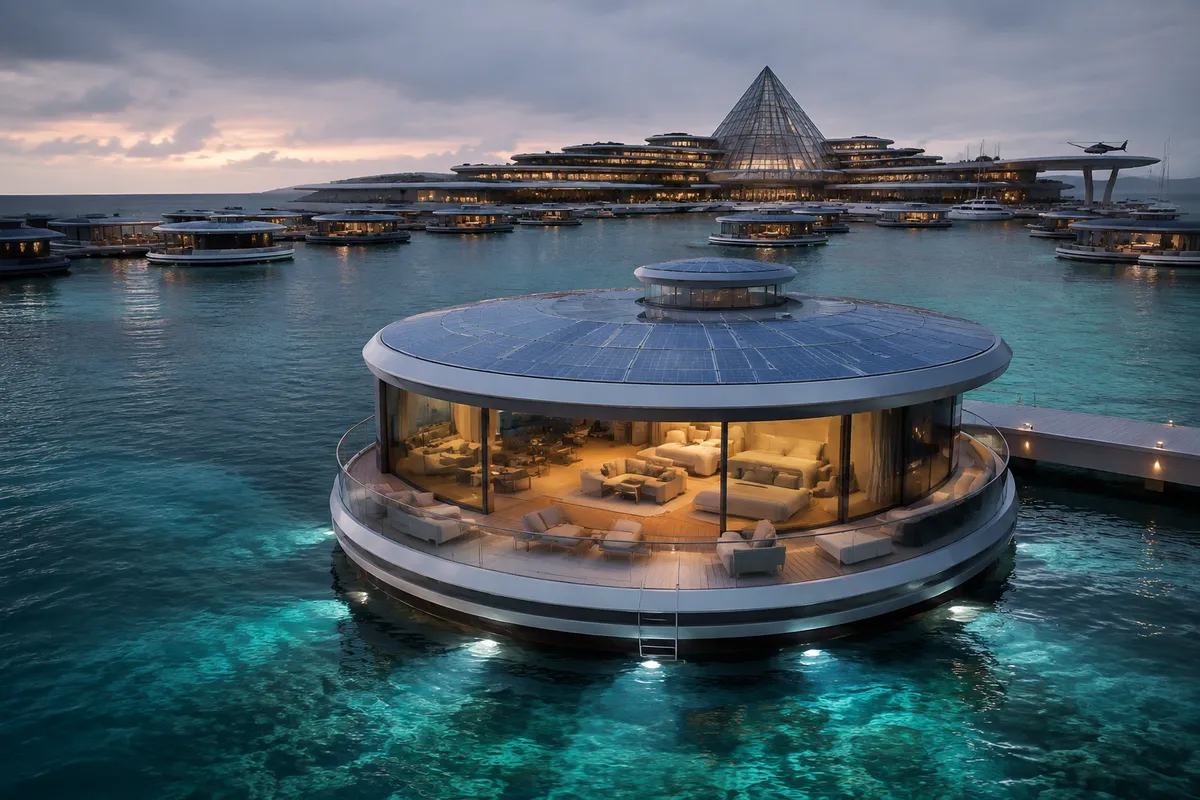
Municipal port authorities and maritime safety boards across Europe and the Middle East tightened mooring regulations and waste-discharge rules for commercial floating berths in 2026. Travelers booking newly launched waterborne accommodations face unexpected security deposits, mandatory weather lockouts, and sudden cancellations whenever a vessel is towed away for mandatory hull inspections. Anyone expecting the static stability of a land-based hotel room risks seasickness, sleepless nights from hull-conducted engine vibration, or discovering that their overwater villa cannot be reached during extreme tidal ebbs.
Different waterborne structures serve entirely different travel profiles. Fully autonomous electric pods and elevated jack-up yachts suit travelers seeking complete off-grid privacy who can handle bareboat charter paperwork and tight luggage limits. Conversely, urban river pontoons and converted cargo vessels offer central city locations at accessible nightly rates, provided you are prepared for compact cabin footprints, steep articulated gangways, and shared municipal shore power.
Architectural Foundations of New Floating Hotels 2026: Hydrodynamics vs. Static Pilings
Overwater Bungalows vs Floating Rooms: Structural Classification and Wave Dynamics
Booking platforms regularly conflate static overwater bungalows with displaced buoyant rooms, yet the two systems react to water movement in fundamentally opposite ways. A static overwater bungalow rests on bored concrete pilings or cantilevered steel jackets driven deep into the seabed. The structure does not rise or fall with the tide, which subjects its support columns to continuous hydrodynamic shear forces and transmits wave-slap shock directly into the floor frame.
True buoyant rooms rely on displaced pontoons, catamarans, or monolithic concrete caissons that float directly on the surface. These units maintain a neutral waterline but transfer orbital wave energy directly into roll and pitch motion. In open bays, a moored displacement pontoon experiences low-frequency roll periods between 2.5 and 4.5 seconds, which can induce sensory conflict and vestibular nausea even in protected anchorages where surface chop looks deceptively mild. Before selecting an overwater stay, check our guide to sleeping on water and cabin living to understand how different hull types influence sleep quality.
| Structural Feature | Fixed Overwater Stilt Villas | Displaced Buoyant Suites |
|---|---|---|
| Substructure Foundation | Bored concrete piles / steel jackets | Concrete caissons / catamaran hulls |
| Tidal Response | Fixed elevation; clearance fluctuates | Floats with water level; elevation constant |
| Benthic Footprint | Direct seabed drilling and reef core damage | Localized helical screw or drag anchors |
| Motion Dynamic | Zero heave; vibration from wave impact | Translational roll, heave, and pitch motion |
| Relocatability | Permanent; requires demolition to remove | Towable or self-propelled to new berths |
Examine the property's architectural elevation drawings on official planning portals. If the foundation shows vertical piles extending above high water with no guide collars or rollers, the suite is a static pier structure, not a floating hull.
Pontoon Hotel Suites and Retrofitted Hulls: Structural Mechanics and Enclosed Waterways
Most commercial floating developments rely on either purpose-built cellular concrete caissons or converted welded-steel industrial hulls. Monolithic concrete pontoons, often filled with expanded polystyrene cores, provide immense deadweight displacement. This heavy ballast lowers the platform's center of gravity, generating a high metacentric height that prevents uncomfortable listing when guests gather along one side of an observation terrace.
Converted steel cargo hulls behave differently. While cheaper to acquire, steel transfers thermal extremes and requires strict corrosion maintenance. Under classification society rules from DNV and Lloyd's Register, commercial steel botels must undergo dry-dock ultrasonic hull-thickness gauging every five years. During my stay on a retrofitted North Sea river barge, the metallic clank of an auxiliary bilge pump cycling at 03:00 AM carried straight through the uninsulated ribbing into my berth.
- Cellular Concrete Caissons: Operational lifespan exceeds 50 years without dry-docking; superior acoustic mass damping against water chop.
- Retrofitted Welded Steel Hulls: Require sacrificial zinc or aluminum anodes, periodic dry-dock maintenance, and specialized thermal break liners to stop internal condensation.
- Composite Catamaran Pontoons: Lightweight and highly resistant to saltwater corrosion, but vulnerable to high-frequency roll under short-period harbor wakes.
Ask the operator whether the floating suite rests on a concrete caisson or a steel hull. Steel hulls over 25 years old frequently suffer from structural vibration transfer from auxiliary machinery.
Megaprojects and Ultra-Luxury Openings: Upcoming Floating Resorts 2027
Dubai Offshore Megastructures: Kempinski Floating Palace and Solar-Propelled Neptune Villas
Off the coast of Dubai, the Kempinski Floating Palace development targets completion and opening in late 2026. The master structure comprises a 163-key central floating palace anchored around a central glass pyramid, linked to an interconnected floating helipad and docking slips engineered to berth up to 16 private yachts simultaneously. The main platform connects flexibly to surrounding pontoon fingers to absorb wake energy from Gulf maritime traffic.
Flanking the main palace are 48 detached Neptune floating villas. Engineered by El Bahrawy Group, these multi-story residential units feature roof-integrated solar arrays paired with electric propulsion systems capable of navigating at speeds up to 6 knots. Off-season entry rates are projected to start at 50,000 AED per night (approximately $13,610 USD) for two- to four-bedroom configurations, covering a dedicated onboard operational crew of six.
| Operational Parameter | Central Palace Complex | Detached Neptune Villa |
|---|---|---|
| Capacity & Layout | 163 keys, central atrium, ballrooms | 2 to 4 bedrooms across multiple decks |
| Propulsion Capability | Non-propelled moored megastructure | Electric propulsion; cruising speed 6 knots |
| Power Architecture | High-capacity grid connection & gensets | Solar roof array with hybrid battery backup |
| Crew Configuration | Central hotel operations staff | Dedicated onboard crew of 6 personnel |
| Nightly Base Rate | Tiered commercial luxury hotel pricing | From 50,000 AED (~$13,610 USD) off-season |
Guests cannot navigate Neptune villas independently. Under Dubai Maritime Authority regulations, every relocation through Dubai coastal waters requires certified marine pilots, filed passage plans, and harbor master clearance.
Stilted Offshore Isolation: Shebara Resort’s Off-Grid Model in the Saudi Red Sea
In the Saudi Red Sea, the Shebara Resort launch announcement by Red Sea Global marked the debut of 73 reflective stainless-steel orb villas designed by Killa Design. The inventory divides into 38 overwater units cantilevered on static pilings and 35 beachfront suites. Introductory rates start at 9,000 SAR (~$2,400 USD) per night for beach villas and 10,000 SAR for cantilevered overwater units.
Shebara functions as a fully off-grid destination powered entirely by a dedicated solar farm and central battery energy storage system. The orb facades use marine-grade 316L stainless steel with a high-mirror polish. This reflective surface repels intense desert solar radiation to cut cooling loads while shielding the structural shell against severe chloride pitting in the hypersaline Red Sea. For broader context on high-end overwater architecture, explore our guide to luxury floating resorts and sea lodges.
Transfer to Shebara takes 30 minutes by Fly Red Sea seaplane or 30 to 40 minutes by boat from Red Sea International Airport (RSI). When coastal wind chop exceeds Beaufort scale 4, seaplane transfers pause, and resort logistics shift exclusively to rigid hull transfer vessels.
Kinetic Platforms and Modular Suites: Floating Hotel Architecture Projects
Autonomous Pods in Coastal Waters: Anthénea and Off-Grid Solarium Living
The French-designed Anthénea pod operates as an autonomous, circular floating suite in Perros-Guirec along Brittany's Pink Granite Coast. Offering 50 square meters of interior space, entry rates start from €290 (~$315 USD) per night for two guests. The pod features a central underwater observation well built into the salon floor, a 360-degree rooftop solarium with seating for 12, and curved solar arrays that drive low-voltage life-support and water-desalination systems.
Operating these composite pods requires disciplined nautical etiquette. Guests must remove outdoor footwear at the entry threshold to prevent grit from scratching the waxed composite finishes or degrading the watertight rubber seals on access hatches. Booking channels are not locked to exclusive developer registries; travelers can reserve stays directly or via major online travel platforms.
- Wind Thresholds: Exterior solarium access is locked out whenever coastal gusts exceed 20 knots (Beaufort scale 5).
- Wave Limits: Harbor swell over 0.8 meters triggers boarding suspensions from tender shuttles.
- Tidal Range Management: In Brittany's 8-to-10-meter tidal cycles, mooring lines adjust along weighted guide tracks to prevent the pod from grounding on tidal flats.
Anthénea's freshwater production relies on an onboard reverse-osmosis unit powered by solar batteries. Heavy cloud cover over consecutive days reduces daily water allowances for showers to protect navigational power reserves.
Electro-Hydraulic Elevation: Arkup Livable Yachts and Jack-Up Seabed Anchoring
The Arkup 40 and Arkup 75 livable yachts overcome waterborne motion by integrating commercial offshore engineering into luxury residential craft. Stays aboard an Arkup 40 in South Florida start at $1,600 per night according to autoevolution's review of the Arkup house yacht. These vessels use four electro-hydraulic 17-foot spud poles installed at the hull corners.
When lowered to the seabed, these hydraulic spud poles lift the hull up to 7 feet above the waterline. Elevating the hull neutralizes rolling and pitching entirely, converting the floating yacht into a rigid, elevated stilt house within minutes. This mechanical lift protects guests from motion sickness and shields the superstructure from small boat wakes.
- Site Survey: Depth sounders verify a seabed depth under 5 meters with firm sand or limestone subgrade.
- Hydraulic Deployment: Four jack-up spud poles lower simultaneously until footpads achieve stable bottom contact.
- Hull Elevation: Hydraulic rams raise the displacement hull out of water contact, setting a secure clearance above surface waves.
Chartering an Arkup in Miami requires signing a standard Bareboat Charter Agreement and placing a refundable $5,000 security deposit. Miami-Dade County environmental regulations strictly prohibit deploying spud poles onto protected seagrass beds (such as Halodule wrightii or Thalassia testudinum), limiting jack-up operations to designated sandy anchorages.
River Conversions and Cold-Climate Mechanics: New Botel Openings and Urban Moorings
Urban Maritime Repurposing: Good Hotel London and Tidal River Pontoons
Moored at Royal Victoria Dock, Good Hotel London demonstrates how heavy monolithic pontoons can repurpose urban water space. Unlike traditional river barges, this 148-room botel sits atop a massive non-propelled concrete platform that provides superior structural dampening. Nightly rates range between £110 and £240 GBP (~$140 to $310 USD) for standard cabins measuring 13 to 15 square meters, compared to 22 to 28 square meters in nearby Canary Wharf towers priced from £180 to £320.
The vessel's location in Royal Victoria Dock protects it from the steep tidal fluctuations of the open River Thames. Moorings here fall under the jurisdiction of the Royal Docks Management Authority (RoDMA) and GLA Land and Property (GLAP), rather than the Port of London Authority. The dock's lock gates maintain a stable water level, eliminating the steep ramp angles typical of tidal river moorings. For travelers comparing converted vessels across the continent, read our comprehensive guide to European urban botels and barge hotels.
| Accommodation Feature | Good Hotel London (Waterfront Berth) | Docklands Land-Based Hotel |
|---|---|---|
| Standard Room Footprint | 13 to 15 m² (compact ship cabin layout) | 22 to 28 m² (standard commercial layout) |
| Nightly Rate Range | £110 to £240 GBP (~$140–$310 USD) | £180 to £320 GBP (~$230–$410 USD) |
| Waterline Elevation | Eye-level with dock basin surface | Elevated street or high-rise view |
| Motion Sensitivity | Negligible roll due to heavy concrete mass | Completely static foundation |
| Mooring Authority | RoDMA / GLAP enclosed dock licensing | Standard municipal borough planning |
Good Hotel London draws electricity and municipal water through shore-to-ship connection lines. This hookup bypasses onboard generators, keeping guest corridors free from low-frequency mechanical drone.
Dynamic Cryogenic Hydrodynamics: Arctic Bath’s Seasonal Freeze-and-Float Architecture
In Harads, Sweden, the timber cabins at Arctic Bath on the Lule River showcase extreme cold-climate engineering. These 24-square-meter water cabins start from 5,995 SEK per night. During open-water summer months, the units float freely on displaced pontoons; in winter, sub-zero conditions down to -30°C lock them directly into thick river ice.
Architects Bertil Harström and Johan Kauppi shaped the submerged pontoon walls with inward-sloping hull angles. When river ice expands laterally, the angled surfaces convert horizontal compressive force into upward vertical thrust, lifting the hulls slightly rather than crushing them. Continuous circulation pumps around the central cold bath maintain open water to prevent ice dams from tearing away structural access footbridges.
- Freeze-Cycle Protection: Sloped pontoon hulls displace compressive river ice upward to prevent structural buckling.
- Insulated Waste Lines: Heat-traced utility conduits prevent graywater and blackwater lines from freezing between cabins and the riverbank.
- Hydronic Heating: Cabins use insulated timber envelopes and embedded subfloor heating powered by regional hydro grids to maintain 21°C indoor temperatures over solid river ice.
During the spring thaw between April and May, shifting river currents cause noticeable cabin listing and creaking as ice floes break apart. Travelers sensitive to balance changes should book land-based suites during this transition window.
Onboard Comfort and Infrastructure: Seasickness, Noise, and Marine Utilities
Hydrodynamic Motion Control: Seasickness Mitigation on Moored Vessels and Articulated Gangways
Moored vessel seasickness stems from low-frequency motion between 0.1 and 0.3 Hz. This continuous roll and pitch creates a sensory mismatch between inner-ear fluid movement and the fixed visual horizon inside an enclosed cabin. Well-engineered floating structures counter this motion by installing longitudinal bilge keels beneath displacement pontoons, reducing resonant roll amplitudes by 35% to 50% compared to flat-bottomed barges.
Shore connections introduce distinct mobility challenges. At coastal berths with large tidal swings, articulated gangways rotate through wide angles. Under the U.S. Access Board boating guidelines, gangways can exceed the standard 1:12 accessible ramp slope up to a steep 1:8 during extreme astronomical low tides. I watched a guest with a rolling duffel slip on an exposed aluminum hinge plate when low tide tilted the gangway past 12 degrees.
| Tidal Condition | Water Surface Elevation | Gangway Articulation Slope | Accessibility Status |
|---|---|---|---|
| Mean High Water (MHW) | +3.2 m datum | 1:14 (approx. 4.1°) | Exceeds standard ADA accessibility |
| Mean Sea Level (MSL) | +1.6 m datum | 1:11 (approx. 5.2°) | Fully compliant step-free access |
| Astronomical Low Water | -0.4 m datum | 1:8 (approx. 7.1°) | Regulatory exception; assistance required |
If anyone in your party uses mobility aids, check local tide charts against planned arrival times. Boarding during mid-to-high tide ensures gangway angles remain within manageable slopes.
Structural Acoustics and Marine MEP: Bulkhead Insulation, Power Grids, and Vacuum Sanitation
Noise transmission on floating vessels travels primarily as structural vibration through metal decks rather than airborne sound. International regulations like IMO SOLAS Resolution MSC.337(91) limit cabin noise to 55–60 dB(A). However, when a converted botel runs auxiliary diesel generators instead of using a municipal shore connection, engine vibrations produce 100–110 dB(A) inside the machinery room. This vibration radiates straight through uninsulated steel bulkheads as a continuous 45–50 dB(A) low-frequency hum in adjacent berths.
Steel hulls also disrupt wireless signals. A watertight 6 mm marine steel bulkhead attenuates 5 GHz Wi-Fi signals by 20 to 30 dB through the Faraday cage effect. Floating properties must run shielded Cat6 cabling into individual compartments or mount dedicated wireless access points inside every cabin.
- Shore-to-Ship Power: Keeps cabin background noise down to 35–42 dB(A) by silencing onboard generators and eliminating diesel exhaust odors.
- Auxiliary Diesel Gensets: Produce continuous low-frequency vibrations and increase cabin noise to 48–56 dB(A) when moored away from city grids.
- Vacuum Sanitation: Vacuum marine heads use only 1.0 to 1.2 liters per flush, cycling directly into sealed blackwater tanks to meet MARPOL Annex IV zero-discharge standards.
Inspect the corridor walls outside your berth. If you see surface-mounted conduit and bare painted steel rather than thick acoustic paneling, pack high-density earplugs to block nighttime pump noise.
Safety Compliance and Maritime Visibility: AIS Vessel Tracking and Mooring Permits
Before reserving an extended stay aboard a converted vessel or private botel, verify its operational status using the Automatic Identification System. Commercial hotel ships and self-propelled vessels broadcast their location, draft, and status via AIS transponders. You can monitor this live data through tracking platforms governed by standard terms, such as the VesselFinder service agreement.
Checking a vessel's Maritime Mobile Service Identity (MMSI) number confirms whether the property is securely moored at its advertised pier or berthed elsewhere for seasonal dry-docking. Legitimate botels must also display certified mooring permits from the local harbor master and post in-date life-raft inspection certificates from maritime safety authorities.
- Locate Identifiers: Find the vessel's official IMO or 9-digit MMSI number on the operator's booking disclosure or fleet registry.
- Run AIS Search: Enter the number into an AIS tracking database to verify the vessel's status shows "Moored" at the correct coordinate berth.
- Check Permit Seals: Look for current harbor master mooring licenses and municipal sanitary discharge permits posted beside the gangway check-in desk.
If an AIS search flags a vessel as "Underway," "Aground," or located in an industrial shipyard within two weeks of your arrival date, call management immediately to confirm the hotel will actually be at its pier.
Strategic Booking Verdict: Evaluating the Future of Floating Hospitality (2026–2027)
Blue-Tech Speculation vs Real Inventory: Why Projects Like OCEANIX Busan Remain Unbookable
Architectural renderings of futuristic floating cities often present a distorted picture of available hotel inventory. The OCEANIX Busan project, developed with UN-Habitat and Bjarke Ingels Group, continues to serve as an experimental blue-tech testbed rather than a commercial resort. The development focuses on closed-loop waste systems, scalable marine platforms, and wave-energy harvesting.
No commercial hotel rooms or floating suites at OCEANIX Busan are open for public booking for the 2026–2027 seasons. Massive offshore platforms face complex regulatory hurdles, including dual-classification codes between land building laws and maritime registries. For a grounded look at commercially operational houseboats, read our guide to rented houseboat hotels and static stays.
- Regulatory Gaps: Maritime nations lack legal frameworks to classify multi-acre floating platforms as standard commercial real estate.
- High Capital Costs: Building marine-grade cellular concrete platforms costs three to five times more per square meter than standard terrestrial foundations.
- Utility Scaling: Offshore installations must build dedicated desalination, waste treatment, and microgrid plants before opening to overnight guests.
Disregard promotional announcements that lack clear reservation engines, nightly rates, or confirmed classification certificates from established maritime registries.
Decision Matrix: Matching Vessel Typologies to Budgets, Mobility, and Motion Sensitivity
Selecting the right waterborne stay requires balancing your budget against physical mobility and susceptibility to seasickness. Self-elevating yachts like the Arkup eliminate motion entirely through mechanical spud poles, but require deep budgets and bareboat charter paperwork. Converted urban botels deliver exceptional city locations at moderate rates, but feature compact cabins and fluctuating gangway slopes. To avoid hidden mooring costs, review our guide to floating hotel pricing and dock fees before paying a deposit.
| Vessel Typology | Nightly Price Range | Motion Sensitivity | Step-Free Access | Best Suited For |
|---|---|---|---|---|
| Autonomous Pod (Anthénea) | €290–€550 (~$315–$600 USD) | Moderate (coastal harbor chop) | Low (tender boarding required) | Eco-focused travelers; off-grid short stays |
| Urban Concrete Botel (Good Hotel) | £110–£240 GBP (~$140–$310 USD) | Minimal (heavy concrete damping) | High (enclosed non-tidal dock basin) | City travelers; budget-conscious visitors |
| Jack-Up Livable Yacht (Arkup 40) | From $1,600 USD | Zero (elevated above water) | Moderate (stair access from dock) | Families seeking absolute stability |
| Cantilevered Villa (Shebara) | 9,000–10,000+ SAR (~$2,400+ USD) | Zero (rigid seabed pilings) | High (fixed golf cart jetties) | High-budget travelers requiring full luxury |
| Propelled Palace Villa (Neptune) | From 50,000 AED (~$13,610 USD) | Low to Moderate (displacement hull) | Moderate (crew-assisted boarding) | High-net-worth groups wanting private crew |
The best rule for booking any floating hotel over the next two years is simple: match the vessel's hull and mooring mechanics to your personal sensitivity to motion and noise, rather than booking based on wide-angle room photos.