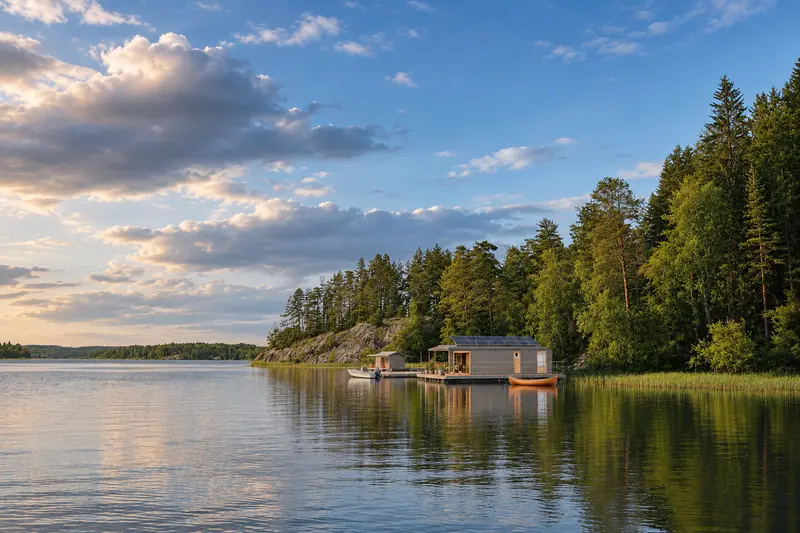
One or two guests pay ≈ $420 (kr 4,200) for the night. The rate covers the cabin, the rowboat that comes with it, the deck kitchen, the farm's wood-fired sauna, and the breakfast that arrives by water in the morning. Power comes from solar panels on the cabin roof charging a battery bank that runs the lights, the fridge and the raft's electric motor, and nothing on the farm is connected to the grid.
| Your trip | Verdict | Reason |
|---|---|---|
| Two swimmers spending a summer night outdoors | Raft stay | The deck, bathing ladder and rowboat are the main living space. |
| A cold-weather break with a heated room | Log cabin | Timmerstugan has a wood-burning stove; the raft has no insulation. |
| A trip with a dog | Stay ashore | The log cabin and safari tent accept dogs; Flottellet does not. |
| A working holiday with video calls | Mainland hotel | The island has weak mobile reception and no guest Wi-Fi. |
The raft, the mooring, and the rules that come with them
Flottellet is purpose-built: a glazed timber cabin on a float, with a deck, a grill at the rail and a bathing ladder for swimming straight off the platform. Staff move it on the raft's electric motor and moor it in a calm corner of the lake, and only trained personnel are allowed to drive it. What you steer is the rowboat that comes with the stay, which is your link to the farm's own landing stages and your own way to explore the bay at any hour.
Arrival includes a safety walk-through, and everybody sleeping on the raft must be able to swim. The rowboat is also the route back to shore facilities, so boarding and rowing form part of the overnight stay. The farm also cannot promise that you will be the only guest on the island, because the log cabin, the Magasinet rooms, the safari tent and the floating tree tents are rented out at the same time. The buildings are out of sight from the mooring, and the sound that carries across the water in the evening is voices from the farm and the dip of an oar.
Inside the cabin: sleeping temperature and battery power
The double bed comes made up with ironed linen, towels and bath slippers to borrow. USB sockets in the bedside lamps charge phones. The glazing gives a close view of the lake, but the timber structure is uninsulated: a sunny afternoon heats the room, and after sunset it cools with the outside air. A gas heater is provided for colder nights. My packing list for a floating stay starts here with layers, a power bank and a headlamp for the return from the sauna.
One September I rowed back from the sauna to a bedroom at roughly outdoor temperature, ran the gas heater for an hour and slept in wool under two quilts. It was the coldest night of that trip and the best sleep of it.
The roof panels charge batteries supplying the motor, lights, fridge and phone charging. Charging a laptop or relying on continuous power for work would change the trip considerably. The farm has charging points in the safari tent, log cabin and common kitchen in Magasinet. There is no guest Wi-Fi, and mobile reception is weak; I download my route and booking details before reaching the lake.
The raft has a toilet with panoramic lake views. Back at the farm, the two Separett toilets separate liquid and solid waste and use extractor fans. The shower is in the shore sauna, so washing involves a row back to the island.
Getting there by car: Gnestavägen, the boom and the last 100 metres
The drive from central Stockholm takes about 50 minutes. Motorists head south on the E4 toward Södertälje and turn off Gnestavägen at the sign for the Stora Envättens nature reserve. Roughly 200 metres further on, a road branches right behind a boom; the code arrives with your booking confirmation, and beyond the gate the surface turns to forestry gravel with the usual washboard corrugations, so keeping the speed down protects tires and sump. The farm's directions page asks drivers to use Google Maps and warns that built-in navigation and other apps have sent guests down logging tracks. Parking is a signed gravel area at the water's edge next to the pickup point, and it is free.
Low-slung cars and vehicles with a loaded rear rack struggle on the estate track: ruts and loose gravel after rain are the usual culprits, and the undercarriage takes the damage. If the week has been wet, take the taller car.
On my last drive down, rain set in over the E4, so I stopped in Gnesta for coffee and dinner shopping before the turn-off, which is the right order of operations because there is nothing to buy past the boom. The code opened the gate, the signposted track led to the gravel lot, and two blasts on the horn brought the farm's raft across within a few minutes.
There is no charging at the lakeside lot, so plan the last stretch around a full battery; Gnesta, Järna and Nykvarn are the nearest towns with services, depending on which way you approach.
Without a car: train to Mölnbo or Gnesta, then a long walk
No public transport reaches the farm. The workable version is a commuter train from Stockholm City (beneath Stockholm Central) to Södertälje centrum and a change to SL line 48 toward Gnesta, which calls at Järna, Mölnbo and Gnesta. The last stretch is a hike, and with a light pack it is a good half-day out, since Sörmlandsleden runs past the property and the stage lengths are published. Mölnbo to Yngsviken on stages 12:1 and 12 covers 12.5 km, and Järna to Yngsviken on stages 11 and 12 covers 17.5 km. From Yngsviken, stage 13 runs about a kilometre to the gravel road, where a sign points to the farm, another 2.2 km on foot.
Those distances total 15.7 km from Mölnbo or 20.7 km from Järna, including the final approach to the pickup point. With a suitcase, the alternative is a taxi to the mainland landing. A pre-booked Sverigetaxi between the mainland pickup point and Mölnbo or Gnesta has a guide price of about $50 (kr 500) one way. For groups, the farm works with coach operator Björcks Resor to bring people to the mainland side, where the electric raft comes out to meet them. A return taxi needs its own booking and fare; the train ticket is separate. Group coach transport also needs arranging before departure.
Meals: breakfast on the water, dinner from the deck kitchen
Breakfast is a buffet built as far as possible on seasonal and local produce, most of it organic and bought from Saltå Kvarn in Järna, sometimes supplemented by the farm's own gardens. If you are staying on the raft, staff paddle it out to you in the morning, so the first meal arrives without you leaving the mooring. Tell the farm about allergies when you book, because breakfast is ordered in advance rather than improvised.
Lunch and dinner are yours to organise. The raft has a fridge, a hotplate, a grill, pans, plates and a spice kit, and the farm supplies drinking water but no other drinks, which includes coffee. The nearest food shops and the nearest Systembolaget are in Gnesta, Järna or Nykvarn depending on the direction you come from, so the shopping happens before the boom and not after it.
If cooking on holiday is not the plan, the farm sells a sous-vide meal package through its catering partner VAK: a main course and a dessert for two, put together around your preferences, reheated in boiling water on the raft's hotplate. The package is ordered as an extra with the accommodation; its quoted total goes into the calculator as food spending for the whole stay. Guests wash their own dishes.
Sauna, swimming and wildlife
The wood-fired sauna is at the farm, reached by rowboat and then on foot from the landing stages. Overnight guests have sauna access and firewood included. Water for the shower and washing dishes is heated separately, so a sauna visit takes some preparation. The raft and the farm's floats have bathing ladders; there is also a jumping trampoline at the farm.
I keep soap and dishwater out of the lake and wash with basin water ashore. Even the supplied gentle washing products need careful use beside freshwater. The practicalities of off-grid Nordic saunas include heating water and returning along dark paths after a late session.
Guided raft trips look for beaver lodges. Osprey, white-tailed eagle and black-throated diver occur around Yngern. Binoculars are supplied with the cabin.
Fishing on Yngern: cards, prices and the perch rule
Perch and pike are the two draws, and a clear-water lake with deep edges and shallow bays suits a rowboat and a box of spinners. You can fish from the raft's deck, though the boat gives you better angles along the drop-offs. The permit comes from the Yngern listing on iFiske and is sold as the Sportfiskekortet Stockholm card, which covers the whole 1,430-hectare lake: ≈ $9.9 (kr 100) for 24 hours, ≈ $20 (kr 200) for a week and ≈ $35 (kr 350) for a member annual card or ≈ $45 (kr 450) for the senior/family annual card. Junior anglers fish free on a personal junior card until the year they turn 19, so a family trip does not need three permits.
Perch measuring 38 cm or more must be returned to the water; the maximum-size rule has applied on Yngern since 2015 to protect large breeding fish. The standard card excludes trolling, rowing with a trailing lure, tip-up ice fishing and crayfish fishing. Those methods require separate permission; the farm also sells seasonal crayfish outings.
What an overnight costs
Flottellet costs ≈ $420 (kr 4,200) per night for one or two guests: ≈ $420 (kr 4,200) for a solo guest or ≈ $210 (kr 2,100) each when two share. Breakfast delivery, mainland raft transfers, parking, the rowboat and sauna access with firewood are included. The cabin also comes with deck furniture, blankets and games; guests can borrow the farm's canoes, kayaks and paddleboards.
A guided raft trip costs ≈ $40 (kr 400) per guest for 1.5 hours, with a minimum of two guests, so the minimum tour booking is ≈ $79 (kr 800) even for a solo traveller. Life jackets, binoculars and a bird book are included on that trip. Fishing permits start at ≈ $9.9 (kr 100) for 24 hours. Dinner, groceries, drinks other than supplied water, train tickets and road transport are additional costs.
The calculator starts with the accommodation charge only. Food and other expenses are whole-trip totals; taxi costs use the number of one-way journeys and the fare per journey. Optional spending stays outside the estimate until entered.
Private-guest prices include VAT. The stay is paid when booking by Swish, card or bankgiro; extras can be settled on site by Swish or card.
Booking, arrival times and the operating season
Book the Flottellet floating cabin directly with Myssjö Gård. The farm also takes bookings through STF Myssjö Gård accommodation booking. The named accommodation matters: other beds on the same island are on land or in suspended tents.
May through September is the core operating season. The wider weather-dependent window is mid-April through October 31, with April and October stays requiring agreement with the farm for the specific dates. A seasonal window is not a promise that the raft is available every day. The booking calendar and the farm's confirmation determine the dates for a stay.
Check-in is normally between 2 p.m. and 4 p.m.; check-out is by 11 a.m. There is no staffed reception. Staff meet guests at the mainland landing at an agreed time, so an arrival outside that window needs arranging with the farm before travelling. The confirmation supplies the gate code, and a further practical-information email arrives about a week before the stay.
The farm's cancellation and payment terms allow a full refund until one week before arrival. Later cancellation is referred to the guest's insurer, whose policy determines any reimbursement. Date, accommodation and activity changes carry no extra change fee, subject to availability. Group and business bookings have separate terms.
Space, weather and dogs
The mooring is sheltered, but wind and footsteps still register through the platform. The raft remains where staff place it. Compared with sleeping aboard a larger moored hotel, the room gives less separation between the bed, the deck and the water.
Guest feedback describes the raft as cramped even for a celebratory stay for two; reviews also mention wanting a roof over the outdoor seating. Rain therefore changes more than the view: it removes much of the usable living space. At dusk, long sleeves and insect repellent make sitting outside more comfortable. I keep luggage small enough to stow without covering the floor around the bed.
Dogs are not allowed on Flottellet. The safari tent and Timmerstugan accept guests staying with their dogs. This is an alternative booking for owner and pet together; it does not include permission to leave a dog alone ashore while its owners sleep on the raft.
Other beds on the same island
The land accommodation shares the common kitchen, sauna, games and paddling equipment. Its larger sleeping capacity makes a substantial difference to families and groups.
| Stay | Capacity | Layout or comfort difference |
|---|---|---|
| Timmerstugan | 5 guests | Log cabin with cooking facilities and a wood-burning stove; dogs welcome. |
| Magasinet | 7 guests | Upstairs sleeping space above the communal kitchen, beside the lake. |
| Safari tent | 4 guests | Glamping accommodation with charging points; dogs welcome. |
| Tree tents and hammock | 2 adults and 1 child per tent; 1 in the hammock | Suspended above the ground, with camping-style exposure to the weather. |
For a solid floor and a train station within walking distance, STF Långbro Gård in Mölnbo, an 1844 manor house, is the nearest alternative.
I would book Flottellet for a summer night for two, with dinner already bought and time to row back for the sauna. For a cold-weather stay I would take Timmerstugan, because its wood-burning stove heats a land cabin without the extra boat journey to shared facilities.