
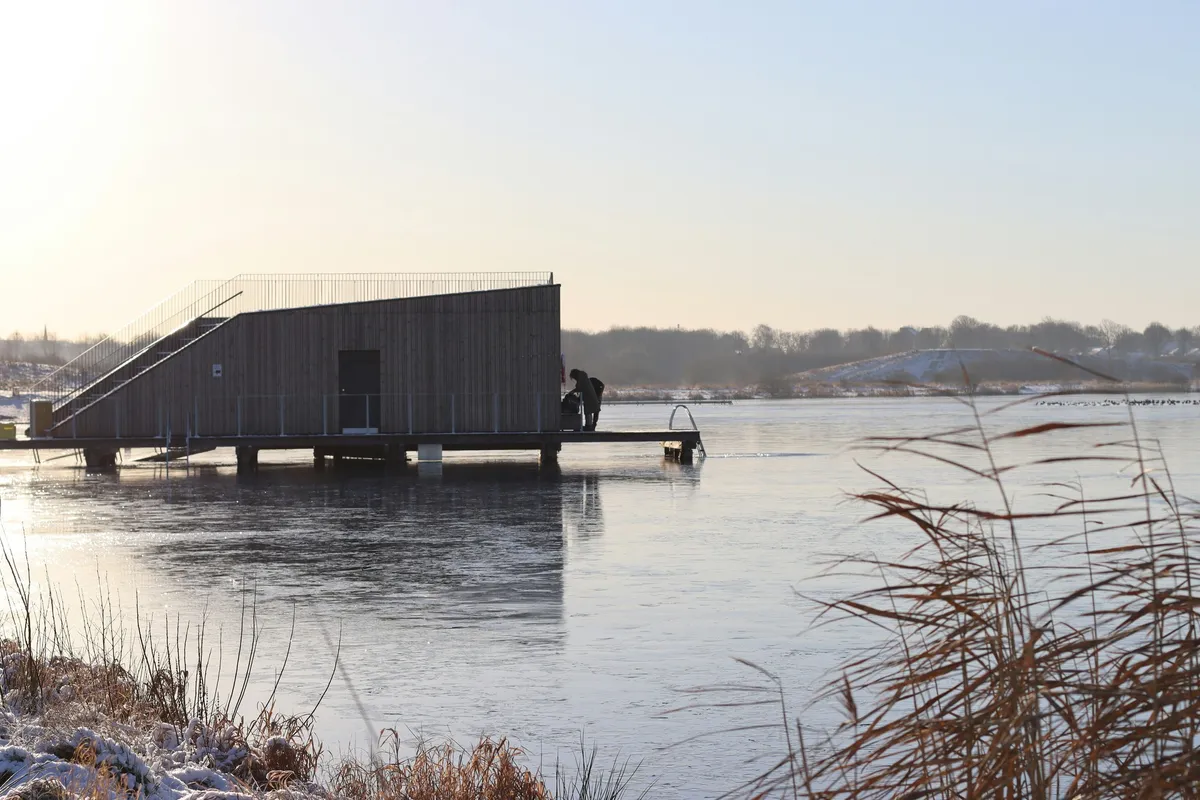
Municipal storm runoff advisories, strict marine discharge laws, and sub-zero gangway icing have turned unvetted cold-weather bookings into logistical headaches. Stepping onto an uninsulated floating sauna hotel or an off-grid Nordic raft without understanding closed-loop heating, municipal water closures, and strict zero-alcohol mandates risks ruined itineraries, sudden fines, and severe cold shock hazards.
Stationary urban bath rafts suit day visitors seeking a controlled ninety-minute thermal cycle near city transit, whereas remote off-grid glass water cabins require full self-sufficiency for winter stays. Choosing between them demands an unvarnished assessment of autonomous electrical budgets, freezing river ice dynamics, and your personal cold-water tolerance.
Hydro-Geological Realities: Late-Autumn Swells and Mid-Winter Freezes
Autumn Wave Dynamics, Tidal Swings, and Gangway Articulation
Navigating an autumn water hotel stay in Scandinavia means facing volatile coastal water dynamics. In the micro-tidal basin of the inner Oslofjord and along the Skagerrak coastline, the mean tidal amplitude stays minimal at 0.3 to 0.4 meters, with spring tidal ranges rarely exceeding 37 centimeters. Further north along the North Atlantic margin, Arctic ports encounter severe macrotidal conditions where the spring range reaches 2.24 meters, with astronomical storm surges pushing vertical water shifts well past 2.5 to 3.2 meters.
These vertical shifts place severe structural demands on access ramps. Articulated pontoons rely on a heavy tidal gangway hinge and integrated deck rollers that adjust to moving water levels. While inspecting these connections during late-autumn gales, I watched an articulated hinge grind against its dock plate under sudden wind load; these mechanical assemblies, along with mooring chains and tension cables, are exclusively maintained by licensed marine operators and must never be adjusted by guests.
Operations stop entirely when autumn squalls blow through. Floating platforms and motorized badstu vessels cancel all departures and dock sessions when sustained winds hit 14 to 17 meters per second or wave chop exceeds 0.8 to 1.0 meters. On urban fjords, heavy autumn rainfall brings another operational pause: municipal storm runoff advisories regularly trigger a mandatory 24-hour swimming moratorium due to raw urban stormwater entering the harbor, as outlined in the official Oslo Badstuforening FAQ.
Never disregard a municipal swimming advisory after autumn rainstorms. Runoff flushes urban street contaminants and sewer overflows directly into inner harbor docks, turning a cold plunge into a significant health risk.
The Freeze-Up Phenomenon: When Floating Structures Anchor Into River Ice
Floating properties on inland waterways operate under completely different physics once autumn transitions into sub-zero winter. The prime example is the Lule River freeze-up in Swedish Lapland. At Arctic Bath in Harads, the accommodation pods float freely on open river currents through September and October, but freeze solidly into a thick river ice sheet from mid-November through mid-April, as documented on the Arctic Bath Water Cabin portal.
Remaining structural integrity during this transition requires specialized naval engineering. The pontoons are constructed from marine-grade aluminum and heavy-gauge polyethylene with angled, tapered hulls. As expanding river ice builds lateral crushing pressure, these tapered profiles convert horizontal compressive loads into vertical lift, pushing the structures slightly upward rather than allowing the ice to crush the pontoon walls inward.
This transition creates a distinct logistical challenge known as the shoulder-season freeze-in. From late October to late November, and again during the mid-April thaw, river ice is too fragile to support pedestrian traffic or snowmobiles (requiring a minimum load-bearing thickness of 10 to 12 centimeters), yet too choked with slush and jagged ice floes for boat tenders to navigate safely. In my experience assessing waterside logistics, guest transfers during these shoulder windows are frequently rerouted to fixed land-based walkways or delayed until the ice stabilizes.
Off-Grid Engineering: Thermal, Power, and Waste Closed-Loop Systems
Autonomous Heating and Micro-Power Generation in Polar Darkness
Operating an off-grid sweden floating hotel sauna or detached guest cabin north of the Arctic Circle rules out standard municipal grid connections. During polar night, photovoltaic arrays produce zero wattage for weeks on end. To maintain uninterrupted power for circulating pumps, LED lighting, and safety communication arrays, modern floating units utilize a compact EFOY direct methanol fuel cell alongside auxiliary marine battery banks.
These direct methanol fuel cells operate automatically, generating 12V or 24V direct current without the exhaust rumble or localized vibration of a conventional diesel generator. Space heating relies on closed-circuit off-grid hydronic heating units and high-efficiency auxiliary heaters. To prevent fuel gelling in extreme sub-zero conditions, these heating loops burn specialized Neste MY Renewable Diesel, engineered with a cold filter plugging point certified down to -32°C for winter blends and -38°C for arctic grades, avoiding the pressure failures common to standard propane regulators below freezing.
Because compact floating glass cabins are built with airtight thermal insulation, heating life-safety protocols are non-negotiable. Every autonomous living pod must feature ceiling-mounted, battery-backed optical carbon monoxide (CO) detectors and combustible gas alarms. If snow drifts block exterior fresh-air intake vents, these detectors provide early warning before dangerous exhaust gases can build up.
Before settling into an autonomous floating cabin for the night, locate the external combustion exhaust and fresh-air intake cowls on the seaward bulkhead. Make sure they remain clear of blowing snow drifts.
Blackwater, Greywater, and Marine Environmental Compliance
Environmental regulations regarding marine discharge are strictly enforced throughout Scandinavia. Under the Swedish Environmental Code (Miljöbalken) and Swedish Transport Agency regulation TSFS 2012:13, discharging untreated blackwater or toilet waste from leisure craft and floating platforms into coastal waters, lakes, and rivers is illegal, as detailed by Havs- och vattenmyndigheten.
To comply with zero-discharge legislation, remote waterside lodges employ two primary sanitation systems. Some install an incinerating toilet Cinderella unit, which burns human waste with electric or gas elements inside a sealed combustion chamber, leaving behind a small cup of sterile, pathogen-free mineral ash. Other units rely on an internal blackwater and greywater holding tank, requiring scheduled vacuum pump-out tenders from shore-based municipal service vessels.
These environmental restrictions directly affect daily routines on the water. Outdoor rinse showers installed on floating docks drain directly into the sea, meaning body washes, exfoliating soaps, and synthetic shampoos are strictly banned. At unstaffed installations such as the Pust floating sauna in Tromsø harbour, the platform design provides zero on-site toilets, requiring guests to use municipal facilities on land before walking across the pier.
Wood Stove Clearances and Chimney Flue Safety Over Water
Wood-fired sauna stoves installed aboard wooden pontoons operate under stringent fire-prevention codes. Floating timber structures flex continuously with wave motion, making rigid masonry clearances impossible. Marine sauna builders must adhere strictly to the European standard EN 15821, which governs physical distances between steel fireboxes and combustible timber bulkheads.
The baseline safety distance from an unshielded wood stove to an unprotected combustible wooden wall is 500 millimeters. Installing a single certified protective sheet metal or mineral board heat shield with an air gap cuts that requirement down to 250 millimeters. A certified double heat shield reduces the clearance further to 125 millimeters, preserving limited interior space inside compact timber saunas.
| Heat Shield Configuration | Minimum Wall Clearance | Deck Plate Protection | Primary Application |
|---|---|---|---|
| Unshielded Firebox | 500 mm | Steel / Mineral plate (100 mm apron) | Wide commercial stationary badstu rafts |
| Single Protective Screen | 250 mm | Continuous non-combustible base | Mid-size timber sauna pontoons |
| Certified Double Heat Shield | 125 mm | Insulated multi-layer hearth plate | Compact off-grid glass water cabins |
Exhaust systems require insulated double-wall stainless steel flues fitted with fine-mesh spark arrestors at the chimney cap to prevent glowing cinders from landing on timber decks. For onboard fire protection, standards established by the Finnish Transport and Communications Agency (Traficom) and ISO 9094 require a portable 2-kilogram ABC dry powder fire extinguisher (minimum rating 8A/68B) mounted immediately outside the hot room entry door.
Thermal Shock Protocols: Cold Plunging and Fjord Immersion Safety
Physiology of the Gasp Reflex and the Hypothermia Safety Window
Stepping from a 90°C sauna directly into winter seawater shocks the human cardiovascular and respiratory systems. In January and February, water temperatures across the inner Oslofjord and coastal Norway plummet to between 1°C and 4°C, compared to summer peaks of 18°C to 22°C. This extreme thermal plunge triggers the involuntary cold shock response within fractions of a second.
The initial phase lasts from zero to sixty seconds, marked by an uncontrollable gasp reflex, immediate hyperventilation, and a severe spike in heart rate and blood pressure. Inhaling during that initial gasp while underwater leads to instant water aspiration. For this reason, Nordic safety rules strictly prohibit diving head-first from floating platforms into winter fjords; bathers must descend deliberately via ladders while keeping their heads fully above the surface.
The subsequent danger is neuromuscular cooling, known as cold incapacitation, which sets in within two to five minutes of sub-zero water immersion. Blood vessels in the extremities constrict, causing rapid loss of finger dexterity and arm strength. Swimmers who stay in the water too long frequently discover they cannot pull their own body weight up a frozen boarding ladder, making immediate exit within 60 to 120 seconds essential for safe winter isbading.
Never swim away from the platform ladder during winter fjord immersion. Cold incapacitation drains grip and arm power in under three minutes, leaving you unable to climb back onto the floating dock without assistance.
Black Ice Deck Traps and Cold-Weather Foot Protection
Exiting an outdoor floating sauna creates an immediate deck slip hazard. Wet footsteps and dripping runoff from swimsuits flash-freeze on cold timber gangways, steel decking plates, and boarding ladders, generating invisible black ice deck hazard zones in minutes. Navigating these slick decks requires deliberate footgear choices.
Standard boat shoes with vulcanized rubber outsoles tend to fail on iced decks because hard rubber compounds stiffen and lose traction below freezing. Operators strongly recommend wearing thick wool socks or dedicated 3 to 5 millimeter neoprene swim booties with flexible, textured treads. Wool fibers adhere surprisingly well to micro-rough iced timber, providing traction where smooth rubber slides.
While Oslo Badstuforening clarifies that footwear remains optional on their rafts, their staff strongly urge guests to wear thermal slip-on sandals or insulated booties along the approach ramps. Stepping bare-skinned onto frozen metal ladder rungs also carries a direct risk of wet skin freezing and adhering to bare steel, which insulated booties eliminate entirely.
On-Deck Etiquette, Booking Conditions, and Cultural Norms
Löyly Chemistry: Steam Etiquette and Stone Preservation
Inside a traditional floating sauna, generating steam—known in Finnish as löyly—follows precise physical and social protocols. One rule enforced across all Nordic floating facilities is the total prohibition against scooping seawater or fjord water directly onto the stove rocks. Heaters require clean, fresh tap water supplied from designated interior buckets.
Throwing saltwater onto hot sauna stones triggers rapid structural breakdown. Natural olivine and peridotite stones suffer violent thermal stress from salt crystallization, causing them to crack and spray sharp stone fragments across the sauna. Saltwater also leaves corrosive crusts on steel heating elements and releases an acrid, vaporized chlorine odor that burns the throat and eyes.
Communal hygiene relies on a mandatory two-towel system, strictly enforced by operators like Pust Tromsø Sauna. Guests must carry two separate towels: a clean, dry bench towel placed beneath their entire body and feet to catch perspiration inside the sauna, and a second towel kept in the changing area for drying off after fjord plunges. When sharing a bench, ask "Saako heittää löylyä?" or simply check with your fellow bathers before ladling fresh water over the rocks.
Alcohol Caps, Age Thresholds, and Communal Vessel Regulations
Communal floating saunas maintain strict substance policies to prevent drowning and cardiovascular collapse. At Oslo Badstuforening, alcohol is completely prohibited during shared drop-in sessions. Private group sauna rentals permit a strictly monitored cap of two standard beers (0.33L) or two glasses of wine per guest, while hard liquor and glass bottles remain banned across all rafts.
Entry systems and supervision models differ substantially between urban hubs. Pust in Tromsø operates on an unmanned model: guests receive a digital PIN code on the morning of their booking, arrive at the dock, enter the code on the electronic lock, and let themselves in. Swimwear is mandatory at all times on the Pust platform, ruling out traditional nude bathing.
Age policies on sauna boats protect younger bathers from maritime hazards while keeping the space quiet for adults. On the S/S Silla catamaran at Salt & Sill, children aged 12 and under may only access the sauna boat between 10:00 and 15:00 under direct adult supervision, leaving late afternoon and evening hours reserved exclusively for guests aged 13 and over, as confirmed in the Salt & Sill bath boat rules.
When packing your day bag for an unstaffed floating sauna session, pack your gear inside a waterproof dry bag. Compact changing rooms on floating rafts often get damp from wet bathers tracking sea spray across the floor boards.
Regional Destination Analysis: Route Logistics, Operations, and Costs
Swedish Lapland and West Coast Archipelagos
Sweden presents two distinct environments for floating retreats: coastal archipelagos exposed to maritime tides and remote sub-Arctic river systems that freeze solid. On the western seaboard at Klädesholmen in the Bohuslän archipelago, Salt & Sill operates the S/S Silla bath catamaran. A shared 90-minute session costs 195 SEK (roughly $19 USD) per bather, including robe, towel, and slippers, while a private 90-minute charter runs 3,125 SEK (approx. $300 USD) including VAT.
Further north in Swedish Lapland, Arctic Bath on the Lule River provides stationary water cabins that lock directly into the winter ice sheet. Standard winter nightly rates start from 5,995 SEK (approx. $580 USD) per night, which includes an à la carte breakfast and full access to the open-center cold plunge pool and saunas. Specialized activities require separate reservations; their private Winterdog husky sledding safari costs 5,185 SEK per person, which covers dedicated transfers and heavy Arctic outerwear.
For deep sub-Arctic solitude, the Peace & Quiet Hotel in Jokkmokk operates off-grid floating glass rooms anchored in wilderness river waters. Nightly room-only rates range from €346 to €463 (~$380–$510 USD), rising to €728 for Stay and Dine packages with local Sami culinary service. During the historical Jokkmokk Winter Market in February, rooms are sold exclusively as multi-day expedition packages starting around €6,997, requiring snowmobile transport across packed lake ice to reach the pods.
Urban Fjords and Arctic Ports of Norway
Norway offers some of the world's most active urban sauna scenes, clustered around downtown harbor frontages and Arctic coastal settlements. Oslo Badstuforening maintains central floating hubs at Sukkerbiten and Langkaia. Standard 90-minute drop-in passes cost 260 NOK (approx. $24 USD) for non-members and 150 NOK (approx. $14 USD) for registered members, with booking calendars releasing slots up to 21 days in advance.
Operating nearby on the Oslo waterfront, KOK Oslo provides both stationary bathhouses and motorized sauna boats. Shared 90-minute sessions (branded as 'FELLESKOK') run between 240 and 270 NOK per guest. Two-hour private docked rentals ('PRIVATKOK') start from 1,360 to 1,920 NOK depending on off-peak timing, while their motorized 'KOKCRUISE' electric-motor fjord trips start from 2,640 NOK and reach 3,300 NOK for prime weekend departures.
High above the Arctic Circle, Pust floats directly in the Tromsø inner harbor, framed by fishing trawlers and snowy peaks. Sixty-minute public cold plunge and sauna drop-ins start at 150 NOK (approx. $14 USD) per ticket. Because northern Norway fjord floating lodges and urban platforms see intense weekend demand, prime Friday through Sunday evening slots reliably book out two to three weeks ahead.
Strategic Selection Matrix: Matching Rig Types to Winter Conditions
Self-Contained Water Cabins vs. Moored Badstu Rafts
Choosing between a stationary badstu raft and an overnight off-grid water cabin comes down to the operational trade-offs between short drop-in visits and self-contained stays. Urban sauna rafts function as brief, affordable health facilities with minimal packing requirements, whereas autonomous glass cabins require preparing for off-grid heating, waste management, and potential weather delays.
| Operational Metric | Moored Urban Badstu Rafts | Self-Contained Floating Cabins |
|---|---|---|
| Session Duration | 60 to 90 minutes | Overnight to multi-day stays |
| Average Price Point | $14 to $25 USD per person | $380 to $600+ USD per night |
| Electrical Architecture | Shoreline 230V grid umbilical | Hybrid EFOY methanol fuel cells & 12V/24V solar |
| Sanitation Infrastructure | Shore-based municipal toilets (often 0 on board) | Cinderella incinerating toilets or sealed tanks |
| Transfer Logistics | Direct city transit & pedestrian piers | Snowmobile, sled, or rigid walkway over ice |
| Safety Management | On-call or automated PIN entry system | Isolated off-grid stay with automated alarms |
For additional perspective on dealing with close quarters, motion, and equipment limitations during overnight stays, read through my guide on what it is actually like sleeping on a water cabin. Understanding these interior boundaries beforehand helps prevent unrealistic expectations on arrival.
The Cold-Season Guest Readiness Verdict
Before confirming your booking for a Nordic floating sauna or an autumn water hotel stay, work through this practical go/no-go checklist to make sure your gear and personal limits align with the realities on the water:
- Thermal shock threshold: Are you physically prepared to handle the involuntary gasp reflex and intense heart rate surge of 1°C to 4°C seawater without panicking or thrashing?
- Sobriety guidelines: Are you comfortable adhering to a total alcohol ban during public sessions, or keeping to a strict two-drink maximum during private charters?
- Footwear prep: Have you packed thick wool socks or 3 to 5 mm textured neoprene booties to prevent slips on frozen ramps, as recommended in my floating hotel packing list for footwear and gear?
- Environmental rules: Are you willing to skip body soap and shampoo entirely in open fjord showers and use only fresh tap water on the sauna rocks?
- Logistics planning: For overnight water cabins, are your arrival dates flexible enough to accommodate sudden freeze-ups, thinning ice floes, or low-season schedule shifts, detailed in my analysis of booking low-season floating hotel deals?
If you want a brief, energizing contrast bath followed by a hot shower back on land, choose an urban badstu raft in Oslo or Tromsø. If you are eager to manage your own off-grid firebox, monitor fuel levels, and watch river ice lock around your living room pod, book an insulated floating cabin in Lapland.