| Stay | Verdict | Reason or condition |
|---|---|---|
| Sunborn London | More space | Classic cabins are 19–23 m²; strongest fit when ExCeL and a larger bedroom matter. |
| Good Hotel London | Compact base | Main Good Room categories are 13 m², with an en-suite shower and no television. |
| Fixed-mooring canal boat | Private living | For a kitchen and a neighbourhood stay, with a named berth and a full arrival handover. |
| Hotel by North Greenwich | Simpler return | For an O2 trip where walking back after the show matters more than sleeping afloat. |
Two Docklands hotels, two different bedrooms
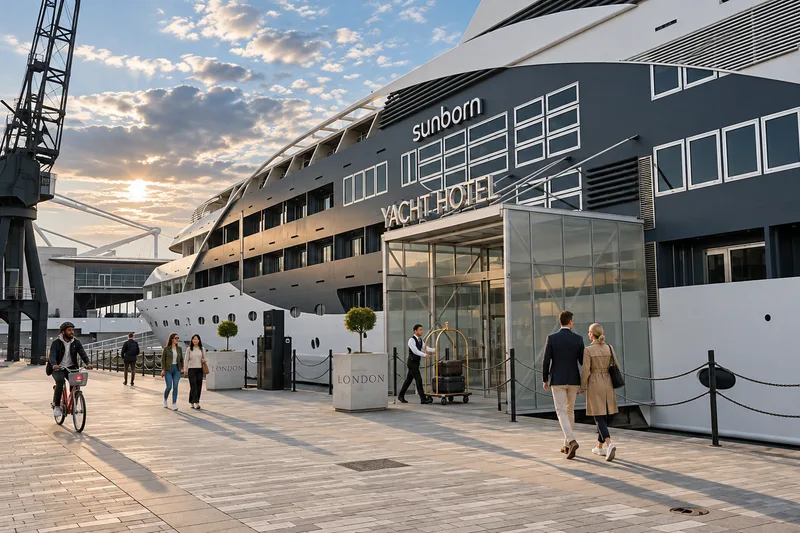
Sunborn is the white yacht beside ExCeL’s western end, at Royal Victoria Dock, London E16 1AA. Good Hotel is the rectangular floating platform farther west, at Western Gateway, Royal Victoria Dock, E16 1FA, beside the Royal Docks cable-car terminal. Neither hotel sails during your stay. The dock water outside the window is Royal Victoria Dock, even where a room category uses the word “Riverview”.
I find the distinction easiest to understand with luggage: in a compact room, an open suitcase becomes part of the floor plan. Good Hotel’s 13 m² Good Room and Good Room on the Water both sleep two; the latter faces the water. Its corner Best Room is approximately 30 m². Rooms have en-suite showers and free Wi-Fi, but no TV or minibar. A water view changes the outlook without enlarging the standard room.
Sunborn’s Classic rooms provide 19–23 m². Executive rooms add a balcony or terrace, while suites occupy a separate price bracket. There is no swimming pool or casino on the London yacht; photographs of those facilities aboard the Gibraltar sister ship cause an expensive misunderstanding. The Sunborn London cabin review covers room positions in more detail.
What the advertised prices actually buy
Sunborn advertises Classic Dockview rooms from ≈ $140 (£108) a night, Classic Riverview from ≈ $170 (£126) and Executive Dockview from ≈ $190 (£143). These are starting room rates, not quotes for a particular exhibition weekend. Classic categories have a maximum occupancy of two. The Executive Dockview upgrade adds outside space; paying for Riverview alone buys an outlook rather than a suite.
At Merchant Square in Paddington, Boathouse London’s Paddington West accommodation boat starts at ≈ $480 (£360), with a double bed and sofa bed for up to four guests. That is a whole-boat comparison against a hotel room. Four adults would occupy the sofa bed as well as the bedroom; the capacity figure does not mean two private bedrooms.
I put the final payable total beside the sleeping arrangement before comparing these formats. A houseboat’s cleaning charge, minimum stay and refundable deposit belong in that comparison; a refundable hold also ties up spending money even though it is not part of the room cost. Breakfast and cancellation terms need to match across the quotes. The houseboat fee breakdown explains how cleaning and security deposits appear in bookings.
Getting to ExCeL and central London with bags
Custom House serves both the Elizabeth line and the DLR. From the station, follow signs towards ExCeL and its western entrance, then the dockside route to the hotel. Sunborn sits beside this end of the exhibition centre. Good Hotel is farther west along the waterfront; allow 10 minutes on foot from Custom House. Royal Victoria DLR is less than five minutes’ walk from Good Hotel.
The entrance printed on your event ticket matters. A room beside ExCeL’s west end still leaves a walk through or around the venue for an event using the east end. Prince Regent DLR serves the eastern side. The dockside approach is outdoors. In rain, I keep both hands free for the case and boarding rail; juggling a second loose bag makes the gangway harder than the station walk.
The Elizabeth line links Custom House directly with Liverpool Street, Farringdon, Tottenham Court Road and Paddington. From Heathrow, an Abbey Wood-bound Elizabeth line train runs through to Custom House; trains towards Shenfield take a different eastern branch. On a return airport journey, the terminal shown on the train matters. Use the TfL journey planner with the hotel’s postcode and your actual arrival time, including the final walk.
The O2: the cable car out and the railway back
The cable car connects Royal Docks with Greenwich Peninsula. The crossing takes up to 10 minutes, followed by a walk to The O2. That crossing time excludes the walk from your room, ticketing and queues. Contactless and Oyster are accepted, but cable-car journeys do not count towards daily fare caps.
Standard closing times are 21:00 Monday–Thursday, 22:00 Friday, 23:00 Saturday and 21:00 Sunday and bank holidays. Strong wind and thunderstorms also interrupt service. A concert finishing after closing needs another route back; the cable car is not an overnight hotel shuttle.
- From The O2, walk to North Greenwich station.
- Take the Jubilee line eastbound one stop to Canning Town.
- Change to a Beckton-bound DLR train: Royal Victoria is one stop away for Good Hotel, Custom House two stops away for Sunborn.
Train operating hours and engineering work still govern this route. The cable-car operating hours and disruption information settle whether the scenic crossing works on your evening. There is no pedestrian bridge directly between these hotels and the arena.
A canal houseboat: the berth is part of the accommodation
Paddington Basin, Little Venice, the Regent’s Canal and Limehouse are separate locations, with different station walks. “London canal boat” supplies too little information to calculate any of them. A map pin at Paddington station does not describe a berth farther along the canal. The useful location is the boarding point, the gate into the mooring and the route from the station.
Merchant Square gives Paddington West a fixed destination. Paddington provides Elizabeth line and National Rail connections; Edgware Road is another nearby Underground option. This location changes a West End trip substantially compared with returning to Royal Victoria Dock. A narrowboat listing elsewhere needs its own dimensions: bed length, standing headroom and shower space cannot be inferred from pictures of a wider boat. The static houseboat rental guide explains the differences between hull conversions and floating homes.
For a static stay on Canal & River Trust waters, the boat needs a permanent mooring and a business licence. The outward-facing licence identifies static letting with “SL”; holiday hire uses “SDHH”. Commercial insurance and hire-standard boat safety requirements are part of that licensing. Before payment, obtain the boat’s name and index number and confirmation of the berth for the entire reservation. A listing offering only a changing canal location leaves both the journey and the letting arrangement unresolved.
The rental licence guidance and verification contact give a way to resolve that uncertainty. These rules concern Trust waterways; a tidal Thames mooring has a different authority and should not be treated as a canal berth.
Heating, noise and the handover that changes the stay
A hotel booking leaves water, waste and power with the hotel team. On a private boat, the handover determines your responsibilities. Shore power provides a different arrangement from batteries that need engine charging. A tank-fed shower has a finite water supply; a cassette toilet has a different servicing routine from a plumbed bathroom. The reservation needs to say who handles refilling and emptying during your stay.
Travellers report a sightseeing problem with some hire boats: they need engine-running time to recharge batteries while their guests want to be out all day. This operating constraint does not affect every canal rental. A boat with shore power avoids that particular conflict.
For winter bookings, the relevant distinction is between automatic heating and a stove the guest must tend. The handover should include heating controls, hot-water production, electrical limits, emergency contact details and the positions of fire exits and carbon-monoxide alarms. Keep ventilation openings clear. The houseboat safety checklist adds the boarding and mooring details.
Royal Victoria Dock is sheltered from the open Thames, but “floating” says nothing about sound insulation. London City Airport, dockside activity, hotel events and ventilation equipment belong in the noise picture. On a canal, a towpath-facing window brings passers-by close to the bed. I care more about which side the bedroom faces than whether the listing calls the setting peaceful.
Steps, children and arrival times
Both Sunborn and Good Hotel list check-in from 15:00 and checkout by 11:00. Good Hotel stores luggage on arrival and departure days, but not overnight outside those days. A private boat needs an agreed handover appointment: arriving after a flight delay has different consequences when one host holds the keys.
A lift inside a floating hotel answers only one part of an access question. The route from pavement to reception, gangway gradient, thresholds and bathroom layout all matter. Good Hotel’s water-facing rooms have lift access; that alone does not establish an adapted bathroom. My floating-hotel accessibility guide separates boarding access from usable cabin space.
For a child, a sofa bed confirms a sleeping place rather than a protected deck. An unguarded edge or a steep companionway changes how adults supervise every trip outside. Private-boat arrival instructions should show the steps and deck barriers before the reservation becomes non-refundable.
Where I would book
For a trip centred on ExCeL, I would pay the difference for Sunborn’s larger Classic cabin because two people and luggage make the extra floor space useful every morning. For a canal weekend, my booking would need a named fixed berth, shore power and a handover appointment. A late O2 finish would move my search to North Greenwich unless sleeping afloat mattered enough to justify the railway return.