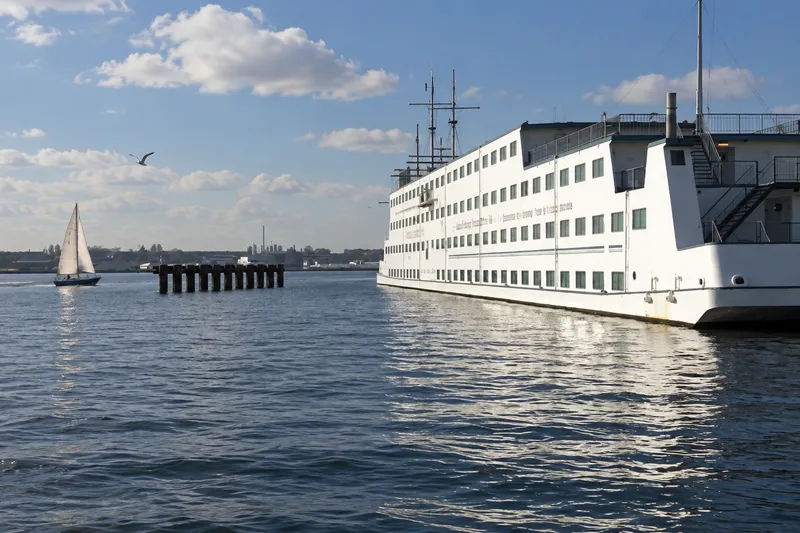
Two things sort the options before you look at a single photo. A dedicated botel that never leaves its mooring keeps its gangway, deck furniture and reception in place all season; a vessel that also runs cruises or bike-and-barge trips may be somewhere else the week you arrive. And inside one hull, a cabin below the waterline and a cabin under a south-facing skylight are different rooms at the same price.
How a Moored Hull Handles Heat
Star ratings tell you almost nothing about a boat in July. Thermal mass and airflow do. A steel hull takes heat in through its deck plates and superstructure all day, and by mid-afternoon the exposed upper decks are uncomfortable underfoot. Below the waterline the same steel sits in canal water that lags well behind air temperature, which makes a hold cabin with decent mechanical extraction several degrees cooler than an upper-deck room, and an upper-deck cabin without a compressor unit a very unpleasant place by late afternoon.
Ventilation is the part guests underestimate. A porthole only cools a cabin if air can enter and leave, which normally means a second opening: the cabin door ajar onto the companionway, or an extraction fan left running. On the historic Oosterdok barges the portholes sit low in the hull and are often too small to move much air, and the ones nearest the waterline have to stay shut when a passing vessel sends a wash against the hull.
Converted freight barges carry their own layout logic. Ceilings sit low, companionway ladders are steep, and cabins are split between the hold and the deckhouse, so two rooms in the same booking category can differ sharply in temperature. Ask which deck your cabin is on before you pay, not at check-in.
Orientation is the lever most guests never touch. The afternoon sun works on the west and south faces of a hull, so a cabin with its porthole on the north or east side runs cooler into the evening, while a cabin under a skylight gains heat all afternoon and holds it after sunset. When you email a botel about a summer room, ask which way the porthole faces and whether the cabin sits under a skylight; both are fixed by the ship and matter more than a water-view upgrade.
Ten Amsterdam Floating Stays Compared
The table covers the mooring clusters that matter for a summer booking: NDSM Wharf on the IJ, the enclosed Oosterdok basin, and the Amstel. Rates are indicative low-season figures taken from operators' own booking pages, not confirmed quotes, and they climb sharply on summer weekends; the tax treatment on top of them is explained further down. Hotelboot Zwaan is left out on purpose, because it is not a summer option at all.
| Vessel | Mooring | Vessel Type | Indicative Rate | Summer Reality |
|---|---|---|---|---|
| Botel Amsterdam | NDSM Wharf (Pier 3) | Stationary botel pontoon, 175 cabins | From ≈ $100 (€95) | Vast rooftop deck over the IJ and a 24-hour desk; only the Deluxe cabins and Loft Letter suites have real air conditioning, and NDSM event weekends are loud |
| Hotel Asile Flottant | Amsterdam-Noord (De Ceuvel) | Six restored cargo barges | From ≈ $180 (€165) | A private wooden deck on every barge and a quiet inlet; steep companionways, and up to six guests share one compact bathroom |
| Lightship Amsterdam | Amsterdam-Noord (Mariadistelkade) | 1952 British lightship, two suites | From ≈ $390 (€350) | 60–65 m² suites and riveted steel that holds heat out better than barge plating; you pay for it and descend by ship ladder |
| AmicitiA | Oosterdok (Steiger 3) | 1897 freight clipper barge | From ≈ $77 (€70) | Upper-deck lounge facing NEMO, walkable from Centraal; hold bunks, shared bathrooms, no air conditioning |
| Vita Nova | Oosterdok (Steiger 2) | Moored botel barge | From ≈ $72 (€65) | Cheapest berths in the basin with an open water terrace; 6–8 m² cabins, shared facilities, weak airflow |
| MPS Holland | Oosterdok (Steiger 3) | Moored river passenger ship | From ≈ $83 (€75) | Big top deck and a short walk to Centraal; thin cabin bulkheads and no air conditioning |
| Passengership Avanti | Oosterdok (Steiger 3) | Converted 1930s Dutch barge | From ≈ $88 (€80) | Timber deck saloon with genuine harbour atmosphere; low headroom, steep internal stairs, and often a neighbour's deck to cross |
| Hotelschip Gandalf | Oosterdok (Steiger 3) | Motor passenger vessel | From ≈ $94 (€85) | En-suite cabins in a sheltered basin; the ship also runs barge-and-bike tours, so static summer availability can be limited |
| Houseboat Little Amstel | Amstel (Amsteldijk) | Static residential houseboat | From ≈ $200 (€180) | Two 15 m² studios with floor-to-ceiling doors onto a water-level patio; no front desk, and tour boats pass close all afternoon |
| Anna Maria II | Oosterdok (Pier 3) | Historic Frisian freight barge | From ≈ $83 (€75) | Calm bow seating steps from the Maritime Museum; a narrow access pier, simple bunks and strict quiet hours |
Why Hotelboot Zwaan Is Missing
Zwaan advertises exactly what a July guest wants: cabins with air conditioning and opening portholes. It is simply not in Amsterdam then. The operator's own website states that the ship is stationed in the Oosterdok from the beginning of October to the end of March, and spends the rest of the year on charter and boat tours. If a booking site offers you a Zwaan cabin in July or August, confirm the dates with the ship before you pay a deposit.
Vessel Profiles
NDSM Wharf: Botel Amsterdam
Botel Amsterdam is the largest floating address in the city: 175 rooms on a stationary pontoon at NDSM-pier 3, which makes it feel closer to a mid-sized hotel than to a historic barge. The reason to pick it in a hot spell is the roof terrace over the IJ, where open water keeps a steady breeze moving across the top deck even when the centre is still.
Cabin choice matters more here than anywhere else on this list. The standard twins and doubles have no compressor air conditioning and rely on ventilation shafts and small desk fans, which lose the fight once outside temperatures pass 30 °C. The Deluxe Quadruple cabins do have split-system air conditioning, and the five Loft Letter suites built into the giant red B-O-T-E-L letters on the upper deck are the most striking rooms, though their glazing catches sun all afternoon.
Practically, the desk is staffed around the clock, so a late arrival is straightforward. Parking sits a short walk away at P+R NDSM on the Mt. Lincolnweg, and the free GVB ferries reach the NDSM pier from Centraal in roughly ten minutes. NDSM itself is a former shipyard with bars, a street-art museum and a large event hall, which is either the attraction or the problem depending on your week.
Amsterdam-Noord: Hotel Asile Flottant and Lightship Amsterdam
East of NDSM, on the Johan van Hasseltkanaal at Korte Papaverweg 2, Hotel Asile Flottant occupies six restored cargo barges moored along a quiet inlet inside De Ceuvel, a former shipyard turned circular tech park. You reach the boats along wooden boardwalks planted with phytoremediation beds rather than through a lobby.
Each barge has its own wooden deck with tables and loungers, so breakfast happens over the water. Sizes vary a lot: Anneliese is 25 m² for a couple, Les Six Frères gives 50 m² over two cabins, De Amsterdam spans 60 m² for six, and De La Soul tops out at 65 m² for six. The catch is the hull itself. Companionway stairs on De Amsterdam sit at close to 60 degrees, and six guests share one compact bathroom.
On the Mariadistelkade, Lightship Amsterdam is a 1952 British lightship (LV-12) cut down to two suites, the Upper Deck Suite at 60 m² and the Machinery Space Suite at 65 m². Its riveted steel plates insulate better than barge sheet metal, which shows on a hot day, and each suite opens onto a private steel deck platform with lounge seating. The Machinery Space suite is reached by genuine ship ladders, so pack a duffel rather than a hard case.
I learned that last point the hard way: hauling a hard-shell suitcase down a companionway ladder cost me a wheel and a bruised shin, and everything I bring on board now goes in a soft bag.
Oosterdok: The Dense Historic Cluster
Oosterdok, the basin behind NEMO just east of Centraal, holds the city's densest concentration of hotel barges. AmicitiA, Vita Nova, MPS Holland, Passengership Avanti and Anna Maria II all moor along Steiger 2 and Steiger 3. The draw is location: you walk off your train and reach the gangway in ten to fifteen minutes without buying a tram or ferry ticket. Cabin formats here differ more than the photos suggest, and the en-suite versus shared bathroom comparison is the fastest way to see which ships suit you.
Summer on these freighters needs clear eyes. Hold cabins are compact, often 6 to 9 m² with narrow twin bunks, and on AmicitiA and Vita Nova the bathrooms are shared down the central companionway. Most ships have no air conditioning, so you depend on portholes and small electric fans, and heat trapped under iron decks drains away slowly. Because the ships moor two abreast along the piers, reaching an outer vessel such as Passengership Avanti can mean crossing the gangway and deck of the neighbour.
The upper deck is where these barges win. AmicitiA and MPS Holland both have open deck space with a view across the basin, and Oosterdok water is almost flat because the basin sits behind harbour locks, so there is no swell to disturb you. What you get instead is other people's evenings: restaurant terraces at NEMO and conversation on the quayside carry straight into an open porthole.
Two options are worth skipping. The standard twin and double cabins at Botel Amsterdam are the cheapest way onto that roof deck, but without air conditioning they are the wrong choice for a July heatwave, and the Deluxe upgrade costs less than moving hotels mid-trip. A cabin sold as a water view whose only porthole faces a neighbouring barge is the other one to avoid, because you take the noise of the basin without the view.
The Amstel: Houseboat Little Amstel
Houseboat Little Amstel sits on the Amsteldijk near the Torontobrug and rents two 15 m² studios with floor-to-ceiling glass doors onto a private patio at water level. The mooring is on the river itself, with rowing sculls going past in the morning. There is no front desk and no breakfast, and tour boats run within a few metres of the terrace through the afternoon, so it suits travellers who want a self-contained base more than hotel service.
Cabin Heat and Ventilation
Compressor Cooling Against Water-Cooled Hulls
Active, compressor-driven air conditioning is the exception among Amsterdam botels. It is standard in Botel Amsterdam's Deluxe Quadruple rooms and available in some newer cabins elsewhere, but across the historic Oosterdok barges you will not find it. What those hulls offer instead is passive cooling: the part of the hull that sits in the canal is surrounded by water that stays cooler than the summer air, and a cabin down in the hold gets some benefit from that.
The trade-off in the hold is damp. Warm, humid air meeting cold steel near the bilge condenses unless air is exchanged, and a hold cabin can feel clammy by morning after a muggy night. Keep the bathroom extraction fan running, and place a small desk fan low near the floor, where the coolest air collects.
Portholes, Night Air, and Insects
Without air conditioning your night depends on the portholes. The variety across Dutch hulls is wide: fixed brass deadlights that never open, narrow horizontal slits with rain flaps, and large pivoting scuttles that swing open on their hinges. On ships moored at Oosterdok or NDSM, an openable porthole is the difference between a breeze off the IJ and still air.
In the middle of a heatwave I was in a hold cabin on an Oosterdok barge with no air conditioning. The desk fan only pushed warm air around, so I opened the leeward porthole and wedged the cabin door ajar with a rolled towel to pull a draught along the companionway. It worked until a passing tug sent a wash along the hull that slammed the brass pane shut, and I have tightened the wing nuts before sleeping ever since.
Open water also brings insects. On wind-swept NDSM Wharf midges rarely settle, because the harbour breeze keeps them moving. In sheltered, shallow water with reed banks and floating plant beds, especially around De Ceuvel and the enclosed corners of Oosterdok, they become active after sunset, and most historic barges have no screens on their curved portholes. The one time I left a porthole wide open in the sheltered corner of Oosterdok, I woke up with bites on both arms and spent the rest of the stay with a plug-in repellent in the socket.
If there is no air conditioning: skip the top-deck cabin with south-facing skylights and take a berth on the shaded side of the pier, where the canal water moderates the temperature.
Ferries, Mooring Motion, and Noise
Getting to a Noord Mooring
A stay at Botel Amsterdam, Hotel Asile Flottant or Lightship Amsterdam means crossing the IJ to reach the historic centre, and the crossing costs nothing. The GVB ferries F1 to F7 carry pedestrians, bicycles and mobility scooters free of charge, and they are the fastest link between the two banks. For NDSM, take the F4 from the rear quayside of Centraal; the ride takes about ten minutes and lands a few minutes' walk from the pier.
Late nights need planning. The F3 to Buiksloterweg is the line GVB runs day and night, while the NDSM crossings stop earlier, so an evening in the centre can end with a ferry to Buiksloterweg and a bike or taxi north. Timetables also shift with the season, since GVB runs a reduced summer timetable through mid-August each year with fewer departures.
For Hotel Asile Flottant the metro is the simpler route. Noorderpark station on line 52 is roughly an 800-metre walk from the barges and connects to Centraal in a few minutes.
What You Feel and Hear at Night
Motion depends on which side of the IJ you sleep. Botel Amsterdam sits on the main commercial corridor, so water-bus catamarans, container barges and tugs pass through the day and their wash works against the hull; you feel a slow roll and hear the mooring lines take up on the bollards. Most guests stop noticing within a night, but if you are prone to motion sickness it will register.
Oosterdok is a locked basin, so the water stays flat and there is no wake at all. The noise profile also changes: wind across the basin sets mooring lines groaning in their fairleads, rubber fenders squeak against timber, and sound carries cleanly over flat water, so voices from the quayside arrive in the cabin.
NDSM is the loud one. The former shipyard hosts large music and cultural events at the NDSM Loods, and the waterfront bars Pllek and Noorderlicht fill up on warm evenings; bass from outdoor systems passes through thin steel easily. Oosterdok and De Ceuvel are quieter, and operators close boat decks and ask guests to move inside at night to avoid complaints from liveaboard neighbours.
Rates, Tourist Tax, and Booking
What the Final Bill Looks Like
Two changes have moved the arithmetic on an Amsterdam boat stay. The tourist tax for 2026 stands at 12.5% of the overnight price excluding VAT, as set out in the City of Amsterdam tourist tax rules, and VAT on accommodation rose from 9% to 21% on 1 January 2026 under the Belastingdienst rules for accommodation. Together they make the total noticeably higher than older guides suggest.
The city has also decided to raise the tourist tax to a flat 16% in 2027, confirmed in the municipal college decision of 23 September 2026, with further steps planned later in the decade. Here is how a two-night summer stay at ≈ $200 (€180) per night works out:
| Cost Component | Calculation | Amount |
|---|---|---|
| Base accommodation, 2 nights | ≈ $200 (€180) × 2, including 21% VAT | ≈ $400 (€360) |
| Net overnight rate, excluding VAT | ≈ $400 (€360) / 1.21 | ≈ $330 (€297.52) |
| 2026 tourist tax, 12.5% | 12.5% of ≈ $330 (€297.52) | ≈ $41 (€37.19) |
| Total for 2026 | ≈ $400 (€360) + ≈ $41 (€37.19) | ≈ $440 (€397.19) |
| 2027 tourist tax, 16% | 16.0% of ≈ $330 (€297.52) | ≈ $52 (€47.6) (total ≈ $450 / €407.6) |
Whether the tax is collected by the booking platform or at the desk varies by property, and smaller private barges often ask for a ≈ $55 (€50) to ≈ $110 (€100) key deposit on arrival. Ask which it is before you arrive rather than hunting for a working card at the gangway.
Rates for the same cabin also swing widely between platforms, and the cheapest headline is rarely the cheapest total. Compare the property's own booking page with one or two large platforms for your dates, because the tourist tax and the key deposit are sometimes folded into the displayed price and sometimes added at check-in.
Payment is worth a check for non-EU visitors. Cards issued under Russia's Mir system and Russian-issued Visa and Mastercard do not work anywhere in the Netherlands, as Betaalvereniging Nederland sets out, so you need a card from a bank outside Russia or a cash arrangement agreed with the operator in advance. Entry paperwork has tightened for some nationalities as well, and the Netherlands Worldwide visa service lists the current requirements.
Which Berth Fits Your Trip
The three mooring clusters suit different trips, and picking the wrong one is the easiest mistake to make in a summer booking.
- Heat relief and nightlife: a Deluxe Quadruple or Loft Letter room at Botel Amsterdam gives you confirmed air conditioning, the big roof deck and NDSM's bars, with the free ferry into town.
- Families and small groups: a whole barge at Hotel Asile Flottant such as De Amsterdam or Les Six Frères buys a private deck and a quiet inlet, at the cost of steep companionways and one bathroom between you.
- Couples after comfort: the two Lightship Amsterdam suites are the only floating rooms here with freestanding tubs and dedicated private decks, and the thick hull keeps them calm.
- Budget first: AmicitiA or MPS Holland in Oosterdok are the cheapest berths with a short walk to the museums, and you trade air conditioning and en-suite bathrooms for that price.
Before You Book
Work through these before you pay a deposit.
- Confirm the ship is static. Ask directly whether the vessel is moored as a hotel during your dates, since cruise and bike-and-barge operators move in summer.
- Ask about cooling for your exact cabin. Compressor air conditioning, a desk fan and an openable porthole with a screen are three different things, and the answer often changes between room categories on the same ship.
- Work out the real total. Add 12.5% tourist tax to the rate excluding VAT, remember that VAT is now 21%, and check whether the tax is charged by the platform or at check-in.
- Plan the late journey. The NDSM ferries stop earlier than the F3 to Buiksloterweg, which runs through the night, so decide how you will finish the trip home.
- Check the bathroom. An en-suite shower and toilet or a walk down a shared companionway is the biggest single difference between two similarly priced cabins.
- Bring a card that works. Key deposits and incidentals are usually settled on arrival, and some international cards are not accepted in the Netherlands.
- Pack soft luggage. Narrow companionway ladders and low deckhead beams make a rigid hard-shell case a liability.
Do not swim off the deck. Amsterdam's canals and the IJ are not swimming water. After heavy rain the city's combined sewers overflow into the canals, and GGD Amsterdam advises against swimming in open water afterwards; swimmer's itch, blue-green algae and, rarely, Weil's disease are the documented risks. Use an outdoor pool or an official swimming spot instead.