 Floating Hotel
Amazon Floating Lodges vs Mekong Riverboat Hotels: The Core Operational Divide
Choosing between stationary amazon floating lodges and an active cruising expedition vessel comes down to a fundamental engineering compromise: absolute geographical stillness versus mechanized linear reach. During my years inspecting waterborne accommodations, I have found that travelers rarely evaluate how a property stays in place or moves against the river current, yet this single mechanical choice dictates your daily schedule, cabin acoustics, and insect exposure.
Stationary Moored Suites: Immersive Isolation and Structural Anchoring
Moored river suites operate as static outposts permanently anchored along protected river bends, oxbow lagoons, or riverbanks. Properties such as Uakari Floating Lodge in Brazil, Canvas & Orchids Retreat in Cambodia, and The FloatHouse River Kwai in Thailand do not travel between ports; they serve as self-contained floating islands. Because they remain tethered in place, daily excursions rely on departing and returning to the exact same water plot via small support craft.
To withstand extreme river dynamics, these stationary properties rely on a heavy anchoring setup rather than rigid pilings. Vertical water shifts during the transition from monsoon high water vs dry season low water reach 8 to 12 meters across both the Amazon and Southeast Asian watersheds. Rigid steel spuds or fixed concrete pillars would snap under the immense lateral load of floating debris and floodwater pressure.
Instead, stationary floating platforms employ flexible anchoring arrays designed to slide vertically with river fluctuations:
- Pontoon mooring lines and articulating gangways: Heavy-gauge galvanized steel cables secured to reinforced shore trees or concrete ground blocks on the bank, feeding through fairleads with self-tensioning counterweights.
- Gravity deadweight anchors: Massive submerged concrete sinkers dropped into riverbed silt that prevent transverse drift while allowing the pontoon to rise and fall freely.
- Hinged articulating ramps: Multi-section gangways fitted with rolling rubber caster tracks on the deck side that automatically adjust their pitch angle as the waterline climbs or drops.
Engineering Field Note: When inspecting moored pontoons in the várzea seasonally flooded forest, I look for submerged log deflectors on the upstream bows. A single drifting hardwood trunk swept along by an eight-knot current can rip away pontoon mooring lines and articulating gangways if the upstream hull lacks angled steel cowlings to divert the river flotsam.
Cruising Expedition Riverboats: Linear Transit and Tributary Navigation
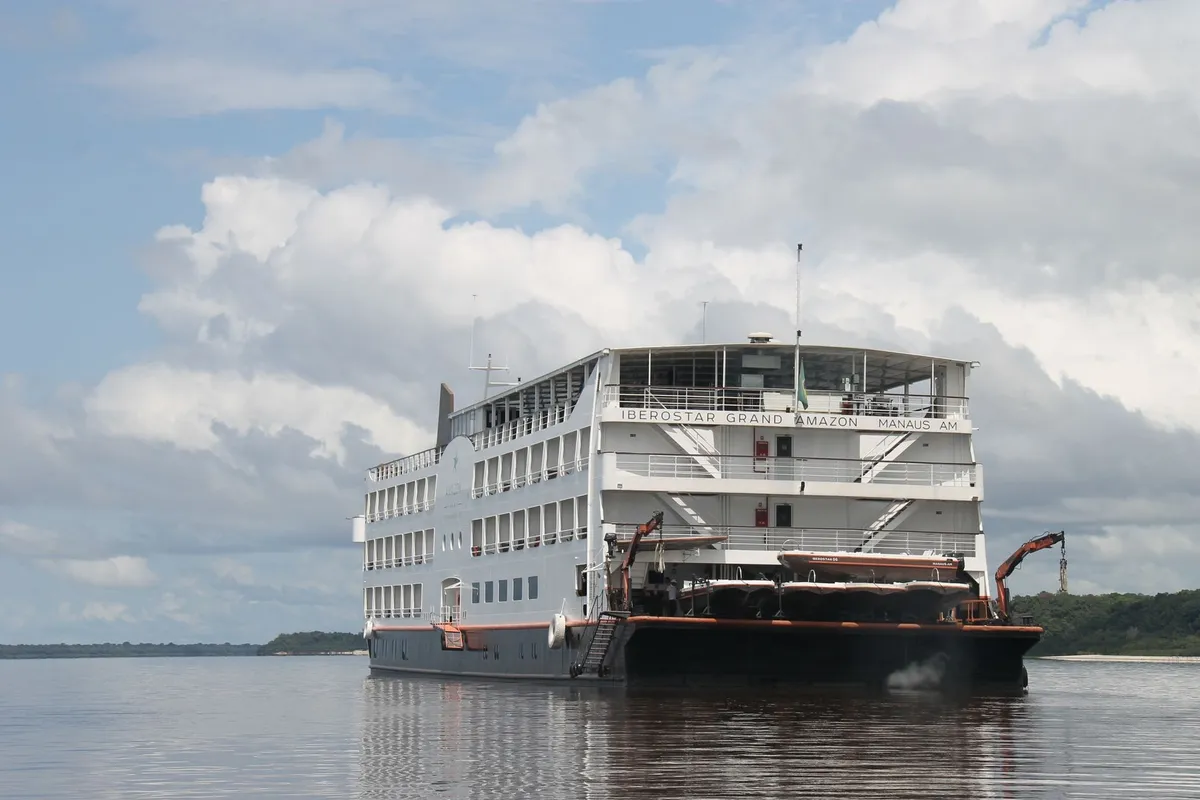
A cruising amazon riverboat hotel like Aqua Nera or a mekong river floating hotel like Aqua Mekong operates on a linear transit model. Instead of returning to the same bay each evening, the mother ship navigates 200 to 400 miles along major river channels over a three- to seven-night itinerary. This moving base camp allows access to distant reserves, such as Peru’s Pacaya-Samiria National Reserve, while your private living quarters reposition continuously downstream or upstream.
Because full-sized expedition vessels cannot navigate shallow backwaters or flooded forest canopies, daily wildlife spotting relies on motorized skiff tender excursions. High-powered aluminum tenders launch from the mothership’s stern twice daily, penetrating narrow river channels where larger ships would run aground. This system pairs hotel living on primary waterways with deep exploration into sensitive aquatic ecosystems.
| Operational Dimension | Stationary Moored Eco-Lodge | Cruising Expedition Riverboat |
|---|---|---|
| Transit Pattern | Fixed coordinates; radial excursions | Linear river navigation (30–80 miles/day) |
| Exploration Reach | Limited to skiff range from lodge (5–12 miles) | Broad corridor coverage across distinct biomes |
| Structural Anchoring | Bank winches, deadweight anchors, floating logs | Twin dynamic anchors dropped in deep channels |
| Tender Craft Protocol | Boarding from stationary wooden pontoons | Boarding from moving or stern-anchored mothership |
The daily reality of small tenders requires reasonable physical stability. You step directly over wet gunwales from a moving swim platform while river swells roll underfoot, a process discussed in my assessment of river hotels and moored cruise ships. Watertight dry bags are mandatory on every excursion, as sudden tropical downpours will soak exposed gear in open tenders within seconds.
Luxury Riverboat Hotels: Aqua Expeditions, Delfin, and Navigational Engineering
Expedition cruising vessels in the Amazon and Mekong basins represent some of the most capital-intensive boutique ships afloat. Unlike ocean-going cruise liners that accommodate thousands of passengers, these vessels maintain low guest numbers to navigate tight river bends and preserve small-group excursions inside fragile reserves.
Suite Architecture, Guest Density, and Crew Ratios on Moving Vessels
Cabin volume on boutique river vessels is strictly constrained by naval architecture. A detailed look at any Aqua Expeditions vessel or Delfin vessel reveals a standard footprint designed to maximize stability and usable floor space. Aboard the 205-foot Aqua Mekong, all 20 guest suites measure an identical 30 square meters (322 square feet), featuring floor-to-ceiling glass walls oriented toward the riverbank.
On Peru’s Marañón and Ucayali rivers, the 20-suite Aqua Nera provides the same 30-square-meter suite footprint. The boutique vessel Delfin Amazon Cruises Delfin I operates with only four oversized suites, carrying a maximum of 8 to 12 guests. Two lower-deck Deluxe Master Suites on Delfin I feature private whirlpools on their forward balconies, built into the structural bow curves.
| Vessel Name | Operating River / Region | Suite Count & Dimensions | Max Passenger Capacity | Crew-to-Guest Ratio | Entry Starting Rate (Double Occupancy) |
|---|---|---|---|---|---|
| Aqua Nera | Peruvian Amazon (Iquitos) | 20 Design Suites (30 sq m / 322 sq ft) | 40 | 1:1 (40 crew) | $5,130–$5,460 USD per person (3-night cruise) |
| Delfin I | Peruvian Amazon (Pacaya-Samiria) | 4 Suites (2 with whirlpools) | 8–12 | 1:1 (12 crew) | $4,490–$5,300 USD per person (4-day cruise) |
| Aqua Mekong | Mekong River (Cambodia/Vietnam) | 20 Suites (30 sq m / 322 sq ft) | 40 | 1:1 (40 crew) | From $9,500 USD per person (7-night cruise) |
The 1:1 crew-to-guest ratio on these vessels translates into smooth logistics during off-ship activities. When embarking on dawn birdwatching runs, four separate tenders carry no more than eight to ten guests each, led by certified naturalist guides. The 30-square-meter suites rival standard land hotel rooms through built-in wardrobes, flush wall paneling, and sliding bathroom pocket doors that eliminate swing clearance waste.
Navigational Capabilities: Hull Draft and Shallow Tributary Access
Navigating seasonal inland waterways requires specialized hull geometry. Both Aqua Nera and Aqua Mekong operate with an ultra-shallow draft riverboat profile drawing just 1.5 meters (5.0 feet) of water. This flat-bottomed steel design allows the vessels to cross silted sandbars and enter side channels that turn away deeper commercial cargo traffic.
Even with a 1.5-meter draft, hydrological shifts introduce hard navigational limits. During low-water cycles, shifting riverbeds force vessels to adjust itineraries overnight. When the river drops below safe operating thresholds, the mother vessel drops twin bow anchors in the main navigable channel, and guests travel farther aboard motorized tenders.
Navigation Warning: Severe low-water anomalies can halt operations entirely. In October 2023, the Rio Negro tributary at the Port of Manaus reached a historic low of 12.70 meters, and in October 2024 it fell below 12.11 meters. These extreme droughts grounded river traffic across the central basin, stranding standard draft vessels and forcing operators to reroute itineraries to deeper mainstream corridors.
Floating Jungle Hotels: Pontoon Engineering, Off-Grid Grids, and Eco-Lodge Design
Stationary floating jungle hotels take an entirely different architectural path than steel-hulled ships. Instead of navigating around river hazards, these lodges sit directly inside the flood boundary, rising and falling with the natural seasonal pulse while leaving the underlying riverbed undisturbed.
Moored Eco-Lodges of the Amazon: Mamirauá and the Flooded Forest
Located deep inside Brazil’s Mamirauá Sustainable Development Reserve, Uakari Floating Lodge offers a classic template for low-impact tropical architecture. The property consists of five floating wooden bungalows containing 10 en-suite guest rooms, strictly capped at 20 guests at any time. The central dining facility and guest bungalows rest directly on massive submerged trunks of the Assacu tree (Hura crepitans), an indigenous wood with natural buoyant properties and rot resistance.
The entire facility stays afloat on the lake surface without driven piles or concrete foundations ashore. Articulated wooden gangways bridge the gaps between individual bungalows and the main house, flexing whenever passing wake waves hit the float array. A standard 7-night package departing from Tefé costs between R$ 14,245 and R$ 15,240 BRL (approximately $2,600 to $2,800 USD) per person, covering boat transfers, meals, and guided flooded-forest boat excursions.
Building codes inside protected conservation reserves prohibit standard shoreline construction. Because the várzea seasonally flooded forest undergoes complete inundation for up to six months each year, a terrestrial lodge would require 12-meter stilts, stranding visitors high in the tree canopy during dry periods. Floating architecture provides direct water-level access year-round without altering riverbed topography, an approach examined in depth across tropical floating eco-resorts and sustainability limits.
Southeast Asian River Villas: Pontoon Design from Kanchanaburi to Tatai
In Southeast Asia, stationary floating hotels balance heavy timber framing with modern pontoon flotation. Along the River Kwai in Kanchanaburi, Thailand, The FloatHouse River Kwai operates 30 moored floating villas measuring 90 square meters (968 square feet) each. These expansive units are built from local bamboo and polished teakwood, supported by modular flotation platforms, with nightly rates starting from 4,291 THB (approximately $125 to $190 USD) including breakfast.
In the Koh Kong conservation corridor of Cambodia, Canvas & Orchids Retreat (formerly 4 Rivers Floating Lodge) uses pontoon systems anchored to the Tatai River. The property features 13 pontoon-moored floating tented villas measuring 45 square meters (484 square feet) each, with nightly rates ranging between $200 and $259 USD for double occupancy, including scheduled boat transfers. Larger 60- to 65-square-meter tent options are reserved strictly for on-land family installations.
| Property Name | Location | Unit Footprint & Construction | Base Unit Count | Flotation Substructure | Nightly Rate Range (Double Occ.) |
|---|---|---|---|---|---|
| Uakari Floating Lodge | Mamirauá Reserve, Brazil | En-suite rustic timber rooms | 10 rooms (5 bungalows) | Assacu (Hura crepitans) buoyant tree trunks | ~$370–$400 USD (as part of 7-night package) |
| The FloatHouse River Kwai | Kanchanaburi, Thailand | 90 sq m (968 sq ft); teak and woven bamboo | 30 villas | Interlocking pontoon modules | 4,291 THB (~$125–$190 USD) room-only |
| Canvas & Orchids Retreat | Tatai River, Cambodia | 45 sq m (484 sq ft); 4-layer canvas & composite | 13 floating tents | Pontoon flotation with articulated ramps | $200–$259 USD per night with transfers |
Rather than using energy-hungry central HVAC systems, Canvas & Orchids relies on evaporative cooling vs central air conditioning, circulating river-chilled air alongside high-volume ceiling fans. The 4-layer insulated tent membrane vents rising midday heat through top louvers, maintaining a stable indoor temperature without drawing heavy electrical loads from the pontoon grid.
River Ecology, Water Chemistry, and Seasonal Hydrology Constraints
The chemical composition of tropical rivers shapes the everyday guest experience far more than most travelers realize. The surrounding water chemistry directly dictates insect density, water clarity, and how safely you can swim off the edge of your private deck.
Water Chemistry Variations: Whitewater Sediment vs Blackwater Acidity
Tropical river systems fall into clear chemical classifications: sediment-heavy whitewater and acidic blackwater. The Amazon main stem, the Marañón, the Ucayali, and the Mekong are classic whitewater rivers. They carry massive suspended loads of nutrient-rich Andean and Himalayan silt, resulting in a neutral pH balance between 6.5 and 7.5. These nutrient-loaded waters provide ideal breeding conditions for aquatic insect larvae.
Conversely, blackwater systems like the Rio Negro run dark with dissolved humic acids leached from decomposing jungle vegetation. The Rio Negro acidity pH levels range between an acidic 3.5 and 5.5—roughly equivalent to black coffee or orange juice. This high acidity and low mineral content naturally disrupt insect breeding cycles, leaving blackwater channels virtually free of biting mosquito swarms.
| Chemical Parameter | Whitewater Rivers (Amazon, Mekong, Ucayali) | Blackwater Rivers (Rio Negro, Tatai) |
|---|---|---|
| Water pH Range | 6.5 – 7.5 (Neutral to slightly alkaline) | 3.5 – 5.5 (Highly acidic) |
| Suspended Sediment Load | Heavy mineral silt; zero subsurface visibility | Low sediment; high dissolved organic tannins |
| Mosquito Larvae Proliferation | High density; daily repellant required | Naturally suppressed by water acidity |
| Deck Swimming Safety | Poor visibility; submerged obstacles and river fauna | Clear acidic water; lower parasitic loads |
When packing for whitewater river expeditions, follow the two-barrier personal defense standard established in the CDC Yellow Book. Treat long-sleeve shirts and field trousers with a 0.5% permethrin spray solution before departure, and apply skin repellents containing 20% to 30%+ DEET or 20% Picaridin to open skin. Relying on organic botanical sprays in high-silt river valleys will leave you covered in bites within hours.
Hydrological Swings: Tonle Sap Lake Crossings and Amazon Drought Baselines
Seasonal hydrological swings dictate where expedition riverboats can travel. The most dramatic example occurs during the seasonal Tonle Sap lake crossing in Cambodia. Tonle Sap functions as a massive flood-relief basin for the Mekong; during the monsoon, river currents reverse, expanding the lake’s footprint dramatically.
Between mid-August and November (monsoon high water), cruise vessels like Aqua Mekong sail smoothly across the open lake, docking directly at Siem Reap. From December through mid-August (dry season low water), the lake level drops below 1.0 meter. Vessels cannot make the crossing and must terminate passenger itineraries downstream at Kampong Cham, transferring travelers to Siem Reap via a mandatory 4.5-to-5-hour overland bus coach transfer.
Booking Precaution: If your Mekong expedition is scheduled between January and July, look closely at the daily itinerary paperwork. Claims of sailing to Siem Reap during low-water months mask the reality that your cruise ends at Kampong Cham, followed by five hours on bumpy asphalt highway routes.
Technical Realities: Power Generation, Water Filtration, and Cabin Acoustics
The quiet moments depicted in resort brochures rarely detail the machinery operating beneath your bed. A floating property is a self-contained life-support unit, and the choice between running heavy internal combustion engines or quiet battery banks affects every night of sleep.
Mechanical Systems: Continuous Generator Vibration vs River Wake Sway
Cruising riverboats must keep their mechanical hearts beating around the clock. Vessels like Aqua Nera and Aqua Mekong run twin Caterpillar Tier 3 marine generators 24 hours a day to supply electricity for high-tonnage chiller air conditioning, industrial freezers, water pumps, and dynamic positioning thrusters. This creates continuous generator hum and hull vibration throughout the lower decks.
Under the International Maritime Organization’s resolution IMO MSC.337(91) (Code on Noise Levels on Board Ships), passenger cabins must not exceed 55 dB(A), with luxury operators aiming for 45 to 50 dB(A). However, even when sound insulation keeps airborne noise low, the low-frequency mechanical thrum of the diesel crankcase travels directly through the structural steel hull plating, a challenge I evaluated in detail in my piece on river currents, vibrations, and sleep quality.
Moored eco-villas eliminate internal diesel vibration by relying on an off-grid solar battery bank. At Uakari and Canvas & Orchids, nighttime background sound levels drop to the 30-to-35 dB(A) rustle of the surrounding rainforest. The trade-off is mechanical hull roll: whenever motorized longtail boats or commercial barges pass by, their wake sends rolling chop against the floats, rocking your bed and groaning against the articulating shore hinges.
Berth Selection Strategy: When booking a cabin on an expedition riverboat, reserve suites located on the upper deck amidships. Avoid stern cabins positioned directly above the engine compartment and Caterpillar Tier 3 auxiliary suites, where vibration transfer peaks during upstream full-throttle running.
Sanitary and Connectivity Infrastructure: Desalination, Bio-Septics, and Satellites
Waste management and potable water generation reveal clear differences between fixed and moving properties. Cruising river vessels operate onboard water treatment facilities pairing multi-stage sand separation with reverse osmosis water filtration, producing potable water directly from the silt-laden river. Their blackwater drains into closed-loop aerobic marine sanitation units that treat human waste before offloading sterilized effluent.
Stationary eco-lodges cannot handle energy-intensive water plants. Uakari Floating Lodge uses an eco-engineered root-zone bio-filtration septic system. Greywater from sinks and showers drains through floating beds of water hyacinths and wetland reed beds, where root microbes neutralize organic waste before the water returns to the river. Blackwater flows into enclosed submerged settling tanks that require physical servicing and removal.
| Infrastructure Domain | Cruising Riverboat (e.g., Aqua Mekong) | Moored Eco-Lodge (e.g., Uakari) |
|---|---|---|
| Electrical Power Core | Twin Caterpillar Tier 3 marine generators (24/7) | Off-grid solar battery bank; backup daytime generator |
| Air Temperature Control | Closed-loop compressor-driven central AC | Evaporative cooling, ceiling fans, passive airflow |
| Water Treatment System | Onboard reverse osmosis and UV sterilization | Rainwater catchment & sand-sediment gravity filtration |
| Effluent Management | Closed-loop aerobic marine sanitation devices | Root-zone bio-filtration septic reed beds |
| Satellite Connectivity | Complimentary Starlink Maritime in all suites | No Wi-Fi in guest rooms; intermittent radio/cellular |
Data connectivity has shifted dramatically with the rollout of low-Earth-orbit satellites. Aqua Expeditions now provides complimentary Starlink Maritime satellite internet across all guest suites on Aqua Nera and Aqua Mekong, maintaining 50 to 120 Mbps download connections beneath remote rainforest canopies. In contrast, staying at Uakari or Canvas & Orchids means stepping into a digital dead zone where in-cabin data is nonexistent and daily power outlets run on strict schedules, a pattern familiar to anyone who understands Wi-Fi and cellular reception challenges on metal-hull ships and remote pontoons.
Practical Planning, Booking Realities, and Expedition Decision Framework
Committing to an expedition river experience requires looking past glossy marketing photos to evaluate strict single supplement charges, minimum age thresholds, and travel logistics. The operational limits of remote river travel demand careful advance planning.
Financial Outlays: Base Fares, Solos, and Mandatory Pre-Trip Clearances
Base fares for luxury Amazon river cruising reflect an all-inclusive expedition format. A 3-night cruise aboard Aqua Nera starts between $5,130 and $5,460 USD per person in double occupancy for standard 30-square-meter Design Suites, scaling past $10,325 USD for full 7-night itineraries. Delfin I rates start from $4,490 to $5,300 USD per person for 4-day journeys. In Southeast Asia, Aqua Mekong commands rates starting above $9,500 USD per person for its signature 7-night full Mekong expedition itineraries.
Stationary eco-lodges offer lower entry costs, though you handle international air transfers to regional hubs yourself. A 7-night package at Uakari Floating Lodge costs between R$ 14,245 and R$ 15,240 BRL (approx. $2,600 to $2,800 USD) per person, inclusive of meals, transfers from Tefé, and excursions. Thailand’s FloatHouse River Kwai starts around $125 to $190 USD (4,291 THB) per night for villa accommodation with breakfast, while Cambodia’s Canvas & Orchids runs $200 to $259 USD per night.
Solo travelers face steep financial hurdles on riverboats. Delfin Amazon Cruises imposes a 50% to 75% single supplement surcharge across Delfin I, II, and III cabins. Aqua Expeditions occasionally introduces select single-supplement fee waivers on suites 109 and 110 during shoulder-season Mekong departures, providing rare relief for individual travelers.
Age restrictions and medical rules are strictly enforced across operators:
- Minimum age requirements: Delfin I enforces a strict minimum passenger age of 10 years (rising to 12 years if two or more children travel in one party) on shared departures. Aqua Expeditions recommends a minimum child age of 5 years across its Amazon fleet, requiring minors under 18 to share a suite with an adult.
- Yellow fever international certificate: Proof of yellow fever vaccination administered at least 10 days prior to arrival is strictly recommended or required for river journeys originating in Iquitos (Peru) or Tefé (Brazil).
- Emergency medical evacuation insurance: While Delfin Amazon Cruises does not require a fixed $50,000 policy before boarding, operators strongly advise comprehensive travel insurance that includes emergency air evacuation due to the extreme remoteness of upper Amazon tributaries.
The Selection Matrix: Deciding Between Cruising Mobility and Moored Stillness
Choosing between a moving expedition ship and a moored eco-lodge comes down to your personal priorities for comfort, connectivity, and environmental immersion:
- The Wildlife Photographer: Choose stationary amazon floating lodges like Uakari. Staying within Mamirauá allows you to access prime flooded forest canopies at dawn without waiting for tender deployment routines or listening to auxiliary engine rumblings.
- The Premium Comfort Traveler: Book cruising vessels like Aqua Nera or Aqua Mekong. The 1:1 crew ratio, continuous compressor air conditioning, quiet Starlink connectivity, and spacious 30-square-meter suites offset the high cabin price.
- The Digital Professional: Restrict your options to Starlink-equipped vessels. True off-grid floating lodges offer genuine solitude, but limited solar battery hours make sustained remote work impossible.
- The Active Eco-Traveler: Choose moored options like Canvas & Orchids or The FloatHouse River Kwai. These river villas let you step directly from your private veranda into a kayak, completely free from diesel exhaust smells and fixed daily cruise timetables.
If you value dynamic travel across vast national parks and expect reliable climate control and high-speed Wi-Fi, the investment in a luxury expedition ship is well justified. But if your goal is deep jungle quiet—where the river laps gently against floating timber logs while pink river dolphins surface just feet from your open balcony—a moored jungle lodge provides an authentic water experience that no motorized vessel can match.