
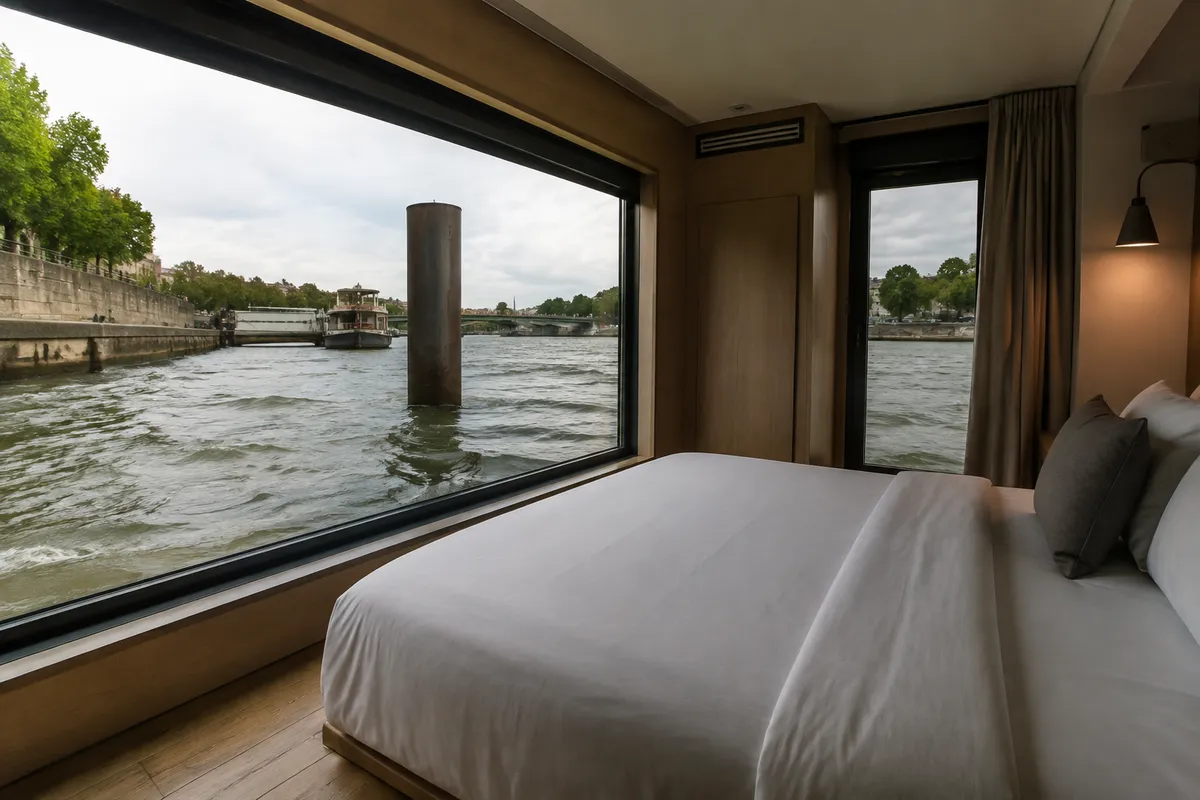
European inland waterway regulations changed with the formal enforcement of Commission Delegated Regulation (EU) 2025/2177 adopting the ES-TRIN 2025/1 standard. While these rules mandate strict noise isolation thresholds and require passenger accommodation vessels to maintain shore electrical connections, older botels and conversion barges operating under transitional provisions still expose guests to continuous nocturnal machinery hums and kinetic river swells. For light sleepers, an unvetted booking can turn an overnight stay into eight hours of broken rest caused by hydrodynamic drag, vibrating hull plating, and shifting mooring cables.
Booking a floating room works well if you choose an impounded basin behind commercial sea locks or take a midship cabin on a grid-connected vessel equipped with modern vibration dampening. Conversely, sensitive travelers who book an estuary berth subject to heavy tidal swings, or a river-facing berth in an active shipping channel, face predictable sleep disruptions. Evaluating the hull geometry, the mooring arrangement, and the vessel's electrical source before arrival makes the difference between uninterrupted sleep and a completely ruined night.
The Hydrodynamic Realities of Sleeping on Moored River Boats
Moored vessels interact continuously with moving water, creating an acoustic and mechanical environment fundamentally different from solid ground. River currents press against the hull around the clock, producing drag forces that scale quadratically with water speed. When booking a berth, understanding how fluvial water forces translate into cabin motion is the first step toward protecting your sleep.
Hydrodynamic Drag, Current Shear, and Low-Frequency Structural Resonance
A frequent error made by light sleepers is assuming that converted barges in moving rivers behave like canal houseboats moored in dead-end basins. In a canal basin, water velocity rarely exceeds 0.1 meters per second, generating virtually no dynamic hull pressure. In urban river channels like the Seine or the Vltava, normal surface velocities run between 0.5 and 1.5 meters per second, climbing past 2.0 meters per second during seasonal high-water periods.
| Waterway Environment | Surface Water Velocity | Kinetic Hull Loading | Primary Vibration Risk |
|---|---|---|---|
| Still-Water Canal Moorings | < 0.1 m/s | Negligible static pressure | Zero structural current resonance |
| Fluvial River Berths (Normal) | 0.5–1.5 m/s | Continuous lateral drag | Vortex-induced oscillation at 2–15 Hz |
| High-Water River Runoff | > 2.0 m/s | Heavy shear force against spuds | Severe hull shudder and creaking lines |
As river currents hit stationary pontoon hulls and cylindrical mooring piles measuring 0.3 to 0.6 meters in diameter, they cause alternating vortex shedding. This flow phenomenon triggers vortex-induced vibration (VIV), producing low-frequency oscillations typically between 2 and 15 Hz according to Silent Line Group vibration control data. Standard sprung and foam hotel mattresses do not absorb sub-15 Hz oscillations; the vibration passes directly through the bed frame and into your skeleton.
Low-frequency structural resonance between 2 and 15 Hz is often inaudible, presenting instead as an internal chest flutter or a persistent tremor in the pillow that keeps light sleepers from entering deep slow-wave sleep.
Hull Hydrodynamics: Chine Slap vs. Round Bilge Displacement Hulls
The profile of a submerged hull dictates how moving water releases its kinetic energy. Flat-bottomed utility barges and box-section hotel pontoons employ a hard chine hull, featuring sharp, near-ninety-degree transitions between the flat hull bottom and the vertical topsides. When current eddies or surface ripples hit this angular junction, trapped air pockets collapse abruptly against the steel plate.
- Hard chine hull dynamics: Sharp underwater transitions trap surface chops, generating intermittent acoustic slapping spikes measuring 40 to 60 dB(A).
- Round bilge displacement hulls: Curved bilge transitions allow water to pass smoothly beneath the vessel, eliminating slapping sounds while deflecting lateral current energy.
- Submerged pontoon edges: Square-edged floats act like sounding boards, amplifying minor surface chop into metallic thumps audible inside nearby sleeping berths.
On a converted freight barge in Germany, I could not sleep because every short wave from an opposing wind hit the squared swim head of the barge, sounding like a muffled wooden mallet striking the headboard every four to eight seconds. Inspecting the vessel's hull profile from marketing photos or satellite views reveals whether the boat has a curved displacement bow or a slab-sided pontoon box.
Acoustic Awakening Thresholds: Measuring Noise Spikes Against Health Norms
Sleep architecture depends on stable baseline sound levels rather than just absolute quiet. According to the WHO Night Noise Guidelines published by the World Health Organization, nocturnal noise inside a bedroom must not exceed 30 dB(A) LAeq for continuous sound, with individual noise peaks remaining below 45 dB(A) LAmax to prevent sleep fragmentation and heart-rate spikes.
Acoustic tests of wave slaps against flat pontoon hulls show transient impact spikes ranging from 40 to 60 dB(A), as documented in Silent Line Group water flow noise research. When a passing swell strikes the chine, the sudden 15-to-25-decibel jump over ambient room noise breaches the brainstem's arousal threshold, provoking an autonomic stress reaction without the guest necessarily waking up enough to remember it.
If an exterior photo shows the botel constructed on flat-sided modular floating cubes, plan for erratic midnight sound spikes exceeding 50 dB(A) whenever the wind opposes the river flow.
River Hotel Engine Vibration and Secondary Machinery Disturbances
While water dynamics act externally on the hull, internal mechanical systems create an entirely separate layer of nocturnal disturbance. A floating hotel requires continuous electrical power, freshwater delivery, and sanitary waste processing, all of which run through the vessel's structural steelwork.
Auxiliary Diesel Generators vs. Shore-to-Ship Power Infrastructure
Floating accommodations require steady electrical current for climate control, refrigeration, and lighting. Properties tied into municipal grids utilize shore-to-ship power (cold ironing), receiving electricity through heavy marine cables and leaving their mechanical engine rooms cold and silent. In contrast, off-grid conversions rely on an onboard auxiliary diesel generator (genset) running day and night.
An active marine diesel genset generates a continuous low-frequency drone between 55 and 70 dB(A), paired with mechanical floor vibration that travels straight through the hull framing. While Commission Delegated Regulation (EU) 2025/2177 adopting ES-TRIN 2025/1 establishes strict quayside shore-power standards and cabin sound thresholds for European passenger vessels, older botels outside these regulatory frameworks continue to burn diesel at their moorings.
- Genset visual signs: Look for a constant thin exhaust plume at the stern or mast, a steady stream of hot cooling water splashing into the river, and a low diesel drone audible from the gangway.
- Cold ironing signs: Look for heavy shore cables running from a quayside utility pedestal directly into an electrical connection locker on the main deck.
Guests can explore our complete guide to European urban botels to see how specific city vessels manage their shore utilities and generator schedules.
Secondary Mechanical Noise: Partition Bulkheads, Pumps, and HVAC
Even on a botel connected to land power, auxiliary machinery can disrupt your sleep if your room sits near a utility locker. Unlike concrete hotels where walls attenuate mechanical vibrations, steel and aluminum marine bulkheads transmit shear waves across frames and decks if the machinery lacks proper isolation mounts.
The worst noise sources in floating accommodations are freshwater hydrophore pressure booster pumps and blackwater macerator pumps. Every time an adjacent guest flushes a toilet or turns on a tap, the macerator blades spin up, emitting high-torque mechanical whines and pipe shudder through the shared bulkheads. The CESNI ES-TRIN standards regulate sound insulation in new passenger vessels, yet older converted hulls frequently transmit macerator cycles directly into adjacent cabin walls.
Always ask for a mid-deck cabin situated midway between the vessel's bow and stern, staying clear of service lockers, air-handling fans, and waste discharge manifolds.
Tidal Swell Floating Hotel Sleep Dynamics: Open Rivers vs. Impounded Basins
The hydrological classification of a hotel's berth shapes how much the vessel moves overnight. While many travelers group all floating stays into a single category, the movement profile of an open tidal estuary is entirely different from that of an engineered impounded dock.
Semidiurnal Tidal Amplitude: The Dynamic Estuary vs. The Impounded Dock Basin
Tidal rivers experience semidiurnal cycles: two high tides and two low tides roughly every 24 hours and 50 minutes. On open tidal rivers like the Thames in London, the tidal range reaches up to 7 meters between high and low water, based on hydrographic data from the Port of London Authority. This vertical movement forces the hotel to slide continuously up and down its pilings, altering gangway slopes and line tensions throughout the night.
By comparison, impounded maritime basins like London's Royal Victoria Dock use lock gates to isolate the basin from the main river. Water levels inside vary by less than 0.5 meters, eliminating the steep gangway shifts, current drag, and tidal line creaks found on the open river.
| Berth Location | Tidal Swing | Current Velocity | Kinetic Vessel Behavior |
|---|---|---|---|
| Open River Estuary (e.g., Thames) | Up to 7.0 m | 1.0–2.2 m/s | Vertical motion, shifting gangway angles, hard line strain |
| Impounded Dock Basin (e.g., Victoria Dock) | < 0.5 m | 0.0–0.1 m/s | Stable hull attitude, negligible current shear, silent lines |
| Regulated Fluvial River (e.g., Seine, Vltava) | 0.1–0.4 m (dam controlled) | 0.6–1.4 m/s | Steady lateral current drag, static water elevation |
During the slack water period—the brief pause when the tide turns from flood to ebb—water velocity drops near zero and the hull settles. Once the run resumes, current shear climbs back up, dynamic pressure builds against the hull, and mooring assemblies take the strain again.
Mooring Hardware Kinematics: Spud Poles, Bare Gangway Rollers, and Line Snubbers
Vertical and lateral hull motion transfers directly into the vessel's mooring attachments. If the property uses loose-fitting spud pole mooring collars, the steel guides bang against the vertical pipe legs whenever minor waves pass, sending hollow metallic knocks through the vessel's structural frame.
The access gangway also creates frequent nocturnal noise. As the tide changes, the shoreward end of the gangway rolls back and forth across the quay. If bare steel wheels roll over rough quayside concrete, every minor swell produces a loud screech. Well-maintained properties fit vulcanized rubber rollers or high-density polyethylene wear pads under the gangway tracks to stop the noise.
Finally, mooring lines rigged straight from deck cleats to quayside bollards groan as they stretch under load. Adding an inline mooring snubber rubber dampener absorbs peak shock loads, stopping the loud structural pops that happen when raw synthetic ropes jerk taut against iron hardware.
Check the gangway landing during check-in: if bare steel wheels rest directly on gritty concrete without a rubber or polymer pad, expect metallic scraping sounds throughout the night.
River Current Noise Botels and Wake Dynamics: Managing Fluvial Disturbance
Beyond natural tides and currents, floating accommodations must handle external vessel traffic. Passing boats push bow waves and pull stern drawdowns, causing sudden motion that can disrupt a light sleeper's night.
Wake Wash Surges and Navigation Speed Limit Realities
Urban river channels carry regular night traffic, including commercial tugs, gravel barges, and late-running dinner cruises. On the Seine through central Paris, navigation rules limit vessel speed to 12 km/h in primary reaches and 6 km/h through narrow island channels. Even at these legal speeds, a heavy 400-ton dinner vessel pushes a displacement wake wash surge with wave periods of 4 to 8 seconds.
- 22:30 to 23:45 peak disruption window: Large banquet ships return to their home piers, throwing successive wakes that strike moored hotels just as guests are falling asleep.
- 04:30 to 06:00 cargo window: Early-morning commercial freight barges push hard against the current, generating deep displacement swells and engine rumbles.
- Surge-induced line shock: Passing wakes heave the botel outward, stretching the lines and causing rapid hull rolling that lasts several minutes.
On a floating pontoon hotel on the Seine, I timed the wake from a returning tour boat: the initial roll tossed the berth 15 seconds after the boat passed, followed by two minutes of mooring line shudder and chine slapping against the quayside fenders.
The Berth Orientation Dilemma: River-Facing Cabins vs. Quay Wall Echo Reverberation
Choosing a cabin involves balancing two distinct noise sources: the water outside or the city streets. Guests often assume river-facing rooms offer the quietest stay, but each cabin aspect brings its own acoustic issues.
River-facing berths take the full force of passing boat wakes, natural river chop, and floating debris brushing against the hull plate. Quay-facing cabins avoid direct wave action because the hull blocks the river chop. However, quay rooms face the concrete embankment wall, which reflects sounds from street traffic, late-night pedestrians, and morning sanitation trucks straight into the cabin window.
Ground-borne vibration adds another complication in historic river cities like Prague. When night trams cross stone transit bridges located within 100 meters of a moored botel, low-frequency mechanical rumblings travel down through the bridge foundations, across the riverbed, and into the vessel's steel bottom.
If you are sensitive to sudden hull movement and wave slaps, choose a quay-facing room; if you wake easily to street traffic, loud voices, or truck engines, select a river-facing cabin.
The Definitive River Hotel Light Sleeper Guide: Acoustic and Mechanical Countermeasures
If you choose to stay on an active waterway, you should carry field-tested isolation gear to counter the specific frequencies found on floating vessels. Standard travel accessories rarely handle low-frequency hull vibrations or sudden water slapping spikes.
Mechanical Decoupling: Isolating the Bed Frame from Hull Micro-Vibration
Most floating hotel beds sit directly on the cabin deck, allowing current-induced oscillations and engine tremors to travel unimpeded into the frame. For light sleepers sensitive to tactile vibration, isolating the bed posts from the floor breaks this direct mechanical connection.
Placing 50-to-70 durometer viscoelastic polymer pads beneath the feet of a freestanding bed frame attenuates structure-borne vibration transmission by 8 to 15 dB. A four-pack of four-inch square Sorbothane or heavy neoprene isolation mounts slips easily into carry-on luggage and slides under the legs of any standard hotel bed.
- Inspect the bed base: confirm the frame stands on four distinct legs rather than being welded directly into the ship's bulkheads.
- Lift each corner slightly and position a 50-durometer Sorbothane anti-vibration pad directly beneath the post base.
- Confirm the bed does not contact the steel outer wall, keeping at least two inches of clear air to prevent flanking vibration.
Learn more about onboard layouts in our guide to living in a water cabin, which covers fixed bunk structures and ways to isolate your sleeping space.
Acoustic Shielding: Specialized Attenuation vs. Brown Noise Acoustic Masking
Standard active noise-cancelling (ANC) headphones struggle aboard floating hotels. Active noise cancellation algorithms excel at reducing steady, predictable drones, but they react too slowly to stop sharp, irregular sounds like a wave slapping against the hull or a mooring cleat snapping under tension. In addition, over-ear ANC headphones are awkward and uncomfortable for side sleepers.
| Countermeasure Type | Acoustic Target | Field Effectiveness | Practical Limitation |
|---|---|---|---|
| Consumer ANC Earbuds | Continuous engine droning | High on static low frequencies | Fails on irregular wave slaps; uncomfortable for side sleepers |
| Tapered Polyurethane Earplugs | Wave splash, chine slapping (mid/high) | Reduces incoming sound by 25–30 dB | Does not block low-frequency hull rumble under 60 Hz |
| Brown Noise Masking Machines | Low-frequency hull tremor, line creaks | Excellent acoustic coverage | Requires continuous electrical power and careful speaker placement |
The best portable setup combines tapered polyurethane foam earplugs with a dedicated brown noise sound machine. Quality foam plugs, such as Mack's Ultra Soft with a 32–33 dB Noise Reduction Rating, block the mid-to-high frequency crackle of water splashing against steel. To cover the remaining low-frequency hull vibrations, play brown noise through a small travel speaker. Brown noise rolls off high frequencies at 6 dB per octave, producing a deep rumble that effectively masks unpredictable river movements and pipe rattles.
Nocturnal Fluvial Telemetry: AIS Tracking and Hydrological Tide Schedules
Instead of guessing when nocturnal waves will disturb your rest, you can use the same tracking data that commercial navigators rely on. Running live vessel trackers and official tide tables lets you anticipate passing wash surges and plan your sleep around the quietest river periods.
Using live AIS tracking platforms such as MarineTraffic or VesselFinder, you can view real-time commercial barge convoys, gravel tows, and passenger cruise ships approaching your section of the river. Spotting a fast-moving container barge two kilometers upstream gives you advance warning of an incoming wake surge.
On tidal rivers, check the National Tidal and Sea Level Facility tide tables to pinpoint nightly high, low, and slack water times. Knowing that slack water falls at 02:30 gives you a reliable three-hour window of minimal current drag and silent mooring lines for your deepest period of rest.
Check the upstream AIS traffic on your phone before going to sleep; if several commercial pushers are queued at a nearby lock, you can expect wake activity once the lock empties.
Room Vetting Protocols, Alternative Stays, and Final Booking Verdict
You can identify noisy cabins and unshielded moorings before you even unpack your bags. Running a five-minute arrival inspection lets you catch mechanical problems early and request a room transfer right at check-in.
The Five-Minute Check-In Audit: Onboard Inspection Checklist
Once you step onto the gangway, look for the main utility and mooring setups. Taking five minutes to evaluate the vessel's connection to the shore will show whether the boat provides a quiet environment or keeps you awake with shifting gear.
- Inspect the gangway landing: Check the shore rollers. If bare steel wheels sit directly on concrete without elastomer pads or nylon glide plates, listen for screeching as water movement rocks the pontoon.
- Confirm shore power: Look at the utility run from the pier. If there are no thick power cables plugged into a quayside pedestal and you feel a faint, continuous vibration in the deck rail, an onboard diesel genset is running.
- Do a barefoot floor test in the cabin: Remove your shoes, stand quietly in the center of the cabin, and rest your hands on the outer wall. If you feel a noticeable vibration through your socks or against the wall paneling, auxiliary equipment is running directly beneath or adjacent to your room.
- Check shared bulkheads: Verify that the headboard wall does not back onto a service void, an air handling fan room, or a pumping station.
If your room fails the barefoot test, return to reception immediately before unpacking. Politely inform the front desk that you have a vestibular sensitivity to low-frequency hull resonance and request a transfer to an alternative cabin situated midship on a higher deck.
Cost Realities, Honest Trade-Offs, and Land-Based Alternatives
Room rates across European botels vary widely based on location and vessel type. In Paris, staying aboard OFF Paris Seine costs roughly €150 to €280 per night, placing you in an active shipping channel subject to wash from late-night dinner vessels and commuter traffic. In Prague, conversions like the River Hotel Königstein and Botel Albatros offer budget-friendly berths between 1,590 CZK and 2,600 CZK per night, though their berths sit close to transit bridges carrying rumbling night trams.
By contrast, luxury yacht hotels in protected environments—such as Sunborn London in the Royal Victoria Dock, where entry-level berths run from £99 to £166—provide exceptional acoustic stability. Because they sit behind lock gates in an impounded basin, water movement is negligible, letting light sleepers enjoy the waterfront setting without dealing with heavy river currents or tidal swings.
For broader pricing contexts across conversion categories, review our analysis of floating hotel true costs and mooring policies before committing your travel budget.
The Ultimate Go/No-Go Decision Matrix for Light Sleepers
Staying on a floating hotel offers great views and a unique setting, but the environment simply does not work for every traveler. If you have medical sensitivities or struggle to maintain sleep, moving water can pose genuine challenges. Use this quick decision matrix to make the right choice before finalizing your reservation.
- Do Not Book: Avoid floating accommodations if you have severe vestibular sensitivity, where sub-audible 0.1–0.5 Hz swaying triggers motion sickness or disorientation. Travelers with chronic sleep-maintenance insomnia should also look elsewhere, as random 45 dB(A) wave slaps easily wake light sleepers. Skip any botel that uses fixed bunks built directly into the ship's framing, since you cannot decouple these beds from hull vibrations.
- Safe to Book: Book with confidence if the hotel sits in an impounded maritime basin or enclosed dock behind lock gates, uses clean shore-to-ship power, and provides freestanding bed frames that let you slip dampening pads under the legs.
For sensitive sleepers, staying on a dynamic river requires deliberate preparation: pack your isolation pads, keep your foam earplugs and brown noise player ready, and insist on a quiet mid-deck berth. If a hotel cannot guarantee shore power or clarify its mooring setup, choosing a traditional masonry hotel two blocks inland is the smartest move for getting a solid night of rest.