
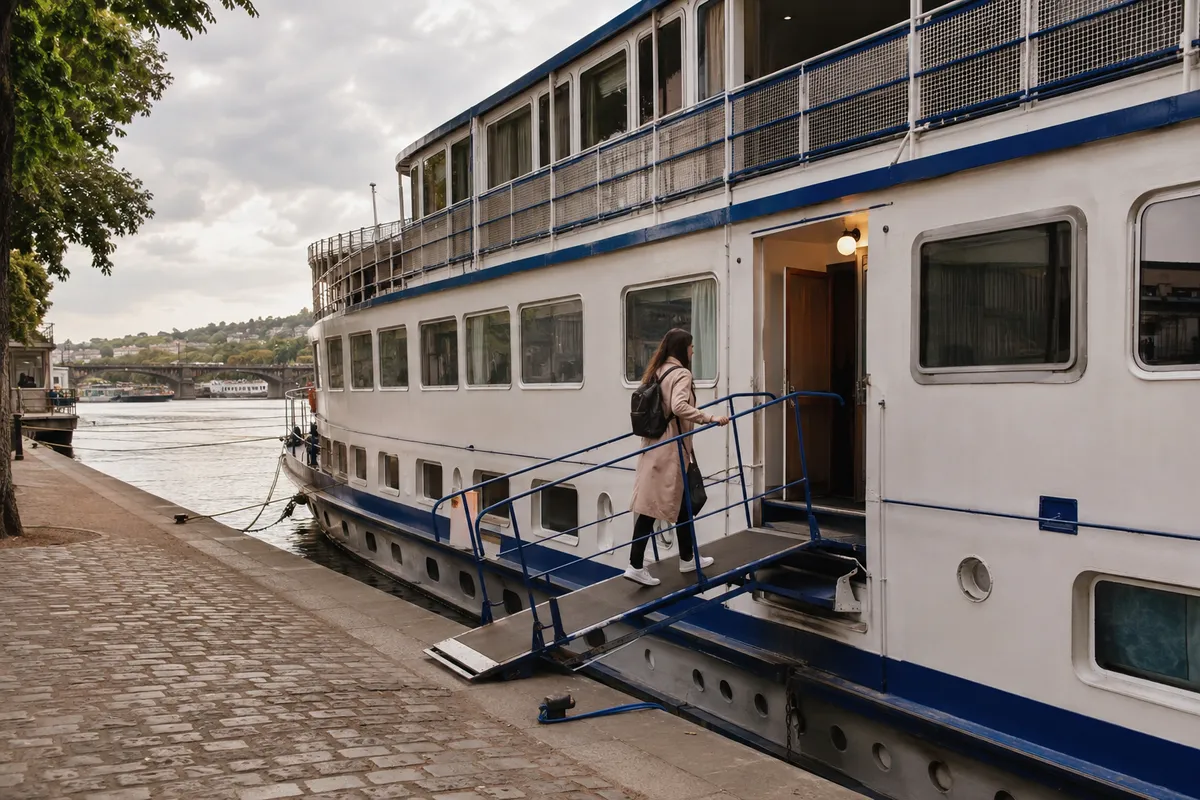
Municipal regulations across European inland waterways tightened significantly in 2026, catching unprepared travelers with steep checkout surcharges and berthing displaced from historic centers. Between the Dutch nationwide accommodation VAT increase to 21% paired with city tourist taxes and strict caps slashing river vessel arrivals, sleeping afloat requires precise logistical scrutiny. Unsuspecting guests who book floating rooms expecting conventional hotel standards frequently encounter mandatory water transit taxes, non-negotiable security holds, and sudden dock relocations.
Different floating accommodation categories serve distinctly separate travel profiles. Low-cost vintage botels offer affordable berths for independent urban explorers who pack light, while purpose-built modular platforms provide stationary stability for remote workers and design-conscious tourists. Meanwhile, chartered trade fair hotel ships serve corporate visitors facing sold-out city hotels, and slow-cruising hotel barges cater exclusively to multi-course culinary tourism on rural canal networks.
River Hotels Guide: Classification from Moored Barges to Floating Pontoons
Converted Passenger Liners vs. Modern Floating Platforms
Static river lodging splits fundamentally between converted motorized hulls and purpose-built non-propelled pontoon structures. Heritage river liners retain their classic displacement steel hulls, curved shear lines, and narrow longitudinal interior corridors. These historic vessels maintain authentic nautical character, but their hydrodynamic hulls remain susceptible to rocking from passing river traffic.
By contrast, modern floating platforms function as land-based buildings resting atop submerged steel or concrete caissons. Units like the 148-room platform housing Good Hotel at London's Royal Victoria Dock use heavy ballast to neutralize low-frequency water movement. Instead of swinging freely on anchor lines, these structures are held securely along vertical spud poles or rigid guide pilings.
I noticed this structural difference distinctly when stepping across the gangway in London; the rigid pontoon foundation eliminated any perceptible roll, but sliding mechanical collar guides produced a dull metallic creak as dock water levels adjusted. Modern floating hotels emphasize stationary stability, while older converted riverboats provide a visceral maritime atmosphere with unmistakable hull movement.
Seasonal Messe Hotel Ships and Commercial Event Charters
During massive industrial trade fairs along the Rhine corridor, conventional hotel room inventories in Cologne and Düsseldorf deplete months in advance. To absorb the extreme accommodation deficit, charter operators deploy temporary river hotel ships that supply critical surge lodging alongside urban promenades. Fleet operators like Köln-Düsseldorfer (KD) berth vessels providing up to 500 surge beds during peak exhibitions.
These temporary event charters command premium nightly rates between €250 and €350, yet guests must navigate strict operational limitations. Onboard restaurants frequently restrict food service to early buffet breakfasts, and wellness centers or fitness rooms often operate in seasonal layup mode. The vessel functions primarily as a floating corporate dormitory rather than an active pleasure cruiser.
| Operational Metric | Messe Hotel Ship | Permanent Urban Botel |
|---|---|---|
| Nightly Rate Range | €250 – €350 (peak trade fairs) | €60 – €190 (standard seasonal) |
| Berthing Configuration | Double-banking (hull-to-hull) | Direct quay or dedicated pontoon |
| Cabin Window View | Adjacent hull or open river | Open river, canal, or dockside |
| Dining Facilities | Buffet breakfast only | Full restaurant or bar lounge |
Double-banking represents a routine reality of Messe charters. When port authorities allocate limited quay space along urban river walls, ships tie up directly alongside one another. If your cabin sits on the inboard side, your window opens against the solid steel hull of an adjacent cruiser barely two meters away.
Fully Crewed Hotel Barges vs. Stationary Waterway Stays
A fundamental operational distinction separates stationary city-center botels from fully crewed hotel barges cruising provincial waterways. Static riverboat accommodations remain tied to fixed urban moorings, leaving guests entirely responsible for their own daily meals, local transit, and itinerary planning across the host city.
In contrast, luxury hotel barge charters operating along historic French canals function as slow-moving, all-inclusive boutique experiences. Operators such as European Waterways run six-night cruises along the Canal du Midi and Burgundy, with fares ranging from approximately €3,500 to €5,050 ($4,000 to $5,500 USD) per person based on double occupancy. These itineraries include private chefs, fine regional wines, daily guided shore excursions, and personal lock-side transfers.
Lock dimensions historically defined by the Freycinet gauge restrict canal barges to roughly 38.5 meters in length and 5.05 meters in beam. Because of these structural constraints, luxury hotel barges typically configure cabins for only four to twelve guests, ensuring generous communal salon space and attentive crew service.
Choosing between these formats depends entirely on your travel objective. Stationary urban botels deliver low-cost or mid-scale lodging within walking distance of metropolitan subway stations. Hotel barges represent self-contained leisure journeys where traversing twelve kilometers of tranquil rural canal per day constitutes the primary travel activity.
Cabin Realities: Space Constraints, Mechanical Systems, and Hydrodynamics
Spatial Layouts, Berth Ergonomics, and Hull Geometry
Stepping aboard an inland waterway hotel requires calibrating your spatial expectations. On older converted vessels, standard double cabins often measure a compact 14 square meters (around 150 square feet), as seen at Prague's Botel Albatros. Contemporary design catamarans like OFF Paris Seine also build standard dock-view and river-view rooms to this efficient 14-square-meter footprint.
On vintage hulls, inward hull curvature—known as hull flare—steals considerable floor area below the cabin waistline. While a cabin's ceiling might measure two and a half meters across, the floor width narrows noticeably against the sloping bilge. Built-in nautical berths often feature custom lengths around 190 centimeters, which can leave tall travelers pressed against wood bulkheads.
Storage ergonomics require disciplined packing strategies. Cabins rarely provide conventional wardrobes, relying instead on open wall hooks, small hanging rails, and shallow open shelves. Under-bed storage space is frequently sealed to house buoyancy compartments, emergency life jackets, or bilge piping, leaving zero clearance for hard-shell luggage wider than twenty-five centimeters.
Wake Resonance, Motion Factors, and Steel Hull Radio Attenuation
Many travelers assume that mooring to a solid quay eliminates motion sickness, but inland waterways generate abrupt hydrodynamic forces. Passing push-tows and commercial freight barges displace massive volumes of water, producing a rapid local drawdown followed by secondary divergent wake waves. This hydrodynamic disturbance causes moored vessels to surge against their mooring springs and roll sharply.
Wake turbulence creates a high-frequency, jerky motion that differs distinctly from slow ocean swells. When a loaded cargo barge passes at night, your bed may shudder and roll abruptly for thirty to forty-five seconds. Light sleepers and individuals sensitive to vestibular disruption often find these sudden hull movements jarring.
A steel vessel acts as a partial Faraday cage. Solid riveted or welded hull plates weaken high-frequency 4G and 5G cellular frequencies and external Wi-Fi signals by 20 to 40 decibels below the deck line. Unless the operator has mounted wired wireless access points inside the corridor ceiling, cabins below the waterline experience persistent signal drops.
When I tested connectivity in lower-deck river berths, mobile signal strength dropped immediately from four bars to edge network reception upon descending below the steel deck plate. If your itinerary requires participation in stable video conference calls, confirm in advance that access points are wired directly on your passenger deck.
Marine Waste Systems and Bilge Pumping Dynamics
Plumbing on inland waterway vessels operates on marine engineering principles rather than standard municipal gravity sewer lines. Many cabin en-suite bathrooms rely on electric macerator pump systems, such as Saniflo units, installed directly behind the toilet bowl. These compact motor assemblies use rotating stainless steel cutting blades to grind waste before pumping it through narrow-bore pipes to holding tanks.
Macerator systems demand strict behavioral discipline. Flushing paper towels, feminine hygiene products, or wet wipes will snag the high-speed cutter shaft within seconds. When the impeller binds, the electric motor overheats and trips its thermal circuit breaker, causing waste water to back up into the shower pan and cabin floor.
The mechanical sound profile also requires adjustment. Whenever you or an adjacent cabin neighbor flush a toilet or run the sink basin, an electric motor whirs loudly through the bulkhead for five to ten seconds. For an overview of how luxury water resorts engineer isolated marine plumbing, examine our guide to luxury floating resorts and water villas.
Flagship Geographic Hubs: European Case Studies and Pricing Models
Heritage Central European Moorings: Prague and Stockholm
Central Europe preserves a substantial inventory of converted passenger ships moored permanently along urban riverbanks. In the Czech capital, classic botels on the Vltava River provide budget-conscious base camps within walking distance of Old Town sights. Rates at these floating outposts swing dramatically across the calendar based on seasonal tourism flows.
According to Botel Albatros official booking terms, a standard double cabin measuring 14 square meters typically ranges from €60 to €75 per night during the low winter season, climbing to €120 to €150 per night during peak summer months. These heritage vessels operate under strict municipal river corridor fire safety ordinances and enforce a non-negotiable no-smoking policy across all interior cabins, backing it with an immediate 5,000 CZK fine and eviction without refund.
Further north, Stockholm's archipelago-connected waterways house vintage floating accommodations like Rygerfjord Hotel & Hostel, permanently moored along the Södermalm shoreline. Sheltered by Lake Mälaren's controlled water levels, Swedish hostel ships avoid heavy river currents but use dynamic pricing yield systems where overnight cabin rates adjust daily based on local harbor demand and summer festival bookings.
Contemporary Architectural Dockings: Paris and London
Western European capitals have embraced modern, purpose-built floating architecture over vintage hulls. In the French capital, OFF Paris Seine operates as an anchored catamaran hotel moored along the Quai d'Austerlitz on the left bank of the Seine. This modern vessel combines floating design with upscale hospitality, featuring a central lounge pool and dual cabin orientations.
Standard 14-square-meter rooms at OFF Paris Seine range from €121 to €190 per night in low season, rising above €300 per night during peak summer demand. When reserving, pay close attention to berth orientation. Dock-view rooms face the stone pedestrian embankment and morning delivery traffic, while river-view rooms look out over the active navigation channel, where tourist sightseeing boats generate frequent wakes from morning until midnight.
In the United Kingdom, Good Hotel London occupies a floating modular platform berthed in the Royal Victoria Dock. Room rates for private cabins range from £87 to £138 per night excluding breakfast. Because Royal Victoria Dock is an impounded dock system separated from the tidal River Thames by lock gates, the platform remains unaffected by the river's six-meter tidal swings, offering level gangway access across all seasons.
The Rhine Event Corridor: Cologne and Düsseldorf Floating Inventory
The industrial Rhine corridor represents Europe's highest-density deployment zone for stationary cruise ships operating as temporary hotels. When major international trade exhibitions occupy Messe Düsseldorf or Koelnmesse, land-based hotels routinely hike standard room rates past €500 per night, opening up heavy demand for floating alternatives berthed along the river walls.
To support this corporate demand, KD Deutsche Rheinschiffahrt expanded its commercial hospitality fleet in 2024 with the 135-meter KD Moment. According to the KD Moment vessel specifications, the ship offers 86 double cabins configured specifically for stationary hotel operations and corporate event charters along the Rhine.
Staying aboard an event vessel moored at Cologne's Konrad-Adenauer-Ufer puts guests within walking distance of the central railway station and cathedral. However, these berths sit directly exposed to the Rhine's powerful downstream current and non-stop commercial barge traffic. The continuous movement of heavy cargo carriers creates constant mooring line tension and regular hull wash against the ship's water-side cabins.
Municipal Regulations, Water Taxes, and Urban Tourism Caps
Navigating Nightly Water Tourist Taxes and Accommodation VAT
Taxes applied to floating accommodations have risen sharply across European waterways. In the Netherlands, short-stay accommodations faced a substantial fiscal shift: the Dutch Tax and Customs Administration VAT guidelines confirm that effective January 1, 2026, the nationwide VAT rate on short-stay lodging increased from 9% to 21%. Combined with Amsterdam's local tourist tax of 12.5%, guests face a cumulative tax burden of roughly 33.5% on moored houseboats and botels.
Day visitors navigating inland waterways on cruise ships also face targeted transit fees. In the Dutch capital, river cruise passengers docking without booking an overnight land hotel are subject to a municipal day passenger transit tax (dagtoeristenbelasting) set at €15 per passenger per day in 2026 under local municipal decrees.
| Jurisdiction | Vessel / Lodging Type | Fiscal Mechanism & Rate (2026) | Collection Method |
|---|---|---|---|
| Amsterdam, Netherlands | Permanently moored botel / houseboat | 21% National VAT + 12.5% Municipal Tourist Tax | Settled on room invoice |
| Amsterdam, Netherlands | Transit river cruise passenger | €15 per person per day (Day Transit Tax) | Billed via cruise operator |
| Paris, France | 4-star floating hotel (OFF Paris Seine) | €8.45 per adult per night (Taxe de séjour) | Paid at reception check-in |
| Prague, Czech Republic | Historic river botel (Albatros) | Local spa and tourist stay fee (~50 CZK/night) | Paid at check-in desk |
In France, the municipal tourist levy (taxe de séjour) applies strictly per guest per night. As stated in the OFF Paris Seine terms and conditions, guests staying at the 4-star floating hotel must pay a mandatory city tax of €8.45 per adult per night directly upon arrival. Budget for these fees separately, as online travel agencies often omit them from baseline advertised cabin rates.
Urban Caps on River Moorings and Capacity Restrictions
European historic capitals are actively curbing vessel congestion along urban waterfronts. The City of Amsterdam tourism policy enforces a strict "no-new-hotels" quota rule: a new floating or land hotel may open only if an existing licensed property closes and total guest bed capacity does not expand. This restriction effectively freezes new botel berths within the central canal ring and historic waterfront basins.
Simultaneously, municipal authorities enacted aggressive policies to de-congest inland waterways. Amsterdam's municipal framework targets a 50% reduction in river cruise ship calls by 2028, capping overall vessel arrivals at a maximum of 1,150 ships per year. Similar berthing constraints are being evaluated in Strasbourg and Vienna to mitigate pedestrian crowding along historic embankments.
These policy caps directly impact travelers by pushing non-permanent botels and charter ships outward into peripheral industrial docks. Instead of stepping off the gangway directly into the historic core, guests may find their vessel assigned to commercial shipping quays like Amsterdam's Coenhaven, requiring bus connections or scheduled water shuttles to reach urban attractions.
Booking Sourcing and Vessel Legitimacy: Aggregators, ENI/IMO Verification, and AIS
Finding legitimate moored boat lodging requires moving beyond generic hotel search engines. While aggregators feature floating properties under "unique stays" filters, booking through specialized platforms or direct operator websites offers clearer cabin specifications and deck layout plans.
Before confirming an independent riverboat stay, verify the vessel's maritime credentials. Commercial vessels operating on European inland waterways carry an eight-digit European Vessel Identification Number (ENI) governed by European Union inland navigation safety frameworks. Legitimate botels and cruise ships maintain an active ENI registration proving compliance with hull inspections, damage stability standards, and onboard fire-suppression regulations.
You can verify a vessel's operational status and precise coordinates by entering its ship name or ENI number into public AIS (Automatic Identification System) tracking portals. If an advertised river hotel fails to appear on AIS tracking or lacks an ENI identifier, it may be operating on an unlicensed private mooring without standard commercial passenger safety certifications.
Direct operator platforms generally offer transparent cabin locations, allowing you to select between upper-deck berths and lower-deck waterline cabins. Third-party aggregators frequently lump all entry-level inventory together, meaning you risk assignment to a noisy engine-casing cabin or an inboard blind berth.
Critical Practicalities: Accessibility, Security, and Seasonality
Physical Accessibility Restrictions on Vintage Hulls
Inland waterway vessels frequently present severe structural barriers for guests with limited mobility, wheelchair users, or parents traveling with heavy strollers. Historic river vessels operate under maritime structural frameworks that exempt them from modern barrier-free architectural building codes.
Watertight bulkheads require raised door sills—known in maritime terms as coamings—measuring 15 to 30 centimeters in height at cabin entries and bathroom thresholds. Crossing these steel lips requires stepping up and over, making unassisted wheelchair access impossible. Furthermore, companionway stairs connecting passenger decks feature steep angles between 45 and 60 degrees with narrow treads.
Even modern cruise vessels configured for event hospitality exhibit accessibility compromises. Official vessel documentation for the KD Moment confirms that while main public areas accommodate guests, the ship lacks passenger elevator service to its lower cabin deck and open-air sun deck. Always verify elevator access and threshold heights with the vessel purser before booking if physical mobility is a priority.
Security Deposits, Onboard Curfews, and Conduct Policies
Operating a hospitality business on public waterways requires strict onboard conduct regulations. Moored vessels enforce rigid check-in protocols, including mandatory photo identification checks and incidental credit card pre-authorizations to cover potential property damage or emergency evacuation costs.
Sanctions against smoking are enforced ruthlessly across floating properties due to severe fire risks on water. In Prague, Botel Albatros levies an immediate 5,000 CZK fine and evicts guests without refund upon detecting interior cigarette or electronic vaporizer use. Similarly, unauthorized pets trigger sanitation surcharges, such as Albatros's mandatory €100 deep-cleaning fee to protect subsequent allergic guests.
Water acts as an efficient acoustic reflector, carrying exterior conversations and footfalls across harbor basins with surprising clarity. Consequently, botels enforce strict quiet hours after 22:00. Open-deck social gatherings are prohibited late at night, and security staff will restrict access to open sun decks to preserve shoreline residential noise compliance.
Cold Convection, Condensation, and Off-Peak Winter Realities
Winter stays aboard steel-hulled river hotels expose guests to challenging thermodynamic phenomena. When ambient river water temperatures drop to between 2°C and 4°C, uninsulated steel plates below the waterline act as direct thermal bridges. Cold water draws heat continuously from the cabin interior through convection, leaving lower flooring surfaces ice-cold.
Moisture dynamics also intensify during colder months. Warm, humid indoor air generated by breathing and hot showers hits cold exterior porthole glass and uninsulated steel framing, reaching the dew point and condensing rapidly. If ventilation is inadequate, moisture pools along interior porthole sills and behind bed headboards, fostering mold growth.
Upon checking into a river cabin during autumn or winter, run an immediate climate check: inspect porthole rubber gaskets for drafts or moisture pooling, verify that electric baseboard heaters respond promptly, and request a ceramic space heater or desiccant dehumidifier at reception if the room smells noticeably damp.
Onboard heating systems frequently struggle during prolonged sub-zero cold snaps. If a vessel utilizes river-source heat pumps, heating efficiency drops dramatically when surface water approaches freezing, forcing reliance on supplemental electric resistance heaters. Pack warm wool socks or indoor slippers to counter cold floor plates during off-peak winter stays.
The Inland Waterway Verdict: Strategic Decision Framework
Trade-Off Matrix: Static Boat Lodging vs. Land-Based Hotels
Choosing between a static river hotel and a conventional brick-and-mortar hotel involves clear lifestyle compromises. Floating accommodations provide remarkable waterfront panoramas and convenient proximity to central riverside cultural quarters, often at a 15% to 25% pricing discount relative to nearby land-based real estate.
However, guests sacrifice acoustic isolation, bathroom dimensions, and spatial freedom. While a standard European 3-star city hotel room averages 18 to 22 square meters, urban botel cabins rarely exceed 14 square meters and require stepping over high door coamings into compact wet-room bathrooms. For broader context on European floating stays, consult our guide to European urban botels and converted barge hotels.
| Evaluation Criterion | Static River Hotel / Botel | Land-Based City Hotel |
|---|---|---|
| Cabin / Room Floor Area | 5 – 14 m² (sloping hull boundaries) | 16 – 25 m² (standard rectangular) |
| Acoustic Environment | Water lap, wake bumps, line tension, macerators | Street traffic, hallway footfalls, sirens |
| Cellular & Wi-Fi Stability | Variable (20–40 dB loss below waterline) | Standard commercial high-speed Wi-Fi |
| Structural Motion | Intermittent wake rolling from river traffic | Zero structural motion |
| Quayside & Transit Access | Gangway ramp (variable tide/dock angle) | Level street access, standard curb entry |
The acoustic landscape differs fundamentally between the two lodging types. Where a land-based hotel exposes guests to automotive traffic and pedestrian noise, a river hotel substitutes mooring line groans, hull slapping, wake shudder, and the periodic buzz of adjacent marine waste pumps.
Booking Profile Matcher: When to Choose Floating Lodgings
Floating accommodations deliver a memorable travel experience when booked for the right reasons, but they prove frustrating if chosen carelessly. The logistical constraints of living on water mean that static riverboat lodging suits specific traveler profiles while causing headaches for others.
Floating accommodations are an ideal choice under specific operational circumstances:
- Trade Fair Overflow: Business travelers visiting Cologne, Düsseldorf, or Frankfurt during major industrial congresses when land-based hotel rooms are completely booked.
- Short Waterfront City Breaks: Solo travelers and couples booking one- to three-night romantic stays who value immediate riverfront views over expansive room space.
- Canal Cruising Enthusiasts: Travelers booking fully crewed luxury hotel barge charters across rural France seeking leisurely, gourmet-focused journeys along historic waterways.
- Budget Travelers Packing Light: Urban explorers carrying soft duffle bags who appreciate central city-center moorings at discounted nightly rates.
Conversely, floating hotels are completely unsuitable for travelers requiring verified wheelchair accessibility, individuals prone to vestibular motion sickness, families traveling with multiple oversized hard-shell suitcases, and remote professionals who depend on low-latency video streaming for daily work. If you value spacious en-suite bathrooms, silent plumbing, and zero floor motion, stick to a conventional land-based hotel.