On my last autumn stay I arrived on a late train from Schiphol, walked from Centraal to Oosterdok with a wheeled case, and found the gangway to the barge I had booked pitched far steeper than it had looked online. The harbor level had dropped through the afternoon, and the guest ahead of me waited a couple of minutes for the ramp to settle before hauling her suitcase aboard. I now do the last stretch with a soft bag and leave the hard case in a station locker.
Over the years I have slept on dozens of moored ships, converted cargo barges and houseboats. The eleven vessels reviewed here all sit in Amsterdam: seven in the Oosterdok basin, three across the IJ in Noord, and one along the Amstel. What separates a quiet night from a restless one comes down to hull design, how exposed the mooring is to passing wake, and how you get aboard.
Side-by-Side Comparison of Floating Hotels in the Netherlands
Cabin Sizes, Boarding, and Air Conditioning at a Glance
The rates below are the lowest standard double each operator publishes before tax; high season and event weekends push them higher, so treat them as a floor. The table fills in what the photographs leave out: how much floor you actually get, whether the toilet is yours, whether the cabin is air-conditioned, and how you board.
| Vessel | Mooring | Cabin size | Private bathroom | Air conditioning | Boarding |
|---|---|---|---|---|---|
| Botel Amsterdam | NDSM-pier 3 | Basic and deluxe doubles, four-bed cabins; five Letter Loft suites | Yes | Deluxe cabins only | Lift between guest decks |
| Hotel Asile Flottant | De Ceuvel, Noord | Six boats, 25–80 m², sleeping 2–6 | Yes | No | Gangway plus fixed steps |
| Hotelboot Zwaan | Oosterdok Steiger 3 | Eight cabins; Captain's Lodge 50 m² | Yes | No | Steps; Lovers Nest has a steep stair |
| Lightship Amsterdam | Mariadistelkade, Buiksloterham | Two suites, 60 and 65 m² | Yes | No | Gangway and companionway steps |
| AmicitiA | Oosterdok Steiger 3 | 10–12 m² cabins | Shared or private | No | Gangway and steep companionway |
| Vita Nova | Oosterdok Steiger 2 | 10–14 m² cabins | Shared and private options | No | Gangway and steep companionway |
| MPS Holland | Oosterdok Steiger 3 | Compact twin and bunk cabins | Yes (shower cubicle) | No | Gangway and steps |
| Passengership Avanti | Oosterdok Steiger 3 | Double and twin cabins | Yes | No | Gangway and steps |
| Hotelschip Gandalf | Oosterdok Steiger 3 | Compact double cabins | Yes | No | Gangway and steps |
| Houseboat Little Amstel | Amsteldijk 700 | Two studios, 15 m² | Yes | No | Street level, no stairs |
| Anna Maria II | Oosterdok Pier 3 | Compact twin cabins | Shared | No | Gangway and steps |
What the 2026 Tax Changes Add to Your Bill
Dutch rack rates can surprise you at checkout, because two separate charges stack on top of the room. The first is national: VAT on lodging rose from 9% to 21% on 1 January 2026, as the Belastingdienst page on the btw rate for accommodation sets out, and the same rate covers gas, water, sanitary facilities and parking bundled into a stay. The wider structure of Dutch VAT, 0%, 9% and 21%, is summarised in VAT rates and exemptions on Business.gov.nl. Breakfast is a separate supply of food, so an operator who bills it on its own line can keep it at 9%; on a week-long booking it is worth asking how the bill is split.
The second is municipal. Amsterdam's tourist tax is 12.5% of the overnight price excluding VAT, with no cap on the number of nights. A cabin quoted at a net ≈ $110 (€100) therefore comes to ≈ $23 (€21) in VAT plus ≈ $14 (€12.5) in city tax, or ≈ $150 (€133.5) in total, about a third more than the headline number.
How the Hull Type Changes Your Stay
Stationary boat hotels do not behave alike in the water. The eleven vessels here fall into four hull types, and the type decides most of what your night is like.
- Multi-deck passenger vessels: purpose-built hulls such as Botel Amsterdam, with several internal decks, a guest lift and wide corridors. They are the least boat-like of the group and feel closer to a budget land hotel.
- Historic converted freight barges: slender steel hulls such as Vita Nova, AmicitiA and MPS Holland, mostly built between 1897 and the 1930s. Cabins run 10 to 14 m², ceilings are low, and the waterline is close.
- Moored residential houseboats: flat-bottomed and heavy, such as Houseboat Little Amstel. Straight walls, domestic plumbing and none of the motion of a narrow hull.
- Heavy industrial vessels: deep-draft ships such as Lightship Amsterdam (LV-12), riveted from British steel, with large internal volume (its two suites measure 60 and 65 m²) and better sound insulation than a barge.
Inside a converted cargo barge, space is tight: under-bed cubbies hold your things and the berth is one you slide into. Most shipboard toilets use a macerator pump, so anything other than toilet paper in the bowl risks a jam and a call for the skipper. Steel carries sound as well: an engine starting two piers away, or footsteps on the deck above, reach your berth directly. Cabins sit either on the main deck or down in the former cargo hold, and that choice matters more than the cabin itself. A hold berth means more steps, less daylight and, in summer, warmer air; ask which deck you are on before you book.
Moorings, Ferries, and Getting Aboard
Where a vessel is moored decides your daily commute. Seven of the eleven sit in the Oosterdok basin behind the NEMO Science Museum, a flat 10- to 15-minute walk from Amsterdam Centraal, so you can arrive by train and walk without buying a transit ticket. Three sit in Amsterdam Noord across the IJ, reached by the municipal ferries. The first winter I stayed in Noord I bought a strip of GVB tram tickets to get across the IJ, then found the crossings are free: GVB ferry services cost nothing for pedestrians and cyclists, and the F4 line between Centraal and NDSM-werf leaves every 15 minutes through the day and every 30 minutes overnight, with a crossing of about 15 minutes. The last of the eleven is on the upper Amstel at Amsteldijk near the Torontobrug, a quiet residential stretch served by city trams.
Boarding is the part photographs never show. A gangway has to bridge a quay at a fixed height and a hull that rises and falls with the water. Large ships use gently graded ramps; historic barges use a narrow gangplank followed by steep, ladder-like companionway steps. The first time I took a cabin in the hold of a converted barge I carried a 23 kg hard case down those steps in the dark, and I would not do it again. I now ask for a main-deck cabin or repack into a duffel before I travel. If you have limited knee mobility or travel with a heavy rolling case, let the boarding arrangements, not the cabin photos, decide your booking.
Hotelboot Zwaan takes no credit cards: bring cash for the room and a ≈ $22 (€20) key deposit.
Oosterdok Barges Within Walking Distance of Amsterdam Centraal
Budget Converted Freight Barges at Steiger 2 and 3
If you arrive late by train and want to avoid trams, the cluster of converted barges at Oosterdok piers 2 and 3 is the most practical base in the city. Vita Nova is the template: a vintage cargo barge permanently moored at Steiger 2, roughly 1 km (a 12- to 15-minute walk) from Centraal, with rates from ≈ $72 (€65). It offers basic bunk berths, a choice of shared or private bathrooms, radiator heating and a small communal lounge; cabins are compact, but the basin stays calm year-round.
A few metres away at Steiger 3 sits AmicitiA, an 1897 freight barge facing the copper curves of NEMO, with cabins from ≈ $77 (€70). The historic lines come with snug companionways and raised storm sills you step over at every doorway, and there is central heating but no air conditioning, so summer ventilation depends on deck hatches and brass portholes.
MPS Holland, also at Steiger 3 and about 900 m from the station, starts at ≈ $83 (€75) and suits solo travellers and rail commuters: compact twin or bunk berths with en-suite shower cubicles, thin partitions between cabins, and a shared sundeck above the basin. Anna Maria II, at Oosterdok 51 on Pier 3, starts at ≈ $83 (€75) with twin cabins and an easy 15-minute walk back to the platforms.
Mid-Range Passenger Ships and Seasonal Cruisers
For more floor space and purpose-built passenger layouts, look to the converted passenger botels at Steiger 3. Passengership Avanti is a 1930s Dutch vessel with private en-suite double and twin cabins from ≈ $88 (€80). Because it was built to carry passengers, its interior gangways are a little wider than a freighter's, and the stern salon is the place to sit out a wet afternoon.
Hotelschip Gandalf lies alongside, from ≈ $94 (€85), with compact en-suite doubles and heating. It sits behind the outer pier, sheltered from the wake of passing cruisers, but the portholes are small and the cabin footprint is modest: a large hard-shell bag left open on the floor blocks the walkway to the bed.
Hotelboot Zwaan runs a different model. Through the cruising season it works as an active bike-and-barge tour vessel; from the start of October to the end of March it lies stationary in the Oosterdok, per the operator's own rate page, and it is the one vessel here where breakfast is included. All eight cabins have a private hot shower and toilet, and for a longer winter stay there is the 50 m² Captain's Lodge, from ≈ $110 (€100) a day with a seven-night minimum and sold only off-season. The Lovers Nest cabin sits in the bow behind its own entrance and a steep stair, and it is the one berth here I would skip with a heavy case or stiff knees.
Boutique and Independent Floating Stays in Noord and Along the Amstel
Botel Amsterdam and Lightship Amsterdam
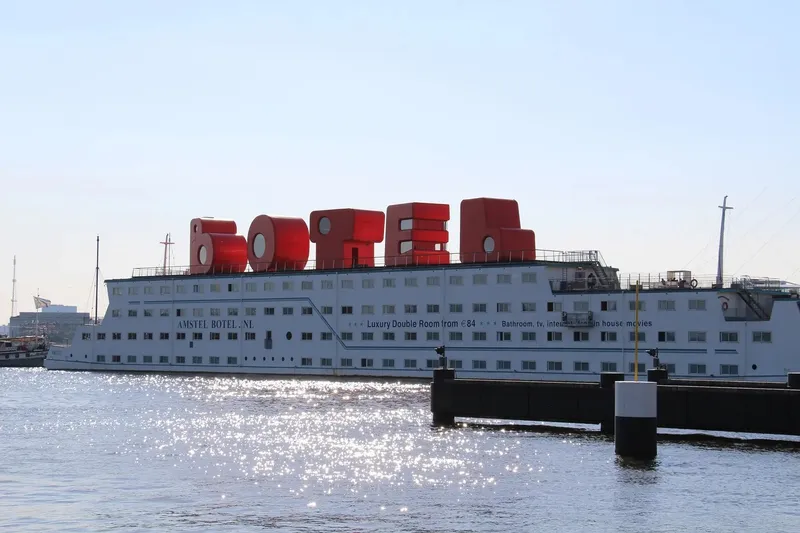
Crossing the IJ brings two very different floating hotels. At NDSM-pier 3, Botel Amsterdam is a multi-deck, 175-cabin ship with a lift to the guest decks, wide corridors, basic and deluxe twins, four-bed cabins and five rooftop Letter Loft suites built around the letters B, O, T, E and L. It sits 250 m from the ferry dock, about 15 minutes from Centraal on the free F4 ferry. Rates start at ≈ $100 (€95) and include heating and en-suite bathrooms; the deluxe cabins add air conditioning while the basic ones do not, and I would avoid a basic cabin here in July or August.
For industrial design, head east along the waterfront to Mariadistelkade in Buiksloterham. Lightship Amsterdam is a converted British lightvessel (LV-12) whose two suites, the Machinery Room and the Upper Store, start at ≈ $390 (€350). Original portholes, watertight bulkhead doors and ironwork sit alongside king beds, private bathrooms and minibars; breakfast is included and there is no cooking. Because the hull is ballasted and lies in a quiet side canal, movement is negligible.
Hotel Asile Flottant and Houseboat Little Amstel
In the circular park of De Ceuvel in Noord, Hotel Asile Flottant is a fleet of six restored ships along the Johan van Hasseltkanaal, with rates from ≈ $180 (€165). The boats range from the 25 m² Anneliese, a two-person cabin with a bath that looks into the engine room, to the 80 m² Holland VII, a former herring lugger that sleeps six; De La Soul (65 m²) has a small cinema and De Amsterdam (60 m²) sleeps up to six in timber-fitted cabins. Entry means passing the De Ceuvel gate and an inner security gate, and the boardwalk between the boats is unlit, so a first arrival after dark goes more smoothly with a charged phone and the pin already dropped.
If you would rather have a residential canal address, Houseboat Little Amstel sits at Amsteldijk 700 near the Torontobrug. It is a flat-bottomed houseboat with two independent 15 m² studios, from ≈ $200 (€180), each with floor-to-ceiling sliding glass, an en-suite bathroom and a view across the river to the Amstel Hotel. There is no reception desk, so you come and go as you please.
Where Boat Hotels Fall Short
Sound, Gangways, and Ventilation
Steel is an excellent conductor of sound. A fire door slamming down a corridor travels through the framing; in a converted hold, internal partitions are often light, so the television or the snoring from the next cabin comes through, and bilge pumps hum and macerator toilets whir whenever someone flushes. Foam earplugs live in my bag for exactly this reason. Wi-Fi is the other weak point on a steel hull: the signal often drops in the hold, and a router on the upper deck struggles to reach through the plating, so bring a hotspot or ask for a cabin near the access point if you plan to work.
Gangways deserve a second look. EN 14206, the European standard for gangways on inland passenger vessels, covers their construction, but no standard gangway can cancel out a quay at fixed height and water that moves; after heavy rain or a passing wake the ramp can sit noticeably steeper than when you boarded. Older barges add high coamings, the raised thresholds that keep water out of the hold. And most historic hulls have no ducted air conditioning: steel decks soak up heat all day, so a hold cabin stays warm in a heatwave unless you keep the hatches and portholes open.
When a Land Hotel Fits Better
Waking up at water level is not for everyone, and there are four cases where a conventional hotel on Oosterdokseiland or Piet Heinkade is the better call.
- Zero-step access. A motorised wheelchair or a walking frame is not workable on a narrow barge gangplank and companionway steps. Botel Amsterdam is the only vessel here with a lift between decks.
- Silent sleep. If water lapping at steel or a distant engine wakes you, a protected harbour basin will still defeat you.
- Individual climate control. If you cannot sleep without in-room air conditioning in warm weather, the vintage barges such as Vita Nova and AmicitiA will not deliver it.
- Hotel services. Botels rarely have a gym, room service or a 24-hour porter to carry bags down the steps.
Picking by Travel Scenario
Solo Travellers, Rail Arrivals, and Winter Weeks
Arriving on an evening train at Centraal, the two cheapest berths in the basin are Vita Nova and AmicitiA, both a short walk from the platforms and both fine for a night or two. With standard luggage and a preference for a reception desk and a lift, Botel Amsterdam is the practical pick, reached on the free F4 ferry to NDSM.
For remote workers staying a full week between October and March, the Captain's Lodge on Hotelboot Zwaan is a self-contained 50 m² apartment with its own kitchen and the wheelhouse view, on a seven-night minimum.
Couples, Design Seekers, and Families
For a romantic weekend, pass over the large hotel ships: Houseboat Little Amstel puts wide sliding doors and river views beside the bed, while Lightship Amsterdam offers a private suite inside a lightvessel, at the top of the price range.
Families and small groups do best at Hotel Asile Flottant, where the 80 m² Holland VII and the 65 m² De La Soul each sleep six and come with their own galley. The trade-off is location: De Ceuvel is in Noord, quieter and further from the centre than Oosterdok, so you will use the IJ ferry.