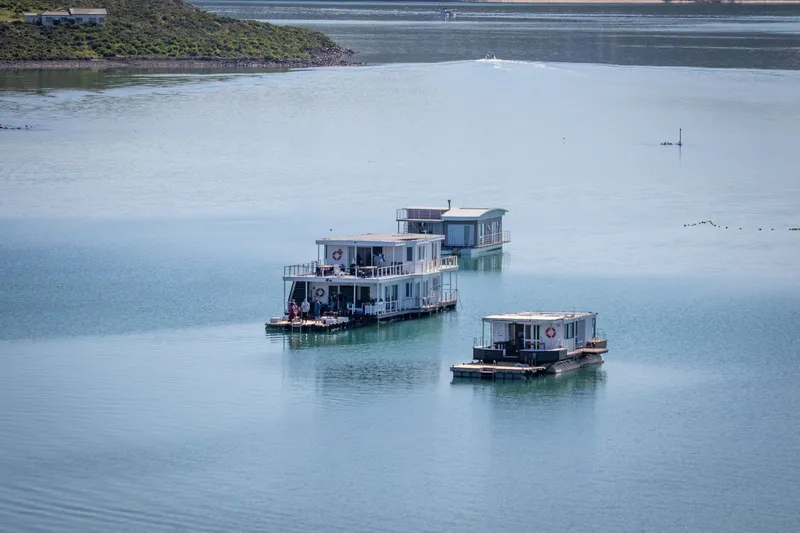
Nine permanently moored properties in Sweden, Denmark and the United Kingdom are compared below, all of them licensed hotels that take single-night bookings. Moving excursion vessels and private houseboats that rent casually are left out. Several of these ships have changed hands or been refitted in the past few years, which is why cabin counts, restaurant names and deck layouts in older reviews are often out of date.
How to Judge a Floating Hotel Before You Book
What Moves, and What Doesn't
Motion is set by the basin, not by the size of the ship. Three situations cover almost every berth in Northern Europe.
- Locked dock basins. Fingal in Leith and Sunborn London in the Royal Victoria Dock sit behind sea gates that hold the water level and block incoming swell, so the hull barely registers a passing boat and the boarding ramp keeps a constant angle.
- Inland freshwater basins. The ships on Lake Mälaren, Mälardrottningen, Rygerfjord and The Red Boat, lie in water held steady by the locks at Slussen. No tide, no ocean swell; what you notice instead is wind pressing the hull against timber pilings overnight.
- Open coast and working canals. Salt & Sill faces the Skagerrak, and Hotel CPH Living takes the wash of harbour tour boats on Christianshavn. Both move, at different rhythms: the pontoon rolls in swell, the barge shivers on wake.
If you know you are prone to motion sickness, choose a berth behind lock gates or on an inland lake, where Fingal, Sunborn London and Mälardrottningen stay close to level all year, and treat the open-strait pontoons as a decision rather than an accident.
Tidal gangways are the other variable in British ports. Locked docks keep boarding ramps flat, while berths on a tidal river need hinged ramps with roller tracks, and at a spring low the walkway can pitch down steeply, turning a routine luggage roll into an awkward descent. If you are arriving with heavy bags, check the tide table against your arrival time before you book the cheapest train.
Three Hull Types and What They Cost You
Converted historic ships keep their steel and their compromises. Fingal (1963), Barken Viking (1906) and Mälardrottningen (1924) all have steep companionways, narrow corridors and cabins pushed below the waterline, and the cheapest grades on Barken Viking have no window at all: the hotel sells them under names like Double room, no window and Single room, no window on its own booking page. That is fine for a night and disappointing if you booked a ship for the view.
Inside those old hulls, bathrooms are usually moulded cubicles rather than full rooms, ceilings dip under deck beams, and storage is built into the curve of the plating. Purpose-built pontoons and barge conversions trade that character for space: flat decks, wide doorways and deck-level boarding. Salt & Sill's two-storey pontoons, Hotel CPH Living's lengthened cargo barge and the 108-metre Sunborn London give you cabins of 19 to 23 m² with big glazing instead of riveted plating, and you step aboard across a ramp rather than down a ladder.
The Nine Properties at a Glance
The table sorts them by what actually decides a stay: where the hull sits, what it was built as, what is inside, how you board, and what you give up.
| Hotel | Location and waterway | Hull type | Cabins and layout | Boarding and access | Main trade-off |
|---|---|---|---|---|---|
| Arctic Bath | Harads, Sweden (Lule River) | Free-floating cabins on flexible moorings | 12 rooms, 6 of them on the river | Transfer from Luleå airport, about 1 h 15 | Cash-free; meals must be prebooked |
| Salt & Sill | Klädesholmen, Sweden (Skagerrak) | Two-storey concrete pontoons | Rooms of 18–30 m² | Bus or car from Gothenburg, about 1 h | Open-coast swell; two units are on land |
| Barken Viking | Gothenburg (Göta Älv) | 1906 four-masted steel barque | Single, double, twin and four-bed cabins; some share a bathroom | Walkable from Gothenburg Central | All decks are reached by stairs |
| Mälardrottningen | Stockholm (Lake Mälaren) | 1924 motor yacht, 73 m | 65 cabins, all with windows; mini suites have terraces | Riddarholmskajen 4, by Gamla Stan | Most cabins have bunk beds |
| Rygerfjord | Stockholm (Lake Mälaren) | Three linked passenger ships | Hotel rooms and hostel berths | Söder Mälarstrand, opposite City Hall | Raised coamings and ladders between ships |
| The Red Boat | Stockholm (Riddarfjärden) | Two joined historic hulls | Economy cabins for one to three people | Kajplats 10, walkable from Gamla Stan | Shared bathrooms in the cheapest grade |
| Hotel CPH Living | Copenhagen (Christianshavn Canal) | Lengthened inland cargo barge | 12 double rooms with a glass wall to the water | Metro to Christianshavn plus a 10-minute walk | Doubles only, no family cabins |
| Fingal | Edinburgh (Alexandra Dock, Leith) | 1963 lighthouse tender | 23 cabins, named after Stevenson lighthouses | Tram to Port of Leith, 2 minutes' walk | The most expensive berth here |
| Sunborn London | London (Royal Victoria Dock) | Purpose-built stationary yacht hotel | Rooms 19–23 m², suites 35–45 m² | Custom House, Elizabeth line and DLR | Docklands goes quiet after office hours |
Sort by basin first, then by boarding. With a heavy case, look past the price: Fingal was rebuilt with a round glass lift serving every deck and Sunborn London boards by a wide ramp, while Rygerfjord and The Red Boat ask you to step over raised coamings and climb narrow ladders between ships.
Nordic Floating Lodges and Subarctic Water Cabins
Arctic Bath, Harads
The floating six at Arctic Bath are anchored to the bed of the Lule River on flexible moorings, so they ride the summer water level and freeze into the ice from roughly mid-November to mid-April. A pellet stove and electric underfloor heating hold the interior warm through the winter, and each cabin carries its own 60-litre hot-water tank; the hotel's own FAQ is candid that more than two long showers on a very cold day means waiting for the water to come back up to temperature.
Terms are firm and worth reading before you pay a deposit. The Arctic Bath FAQ sets a 30% cancellation fee the moment a room booking is confirmed, rising to 100% from 120 days before arrival; restaurant and activity bookings are forfeited inside 14 days, and spa treatments inside 48 hours. Reception runs from 8:00 to 22:00, check-in is from 15:00, and the hotel takes cards only. Lunch and dinner have to be prebooked, and visitors who want to eat or use the spa without staying must call the front desk seven days ahead.
Winter flights to Lapland are cancelled for weather more often than most travellers expect, and Arctic Bath does not sell cancellation insurance. If you book a river cabin for aurora season, check that your own policy covers a missed arrival.
Salt & Sill, Klädesholmen
Sweden's first floating hotel, Salt & Sill, occupies a row of two-storey pontoons off the rocky edge of Klädesholmen, on the Tjörn side of the Bohuslän coast. Västtrafik's Tjörn express (line TEXP) runs from the Nils Ericson Terminal in Gothenburg to a stop called Klädesholmen östra a few minutes' walk from the jetty, and the timetable sits on Västtrafik's Tjörn express timetable. Rooms are compact and bright, singles and doubles at 18 m² and the top-floor suite at 30 m² with the best outlook over the outer archipelago, and every one has a tiled en-suite with granite underfoot.
The bathing is what sets the place apart. Moored at the hotel's own jetty is the S/S Silla bath and sauna boat, with a sauna, showers and a hot tub on the upper deck; 90 minutes with towel, bathrobe and slippers costs ≈ $19 (kr 195), and drop-in works when there is space, though the hotel recommends booking. It is not accessible, since there are changes of level, stairs and ladders down into the sea.
The last time I stayed there, a gale came through overnight and the pontoon moved enough for the glass of water on the shelf to pick up a slow ripple; nothing fell over and I slept, but I was glad to be on an upper floor rather than at deck level with the sea directly under the floorboards. Breakfast is the herring table the hotel is named for, served on shore before the boats start moving.
Two dates are worth planning around: the lobster season runs 1–24 October, and the Christmas buffet from 27 November to 20 December.
Capital-City Botels: Stockholm, Gothenburg and Copenhagen
Stockholm's Mälaren Fleet
Stockholm keeps the densest cluster of permanently moored hotel ships in Europe, all of them in the freshwater of Lake Mälaren. The senior vessel is Mälardrottningen, a 73-metre motor yacht built in 1924 for the New York millionaire C.K.G. Billings and later handed to the Woolworth heiress Barbara Hutton. She has been tied up at Riddarholmskajen 4 since 1982, a short walk from Gamla Stan, and after an Art Deco renovation that added the Brasserie Hutton in 2024 the hotel has 65 cabins, every one with a window, most with traditional bunk beds, plus a few mini suites with their own terrace.
Further west along Söder Mälarstrand, opposite City Hall, Rygerfjord spreads hotel rooms and hostel berths across three linked passenger ships. Just along the quay at Kajplats 10, The Red Boat is two joined hulls, one of them the Ran of Stockholm, with economy cabins for one to three people and shared hallway showers in the cheapest grade. These two are the least expensive berths in the centre, and both run short reception hours, so a late arrival has to be arranged in advance.
Barken Viking, Gothenburg
The Gothenburg landmark is a four-masted steel barque built in 1906 by Burmeister & Wain in Copenhagen and now moored at Gullbergskajen in Lilla Bommen. At 97 metres she is reported to be the largest sailing ship ever built in Scandinavia, and the hotel occupies her deck and lower holds with single, double, twin and four-bed cabins, some en-suite and some sharing a bathroom. The deck restaurant opens daily from 11:30 through the summer, and everything inside is reached by stairs, so if you are carrying a large case ask for an upper-deck cabin. Rates and room grades are listed on Hotel Barken Viking's own site.
Hotel CPH Living, Copenhagen
The twelve-room Hotel CPH Living is the odd one out: a German inland cargo barge, lengthened in Poland and fitted out at the Loksa yard in Estonia, towed to Langebrogade 1A and opened in 2009. Every room is a double with a full glass wall facing the harbour and the city skyline, and the whole barge is heated by a pump that draws warmth from the canal water and pushes it through underfloor circuits. Breakfast is a simple self-serve arrangement in the reception, coffee and tea are free at any hour, and guests get a rooftop terrace above the water; the details are on CPH Living's own site.
Two practical details matter. Air conditioning is not on the amenity list, which is worth remembering in a July heatwave in a glass-walled room, and the desk closes in the early evening, so the hotel asks late arrivals to get in touch before travelling rather than turning up and hoping.
I arrived after the desk had closed on one trip; an email sent that morning was enough, the entry instructions came back the same day, and the underfloor heating was already running when I let myself in. The harbour outside was quiet apart from a tour boat turning at the canal mouth, and breakfast the next morning was laid out on the counter in the reception.
UK Floating Hotels
Fingal, Leith
Fingal began life in 1963 as the last ship built by the Blythswood Shipbuilding Company in Glasgow, a lighthouse tender for the Northern Lighthouse Board that carried keepers and supplies along the Scottish coast, with three decades stationed at Oban and six years at Stromness, before retiring in 2000. The Royal Yacht Britannia Trust bought her in 2014, hollowed out the hull, removed the funnel and built two new decks behind it in a ≈ $6,600,000 (£5,000,000) conversion that opened to guests in 2019. The 23 cabins are named after Stevenson lighthouses, and the rebuild added a round glass lift serving every deck.
Rates start at ≈ $350 (£264) for a Classic Cabin and reach ≈ $1,200 (£880) for the Skerryvore Suite, which has its own private deck. The ship lies in Alexandra Dock, two miles from the centre of Edinburgh, with a private car park at the bow for guests; the full set of routes, including the tram and bus options, is on Fingal's travel page.
Sunborn London, Royal Victoria Dock
Sunborn London is the only purpose-built hotel in the group: a 108-metre yacht-shaped building with no engine, moored in the Royal Victoria Dock beside ExCeL London. Rooms run from 19 to 23 m² with balconies and the suites from 35 to 45 m², and the ship uses multi-zone air conditioning rather than radiators, which is why the cabins avoid the condensation that plagues converted cargo hulls. Direct rates on Sunborn's own room pages start around $140 (£105) for a dock-view Classic room and ≈ $200 (£148) for a river view, with forward-facing Executive Suites from ≈ $490 (£374); packages that include dinner and breakfast cost more.
During an exhibition at ExCeL I stayed here rather than across the dock, and walking over to the west entrance with a coffee took a few minutes, which beats queueing for the first DLR trains at Custom House. Custom House is also the Elizabeth line stop, a short walk from the gangway.
Sundown Bar on the upper deck is open to the public as well as guests, and afternoon tea is served in the Land's End restaurant from Monday to Saturday; both look across the dock towards Canary Wharf.
Heating, Plumbing and Other Things the Photos Don't Show
Hull Heat Loss and Onboard Plumbing
Steel and iron hulls act as heat sinks: warmth drains into the water unless the interior is insulated or the heating is generous, which is why the converted ships here rely on plumbed radiators or ducted systems while purpose-built vessels can afford zone-by-zone climate control. The neatest installation is at CPH Living, where a heat pump takes thermal energy out of the canal water to feed the underfloor circuits.
Older hulls often have marine toilets with a macerating pump behind the bowl. Press the button and the pump runs for several seconds with a hum you can hear through a bulkhead at night, and wipes or heavy paper will jam it, so use only what the cabin provides. Hot water is the second limit: city ships are plumbed into the mains, while remote installations work from individual tanks and reward short showers. Wi-Fi is the third. A steel hull is a faraday cage, so expect the strongest signal in the lounge or on deck and the weakest in a cabin below the waterline; if you need to work, ask before booking whether the boat has shore fibre or a mobile router.
Reception staffing decides how the evening goes. Arctic Bath is staffed from 8:00 to 22:00, CPH Living's desk closes at 18:00, and The Red Boat keeps its reception open from 7:00 to 23:00. Outside those hours there is no one to let you in unless you have arranged it in advance, and on a moored ship there is no night porter to call from the quay.
Booking Traps, Seasonal Timing and What to Skip
Three things cause most disappointing stays in this part of Europe.
- Paying for water and sleeping on land. Six of Arctic Bath's twelve rooms are on land, and two units sold as part of Salt & Sill, Villa Stora Salt and Villa Lilla Salt, stand on shore, one of them a minute's walk from the pontoons. The listings are accurate, but the room names are not obvious, so read them before you pay.
- Taking the cheapest grade on a historic hull. The lowest fares on Barken Viking buy windowless cabins buried in the hull, which is worth knowing if you booked a ship for daylight and a view; the same trap exists on any converted vessel where the entry category sits below the waterline.
- Arriving after the desk has closed. Small botels keep short reception hours, so confirm your arrival window in advance, and carry a card: Arctic Bath states plainly that it is cash-free, and the other Nordic properties here are card-based in practice.
Timing changes what you get. Arctic Bath's river cabins spend a large part of the winter locked in ice, which is the point in aurora season and a limitation if you want to watch the water move. Salt & Sill's lobster season runs 1–24 October and the Christmas buffet from 27 November to 20 December, and both fill the restaurant on Klädesholmen weeks ahead. In Edinburgh the tram extension to Port of Leith has turned the run into town into a short hop, and in Stockholm Mälardrottningen's 2024 renovation means the restaurant and bar are not the ones described in reviews written before that winter.