How I Judge a Floating Hotel in Sweden
Swedish floating accommodation comes in two families, and the difference shows up on the first night rather than in the booking photos. Purpose-built concrete pontoons sit low and heavy and barely register a passing wake. Converted steel hulls are rigid boxes held against a quay: they pass every footstep through the frames and pick up the low rumble of anything diesel moving in the channel. Salt & Sill, the country’s first floating hotel, is a pontoon. Mälardrottningen, Barken Viking and The Red Boat are ships, and they behave like it.
Five things decide whether a berth suits you:
- Hull and mooring. Concrete pontoon, timber raft or riveted steel, and whether the vessel is held off the quay by soft fenders or by mooring springs that creak all night.
- Berth dimensions. A Swedish “double” is often two 80 cm bunks pushed together, and singles are 90 cm wide. If you are tall, ask for the bed width before you book.
- Noise. Generator rooms, water pumps cycling on and off, and whatever is moving in the commercial fairway outside your window.
- Access. Companionway angle, the height of the door coaming, and whether the gangway is sheltered or open to the weather.
- Sanitation. A private plumbed wet room, or a walk down an open pier to a shared service house.
Money is the other thing to settle before you step aboard. Sweden leans harder on cards and the Swish app than anywhere else I book, and most hotel desks and kiosks here have stopped keeping a cash drawer altogether. That is drifting back a little: under a Riksdag decision, from 1 July 2026 staffed supermarket and pharmacy checkouts must accept banknotes again, part of a wider effort to keep cash usable. Carry a few hundred kronor as a backup, expect to pay by card, and check Visit Sweden for the current picture.
Two things about the figures below. The “from” prices are lead-in rates for the cheapest category in the shoulder season, and Swedish floating hotels price by day of the week and by demand harder than land hotels do: a Friday in July on the west coast can cost twice a Tuesday in September. And every property here is small, from three suites at Prince van Orangiën to twelve cabins at Arctic Bath, so the cheap categories are gone months ahead in the short Swedish summer.
Pack a soft-sided bag. The companionways on every historic hull below are narrow and the door coamings stand 15–25 cm above the deck, so a wide hard-shell case has to be lifted through each doorway.
Nine Swedish Floating Hotels Side by Side
The table is the reference sheet: what each place is, where it is, what it costs from and its single biggest drawback. It cannot tell you how a cabin sounds at three in the morning or how the floor moves in a gale, so the sections that follow cover what the numbers leave out.
| Property | City / Region | Type | Price From | Key Advantage | Key Limitation |
|---|---|---|---|---|---|
| Arctic Bath | Harads | Floating Spa Hotel | ≈ $640 (kr 6,500) | River cabins with cold bath pool; winter ice freeze-in | Premium price tier; remote northern Lapland location |
| Salt & Sill | Klädesholmen | Floating Hotel | ≈ $180 (kr 1,800) | Direct sea ladders and private sun decks on Skagerrak pontoons | Limited reception hours; summer rates surge |
| Mälardrottningen Yacht Hotel | Stockholm | Yacht Hotel | ≈ $62 (kr 625) | Central Gamla Stan berth on a 1924 vintage diesel superyacht | Compact entry cabins (6–8 m²); no elevators; no pets |
| Barken Viking | Gothenburg | Sailing Ship Botel | ≈ $88 (kr 889) | Authentic 1907 steel tall ship near Gothenburg Central Station | Steep companionways; industrial river fairway wake and noise |
| Rygerfjord Hotel & Hostel | Stockholm | Botel & Hostel Ship | ≈ $64 (kr 650) | Unobstructed City Hall views; broad range of private cabins | Pier vehicle parking costs ≈ $20 (kr 200)/day; compact bunks |
| The Red Boat | Stockholm | Botel & Co-living Boats | ≈ $59 (kr 590) | Lowest waterfront lodging rates in central Stockholm | Narrow 80 cm mattresses; shared washrooms; high bulkheads |
| Marina Rummet | Mariefred | Floating Houseboat Suite | ≈ $140 (kr 1,450) | Standalone privacy with 34 m² panoramic Gripsholm Castle sundeck | No private toilet in cabin; 25 m walk to marina service block |
| Hotel Prince van Orangiën | Stockholm | Boutique Botel | ≈ $350 (kr 3,500) | Restored 1935 Dutch motor vessel with preserved oak-and-ebony interior | High nightly rates; highly restricted cabin inventory |
| Flottellet at Myssjö Gård | Nykvarn | Solar-Powered Floating Suite | ≈ $420 (kr 4,200) | Complete off-grid lake solitude; breakfast paddled out by canoe | Boat-only access; uninsulated walls; operates May to October |
Three of these are easy to book by mistake. At Salt & Sill the two villas, Stora Salt and Lilla Salt, sit about a minute inland and are not on the water at all. Arctic Bath has twelve cabins and only six of them are the floating Water Cabins; the Land Suite and Land Family cabins stand on shore. And Marina Rummet is one small houseboat with no toilet inside the cabin, so anyone who needs an en-suite should pick a botel with private wet rooms instead.
Lapland and the Södermanland Lakes
Arctic Bath, Harads: six cabins that freeze into the Lule River
Six of Arctic Bath’s twelve cabins float on the Lule River; the other six stand on land. The floating six are the ones in every photograph: timber boxes on a platform, reached by a wooden footpath laid over the water, with full-height glass facing upstream and a private ladder into the current. From roughly mid-November to mid-April the whole platform is locked into the river ice and stops moving altogether, which is either the entire point of the trip or the reason to come in summer.
The spa is included in the room rate, along with an à la carte breakfast: two dry saunas, a steam sauna, two outdoor jacuzzis and the cold bath cut straight into the river. Reception runs 08:00–22:00 with an emergency number on site overnight. Two details catch people out. Each cabin carries a 60-litre hot-water tank, so two long showers on a very cold day will leave you waiting for the next one, and the hotel is cash-free. Dogs are welcome in a designated pet-friendly room but not in the main building, where the restaurant is, so mention it at the time of booking. The operator’s own cabin and spa pages spell out what each category includes.
Arctic Bath stands at Ramdalsvägen 10, about 10–15 minutes on foot from the village of Harads and an hour and a quarter by transfer from Luleå Airport. The hotel books those transfers, by car or by helicopter, for a supplement. If you want to see the architecture without sleeping in it, the front desk arranges a guided tour at ≈ $12 (kr 125) per person, subject to availability.
Cancellation here is unusually strict for Sweden: 30% of the booking is charged from the moment you confirm until 120 days before arrival, and 100% inside 120 days. Dinner and spa treatments have their own deadlines, so read the terms before you commit to a winter week.
Flottellet at Myssjö Gård, Lake Yngern
Myssjö gård’s Flottellet sits at the other end of the spectrum: a single solar-powered raft moored about 100 metres off a farm on Lake Yngern in Södermanland, roughly 50 minutes south-west of Stockholm. It operates only while the lake is ice-free, from May to October. You are driven out by boat on arrival and then lent a Canadian canoe for the rest of the stay, which is the only way back to the farm jetty.
Everything on the raft runs off roof-mounted solar panels and a battery bank: the lights, the fridge and the electric motor, which is why the owners ask guests to watch their consumption. A dry-separating eco-toilet stands behind transparent panels with a full lake view, cooking is on a gas ring, and breakfast is paddled out to you each morning. The walls are uninsulated, so the interior tracks the outside air once the heater is off; bring the layers you would wear outdoors. Swimming ability is a condition of booking, only staff may drive the raft, and pets sleep ashore in the safari tent or log cabin rather than on the float.
Bohuslän and Lake Mälaren
Salt & Sill, Klädesholmen
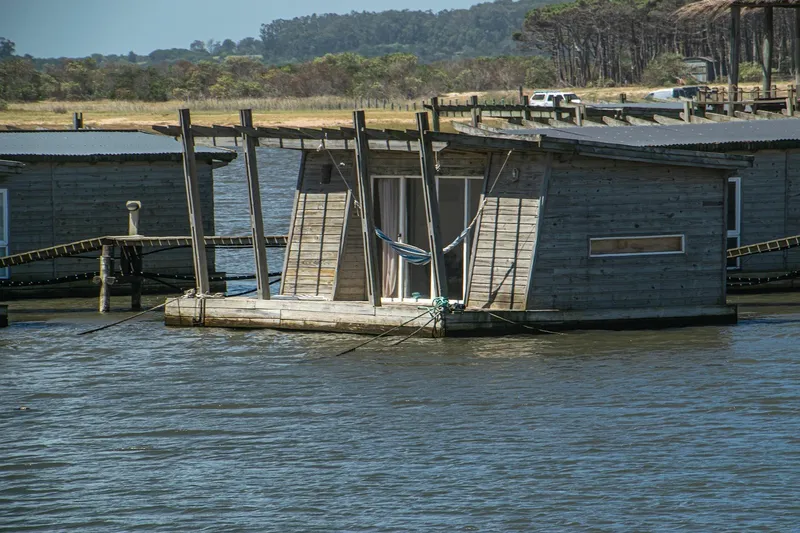
Salt & Sill, on the island of Klädesholmen an hour north of Gothenburg, was the first floating hotel built in Sweden and is still the easiest one to sleep on. It is six two-storey houses on heavy concrete pontoons in the Skagerrak, 23 rooms in all. Standard rooms measure 18 m² and hold two 80×200 cm beds; the single suite occupies the top corner at 30 m² with a view over the outer archipelago. Bathroom floors are heated granite, and every room has its own deck with a swim ladder straight into the sea. Categories and floor areas are set out on the hotel’s own booking page.
A concrete pontoon absorbs movement where a steel hull transmits it, and the motion you feel here comes from weather rather than from other boats. In an autumn gale off the Skagerrak the outermost pontoons pitch enough that a loose glass will slide across the table, which is why I ask for a room on the inner side of the complex. The three-storey concrete blocks also block wind far better than any deck on a ship, so the terraces stay usable later into the season.
Check-in opens at 15:00 and reception is not a round-the-clock desk, so tell them in advance if you will arrive late and they will arrange key-box access. The kitchen side is a serious operation, with four restaurants across the island in season, and herring, prawns and lobster are the reason to be here; the lobster season runs from 1 October to 24 October, which is also when the whole coast books out. Dogs cost ≈ $30 (kr 300) per stay, bed and water bowl included, with a maximum of two per room.
Marina Rummet, Mariefred
Marina Rummet is a single houseboat in the guest harbour at Mariefred on Lake Mälaren, with Gripsholm Castle directly across the water. Inside there are four beds, a kettle and a small fridge, and the room comes made up with towels. What people actually book it for is outside: a 34 m² roof terrace with the castle in the frame.
It is also the most basic option in this list. There is no toilet or shower in the cabin, plumbing stops at cold water at the sink, and you walk about 25 metres along the pontoon to the marina service house for showers, toilets and laundry. I made that walk in sideways rain one evening in late September and would pack a proper shell jacket rather than a hotel robe. Pets are not allowed, check-in is from 14:00 and you must be out by 11:00, and the room is let through Airbnb rather than a hotel desk, so the cleaning fee sits on top of the nightly rate. The marina publishes current rates of ≈ $140 (kr 1,450) for one or two people, 1,730 for three and 2,010 for four, before Airbnb’s fees, on its own Marina Rummet page.
Stockholm’s Botels
Mälardrottningen, Riddarholmen
The 73-metre Mälardrottningen, built in Kiel in 1924 as the yacht Vanadis for the New York industrialist C.K.G. Billings and later owned by Barbara Hutton, has been moored at Riddarholmskajen since 1982 and leaves the quay only for maintenance. A 2024 refit redid the reception, bar and restaurant in 1920s Art Deco style and added small suites with their own terraces on the aft deck. Around sixty cabins, most with traditional bunk beds, dark wood, brass trim and portholes, and all with a private wet room and a window. There are no lifts, and the three deck levels are joined by steep companionway stairs, so this is not the boat for a heavy case or a wheelchair.
Breakfast is a hot buffet in the forward salon and the onboard sauna is open to guests. Brasserie Hutton on board serves Swedish brasserie cooking, and in summer the deck lounge on top opens. Gamla Stan metro station is about 300 metres away, which makes this the most central of the Stockholm boats. Light sleepers should avoid the lowest waterline cabins: they sit level with the quay, so you hear footsteps and trolley wheels on the stone above your head. The upper promenade cabins are quieter, but the cheapest categories are all on the lower deck, so you cannot have both.
Hotel Prince van Orangiën, Beckholmen
Prince van Orangiën is the smallest and most expensive berth in Stockholm: a 35-metre Dutch vessel built in 1935, fully rebuilt and reopened in 2024, moored at Beckholmsvägen 26 beside the bridge to the Beckholmen shipyard. The interior is preserved oak and ebony, and the top-deck salon has an open fireplace. There are three suites with en-suite bathrooms and, below deck, the Captain’s Village: three single rooms that share a bathroom and the boat’s kitchen. That distinction matters more than any other line on the page, because the singles are not the en-suite suites in the photographs.
Breakfast is not served on board. It is taken a few metres away at Slipen, the restaurant by the quay. The boat takes only a handful of guests at a time, and the neighbourhood, between Djurgården’s oak avenue and the working shipyard, is quiet at night. The trade-off is distance: you are a bus ride or a long walk from Gamla Stan rather than in the middle of it.
Rygerfjord Hotel & Hostel, Söder Mälarstrand
Rygerfjord is a flotilla of three connected hulls at Kajplats 12–14 on Söder Mälarstrand, the Norwegian passenger ship M/S Rygerfjord of 1950 out front and two later vessels behind, with City Hall across the water. Around 90 cabins split between shared dorm bunks and private rooms, the private ones with modular en-suite cubicles. The restaurant and quarterdeck bar on the central ship are used by Stockholmers as much as by guests, and the location is a short walk from Södermalm’s bars and the edge of Gamla Stan.
The complication is the gangways. The hulls are joined by exposed metal walkways with open gratings, so moving between your cabin and reception means stepping across gaps in the wind and, in winter, across ice. Ask which hull your room is on before you book: a room in the furthest hull means a walk outdoors every time you want a coffee, and reception is on the middle ship.
The Red Boat, Söder Mälarstrand
The Red Boat is two hulls tied up 200 metres east of Rygerfjord at Kajplats 10: a 1914 steamer painted deep red and the 1946 survey ship Ran af Stockholm. Between them, 36 minimalist cabins at the bottom of Stockholm’s floating price range, with reception open 07:00–23:00 and breakfast available at extra cost. Economy singles and twins run 5–7 m² with 80 cm bunks. A limited number of cabins have their own micro-bathroom and the rest use shared facilities along the central corridor. The quay is a few minutes from Gamla Stan and the Slussen transport hub, which is what you are really paying for.
Here the ship itself is the obstacle. The corridors are crossed by raised steel door coamings, watertight bulkhead sills standing 15–25 cm off the deck, so you step over every doorway rather than walking through it, and the stairs between decks are narrow and steep. Anyone arriving with a wide case will be lifting it rather than rolling it, and anyone unsteady on their feet should think about a hotel ashore.
Gothenburg’s Tall Ship
Barken Viking, Gullbergskajen
Barken Viking is a 108-metre four-masted steel barque, built by Burmeister & Wain in Copenhagen and launched in 1907 as a sail training ship. She is moored at Lilla Bommens Torg 10 on the Göta River, roughly 500 metres from Gothenburg Central Station, with free Wi-Fi in the public areas. The cabins are cut into the old cargo holds and crew quarters and range from singles with a 90 cm bed to four-bed rooms with two bunks; some have private bathrooms and some share, so check the category before you book. Breakfast is included and served in the timber-panelled salon, and the restaurant on deck is a summer operation. Room categories, bed widths and the shared-bath options are listed on the operator’s hotel page.
Living aboard an Edwardian windjammer involves trade-offs that city hotels avoid. Reaching the lower passenger decks means descending steep steel companionway stairs that resemble ship ladders rather than domestic steps, and the corridors are narrow. Gullbergskajen is also a working waterway: as ferries, tugs and pilot vessels transit the fairway, their wash moves the hull slightly against its fenders, and cabins close to the waterline pick up the thrum of diesel engines out in the channel. Light sleepers should ask for a cabin on the quay side rather than facing the fairway.
When to Book, and What I’d Skip
Season is the biggest single lever on both price and experience. Arctic Bath is a floating hotel for roughly half the year and an ice-locked one for the other half. Flottellet and the other lake rafts close once the ice arrives, from October to May. The Stockholm botels run year-round, because the current through the city keeps the water open. On the west coast, Klädesholmen empties from mid-August when the Swedish school holidays end, which is also when Salt & Sill’s autumn seafood season begins, so the shoulder weeks give you the food without the crowd.
If you are prone to motion sickness, the choice is straightforward. A concrete pontoon such as Salt & Sill moves least. A timber raft on a sheltered lake such as Flottellet moves very little in calm weather but swings on its mooring in wind. A steel ship on a working waterway such as Barken Viking moves most, because it is exposed to wash from passing traffic. Nothing in this list is a cruise, but a historic hull in an active fairway is the one that will keep a bad sleeper awake.
Pet rules are set property by property and worth checking before you book, since Sweden is otherwise relaxed about dogs. Salt & Sill charges ≈ $30 (kr 300) per stay for up to two dogs and supplies a bed and a bowl. Arctic Bath takes dogs in a designated room but not in the restaurant building. Marina Rummet and Mälardrottningen do not accept pets at all. At Flottellet the dog sleeps ashore.
Wi-Fi deserves its own warning on the ships. A steel hull behaves like a Faraday cage, so mobile reception drops to a bar or two in the lower-deck cabins and the hotel network often does not reach them at all. Barken Viking offers Wi-Fi in the public areas rather than in the cabins, and on Mälardrottningen and The Red Boat the salon and upper decks are where you will get a usable signal. If you plan to work from the water, ask about the specific cabin you are being assigned rather than the hotel’s headline connection.
Two things I would skip. At Salt & Sill, ignore the villas: Stora Salt and Lilla Salt are comfortable houses about a minute inland, and if you booked a floating hotel on the west coast you will spend the weekend looking at the water rather than sleeping over it. At Marina Rummet, the roof terrace is one of the best views in Södermanland, but if an outdoor walk to the toilet is a deal-breaker, book elsewhere, because the service house is 25 metres away in every kind of weather.
One last logistical point: these are small operations and several run their reception for only part of the day. Arctic Bath’s desk is open 08:00–22:00, The Red Boat’s closes at 23:00, and both Salt & Sill and the Mariefred marina expect you to flag a late arrival in advance. Arriving after the desk has shut means a phone call and a key box, so plan your travel around the check-in window rather than the other way round.