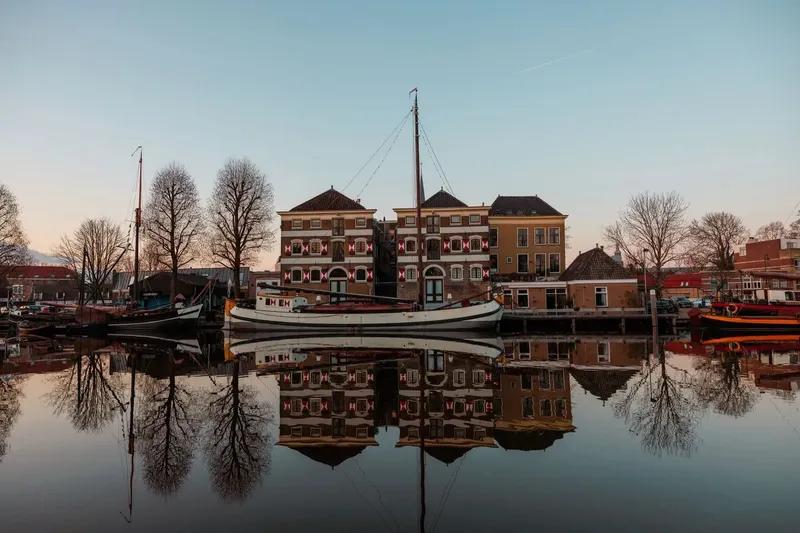
I have slept on converted barges in Oosterdok and across the IJ, though not on every boat in this list. For the ones I have not, I have used the operator's published spec and the questions I would ask before paying. In winter, a missed detail – a shared shower across an open deck, a radiator with no room control, a ferry that stops before midnight – costs more comfort than a lower rate saves.
What a Winter Night on an Amsterdam Boat Actually Feels Like
Steel, Water, and 3.9°C
The city's winter cold is damp and wind-driven. The KNMI 1991–2020 reference table for nearby De Bilt gives a winter mean of 3.9°C and 220.6 mm of precipitation across December, January and February. A raw wind off the IJ makes four degrees feel sharper; the bigger difference on board is the water.
Water pulls heat out of a steel hull much faster than air cools a brick wall. In a lower-deck cabin, the hull plates sit in constant contact with cold canal water. Without spray foam or rockwool behind the panelling, the cold comes through the wall next to your shoulder. A cabin can have a warm duvet and a cold outer edge, and the berth nearest the hull is the one to avoid.
Humidity adds to it. Wet coats, showers and two people breathing in a small cabin put moisture into the air, and a sealed cabin turns clammy by morning. A boat with a radiator and no trickle vent is worse than a slightly cooler boat with air moving through it.
Noise, Wake, and the Cabin at 3 AM
On an older barge the first thing you notice is sound. Rain ticks on the steel deck inches above your head; a halyard slaps; footsteps ring through the hull when someone crosses the gangway. Oosterdok water is flat, but you still hear it against the bow. At NDSM, passing ferries and commercial barges send low swell into the mooring lines, and the fenders groan against the pier.
Three things earn their space in a winter bag:
- Merino wool base layers: Ideal for sleeping if the cabin thermostat drops a couple of degrees before dawn.
- Thick wool socks or hard-soled slippers: Lower-deck floors sit right above the bilge and stay cool even when the air at head height is warm.
- Soft silicone earplugs: They block out the metallic clank of gangways and halyards slapping in a midnight gale.
Before You Book: Heat, Tax, and the Fine Print
Who Controls the Thermostat
The question that decides comfort is who sets the heat. A cabin with its own thermostat or split-unit remote lets you warm the room when you come in wet. A cabin on a shared boiler gives you whatever the engine room is set to, and the radiator may be cooler at 6 a.m. than at midnight.
One winter in Oosterdok the radiator was hot when I went to bed and lukewarm when I woke. It was a shared boiler with no cabin control, and nobody had mentioned that at check-in. Now I ask two questions before booking: is the radiator on a room thermostat, and does the boiler run through the night? The answers change which cabin I take more than the décor does.
Sanitary layout matters as much as heat. An en-suite shower means you do not cross an open deck in a towel. The other specs worth checking are the berth's height above the waterline, the glazing, and whether the mooring is an enclosed basin or an exposed pier. A lower-deck cabin against single-skin steel is the coldest berth on any hull.
The Tax Stack on a ≈ $110 (€100) Cabin
The rate on the listing is net. The Belastingdienst raised VAT on overnight accommodation at the start of 2026, and the City of Amsterdam adds tourist tax on the net room price before VAT. The table below works through a ≈ $110 (€100) net rate; the last row is what you actually pay.
| Cost Component (2026 Rules) | Tax Rate / Rule | Sample Calculation (≈ $110 / €100 Net Room) |
|---|---|---|
| Net Overnight Cabin Rate | Base price before taxes | ≈ $110 (€100) |
| Dutch Accommodation VAT (BTW) | 21% on net room rate | ≈ $23 (€21) |
| Amsterdam Municipal Tourist Tax | 12.5% on net room rate (excl. VAT) | ≈ $14 (€12.5) |
| Final Checkout Total | Combined mandatory total | ≈ $150 (€133.5) |
| Optional Add-on Breakfast | Taxed separately at 9% VAT | ≈ $17 (€15) net = ≈ $18 (€16.35) total |
For any other net rate, multiply by 1.335. A separately priced breakfast is taxed at the lower rate shown in the table, and an all-in price has to be split between the two rates. A key deposit sits outside the tax calculation; if the booking page mentions one, check when it is returned.
The common mistake is comparing a boat's from-rate with a land hotel's inclusive total. The tax and the walk to a shared bathroom are where the saving goes.
The Fleet: Moorings, Published Rates, and Winter Trade-offs
The rates below are the operators' published from-rates for the cheapest double cabin, before the tax table above. Use them to compare berths; the booking page gives the rate for your night.
| Property Name | City & Mooring Area | Vessel Type | Published From-Rate | Main Winter Advantage | Main Winter Drawback |
|---|---|---|---|---|---|
| Botel Amsterdam | Amsterdam (NDSM-Pier 3) | Botel & rooftop letter suites | From ≈ $100 (€95) | Heated cabins; queen-size bed in the Basic Double; elevator access | Exposed NDSM pier; compact standard cabins |
| Hotelboot Zwaan | Amsterdam (Oosterdok) | Seasonal stationary botel | From ≈ $110 (€100) | En-suite shower and toilet; heating and air conditioning; breakfast included | Not bookable as a hotel outside winter |
| Hotel Asile Flottant | Amsterdam (Korte Papaverweg 2, De Ceuvel) | Heritage converted houseboats | From ≈ $180 (€165) | Quiet shallow-water mooring at the De Ceuvel eco-hub; private sundeck on each boat | Bus, bike, or ferry plus walk from Noord; not central |
| Lightship Amsterdam | Amsterdam (Mariadistelkade 6-A) | Converted 1952 British lightship | From ≈ $390 (€350) | Two large glass-walled suites; quiet canal mooring | High nightly cost; 1.4 km from the Buiksloterweg ferry |
| AmicitiA | Amsterdam (Oosterdok Steiger 3) | Converted 1897 freight barge | From ≈ $77 (€70) | Calm inner basin just a 10–15 minute walk from Centraal Station | Small lower-deck berths with basic central radiator heat |
| Vita Nova | Amsterdam (Oosterdok Steiger 2) | Motor barge botel | From ≈ $72 (€65) | Low entry price within walking distance of the central rail hub | Steep companionway stairs and compact cabin footprints |
| MPS Holland | Amsterdam (Oosterdok Steiger 3) | Passenger barge botel | From ≈ $83 (€75) | Sheltered Oosterdok mooring about 900 m from Amsterdam Centraal | Simple cabin finishes and audible footsteps on metal decks |
| Passengership Avanti | Amsterdam (Oosterdok Steiger 3) | Converted 1930s Dutch barge | From ≈ $88 (€80) | Central harbour berth with a cosy upstairs wooden wheelhouse lounge | Narrow corridors and limited luggage storage in twin cabins |
| Hotelschip Gandalf | Amsterdam (Steiger 3, Oosterdok 2) | Motor barge botel | From ≈ $94 (€85) | Walkable central pier with private bathroom facilities | Tight berth dimensions for tall travellers in winter coats |
| Anna Maria II | Amsterdam (Oosterdok 51, Pier 3) | Budget barge botel | From ≈ $83 (€75) | Budget-friendly central dock 15 minutes on foot from Centraal | Shared shower and toilet facilities require leaving your cabin |
| Houseboat Little Amstel | Amsterdam (Amsteldijk 700) | Stationary canal houseboat | From ≈ $200 (€180) | Two 15 m² studios with private entrances; no cooking appliances | Only two units and a residential edge of town location |
Two size facts are worth having before you compare rates: Asile Flottant's six boats run from 25 m² (The Anneliese, two guests) to 80 m² (The Holland, six guests), and each has a private sundeck; Botel Amsterdam's Basic Double uses a queen-size bed, and the cabin is reached by elevator.
Live availability for these vessels:
Oosterdok: The Sheltered Basin
If you do not want to wait for a ferry in freezing drizzle, the cluster of boat hotels beside the NEMO Science Museum is the most practical base. Boats at Steiger 2 and Steiger 3 sit roughly 900–1,000 m from Amsterdam Centraal, a flat 10–15 minute walk. You can compare these inner-harbour docks with the city's other moored ships and walkable docks.
Hotelboot Zwaan is the safest winter bet in the basin because the operator states both the season and the cabin spec: October to March in Amsterdam, two- and three-person cabins with private hot shower and toilet, heating and air conditioning, opening portholes, and breakfast included. The hull is a 1928 barge converted into a passenger vessel, so the cabins sit in the original hull.
Oosterdok is cut off from the main shipping lane by railway bridges and locks, so wake is minimal even in a winter storm. The trade-off is space: cabins are carved out of former cargo holds, with bunk or twin beds, compact radiators and steep stairs up to the deck.
Bathroom setups vary along Oosterdok 51 and Steiger 3. Hotelschip Gandalf and MPS Holland fit compact en-suite heads into their cabins; Anna Maria II relies on shared showers and toilets in the corridor. For me, the en-suite is worth the difference in winter.
For a quieter residential mooring, Houseboat Little Amstel at Amsteldijk 700 near the Toronto Bridge has two studios with private entrances and en-suite bathrooms. You trade the breakfast room of a barge for a private door on the Amstel; neither studio has cooking appliances.
Noord and NDSM: Wind, Ferries, and Three Ships
Across the IJ, Botel Amsterdam at NDSM-Pier 3 is a 175-room hotel ship. The Basic Double has a queen-size bed, heating, a private bathroom and elevator access, which makes it the easiest choice for anyone with luggage or mobility issues. The trade-off is the pier: NDSM is exposed, and the walk from the ferry landing is in the wind.
Hotel Asile Flottant at Korte Papaverweg 2 is a different proposition: six historic boats moored in the shallow water at De Ceuvel, connected by a jetty that runs over soil-cleaning plants. The operator describes the site as a former shipyard in quiet water, and the boats range from 25 to 80 m² with private sundecks. It sits outside the centre: you take a bus, bike, or ferry plus a walk, and the reward is the most secluded mooring in this list.
Lightship Amsterdam at Mariadistelkade 6-A puts two glass-walled suites into a 1952 British lightvessel (LV-12). The ship is permanently moored on the Johan van Hasseltkanaal, 1.4 km from the free Buiksloterweg ferry, so it suits a couple who want space and a viewpoint more than a central base. At from ≈ $390 (€350) before tax, it is a different budget from the Oosterdok barges.
Heating and Insulation: What the Listing Does Not Say
Radiators, Heat Pumps, and What You Can Control
Two systems do most of the work on these hulls: a central marine diesel or gas boiler feeding wall radiators, or individual electric split-unit heat pumps running in reverse cycle. A radiator gives silent radiant heat and dries wet gloves; a split unit responds faster and gives you a remote, but the fan runs at night and the bathroom floor stays cold.
Insulation is harder to judge from a listing. The page will say heating and stop; it will not tell you whether your berth sits against single-skin steel or whether the portholes are double-glazed. Upper-deck wheelhouse suites with double glazing lose less heat than lower-deck berths flanked by submerged plates. Ask for the cabin's position before you book.
| Heating System Type | How It Works on Board | Winter Pros | Winter Cons |
|---|---|---|---|
| Central Boiler & Wall Radiators | Hot water circulates from the engine room to cabin radiator panels | Silent operation; great for drying damp winter coats and gloves | Boiler timers may dip overnight; slower to heat up from cold |
| Split-Unit AC / Heat Pump | Individual wall unit blows heated air controlled by a cabin remote | Instant temperature boost on arrival; guest controls the exact setting | Slight fan hum overnight; does not warm bathroom floors directly |
| Underfloor / High-End Electric | Used in high-end conversions and some houseboats | Even heat distribution from the floor up; no cold bilge draft | Found on pricier suites, not on the Oosterdok barges |
Damp Bedding, Steam, and Five Habits That Work
Moisture is the part that surprises people. On a barge in Oosterdok one winter, the duvet edge against the hull was damp by morning even though the cabin air felt warm. The cold steel wall was the source.
The Canal & River Trust's winter boating guidance makes the same point: condensation builds quickly in a closed hull, and continuous ventilation matters more than extra heat.
An en-suite shower is a winter luxury – see which Amsterdam boat hotels have en-suite cabins – but it puts a cloud of steam into a small space, and that vapour has to go somewhere.
Five habits keep a cabin dry between November and March:
- Pull the duvet 10 cm away from the hull: Keep blankets and pillows from touching the outer steel wall or porthole frame where condensation collects.
- Run the bathroom extractor fan for 15 minutes after showering: Keep the en-suite door shut tight until the mirror clears so steam does not migrate into the sleeping area.
- Leave trickle vents cracked open a few millimetres: Dry cold air coming in heats up much faster and feels warmer than stagnant, humid cabin air.
- Hang wet raincoats in the main entryway or bathroom: Drying two soaked winter jackets next to your bed adds a litre of water to the cabin air overnight.
- Wipe the porthole rim in the morning: A quick swipe with a hand towel stops window condensation from soaking the wooden sill.
Getting There in Winter: Ferries, Ice, and the Last Sailing
The F4 to NDSM and the Oosterdok Pontoons
At NDSM, the free GVB ferry is the lifeline. The GVB and I amsterdam both list the IJ ferries as free for pedestrians and cyclists; the F4 runs between NDSM and Amsterdam Centraal, takes about 10 minutes, and runs several times an hour during the day. It does not run all night, so check the last sailing before an evening across the IJ.
The NDSM landing was rebuilt in early 2026, so the pontoon and shelters are new; the city's project page has the details (City of Amsterdam). High wind can slow or suspend sailings, and GVB posts disruptions on its line page. If the F4 stops, the F7 from Pontsteiger is the other NDSM crossing.
At Oosterdok the wooden walkway between Steiger 2 and 3 is the slick part after frost, and the aluminum ramp onto each boat is next. The planks glaze first; the steel cleats and handrails follow. I wear soft-rubber soles, keep both hands free, and carry a backpack. If the ramp is iced, ask the crew whether they have gritted it – they cross it more often than you will.
OVpay, Entry, and the One Policy Worth Having
Amsterdam's trams, buses and metros use OVpay: tap in and out with a contactless Mastercard or Visa, or a phone wallet. Enable international contactless payments with your bank before you leave and carry a second card.
US passport holders do not need a visa for a short stay, up to 90 days in any 180-day period (Netherlands Worldwide). The more relevant winter risk is a fall on a wet gangway. Most US domestic health plans and Medicare do not cover treatment abroad (U.S. Department of State), so travel medical and evacuation cover is worth arranging before you go.
Five Questions to Send Before You Pay
- Is the boat in Amsterdam for my dates, and which pier? Zwaan's season is stated; for the others, ask for the exact mooring and whether the boat moves during your stay.
- Does my cabin have its own thermostat or a shared boiler? Ask whether the heating runs overnight and whether the cabin is above or below the waterline.
- Is the bathroom en-suite, and does it have an extractor? A private shower is little use if the steam ends up in the cabin.
- What is the checkout total, including VAT and tourist tax? Compare it with the tax table above; the from-rate excludes both.
- Is there a key deposit, and when is it returned? Also check the cancellation window if the rate is non-refundable.
Which Boat for Which Winter
For a first winter trip, I would book Zwaan if my dates fall between October and March. The operator states the season, every cabin has its own shower and toilet, and the walk from Centraal is flat. The trade-off is the fixed window: outside those months the ship runs bike-and-barge trips.
I would skip the cheapest shared-bathroom cabin if I were traveling with someone. Anna Maria II's shared-bathroom rate sits below Zwaan's, but the gap is small once the tax is added, and the difference buys a private shower and a shorter corridor walk. For a solo traveler on a tight budget, the calculation changes; the shared facilities may be worth the saving.
I would also skip NDSM if I had an early train or a short trip. The F4 is the longest crossing, and it stops earlier than the F3; the views and the Botel's 175 rooms are the compensation. If I wanted space rather than a central pier, Asile Flottant's 25–80 m² boats would be the pick, provided I did not mind the bus or bike ride from Noord.
Lightship Amsterdam is the one I would book only if the suite were the reason for the trip: two glass-walled rooms in a 1952 lightvessel, 1.4 km from the Buiksloterweg ferry. It is a worse base for a two-night city break than an Oosterdok cabin, and a better one for a quiet weekend with a bathtub.