| Stay | Best fit | Condition that matters |
|---|---|---|
| AmicitiA | Light luggage | Compact bunk cabin with a washbasin; shared showers and toilets. |
| MPS Holland | Central en-suite | Oosterdok location with a private shower and toilet; arrival time arranged in advance. |
| Passengership Avanti | Simple short stay | Bunk beds and shared bathrooms; narrow stairs and very limited suitcase space. |
| Hotelboot Zwaan | Winter family | Two- or three-person rooms with private bathrooms, October–March; cash payment. |
| Botel Amsterdam | Late arrival | 24-hour reception and en-suite rooms at NDSM; a ferry journey separates it from Centraal. |
| Hotel Asile Flottant | Private group | Whole boat at De Ceuvel; its bathroom is private to your booking, shared within your party. |
| Lightship Amsterdam | Suite space | Two suites with private bathrooms and breakfast; stairs remain part of staying aboard. |
Cabin booking or a whole boat?
On AmicitiA, MPS Holland, Avanti, Zwaan and Botel, the booking is for a cabin or room, with other guests elsewhere aboard. At Asile Flottant, your party occupies its own boat. Lightship Amsterdam contains two separate guest suites. These differences explain more about privacy than the word “botel” on a listing.
I treat reception hours separately from the vessel’s size. Botel has a 24-hour front desk. Asile Flottant has no round-the-clock reception: check-in is at 3 p.m., checkout at 11 a.m., and arrivals outside the normal handover need an arrangement with the host. MPS Holland also requests an arrival time in advance. A berth reservation on a small ship does not include a staffed lobby through the night.
Oosterdok: walking from Centraal with bags
From Centraal’s city-facing exit, the route east along Oosterdokskade reaches the harbour beside NEMO in 10–15 minutes. Oosterdok 2 and Steiger 3 identify the area, but the vessel name identifies your accommodation: several ships use the same jetty address. The quayside pavement is straightforward; the final boarding route can include a sloping gangway, steps and another vessel’s deck where ships berth alongside one another.
Coming back one evening, I crossed a neighbouring barge’s afterdeck, past folded deck chairs, before reaching my own gangway. With a small bag that was easy; carrying a large rigid suitcase would have needed both hands. For a taxi arrival, Oosterdok 2 is a road-side destination, followed by the walk along the jetty to the named ship.
The sheltered basin feels less exposed than the open IJ waterfront at NDSM. It is still a floating berth: another vessel moving or a neighbour stepping aboard can produce movement. The difference between wake, rocking and seasickness matters more than a promise that a harbour stay will be motionless.
AmicitiA, MPS Holland and Avanti
AmicitiA has compact bunk cabins with a washbasin, while showers and toilets are along the corridor. Breakfast is included and served in the bar/saloon: bread, cheese, pastries and hot drinks. The shared bathrooms mean leaving the cabin for a shower; sleepwear and slip-on shoes earn their space in the bag.
A few metres away, MPS Holland has a private shower and toilet in its cabins. The wet room occupies space inside an already compact room, so luggage storage deserves attention alongside the bed arrangement. Breakfast is served in the communal dining area; its inclusion follows the meal plan attached to the selected cabin rate.
Passengership Avanti has wooden bunk beds, a basin in the cabin and shared shower and toilet facilities. Breakfast is included in its B&B offering and served in the communal saloon, with tea and coffee available during the day. Guests describe the stairs as narrow and the cabins as difficult with large cases. Summer guests also report hot, stuffy sleeping quarters and sound carrying between rooms. Those are more useful expectations than judging comfort by the harbour photograph.
“The stairs are extremely narrow, and there was nobody available to help.”
I carry bags over wet boarding surfaces with one hand free for the rail. A wheeled case is convenient along Oosterdokskade, but its wheels do little on the final steps into a cabin.
Hotelboot Zwaan: October to March
Hotelboot Zwaan lies in Amsterdam from the beginning of October to the end of March, then operates sailing trips during the warmer months. Its eight cabins have a private hot shower and toilet. Breakfast is included in the hotel-room stay and served in the dining room; sheets and towels are included too.
The cabin mix includes two family-style rooms with a double and a single, two friends-style rooms with three singles including a bunk, two twins and the Lovers Nest with a small double. The Lovers Nest has its own entrance at the front of the ship, reached by steep stairs. The 50 m² Captain’s Lodge is a separate off-season apartment with two bedrooms and a kitchen, advertised from ≈ $110 (€100) a day with a seven-night minimum. That starting price is for the Lodge, not every overnight cabin; its kitchen also makes it a different meal arrangement from the B&B rooms. The key deposit is ≈ $22 (€20), and payment on arrival is cash, with no credit cards accepted.
Noord: ferries, metro and arriving after midnight
The free F4 ferry connects the landing behind Centraal with NDSM-Werf in about 14 minutes. Allow for the wait as well as the crossing: daytime departures are commonly 15 minutes apart, with 30-minute gaps in quieter periods. In the regular winter timetable, the final F4 from NDSM to Centraal is at 2 a.m. after Sunday–Thursday evenings and 3:30 a.m. after Friday and Saturday evenings. Botel is about 250 m from the NDSM landing. The F4 departure timetable gives the sailings for the actual travel day, including late services.
Missing an F4 departure does not leave a taxi as the only way across the IJ. F3 between Centraal and Buiksloterweg runs day and night. From that northern landing, NDSM is a substantial onward walk, roughly 3 km, or a cycle ride. With luggage late at night, a taxi to the exact quay via the IJtunnel avoids that walk. The tunnel is a road route for the taxi, not a pedestrian crossing. Metro 52 reaches Noorderpark for De Ceuvel during metro operating hours; it is not an all-night substitute for F3. The GVB ferry routes distinguish the 24-hour Buiksloterweg service from the NDSM route.
Botel Amsterdam at NDSM
Botel Amsterdam is at NDSM-pier 3, with 175 rooms, private bathrooms, a bar, a pool table and a 24-hour front desk. Breakfast is a buffet in the breakfast room; inclusion depends on the booked rate. The property has a lift, but that alone says nothing about a particular cabin’s doorway or shower access.
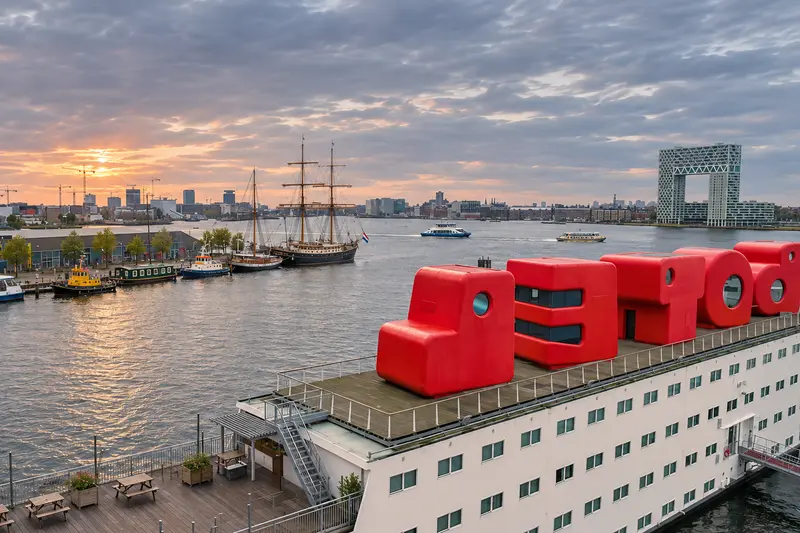
The five rooftop letter lofts have different interiors: Letter B has a skate-inspired design, E has a cinema, and L has a Japanese-inspired layout. They are separate room categories from the standard double, twin and quadruple cabins. Their upper-deck setting gives wide views; summer temperature and stair access depend on the individual loft. NDSM also hosts festivals, so the waterfront setting does not promise a silent evening. Public parking nearby is listed at ≈ $8.8 (€8) a day, without reservations.
Asile Flottant and Lightship Amsterdam
Hotel Asile Flottant occupies restored boats at Korte Papaverweg 2, beside De Ceuvel. Each booking has its own vessel and deck. De Amsterdam sleeps six in 60 m²; Les Six Frères sleeps four in 50 m²; Anneliese is a 25 m² boat for two. A bathroom on a six-person boat belongs to the whole party, rather than sitting inside each sleeping cabin. The whole-boat accommodation has no communal breakfast saloon; the living area and kitchenette provide space for your own breakfast, with any delivered breakfast booked separately. Noorderpark on Metro 52 is followed by a walk of about 10–15 minutes; the last approach includes the shipyard’s outdoor paths and pier. A refundable ≈ $220 (€200) security bond is required on arrival.
Lightship Amsterdam, at Mariadistelkade 6, occupies a 1952 British lightvessel with two suites of 60 m² and 65 m². Each has a king-size bed and private bathroom. Breakfast and the minibar are included; breakfast is brought to the suite rather than taken in a shared hotel saloon. Tea and coffee facilities are provided, but cooking is not allowed. The free F3 ferry to Buiksloterweg leaves about 1.4 km to walk to the ship; it is a different arrival route from Botel’s NDSM ferry.
Narrow the seven stays by your requirements
The selector combines location, bathroom privacy and the operating season. “Private to your party” includes the whole-boat arrangement at Asile Flottant; “en-suite cabin or suite” excludes it. It searches these seven properties, without mixing in similarly named vessels elsewhere.
Prices, breakfast and the amount actually payable
I compare the total for the same nights, guest count and room category. A bunk cabin, a whole boat sleeping six and a 60 m² suite are different purchases. Zwaan’s ≈ $110 (€100)-a-day Captain’s Lodge also commits you to at least seven nights: ≈ $770 (€700) in accommodation at that starting rate, before any separately itemised charges. It is not a ≈ $110 (€100) one-night double-room offer.
In 2026, Dutch short-stay accommodation VAT is 21%. Amsterdam tourist tax is 12.5% of the accommodation price excluding VAT. These percentages describe the taxes, not an automatic surcharge on the displayed price: a quote that includes both already needs no extra tax added. On a VAT-inclusive room price of ≈ $110 (€100) with city tax explicitly excluded, the example total is ≈ $120 (€110.33). Only a ≈ $110 (€100) quote explicitly excluding both taxes produces ≈ $150 (€133.5). These are calculation examples, not offers from a named ship.
At each property, the reservation’s “included taxes” and “excluded charges” lines determine whether city tax is already paid or collected separately. A refundable deposit needs available funds at arrival, but it is not an accommodation expense once returned.
Steps, luggage and sleeping inside a hull
A level quayside does not mean a step-free bedroom. At Oosterdok, the boarding route and the stairs down to the cabin are separate obstacles. Avanti guests report narrow stairs; Zwaan explicitly has steep stairs to the Lovers Nest. Asile Flottant’s boats have individual layouts, so access to one vessel cannot describe the whole fleet. Botel has a lift, which makes it different from the small barges, but a wheelchair booking still needs a continuous route from quay to bed and an appropriate bathroom.
Door sills and stair layouts differ between boats and rooms. I use photographs and measurements of the booked room’s boarding ramp, narrowest doorway, steps and shower entrance when assessing access. A stair-free public saloon alone is insufficient for a guest who cannot transfer or climb steps. The same quay-to-cabin access questions apply even when a listing displays a lift symbol.
Acoustic insulation also differs from masonry construction. Steel hulls transmit mechanical sounds and vibration efficiently. Even with no propulsion engines running, foot traffic on steel deckplates, the cycling of bilge sump pumps, and water moving through sanitary pipes echo down narrow corridors. My worst night on the water came on a barge where nothing at all was wrong: the pump beneath my cabin cycled every few minutes, and I finished the night on a top-deck bench with a blanket, watching the first ferry cross the IJ. Earplugs and a cabin away from the companionway stairs are the cheap fixes, and on the older barges it pays to ask for a berth at the end of the corridor.
Wi-Fi also varies by vessel and deck. AmicitiA provides it in public areas, whereas Botel lists free coverage throughout the property and Lightship includes Wi-Fi in the suites. Steel between an access point and a lower cabin can weaken reception. For work that needs a continuous call, a public-area connection is a different facility from a connection at the bed or desk.
Children, large bags and late check-in
- With children: Zwaan’s family-style rooms have a double plus a single, while Botel lists quadruple rooms and Asile Flottant has whole boats with separate sleeping areas. The child’s age belongs in the reservation: bunk access, bed guards and the route across an open pier matter as much as the advertised capacity.
- With large cases: Oosterdok removes the ferry from the station journey, but Avanti’s cabin stairs remain tight. Space in a whole boat or Lightship suite helps once aboard; it does not remove the boarding steps. I leave a rigid case packed rather than expecting floor space to open it beside a bunk.
- With limited mobility: Botel’s lift is a useful starting feature; the cabin and bathroom must also accommodate the guest. A historic ship’s upper deck being accessible does not establish access to the sleeping deck.
- After midnight: Botel’s 24-hour reception solves the handover problem. A small-ship booking needs the agreed key or host arrangement before departure, even when F3 still provides an overnight crossing.
For a winter weekend with a small bag, I would book a Zwaan en-suite cabin because the walk from Centraal removes ferry waiting and the included breakfast keeps the morning simple. For a summer trip or a flight landing after midnight, I would use Botel’s en-suite rooms and 24-hour reception, with the north-bank journey included in my arrival plan.