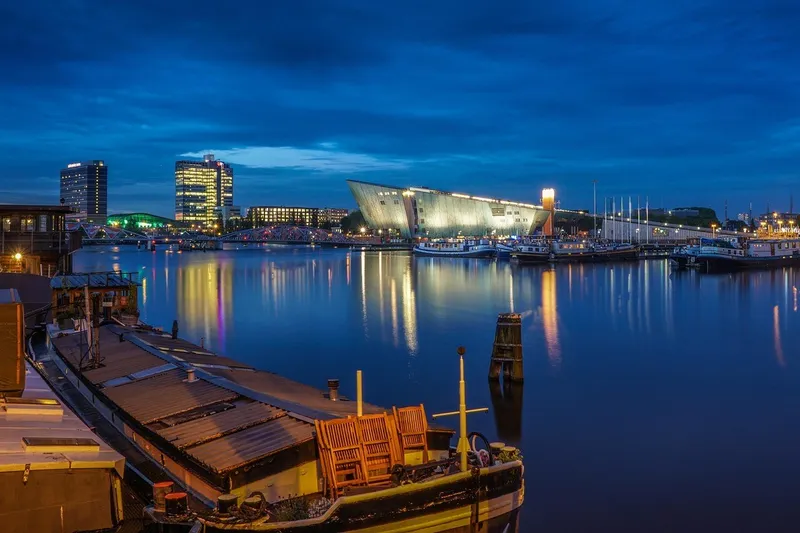
For four to six people, start with the sleeping plan and the route ashore. A boat advertised for six may have one enclosed bedroom and put everyone else in the living room; a quadruple cabin may sleep four without leaving enough clear floor for four open suitcases. Bathroom privacy, deck edges, and luggage access deserve the same attention as the nightly rate.
Amsterdam Group Botel and Barge Comparison
These properties sell different products: cabins on a staffed hotel ship, entire historic boats, and seasonal cabins on a passenger vessel. Only Zwaan publishes a useful from price for one of its group units; the other two require a quote for specific dates.
| Vessel Name | City & Location Specs | Vessel Type | Price Information | Key Advantage | Notable Drawback |
|---|---|---|---|---|---|
| Botel Amsterdam | NDSM Wharf, Pier 3; 250 m to the NDSM ferry landing | Purpose-built hotel ship | Date-specific quote; no fixed from rate published | Quadruple en-suite cabins; free ferry to Centraal; 24-hour reception | No published cabin area; exposed IJ mooring; no solid door between the Deluxe Quad sleeping zones |
| Hotel Asile Flottant | Korte Papaverweg 2, De Ceuvel, Amsterdam-Noord | Whole historic boats with kitchenettes; no cooking | Date-specific quote; refundable security bond charged separately | Whole boats for up to six guests; private sundecks and separate living areas | ≈ $220 (€200) security bond; no 24-hour reception; open water beside the decks |
| Hotelboot Zwaan | Oosterdok, near NEMO and Amsterdam Centraal | Seasonal stationary botel and passenger vessel | Captain’s Lodge from ≈ $110 (€100) per day, seven-night minimum; other cabins require a date-specific quote | En-suite two/three-person cabins within walking distance of Centraal | Seasonal operation; cash payment on arrival; steep stairs to the forward cabin |
With heavy luggage, Botel’s level pier and Zwaan’s walkable Oosterdok location are easier starting points than the boardwalks at De Ceuvel. With teenagers or several adults, read the bathroom and bedroom arrangement before comparing rates.
Evaluating Amsterdam Family Boat Hotels: Criteria, Safety, and Cabin Layouts
How I Compared Amsterdam’s Group Botels and Heritage Barges
Wide-angle cabin photographs hide the part that matters on the first evening: where open suitcases go. I look for clear floor beside the berths, dedicated storage, and enough separation for one person to sleep while another uses the bathroom. Four people in a ten-square-metre cabin with four rolling cases can end up moving luggage every time someone gets out of bed.
A fully enclosed bathroom matters more for four friends or parents with teenagers than it does for a couple. I also distinguish a whole-boat booking from several cabins on a hotel ship. The first gives the group a shared salon; the second provides separate keys and private bathrooms but may put everyone on different parts of the vessel.
Deck space is useful only if the group can safely use it. Ask whether the outdoor area is private, whether there is an unprotected drop into the water, and whether a travel cot fits without blocking the cabin exit. The measurements worth requesting are set out in this guide to cabin layouts, low ceilings, and wet rooms.
Fiscal Realities: Tourism Tax, Accommodation VAT, and Deposits
Amsterdam’s municipal tax is a substantial part of a group bill. Gemeente Amsterdam sets the 2026 tourist tax at 12.5% of the overnight accommodation price excluding VAT. Ask whether the displayed group total includes it or leaves it for payment at the property.
The Belastingdienst applies 21% VAT to short-stay accommodation, including boat cabins, from 1 January 2026. An older accommodation page or checkout showing 6% VAT is outdated for these stays; request a corrected tax line before paying. A useful itemised quote separates the net lodging price, 21% VAT, 12.5% tourist tax, and any refundable bond.
Asile Flottant’s reservation terms require a ≈ $220 (€200) security bond on arrival. It is refundable after the damage inspection, so it should not be confused with a fee, but the group still needs that amount available at check-in.
The Top Vessels Compared: Multi-Berth Cabin Ships in Amsterdam
High-Capacity Cabins: Quadruple Configurations at Botel Amsterdam
For four friends or a family wanting individual beds under one booking, Botel Amsterdam at NDSM Wharf has two four-person formats. The standard Quadruple Cabin has four bunk beds, each with a reading light and electrical socket, plus a private shower and toilet. This is the clearest option when nobody wants to share a bed.
The Deluxe Quadruple Cabin has two pairs of twin beds in two connecting areas. There is no solid door between those areas, so the layout gives some visual separation without providing full acoustic privacy. It suits parents with children better than two couples who each expect an enclosed room.
Botel does not publish interior square metres for these cabins. Ask about luggage storage if everyone carries a full-size case. Its public FAQ also directs guests to contact the hotel for check-in and checkout times, so a late-arriving group should get those hours stated in its reservation correspondence.
Exclusive Heritage Boats: Hotel Asile Flottant
At De Ceuvel, beside the Johan van Hasseltkanaal in Amsterdam-Noord, Asile Flottant rents six restored working vessels as whole units. Each has a private sundeck and a kitchenette, but the operator explicitly lists the kitchenettes as no-cooking. That makes them useful for drinks and simple cold provisions, not for planning every family dinner on board.
Holland VII is the largest option: the operator lists 80 m², six guests, two bedrooms, and one bathroom. Its beds are two 140 x 200 cm doubles and two 70 x 200 cm singles in the living room. UK85 is listed at 30 m² for four guests, with two 140 x 200 cm doubles in the forepeak. Its description mentions two separate bedrooms while the specification field says one; ask for a current plan if separate bedtimes are essential.
De Amsterdam’s official layout accommodates six guests in five beds: one 160 x 200 cm double in the separate bedroom, two 90 x 200 cm singles that serve as settees in the living room, and two connected 80 x 200 cm singles in the lounge. There is one bedroom and one bathroom. Six adults should understand that four of them will sleep in shared living space.
Traditional Passenger Barge: Seasonal Family Cabins on Hotelboot Zwaan
Hotelboot Zwaan offers two family-style cabins with a double bed plus a single bed, and two friends-style cabins with three single beds, one of them a bunk. Each cabin has a private hot shower and toilet. These configurations work for a couple with one child or three friends; they do not provide a conventional four-person family room.
The Captain’s Lodge is a 50 m² unit for one to four guests plus a child, with two bedrooms, a children’s bed, a bathroom, kitchen, laundry set, and wheelhouse. The operator’s rooms and prices page gives its published daily from price and seven-night minimum. It is available only during the off-season.
The separate Lovers Nest in the bow has its own entrance and is explicitly marked “steep stairs” by the operator. A group with limited knee mobility should request another named cabin in writing. A soft duffel is also easier to hand down a companionway than a rigid four-wheeled case.
Staying on a Boat with Kids in Amsterdam: Child Safety, Companionways, and Noise
Companionways, Gangways, and Water Hazards
Moored hotel ships are nautical structures with moving thresholds and compact stairs. Gangways can change incline with water level and wake, making them awkward for lightweight strollers. Interior companionways on converted vessels may require two hands on the rails and a backwards descent, which is difficult while carrying both a toddler and a bag.
Asile Flottant’s private sundecks border open water, and childproof netting is not listed among their amenities. Keep toddlers inside or within arm’s reach outside, and use a properly fitted life jacket on deck. Cot policies and available floor space vary by boat; a travel cot should never block the only exit from a cabin. This family houseboat safety guide covers railings, gangways, and life-jacket checks in more detail.
Marine Motion, Acoustic Insulation, and Harbour Basin Dynamics
At NDSM Wharf, Botel Amsterdam sits on the exposed IJ, where passing barges and fast small craft can send wake toward the mooring. Even a heavy pontoon structure can transmit some movement and mooring-line creaks. The sheltered Oosterdok and the enclosed water at De Ceuvel are better starting points for someone particularly sensitive to motion.
Calm water does not guarantee a quiet cabin. Steel conducts footsteps on overhead decks, pump vibration, and water striking the hull. Families who need an uninterrupted afternoon nap should ask for a cabin away from service spaces and busy deck routes.
Soft silicone earplugs take little luggage space and help with water slap, pump cycles, and footsteps that become more noticeable after the surrounding harbour quietens.
Logistics and Navigation: Ferries, Transit Hubs, and Winter Operations
Trans-IJ Crossings and Station Access: NDSM Wharf vs. Oosterdok
For Botel Amsterdam, GVB ferry F4 connects Amsterdam Centraal with NDSM-Werf. It is free for pedestrians, cyclists, and pushchairs, with a crossing of roughly 15 minutes. From the NDSM landing, the hotel is about 250 metres along the pier.
On a wet spring arrival, I took F4 with a folded pushchair and two cabin-sized bags. No ticket gate or OV-chipkaart was needed, and the crossing cost nothing; the awkward part was keeping the rain cover and luggage together while boarding. With a larger group, I would now check the next departure before leaving Centraal and keep one adult free to manage the bags.
The Oosterdok moorings used by Zwaan are roughly 900 to 1,200 metres east of Amsterdam Centraal. The flat walk takes about 12 to 15 minutes and passes the public library before reaching NEMO. For Asile Flottant, buses 391 and 394 run from Centraal toward Mosplein, the GVB stop close to De Ceuvel, followed by a walk along the site’s boardwalks.
Seasonal Operating Calendars and Cold-Weather Cabins
Zwaan’s published Amsterdam hotel season runs from the beginning of October through the end of March; outside that period the vessel returns to passenger operations. Botel Amsterdam and Asile Flottant remain at their permanent moorings year-round. A summer search should therefore not assume that Zwaan’s Oosterdok cabins are available.
For a winter booking on Zwaan, I kept a ≈ $22 (€20) note separate for the refundable room and entrance-key deposit and carried cash for arrival because the operator does not accept credit cards. Breakfast was included. Having the deposit note already separated avoided opening every bag at the desk.
Cold steel and several people sleeping in a small heated cabin can produce heavy condensation around portholes. Keep ventilation grilles clear and use short bursts of fresh air rather than letting damp bedding and coats accumulate against cold exterior surfaces.
Group Botel Booking in Amsterdam: Peak Windows and Payment Terms
Calendar Demand Spikes
A whole boat exists only once, so a six-person group cannot simply add another identical unit when the preferred date fills. King’s Day falls on Tuesday, 27 April 2027. The ADE organisation announced on 26 October 2026 that its next edition will run from 20 to 24 October 2027; the I amsterdam ADE page explains the scale of the event. Both periods justify booking a specific multi-berth layout well ahead of ordinary weekends.
Payment timing matters as much as cancellation flexibility. Asile Flottant’s reservation terms offer a 50% deposit, with the remaining 50% charged 30 days before arrival; bookings made inside that window require full payment. Other rates and vessels have their own conditions, so use the cancellation schedule attached to the actual quote rather than assuming a group-wide industry rule.
Whole-Boat Privacy vs. Separate Cabins
Several cabins at Botel give each subgroup its own key and bathroom, with a staffed reception and bar shared by all guests. A whole Asile Flottant boat keeps everyone in one living space, but one bathroom can become the morning bottleneck for six people.
Asile Flottant’s house rules prohibit loud noise after 22:00, and there is no 24-hour reception. That combination suits a family or a quiet group of friends. A party returning late and expecting to continue drinking on deck should choose different accommodation.
Choosing the Right Amsterdam Boat Stay for Your Group
For four friends who each want a separate bed, I would take Botel’s standard Quadruple Cabin. The bunk arrangement is unambiguous, and the free ferry keeps the group independent of taxis. Two couples should price two separate cabins before assuming that the Deluxe Quadruple’s connecting areas provide enough privacy.
For six relatives who want to sit together, Holland VII has the most convincing amount of shared space among these options. UK85 is the more compact family possibility, but I would book it only after the operator clarifies the bedroom arrangement. De Amsterdam works best when the group is comfortable using the lounge and living room as sleeping areas.
Zwaan suits a couple with one child or three friends who prioritise walking to Centraal and NEMO. Its Captain’s Lodge fits a longer stay for up to four guests plus a child. Groups comparing other vessels around NDSM and Amsterdam-Noord can use this overview of floating accommodation in Amsterdam North.
Step-free wheelchair access, a toddler who needs to roam freely, or severe difficulty with stairs can make a land hotel the more practical choice. No amount of deck space compensates for an unsafe daily route between the cabin and the quay.
One Pre-Booking Message to Send
- Name the exact cabin or boat and list every bed, including beds located in the lounge or living room.
- Provide the total with 21% accommodation VAT and 12.5% Amsterdam tourist tax itemised, plus the deposit and accepted payment method.
- Confirm check-in hours, late-arrival arrangements, and any minimum-stay condition for the selected dates.
- For children, confirm cot floor space, the companionway route to the assigned cabin, and the barrier arrangement around the deck.