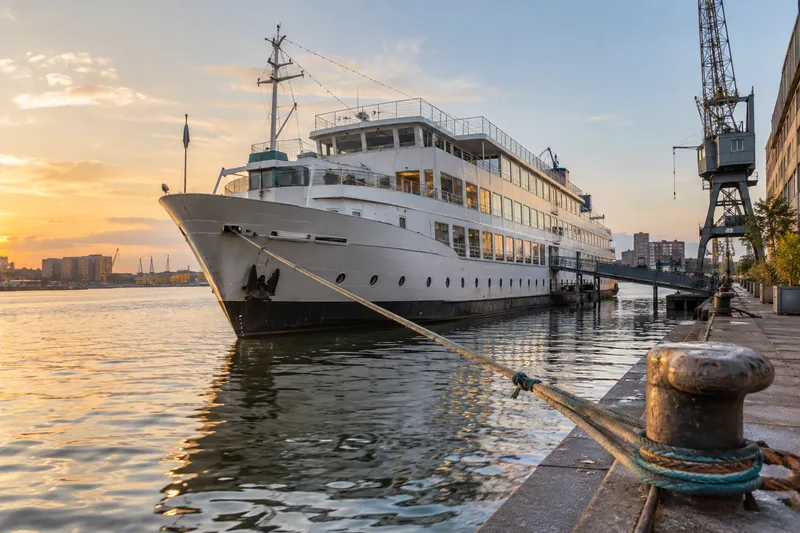
At NDSM you get the festival calendar and the STRAAT museum; at De Ceuvel a sheltered pontoon and a short walk from the F2 landing. Neither base suits every trip.
Shipyard Heritage on the Open IJ
NDSM takes its initials from the Nederlandsche Dok en Scheepsbouw Maatschappij, the shipyard that shaped this bank. The surroundings are decommissioned slipways, the former welding halls that now hold STRAAT, and a quay that still smells of rust and diesel when a barge idles past.
Freight ships, police launches and the double-ended ferries push steady displacement against the pontoons, and on an exposed berth you feel the roll before you see the wash. If you already know you are sensitive, the guide to motion sickness on moored floating hotels is worth ten minutes before you pick a deck. Pier 3 and Pier 6 take more movement than the De Ceuvel basin; an inside-pontoon berth is the calmer choice.
Getting On Board With Luggage
A 28-inch hard case is the wrong luggage for a converted river vessel. The companionway ladders are steep, the watertight thresholds sit a step above the deck, and the corridors were sized for crew. Hauling a rigid case across a floating pontoon and down a metal stair takes five minutes and usually costs a scraped knuckle.
Pack a soft 40-litre duffel you can carry in one hand, and keep a small day bag on your back so both hands stay free on the gangway. Flat rubber soles help on wet aluminium and rain-slicked planks. If this is a first boat stay, start with the notes on harbor navigation and pier etiquette before you pack. Even at Botel the gangway slopes with the water level; the historic hulls have no step-free route at all.
The NDSM Berths
Botel Amsterdam: Basecamp at Pier 3
Permanently moored at NDSM-Pier 3, Botel Amsterdam is a large floating hotel on this bank. It has a staffed reception, a bar with a pool table and a roof terrace over the IJ. Step off the gangway and the free ferry pontoon is under 250 metres away.
The standard stock is a basic double, twin or quadruple cabin with Wi-Fi and a compact shower pod. Steel still blocks the signal between cabin and corridor, so keep a phone hotspot as backup. The five Loft Letter suites are the reason to look twice: Richard Hutten's half-pipe for B, &Prast&Hooft's book-inspired O with a circular bed and bath beside it, MMX's captain's cabin for T, Moriko Kira's white Japanese-minimal L, and E, the small cinema with a tub and double bed on its split level.
Soundproofing between cabins is thin, and reviews mention the stairwell; ask for a cabin away from it if you sleep lightly. A buffet breakfast is served every morning, but the rate decides whether it is included: the direct engine sells both room-only and breakfast-included versions. Basic cabins are the weakest stock, especially in a heatwave. Passing barges are audible on the pier side.
Kapitein Anna: A 1911 Paddle Steamer at Pier 6
Further west at NDSM-Pier 6, Kapitein Anna is a different texture. The vessel is a genuine paddle steamer, built by J. & K. Smit in Krimpen aan de Lek for the Steamboat Reederij op de Lek as paddleboat 6, later well known as Kapitein Kok, and listed as sailing heritage (varend erfgoed) in 2016. Preserved salon woodwork, brass fittings and the curved lines of early twentieth-century Dutch shipbuilding come with the room.
Cabins run from a compact single with a super-single bed to standard and sea-view twins, all with private bathrooms. Portholes and dark timber framing set the dimensions, and the shared salon looks across the water toward the central harbour. Breakfast is optional at ≈ $17 (€15) per person. What you trade for the atmosphere is physical: steep companionways, pronounced step-over coamings and no lift. If you cannot manage a ladder with a bag, choose Botel.
Two Berths East of the Wharf
The next two addresses are not on NDSM. They sit about 1.3 km east, around De Ceuvel and Mariadistelkade, and they need a different ferry strategy. They belong here as quiet alternatives; you cannot step off at the NDSM pontoon.
Hotel Asile Flottant: Whole Boats at De Ceuvel
At De Ceuvel (Korte Papaverweg 4; the hotel pier itself is signed number 2), Hotel Asile Flottant is a collection of six restored working boats and houseboats on a private pier in a former shipyard basin. You rent a whole vessel: Les Six Frères sleeps four across 50 m², De La Soul packs six into 65 m² with a red-velvet cinema, and the 80 m² Holland VII is the largest in the fleet. The basin is sheltered, so the ferry wash that moves an open-pier berth is largely absent.
A whole boat does not necessarily mean self-catering. For example, Hotel Asile Flottant lists De La Soul’s kitchenette explicitly as “No cooking”. If preparing hot meals is part of your family budget, confirm the facilities and restrictions for the specific vessel before booking; do not treat the word kitchenette as permission to cook.
The shortest approach from Centraal is F2 to IJplein, then a 10- to 12-minute walk. F4 to NDSM leaves a 15- to 18-minute walk instead. The site entrance and café are at number 4; the De Ceuvel contact page has the gate details.
Lightship Amsterdam: A Retired Lightvessel with Two Suites
At Mariadistelkade 6, Lightship Amsterdam is a retired British Trinity House lightvessel (LV12), built in 1952 and converted into two glass-walled suites of 60 and 65 m². It is adults-only, breakfast and the minibar are included, and the host rents bikes on site. You cannot cook on board. The Machinery Room and Upper Store each have a king bed, a private bathroom and a deck entrance.
The approach is the part people get wrong. Take F3 to Buiksloterweg, then walk or ride the 1.4 km to the ship; allow 17 minutes on foot. F4 to NDSM is the wrong pier for this address and adds a long walk from the other direction. From Centraal, door to door is about half an hour.
What a Night Actually Costs
Rates at all four move with demand, so compare the band and the checkout total. A midweek night and a festival weekend can sit at opposite ends of the same room: the figures below are the lowest room or whole-boat rates each seller showed, and every row names its seller. None is a locked quote.
| Property | Berth | Layout | Rate band | Seller | Trade-off |
|---|---|---|---|---|---|
| Botel Amsterdam | NDSM-Pier 3 | Hotel ship, cabins and Loft suites | Basic double from ≈ $150 (€135); Loft around $270 (€244); festival weekends above ≈ $280 (€250) | Botel engine, Booking.com | Thin walls; basic cabin is the weakest stock |
| Kapitein Anna | NDSM-Pier 6 | Paddle steamer, standard and sea-view twins | Twin from ≈ $130 (€115); event weekends near ≈ $220 (€200) | Cubilis engine, Booking.com | Steep stairs; ship can close for private charter |
| Hotel Asile Flottant | De Ceuvel, east | Whole boats for two to six guests | From ≈ $220 (€200) per boat | Asile/RoomRaccoon, Booking.com | Walk from NDSM; no 24-hour desk |
| Lightship Amsterdam | Mariadistelkade 6, east | Two glass suites | From ≈ $330 (€300) | Lightship, Booking.com | Long walk from F3 |
The tax line is where quoted rates stop being comparable. Since 1 January 2026, accommodation in the Netherlands carries 21% VAT, as the Belastingdienst sets out. Breakfast served as a separate facility is taxed at 9%, so an all-in price has to be split between the two rates. Amsterdam adds a tourist tax of 12.5% of the accommodation price excluding VAT, per the City of Amsterdam's 2026 rates. On a room-only net rate, 21% plus 12.5% comes to 33.5%, and a ≈ $220 (€200) room lands near ≈ $290 (€267). Not every quote works that way: Botel's own engine already includes both taxes, while some Booking.com rates add the city tax at checkout. The tax and fee lines on a floating hotel booking are worth reading before you compare totals.
At Botel's entry rate, the ferry costs at least 28 minutes of sailing a day, before the wait and the walk at either end. A Centrum hotel at the same price wins on a two-night museum trip. The water earns its premium when you will sit on the deck after the wharf empties; if you will leave after breakfast and return at midnight, pay for the crossing you actually use.
Booking Practicalities: Keys, Bags and the Weekend Minimum
Check-in is not a formality on a boat. Two of these addresses have no staffed desk overnight, and a late arrival can mean a locked gate rather than a key card.
| Property | Check-in / out | Weekend minimum | Bags and desk |
|---|---|---|---|
| Botel Amsterdam | 15:00 / 11:00 | Often one night midweek; two around ADE and holiday weekends | 24-hour desk; luggage storage |
| Kapitein Anna | 14:00–22:00 / 08:00–11:00 | Often one night outside events; two at event weekends | Luggage storage; staffed until 22:00 |
| Hotel Asile Flottant | 15:00–18:00 / 11:00 | Usually two at weekends | No 24-hour desk; ask about bag drop |
| Lightship Amsterdam | 15:00–22:00 / 11:00 | Usually two at weekends | Luggage storage; host meets you |
The minimum changes with the date; there is no single house rule. A Saturday in ADE week is the hardest single night to find; search Saturday to Sunday first. If the calendar refuses, price Friday to Sunday and see whether the extra night is cheaper than changing hotels.
Read the deposit line as well as the cancellation line. Asile charges 1% up to 60 days before arrival, 50% from 60 to 30 days and 100% inside 30 days; it also takes a 50% deposit at booking and a ≈ $220 (€200) refundable security bond on arrival. Lightship's free cancellation applies to direct bookings up to 72 hours before 15:00 on arrival day, and not to third-party rates. Botel's non-refundable rate is 10% below its flexible rate, a small saving for giving up the right to cancel. Kapitein Anna prices each rate separately, so the deadline is on the booking page, not in the hotel description.
Parking is easiest at Botel: a public lot nearby costs ≈ $8.8 (€8) a day and cannot be reserved. Kapitein Anna's nearest public parking is ≈ $1.4 (€1.3) an hour, charged 09:00–21:00. Asile has three parking places and asks you to reserve one; otherwise you park on the paid street and walk. Lightship has a nearby garage but nothing at the pontoon. Botel is the only one of the four with a lift; Kapitein Anna, Asile and Lightship all involve steps or a step over the bulwark. If anyone in your party uses a wheelchair, ask for a photo of the gangway before you pay.
Ferries, Late Nights and the Clock That Matters
GVB runs the IJ crossings as part of the street network: free for pedestrians, cyclists, mopeds and mobility scooters, with cars not carried on these routes. From the NDSM pontoon, F4 reaches the water side of Centraal in about 14 minutes; F7 links NDSM to Pontsteiger in the west in roughly six. Daytime departures run every 10 to 15 minutes, dropping to every 30 minutes late at night.
The old midnight cutoff no longer applies. According to GVB's F4 timetable, weekday service starts at 06:30 from Centraal and 06:45 from NDSM; on Saturday and Sunday the first crossing is at 07:00. Sunday to Thursday the last departures are 02:00 from NDSM and 01:45 from Centraal; on Friday and Saturday the service runs until 03:30. Check the live page before a late dinner, because a 30-minute gap after midnight is a cold wait on an exposed pontoon. F3 to Buiksloterweg, the short hop behind the station, runs around the clock and is the fallback if you end up on the wrong bank. Live departures and countdown clocks sit in the GVB app.
For an airport arrival, Schiphol Airport places its railway station directly below the terminal and gives 14–17 minutes for the train to Amsterdam Centraal. That is only the rail leg, not the transfer to your boat. Allow separately for reaching the ferry, waiting, crossing and walking to the berth; check the rail planner before an early flight.
On one 01:45 crossing from Centraal, the northern bank was empty and the cranes were lit; the only sound at the pontoon was water against the fender. The wharf is a different place after the last restaurant closes, which is worth knowing if you are weighing a late dinner in the Centrum against an early night on board.
Rent a bike at Centraal before you head to Noord. Bikes travel free on every GVB ferry, and wheels turn the late crossing into a short roll along the waterfront instead of a taxi ride.
Cold Steel, Condensation and the Sound of the River
A steel hull sits in cold water, so the hull is the coldest surface in the cabin. In late autumn and winter the IJ can pull a window frame or porthole rim below the dew point, and water runs down the wall behind the bed. Keep bags and shoes a hand's width off the steel, crack the porthole for ten minutes after a shower, and wipe the frame before you sleep. A small microfibre cloth earns its space in the bag.
My first winter berth on an exposed pier ended with the inside of the porthole running by breakfast. The radiator was warm and the deck was not; my bag was on the floor against the hull. I moved it, wiped the frame and kept the porthole cracked after showers for the rest of the stay. I now ask for an inside-pontoon berth in winter and never leave anything soft touching the steel.
Heating and cooling differ by ship. Botel has radiator heating; its basic cabins have no air conditioning, while the Loft suites and Deluxe Quadruple do. Kapitein Anna's standard and single cabins have both heating and air conditioning. On the historic vessels the salon warms faster than the cabins at the far end of the corridor, so ask for a cabin near the saloon if you feel the cold. For a summer stay, ask for air conditioning by name rather than a vague quiet room.
Sound arrives through the same steel. A bass line from a stage or an idling diesel engine reaches a hull cabin with little loss, and the water slap is worse on an exposed pier. Moulded silicone earplugs handle most of it; an inside-pontoon berth removes the slap but not the bass. If you are a light sleeper, the berth matters more than the deck.
Do not treat the hotel pontoon as a swimming platform. The Dutch government warns that currents and suction from passing ships make swimming in rivers and canals dangerous, and directs swimmers to officially designated bathing sites. Plan a separate swimming outing rather than entering the water beside your accommodation.
Festival Weeks at the Wharf
NDSM is an events venue first and a hotel district second, so the calendar decides how quiet your night will be. Into the Woods ADE returns to the wharf on 22 and 23 October 2027, according to the festival's own schedule. It sits inside the wider Amsterdam Dance Event, which the official ADE programme lists for 20–24 October 2027 and which brings heavy ferry crowding toward Noord.
What reaches a hull cabin is the bass. A berth at Pier 3 or Pier 6 is closer to the stages than a Centrum hotel room, and the basic Botel cabins sit lower and nearer the pontoon. If your dates land on a festival weekend and you sleep lightly, book a Loft Letter or move east to De Ceuvel; ask the host about sound before you pay, because the water carries it.
Which Berth Fits Your Trip
Start with the trip, then check the dates against the booking table above.
- A city break with one bag: Botel basic double or Kapitein Anna standard twin. Botel for easier access, Kapitein if the ship matters more than the stairs.
- A design-led weekend: one of Botel's Loft Letters, especially B for the half-pipe or E for the cinema tub.
- Family or group: a whole boat at Asile.
- Maritime history: Kapitein Anna, then the Lightship if you want the British side.
- A quiet working stay: Asile or Lightship. Both sit east of the wharf.
For a group booking, check beds and bathrooms rather than capacity alone. Hotel Asile Flottant lists De La Soul with three bedrooms but only one bathroom: one 180 × 220 cm king bed and two 140 × 200 cm doubles. Its six-person capacity therefore assumes bed-sharing, not six separate sleeping places.
Two Bookings I Would Skip
The Lightship on a 48-hour city break. The suites, breakfast and deck reward a slow stay. For a museum weekend, the F3 crossing and the walk eat into both ends of the day, and you are paying for space you will not use. Book it when the ship is the destination.
A basic Botel cabin during ADE. The cheapest cabin sits lower and nearer the pontoons, exactly when the wharf is loudest and rates peak. Pay for a Loft Letter or move east to De Ceuvel.
The ferry itself is free, so a GVB day ticket or the I amsterdam City Card buys nothing on this crossing. Put that money into trams and the metro in the centre, where the tickets actually apply.