
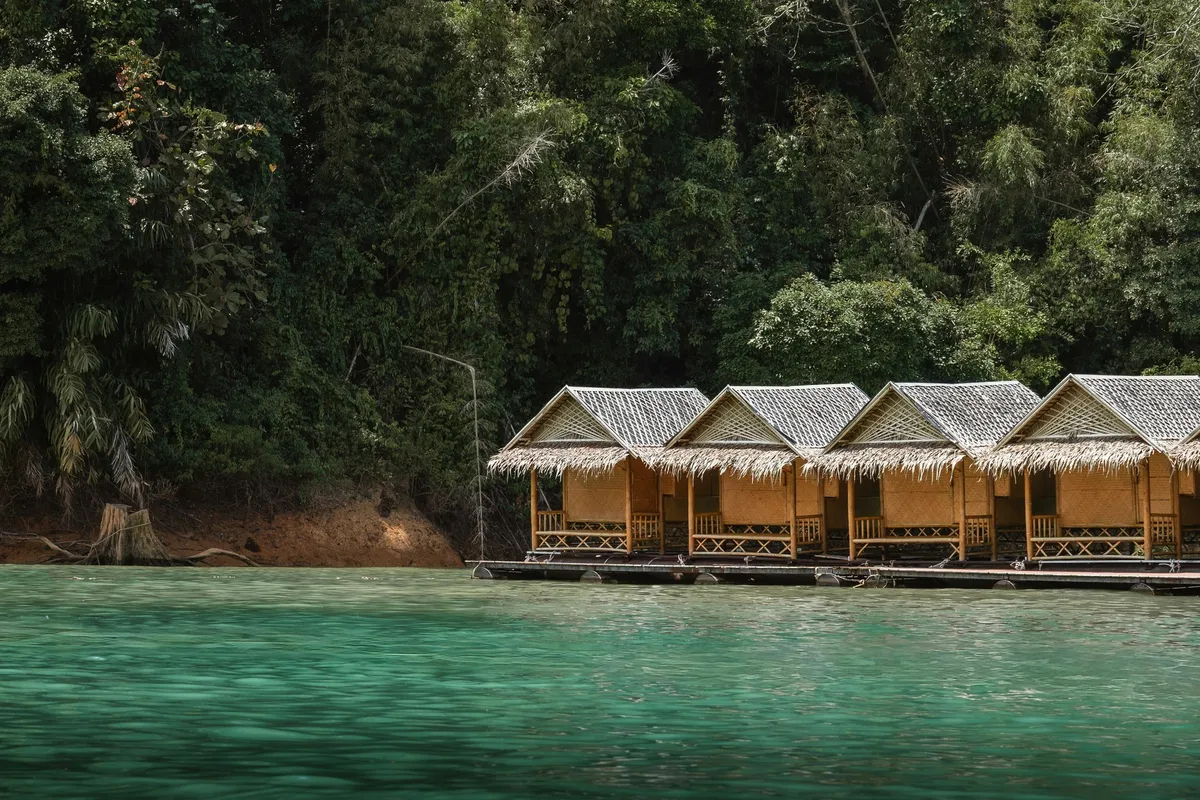
Stricter ecological inspections under Thailand's National Park Act B.E. 2562 have eliminated casual waste-handling shortcuts on inland waterways. Travelers arriving at isolated reservoirs like Ratchaprapha Dam on Cheow Lan Lake encounter strict bans on single-use plastics, tight luggage weight profiles, and mandatory boat curfews that strand tardy arrivals on the mainland. Understanding the mechanical realities of off-grid living prevents costly surprises when stepping off the pier.
Basic community-managed bamboo rafts suit self-reliant travelers seeking kerosene-lit stillness and direct immersion in nature, provided they can handle communal shore toilets and absence of power. Fully appointed floating villas cater to those wanting private plumbing and quiet nighttime cooling, yet guests must still operate within rigid battery limits, paid satellite connectivity, and strict generator curfew hours. Knowing how a floating eco resort generates power and processes waste reveals the actual daily compromises behind the marketing photography.
Engineering the Floating Eco Resort: Buoyancy, Sewage, and Water Closed-Loops
How Floating Hotels Handle Sewage: Submerged Bio-Digesters and Vacuum Pump-Out Barges
Discharging untreated wastewater into an enclosed tropical freshwater lake is an ecological crime that rapidly destroys delicate aquatic biomes. Unlike commercial marine vessels operating under international maritime agreements, stationary inland raft lodges fall under the administrative jurisdiction of regional bodies like Thailand's Department of National Parks, Wildlife and Plant Conservation (DNP) and the Marine Department. Understanding how floating hotels operate worldwide highlights the vast difference between open ocean dilution and closed freshwater containment.
To eliminate blackwater discharge, responsible operators deploy two technical solutions: sealed blackwater holding tanks serviced by scheduled vacuum pump-out barges, or pontoon-integrated submerged bio-digesters. In vacuum setups, wastewater flows to reinforced polyethylene or fiberglass tanks slung beneath the mooring frame. A specialized vacuum barge pulls up twice weekly, extracting the effluent to transport it across the lake to a terrestrial wastewater treatment plant. Anaerobic bio-digesters use submerged multi-chamber tanks where anaerobic bacteria digest solid matter through extended retention cycles before effluent passes into an onboard sterilizing chamber.
Plumbing on floating foundations presents unique fluid mechanics issues that I have observed firsthand on Cheow Lan Lake. When passing longtail boats throw heavy wakes against the pontoons, the sudden pitching motion rocks the structural water seal inside standard plumbing P-traps. The displaced water exposes the trap, allowing hydrogen sulfide gas and sewer odors to siphon directly up into the cabin bathroom. Well-engineered lodges install mechanical one-way air admittance valve plumbing (AAV) on wastewater stacks, equalizing pressure differentials and keeping dangerous sewer vapors sealed beneath the floorboards.
Liquid waste management directly impacts floating stability. Every cubic meter of accumulated sewage adds exactly 1,000 kilograms of asymmetrical ballast beneath the living deck. Irregular pumping schedules create hull listing, which strains structural cross-beams and causes pontoon coupling joints to shear during heavy wake swells.
Greywater Filtration, Reed Beds, and Limiting Freshwater Eutrophication
Greywater generated from bungalow showers, bathroom sinks, and kitchen sculleries carries a heavy load of fats, food particles, and surfactant chemicals. If dumped untreated beneath the deck, the cumulative floating hotel environmental impact triggers severe eutrophication and dissolved oxygen depletion. Organic loading accelerates microbial decomposition, driving dissolved oxygen levels down below the critical 4.0 mg/L threshold established by the Pollution Control Department (PCD) for Class 3 freshwater resources, suffocating local fish populations.
Mitigating this hazard requires a dedicated greywater treatment train built into independent floating pontoons. Drainage passes through mechanical grease traps to remove suspended lipids, flows across multi-stage sand-and-gravel settling filters, and discharges into floating phytoremediation reed beds. These constructed wetland rafts hold emergent aquatic macrophytes whose dense root networks absorb excess phosphorus and nitrogen, preventing localized cyanobacteria blooms.
Mechanical filtration cannot remove synthetic surfactants and chemical additives found in mainstream personal hygiene products. Concessionaires operating on pristine lakes mandate guest use of phosphate-free biodegradable soap and eco-friendly shampoos. I have stayed at properties where housekeepers systematically replace commercial toiletries left on bathroom counters with certified non-toxic plant-based alternatives to protect the downstream aquatic biology.
Rainwater Catchment and Lake Purification: Overcoming the Dry Season Deficit
Rainwater Catchment Metrics and the Dry Season Deficit
Harvesting rainwater seems like the obvious utility solution for sustainable floating hotels operating in tropical rainforest climates. An average guest bungalow roof measuring 35 to 45 m² exposed to 2,500 to 3,500 mm of annual rainfall collects between 70,000 and 120,000 liters of soft water during the monsoon, according to technical engineering metrics documented in the FAO rainwater harvesting guidelines. However, precipitation metrics drop to near zero between December and April across continental Southeast Asia.
| Parameter / Metric | Monsoon Period (May–Nov) | Dry Season Deficit (Dec–Apr) |
|---|---|---|
| Roof Yield (40 m² surface) | 10,000–18,000 L / month | 0–200 L / month |
| Potable Water Self-Sufficiency | 70–90% of technical demand | 0% (complete external reliance) |
| Primary Water Source | Gravity-fed gutter catchment | Direct lake intake & filtration |
| Pontoon Structural Burden | Lightweight variable storage | Maximum static water ballast |
Floating platforms cannot carry massive storage reservoirs to bridge this multi-month drought. Storing a seasonal water reserve requires massive cisterns that severely depress pontoon freeboard. Placing a 2,000-liter storage tank on a single floating bedroom module introduces two metric tons of point loading, dangerously destabilizing buoyancy balances. Consequently, when dry season settles in, floating eco-lodges must switch entirely to active lake intake systems.
Multi-Stage Lake Water Treatment: Sand Media, Ultrafiltration, and UV Sterilization
Drawing raw freshwater from lakes or rivers requires heavy-duty multi-barrier filtration before it is safe for shower valves and bathroom sinks. Tropical surface water contains suspended clay silts, vegetative tannins, algae spores, and biological pathogens introduced by upstream river basins. The raw water intake sits three to five meters below the floating pontoon line, shielded by coarse intake screens to exclude floating debris and macro-organisms.
The core purification line pumps intake water through pressurized multi-media sand filters to strip suspended sediments, followed by automated hollow-fiber ultrafiltration membranes with pore sizes between 0.02 and 0.05 microns. This physical barrier blocks microscopic parasites and coliform bacteria without demanding harsh chemical oxidizers. The final disinfection stage routes clarified water through an inline ultrafiltration UV sterilization chamber emitting shortwave ultraviolet light to destroy viral DNA.
Purifying lake water off the grid carries an unseen utility toll. Operating multi-stage pressure pumps and continuous UV ballasts consumes between 0.5 and 1.5 kWh of solar energy per 1,000 liters of treated water. During periods of heavy guest consumption, the water treatment system competes directly with guest cabin refrigeration and night lighting for limited battery reserves.
Off-Grid Solar Power for Floating Lodges: Energy Storage and Generation Limits
LiFePO4 Marine Battery Banks vs. Lead-Acid Buoyancy Trade-Offs
Designing energy systems for solar power floating lodges involves managing a delicate compromise between storage capacity and pontoon displacement. Historically, off-grid resorts deployed deep-cycle flooded lead-acid or AGM marine batteries. However, delivering 10 kWh of usable power from lead-acid chemistry requires roughly 280 to 350 kilograms of deadweight due to lower energy density and a restricted 50% maximum depth of discharge.
Modern off-grid platforms use 48V Lithium Iron Phosphate (LiFePO4) battery banks, which weigh between 70 and 85 kilograms per 10 kWh of usable capacity, as documented by Victron Energy technical specifications. Switching to lithium chemistry removes several hundred kilograms of point loading per cabin. Concentrated battery weight in one pontoon compartment creates permanent structural list, placing uneven torque on the timber framing and increasing frame stress during seasonal lake chop.
If you rely on continuous electricity, look for properties that house central lithium banks on a detached, dedicated utility pontoon. Isolating battery storage from guest cabins reduces pontoon torsion and eliminates inverter humming through the bedroom floorboards.
Photovoltaic Cloud Derating and Nighttime Air Conditioning Demands
Providing climate control on a floating platform tests the physical limits of off-grid solar engineering. A modern, high-efficiency 9,000 to 12,000 BTU inverter split air conditioner pulls between 0.8 and 1.2 kWh per hour of operation. Keeping a guest cabin cooled through an 8-hour sleep cycle demands 6.4 to 9.6 kWh of dedicated battery storage and a dedicated solar array of 1.5 to 2.0 kWp per bungalow simply to recover the overnight deficit.
Tropical weather systems regularly disrupt this solar equation. During intense monsoon thunderstorms and overcast afternoons, photovoltaic cloud derating reduces panel output by 60% to 80%, yielding as little as 10% to 25% of rated peak capacity. When three consecutive stormy days roll through, solar production plummets, leaving microgrids starved of energy before sunset.
When battery state-of-charge drops below critical thresholds, automated battery management systems (BMS) isolate heavy loads to protect the cells from deep discharge. At off-grid lake properties, climate control systems are the first circuits cut, leaving guests with passive window ventilation in high tropical humidity.
Inverter Wattage Cutoffs and Diesel Generator Curfew Hours
Electricity access at floating hotels spans distinct operational tiers. Truly disconnected properties, such as the historical River Kwai Jungle Rafts in Kanchanaburi, run without electricity whatsoever, relying on woven bamboo construction for cross-breeze cooling and traditional kerosene lamps for evening light. Their nightly rates sit between 3,500 and 5,500 THB ($100 to $160 USD), maintaining an authentic zero-decibel river atmosphere.
Mid-range and budget floating raft houses on Ratchaprapha Dam operate centralized diesel generators governed by strict curfew hours. Electricity flows only from 6:00 PM to 10:00 PM, or occasionally until 6:00 AM. Outside this operational window, generators shut down completely. Ceiling fans stop, wall sockets go cold, and cabins plunge into absolute darkness and humid still air.
Cabins equipped with standalone solar inverters feature strict inverter wattage cutoff limits, often set between 600 and 1,000 watts. Plugging in high-draw resistance heating appliances like a 1,600-watt travel hair dryer or an electric kettle immediately trips the cabin breaker. At remote lodges, resetting a tripped breaker involves tracking down an engineer via canoe.
Environmental Regulations and Sanctions in Sensitive Aquatic Ecosystems
National Park Act B.E. 2562: Single-Use Plastics and Waste Compliance
Floating resorts inside protected regions operate under intense regulatory pressure. In Thailand, Khao Sok National Park enforces the comprehensive single-use plastic ban mandated by the National Park Act B.E. 2562. Under Section 20, bringing single-use plastic bags thinner than 36 microns, plastic drinking straws, plastic cutlery, and foam food containers into national park waters is an administrative violation punishable by statutory fines of up to 100,000 THB under Section 47.
Enforcement occurs before visitors ever set foot on a boat. At Ratchaprapha Pier, park rangers visually inspect passenger luggage and grocery purchases, confiscating thin plastic carrier bags and takeaway food containers. Visitors transferring across Cheow Lan Lake to floating bungalows must settle mandatory municipal and conservation fees in cash at the counter before boarding.
- Khao Sok National Park Foreign Adult Entry: 300 THB (~$9 USD).
- Ratchaprapha Municipal Pier Fee: 40 THB per person.
- Total Mandatory Out-of-Pocket Boarding Cost: 340 THB cash per adult.
- Luggage Restriction: Disposable foam boxes and thin convenience-store plastic bags are seized at the gate.
Longtail boat operators face dock license suspensions if passengers carry prohibited disposables onto the water, meaning crews actively enforce these packing rules before departure.
Chemical Contaminants: Sunscreen Bans and Surface Water Protection
Sun protection chemicals pose severe threats to freshwater reservoirs where guests swim alongside floating verandas. Thailand's Department of National Parks strictly outlaws sunscreens containing oxybenzone, octinoxate, 4-methylbenzylidene camphor, or butylparaben across all Marine National Parks, backing the ban with fines up to 100,000 THB. In inland freshwater parks like Khao Sok, rangers and eco-lodge operators implement these exact standards as mandatory house rules to preserve surface water quality.
Chemical UV filters disrupt endocrine systems in freshwater fish and trigger toxic micro-algae shifts in enclosed bays. Floating resorts mandate that swimmers use exclusively reef-safe, non-nano zinc oxide formulas. I routinely see front desks stock mineral sunscreens while confiscating or storing commercial chemical lotions until guest check-out.
Hospitality Realities vs. Eco-Marketing: Costs, Logistics, and Guest Constraints
Accommodation Tiers, Boat Transfers, and Off-Grid Pricing Realities
Pricing for freshwater floating lodges reflects the immense logistical challenge of operating in complete geographical isolation. Everything from drinkable water to clean linen must be hauled across the lake by boat, driving basic overhead far beyond standard hotel operations. Understanding the tiers avoids expensive booking miscalculations.
| Resort Class & Name | Nightly Rate Range | Power & Climate Control Profile | Bathroom & Transfer Realities |
|---|---|---|---|
| Basic Community Rafts (e.g., Nang Prai, Krai Son) | 1,000–2,500 THB ($30–$75) per person | Generator active 18:00–22:00 only; no A/C; no daytime power | Shared mainland-style shore bathrooms; longtail boat hired separately |
| Heritage Off-Grid (River Kwai Jungle Rafts) | 3,500–5,500 THB ($100–$160) per room | 100% electricity-free; kerosene lamps; river current cooling | Private ensuite with gravity cold shower; boat transfers included in rates |
| Floating Tented Safari (Canvas & Orchids Retreat) | $175–$320 USD (~715k–1.3M KHR) per villa | Centralized off-grid solar with silent generator backup; quiet fans | Private luxury bathrooms; vacuum-treated greywater; scheduled river transfers |
| Luxury Villa Packages (500 Rai Floating Resort) | 18,000–25,000 THB ($500–$700) all-inclusive | Solar battery bank with scheduled night generator A/C cycles | Ensuite bathrooms; packages cover meals and boat; room-only boat fee 1,500 THB/person |
Reaching these remote outposts requires a 45- to 90-minute transfer by traditional wooden longtail boat across open lake water, where the Marine Department strictly enforces life-jacket compliance. Crucially, under Khao Sok National Park safety regulations, all boat navigation across Cheow Lan Lake is strictly prohibited between 6:00 PM and 6:00 AM. If your road transport arrives at Ratchaprapha Pier past 5:30 PM, no boat will launch, and you will be forced to arrange an emergency mainland hotel room at your own expense.
Connectivity Scarcity, Off-Grid Packing Essentials, and Daily Limitations
The glossy marketing images of laptop workers typing from overwater hammocks conceal a bleak cellular reality. Deep limestone karsts deflect mobile signals, leaving extensive blind spots across lake waters. If your work depends on reliable data, reviewing our analysis of connectivity on remote pontoons and metal hulls clarifies how topography limits wireless reception.
At upscale operations like 500 Rai, in-room Wi-Fi is not complimentary. Guests must purchase dedicated satellite or cellular packages costing 350 THB per hour or 1,500 THB for 24 hours of erratic bandwidth. At mid-range and budget raft houses, cellular service is completely unavailable, cutting off calls and messaging until you return to the mainland dock.
Protect sensitive electronics by packing inside a certified IPX7 dry bag, capable of withstanding full submersion up to one meter for thirty minutes. Lake transfers in longtail boats face frequent wind-whipped chop that drenches luggage sitting in the open hull.
Reviewing our field guide to luggage restrictions and packing rules for floating hotels highlights the need for specialized gear. You must pack a durable headlamp for navigating pitch-black pontoon walkways after curfew, non-nano zinc oxide sunscreen, and a rugged power bank rated for at least 20,000 mAh to keep phones and cameras charged through overnight power shutdowns.
Final Evaluative Verdict: When Off-Grid Floating Lodges Justify the Trade-Offs
Decision Framework: Eco-Resort Authenticity vs. Greenwashed Novelty
Separating authentic sustainability from shallow greenwashing requires looking directly past promotional photos and inspecting structural mechanical setups. True eco-resorts design their operations around zero-impact containment rather than aesthetic staging. Read our breakdown of port taxes and houseboat fees to see how remote resorts bill their off-grid waste operations.
- Closed Wastewater Loops: Look for plumbed vacuum pump-out lines or sealed aerobic holding units; open PVC pipes draining beneath restaurant dining decks indicate greenwashing.
- Certified Greywater Polishing: Check for functioning floating reed beds or settlement tanks filtering shower surfactants before water touches the lake.
- Advanced Battery Storage: Verify that the property uses balanced LiFePO4 battery banks rather than unmanaged lead-acid batteries that create hull listing and safety hazards.
- Strict Generator Discipline: Authentic operations enforce firm generator curfews to protect natural ambient soundscapes and minimize fuel burns.
- Zero-Waste Supply Chains: Quality resorts serve water exclusively in reusable glass bottles and prohibit single-use plastic packaging across kitchen operations.
If an operator runs un-muffled diesel generators day and night or dumps kitchen scullery water into the swimming lagoon, you are dealing with an irresponsible novelty rather than a legitimate eco-lodge.
Realistic Suitability Profile: Who Should Book and Who Should Avoid
Off-grid floating stays deliver an unforgettable encounter with pristine rainforest wilderness, but only for guests aligned with physical realities. If you appreciate the mechanics of sleeping on water and cabin living realities, waking to gibbon calls echoing across mist-shrouded limestone cliffs completely justifies the utility compromises.
This setting is ideal for:
- Wilderness enthusiasts, birders, and naturalists eager for profound natural quiet.
- Travelers welcoming a total digital disconnect from emails and social feeds.
- Photographers wanting direct dawn access to rainforest ecosystems without road traffic.
This setting is unsuitable for:
- Remote workers requiring guaranteed high-speed internet and uninterrupted Zoom connectivity.
- Light sleepers sensitive to humidity, creaking pontoons, insect calls, and early morning generator cutoffs.
- Travelers reliant on life-sustaining medical equipment: individuals using overnight CPAP therapy require continuous 30 to 60W power, which fails during night curfews unless supported by a personal, dedicated DC medical battery pack.
If you require continuous municipal grid stability and climate-controlled luxury without buoyancy compromises, book established terrestrial eco-resorts near the park boundary—such as Anurak Community Lodge (Travelife Gold certified) or Our Jungle House. However, if you are prepared to pack a power bank, abide by boat schedules, and accept the limits of tropical solar storage, an off-grid floating lodge offers one of the most rewarding aquatic wilderness stays in Southeast Asia.