
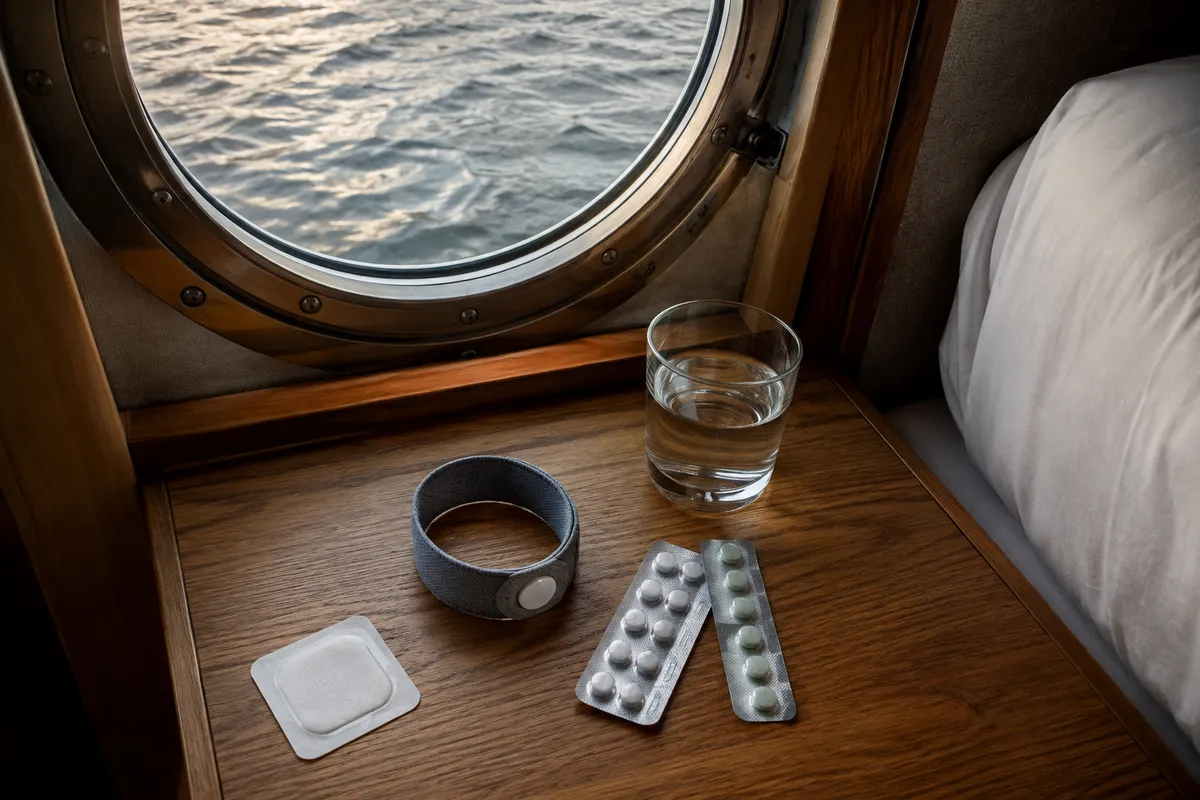
Municipal port authorities and inland navigation offices across Europe have tightened wave-wash monitoring, yet enforcement remains uneven. Commercial tugs and commuter ferries routinely push displacement wakes through harbor basins, leaving guests aboard moored botels to deal with sudden rolling motions that hotel reception desks cannot mitigate or refund.
Light sleepers and travelers prone to motion discomfort need to understand structural displacement and mooring types before booking. Massive concrete pontoons in enclosed basins remain stable under typical weather conditions, whereas lightweight steel barges moored along active tidal rivers transmit continuous low-frequency vibrations and lateral surges directly into the berth.
Seasickness on Floating Hotel Stays: Neurobiology and the Moored Vessel Paradox
Sensory Conflict and the Vestibular Mechanism at the Quay
Experiencing seasickness on floating hotel stays often catches travelers off guard because the visual environment appears entirely stationary. Inside an enclosed cabin, the walls, nightstands, and bathroom fixtures provide the brain with visual signals of a solid, terrestrial room. However, the fluid dynamic environment beneath the hull tells an entirely different story to the inner ear.
The human balance system relies on continuous data integration from three sensory pathways: the eyes, the peripheral proprioceptive sensors in muscles and joints, and the vestibular labyrinth. Within the inner ear, three semicircular canals measure angular acceleration, while the otolith organs and semicircular canals track gravity and linear displacement. When micro-swells gently displace a moored hull, the macular otoliths register horizontal shear and vertical heave.
- Angular displacement signals originate in the fluid-filled semicircular ampullae.
- Linear accelerations activate calcium carbonate crystals within the otolith organs.
- Neural pulses travel along the cranial nerve VIII directly to the brainstem vestibular nuclei.
- Mismatch signals route to the area postrema, initiating autonomic nausea cascades.
This biological discrepancy represents classic sensory conflict theory. Under normal seafaring conditions, stepping out on deck provides a visible horizon line that reconciles optical input with vestibular motion. In a windowless or quayside berth, this visual-vestibular mismatch operates unchecked, inducing motion sickness moored boat discomfort despite steel dock lines securing the vessel.
Enclosed quayside cabins eliminate natural horizon references. The lack of optical flow combined with persistent fluid shear stress on otolith organs creates higher sensory discordance than open-deck sailing.
Prolonged Disequilibrium and Mal de Débarquement Syndrome (MdDS)
Most guests adapt to gentle quayside movement within twelve to twenty-four hours through neurovestibular habituation. Once the cerebellum recalibrates its internal expectations to account for low-amplitude hull movement, the acute feeling of motion sickness moored boat instability generally subsides. The true complication arises when leaving the vessel.
Upon stepping back onto a solid stone pier, the brain must quickly readapt to zero environmental motion. A transient sensation of swaying, commonly termed dock sickness or sea legs, typically resolves within a single day. However, a small subset of guests develops prolonged disequilibrium known clinically as Mal de Débarquement Syndrome (MdDS), where a phantom sensation of rocking, bobbing, or swaying persists for weeks or months.
- Transient post-motion disequilibrium normally fades within 24 hours of checkout.
- Persistent MdDS involves central neuro-chemical entrainment that fails to uncouple.
- Clinical data indicates MdDS represents roughly 1.3% of presentations at specialized neuro-otology clinics according to the Bárány Society consensus criteria.
- Individuals with a history of vestibular migraines or hormonal shifts exhibit elevated vulnerability.
During my stay at an old converted cargo barge in Rotterdam, a fellow traveler spent two days resting flat in the saloon after experiencing phantom swaying on a walk to the metro station. If you have an established history of persistent disequilibrium after boat trips, static hotel ships present measurable physiological risks.
Non-Invasive Otolithic Stimulation: 100 Hz Pure-Tone Acoustic Protocol
Managing acute vestibular mismatch has traditionally relied on heavy anti-emetic medications. However, emerging vestibular research focuses on non-pharmacological neural disruption targeting the inner ear directly. By modulating the firing rates of otolithic receptors, non-invasive sensory inputs can mitigate discordant signals before they trigger gastric distress.
A trial published in Environmental Health and Preventive Medicine demonstrated that a one-minute acoustic pure-tone stimulation delivered at 100 Hz suppresses acute motion sickness symptoms. The acoustic vibration stimulates the saccular macula through air and bone conduction pathways, effectively interrupting discordant signals without inducing sedation.
- The 100 Hz acoustic pure tone stimulates saccular hair cells directly via targeted headphones.
- Saccular activation dampens aberrant firing into the brainstem vestibular nuclei.
- Autonomic emetic reflex pathways show reduced activation during subsequent movement exposure.
While these laboratory findings offer a promising non-pharmaceutical intervention, travelers should treat acoustic stimulation as an experimental adjunctive technique rather than a standalone cure. It does not replace proper hull selection or pre-boarding medical planning, but carrying pre-recorded 100 Hz acoustic files provides an accessible, non-drowsy backup on mobile devices.
Hydrodynamics and Harbor Physics: Do Botels Rock Under Real Waterway Conditions?
Six Degrees of Freedom and Critical Oscillation Frequencies
A floating structure resting on water moves continuously through six degrees of freedom (6DOF). These movements divide into three translational axes (surge, sway, and heave) and three rotational axes (roll, pitch, and yaw). Understanding which of these axes dominates a specific mooring basin is crucial when assessing whether do botels rock during overnight stays.
| Axis Type | Motion Direction | Primary Hydrodynamic Cause | Emetic Impact |
|---|---|---|---|
| Rotational: Roll | Side-to-side tilting around the longitudinal axis | Beam swells, lateral wash from passing traffic | Very High |
| Rotational: Pitch | End-to-end rocking around the transverse axis | Head or stern wakes traveling along the hull | Moderate |
| Rotational: Yaw | Heading deviation around the vertical axis | Cross-current turbulence, asymmetric mooring tension | Low |
| Translational: Heave | Direct vertical displacement along the Z-axis | Passing wave crests, tidal cycles, long swells | Extremely High |
| Translational: Surge | Fore-and-aft displacement along the X-axis | Propeller wash, suction displacement from overtaking hulls | Moderate |
| Translational: Sway | Lateral port-to-starboard movement along the Y-axis | Lateral wind shear, side-pushing currents | Moderate |
Human motion sensitivity is governed by the frequency of these oscillations. Guidelines from the ANSI blog on ISO 2631-1 indicate that low-frequency oscillation resonance between 0.1 Hz and 0.5 Hz triggers the vast majority of human motion sickness symptoms. Frequencies below 0.1 Hz produce slow, barely perceptible leveling shifts, while vibrations above 1.0 Hz manifest as mechanical hull shudder rather than nausea.
The frequency-weighting curve Wf defined in the ISO standard identifies a sharp sensitivity peak between 0.16 Hz and 0.20 Hz. This frequency corresponds precisely to wave periods of 5 to 6 seconds. When a passing commercial vessel creates long-period wake swells that match this 5-second interval, the human balance center experiences rapid sensory overload.
Quantitative Exposure: ISO 2631-1 and Motion Sickness Dose Value (MSDV)
Maritime naval architects quantify motion severity using the Motion Sickness Dose Value along the vertical Z-axis, formalized under ISO 2631-1 whole-body vibration guidelines. Unlike instantaneous acceleration peaks, MSDV calculates cumulative vertical acceleration over time using a fourth-power integral equation:
MSDVz Formula: MSDVz = [ ∫ a_w^2(t) dt ]^(1/4), where a_w is the frequency-weighted vertical acceleration and t represents total exposure time in seconds.
Because the formula integrates total exposure, sleeping aboard a vessel experiencing subtle heave motion for eight continuous hours produces significant biological fatigue. The American Bureau of Shipping (ABS) outlines acceptable passenger comfort thresholds across various sea states. When cumulative nocturnal MSDVz exceeds 30 m/s^1.5, field studies show that vomiting incidence among resting passengers exceeds 10%.
| Nocturnal MSDVz (8-Hour Stay) | Perceived Physical Discomfort | Predicted Motion Sickness Incidence |
|---|---|---|
| Under 10 m/s^1.5 | Barely perceptible or stable sensation | Under 1% of occupants |
| 10 to 20 m/s^1.5 | Noticeable swaying; light sleep disruptions | 2% to 5% of occupants |
| 20 to 30 m/s^1.5 | Pronounced periodic heave; balance correction required | 5% to 10% of occupants |
| Over 30 m/s^1.5 | Severe vertical displacement; acute nausea | Exceeds 10% to 25% of occupants |
A concrete pontoon anchored in a protected basin often stays below 5 m/s^1.5 throughout the night. Conversely, converted steel barges moored near active waterways frequently exceed 25 m/s^1.5 when passing traffic generates persistent nocturnal wash, directly undermining sleep quality.
Channel Traffic Dynamics: Vessel Wake, Wash, and Regulatory Speed Caps
Inland commercial waterways remain active around the clock. Even when wind conditions are calm, passing gravel barges, tugs, and high-speed harbor patrol craft create vessel wake and wash that ripple outward toward moored hotel structures. When displacement wakes strike a pontoon's vertical flank, energy transfers directly into rolling and surging motions.
To protect moored infrastructure and historic houseboats, municipal authorities impose strict navigation caps. In central Amsterdam canals, vessels must maintain speeds under 6 km/h (3.7 mph). Under the Dutch Openbaar Ministerie Boetebase, operators violating inland waterway regulations (BPR) or creating hazardous wash face baseline fines ranging from €100 to over €390, alongside mandatory administrative fees.
Enclosed dock basins experience clapotis—a standing-wave phenomenon where displacement wash reflects off vertical stone quays without losing energy, causing hulls to sway for over an hour after a boat passes.
During one stay at an inner-city mooring, I watched a delivery barge pass at 04:30. The water appeared calm thirty seconds later, but the hull began rolling two minutes afterward as reflecting waves bounced off the opposite masonry wall, triggering rhythmic creaking across every berth line.
Mooring Engineering: How Floating Accommodations Suppress Environmental Motion
Structural Grounding: Spud Poles and Dolphin Piling Guides
How an accommodation vessel connects to the seabed determines whether environmental swells cause minor vertical heave or sudden angular rolling. The most structurally rigid installation uses a spud pole mooring setup or an engineered dolphin piling system. Heavy tubular steel pilings are driven deep into harbor bedrock, creating permanent vertical axes.
The floating pontoon links to these columns through exterior structural collars fitted with Ultra-High Molecular Weight Polyethylene (UHMW-PE) low-friction wear pads. This configuration physically restricts five degrees of freedom: surge, sway, yaw, pitch, and roll. The structure can only slide vertically along the pilings, accommodating normal tidal fluctuations.
- Vertical steel piles restrict lateral and rotational movement during side-impact wash.
- UHMW-PE collar inserts prevent metal-on-metal binding and dampen structural vibration.
- Wave impacts dissipate through benthic bedrock rather than pitching guest rooms.
While spud poles eliminate motion-induced nausea, they introduce an acoustic trade-off. During wind chop, guide collars can creak and shudder against the pilings. If you are sensitive to noise, that repetitive structural friction can disturb rest even while the floor remains flat.
Compliant Mooring: Taut Lines, Rubber Snubbers, and Dampening Hardware
Smaller botels and converted historic freighters often dock along municipal wharves using traditional line arrays rather than fixed pilings. These arrangements rely on taut elastic mooring lines tied to shore bollards. Because static lines transmit shock loads when wakes roll through, operators add specialized inline shock absorbers.
High-stretch three-strand or braided nylon lines (offering 15% to 25% elongation under load) are paired with elastomeric rubber mooring snubbers made of EPDM rubber, or heavy stainless steel compression springs. Rigging tests demonstrate that inline EPDM snubbers absorb 40% to 60% of peak kinetic impact forces, smoothing sharp hull snatch into gradual swaying.
Vessels rigged with high-modulus lines like Dyneema experience harsh, abrupt jerking because the synthetic fibers have virtually no stretch, transmitting wake impulses directly into cabin floors.
When snubbers exceed their elastic travel during severe wake strikes, lines suddenly bottom out. This abrupt stop causes secondary snap-back, where the hull snaps back against the pier fenders. This sharp lateral snap is particularly disorienting for sleeping guests.
Pontoon Ballast Engineering: Heavy Concrete Caissons Versus Converted Steel Barges
The total submerged mass and cross-sectional geometry of a hull dictate its natural rolling frequency. Purpose-built floating hotels rely on massive, box-shaped reinforced concrete pontoons, whereas converted river cruisers and freight barges use lightweight steel plate construction. These differences fundamentally alter how each vessel reacts to wave movement.
| Design Parameter | Monolithic Concrete Caisson | Converted Steel Hull Barge |
|---|---|---|
| Structural Displacement | 5,000 to 10,000+ metric tonnes | 150 to 500 metric tonnes |
| Metacentric Height (GM) | Very wide beam; high initial static stability | Narrow beam; moderate to low initial GM |
| Roll Damping Characteristics | Massive inertia; square bilges cancel roll | Rounded chines; continuous oscillatory rolling |
| Natural Oscillation Period | Very long; resists short 2–4s wakes | Short, snappy 1–3s jerky cycles |
| Hull Noise Transmission | Dampens lapping water; deadens acoustic wash | Acts as a sounding board; reverberates wave slap |
At London's Royal Victoria Dock, Good Hotel London rests upon an 8,000-tonne floating concrete pontoon originally built in the Netherlands and transported across the North Sea on a semi-submersible barge. Its immense mass moment of inertia ($I_{xx}$) easily dampens wakes. Similarly, the Salt & Sill hotel at Klädesholmen in Sweden utilizes heavy SF Marina concrete pontoons supporting 23 guest rooms across six two-storey modules, remaining stable despite open archipelago winds.
Conversely, lightweight steel barges have low mass moments of inertia. When struck by minor surface ripples, they respond with abrupt, jerky roll accelerations. If you want to review the broader structural tradeoffs of water-based accommodations, check our cabin living reality check.
Cabin Selection Tactics: Preventing Nausea on Hotel Ship Bookings
Metacentric Geometry: Lower Midships Cabins Versus Upper Periphery Suites
Vessel movement is not experienced equally throughout a floating structure. Because rotational angular acceleration ($\\ddot{\\theta}$) acts across the entire rigid hull, the actual linear acceleration experienced in a specific cabin depends directly on its physical distance ($r$) from the vessel's center of gravity and metacenter ($a = r \cdot \ddot{\\theta}$).
Upper-deck penthouse rooms feature wider panoramic views, but their elevation amplifies lateral sway. Cabins situated at the extreme bow or stern endure the greatest vertical movement from hull pitching. In contrast, lower-deck cabins placed amidships near the waterline sit close to the vessel's center of flotation, reducing total linear accelerations by 50% to 70%.
- Request a cabin on the lowest accommodation deck, as close to the waterline as possible.
- Select rooms located amidships along the vessel's longitudinal center line.
- Avoid forward bow staterooms, where incoming wakes generate severe vertical displacement.
- Avoid extreme aft cabins positioned directly above vibrating graywater pumps or chiller units.
- Opt for an exterior window with a direct sightline to the shore to maintain an optical horizon.
When selecting your berth, also account for mechanical sounds. While midships lower decks minimize motion, they often sit adjacent to heavy service infrastructure. For a deeper breakdown of operational noise and safety elements, read our guide on inspecting mooring lines and pontoon stability.
Real-Time Traffic Awareness: Marine AIS Monitoring for Anticipating Wakes
Unanticipated hull movements are far more disorienting than predictable ones. When a floating hotel rolls unexpectedly while you are brushing your teeth or carrying hot coffee, the risk of stumbling increases. Monitoring local harbor traffic allows you to anticipate major displacement wakes before they reach your room.
Using live Automatic Identification System (AIS) tracking apps such as MarineTraffic or VesselFinder, you can view approaching commercial tugs, bulk transport barges, and passenger ferries in real time. Knowing when a vessel will pass gives you practical notice to prepare.
- Check the vessel fairway map roughly thirty minutes before going to bed.
- Note passing commuter ferries, which maintain regular timetables and generate repetitive wash.
- When heavy hulls approach, avoid balancing in high-heeled footwear or stepping into the shower.
- Sit or lie down near the center of the bed before the displacement wave reaches your berth.
On an evening stay along an active shipping channel, checking my phone screen showed a 110-meter inland freighter approaching the adjacent bend. That three-minute head-up let me secure an open drink bottle on the desk before the wash set the cabin rocking.
Commercial Policies: Cancellation Clauses, Non-Refundable Rates, and Medical Exclusions
Standard European botel room rates generally range from €80 to €220 per night, depending on the season, city center proximity, and hull dimensions. Most budget reservations utilize non-refundable booking tiers that enforce strict penalties for early departures.
Standard hotel reservation terms do not recognize kinetic motion discomfort or seasickness as valid grounds for an emergency cancellation refund once you have checked in.
Standard travel insurance policies rarely cover voluntary early checkouts caused by mild or moderate vestibular distress, requiring formal hospital admission documentation to process trip-interruption claims. If you are uncertain about your tolerance for floating rooms, protect your booking with practical measures:
- Book directly using flexible cancellation tiers that permit departure changes up to 24 hours prior.
- Choose properties linked to onshore parent hotels that can transfer your reservation to land.
- Inquire at reception upon check-in whether unused nights can convert into food or dining vouchers.
- For regional context on pricing across major canals, consult our guide to botel locations in Amsterdam.
Pharmacological and Neuromodulation Interventions for Moored Guests
Oral Antihistamines: Dimenhydrinate Versus Meclizine Protocols
Over-the-counter antihistamines remain the most accessible remedy for quayside motion sickness. These drugs work by crossing the blood-brain barrier to inhibit H1 histamine receptors and central muscarinic acetylcholine receptors within the vestibular apparatus, dampening emetic signaling.
| Therapeutic Attribute | Dimenhydrinate (Dramamine Original) | Meclizine Hydrochloride (Bonine) |
|---|---|---|
| Standard Dose | 50 mg to 100 mg per administration | 25 mg chewable tablet |
| Timing Before Boarding | 30 to 60 minutes prior to boarding | 60 minutes prior to boarding |
| Duration of Action | 4 to 6 hours | Up to 24 hours |
| Sedation Severity | Marked drowsiness; impairs concentration | Significantly reduced daytime sedation |
| Retail Price Range | $7.99 to $13.99 (36-tablet pack) | $7.90 to $9.39 (16-tablet pack) |
Timing your dose is essential. Once inner-ear conflict triggers acute nausea, the vagus nerve inhibits normal gastric motility, causing gastric stasis. Oral pills swallowed during active nausea often sit unabsorbed in the stomach rather than passing into the duodenum, rendering late treatment largely ineffective.
Transdermal Scopolamine: Application Protocols for Multi-Night Stays
For multi-night botel bookings, prescription transdermal scopolamine delivers steady preventive protection without the need for frequent redosing. The patch slowly releases the belladonna alkaloid scopolamine through the epidermis, blocking muscarinic transmission directly within the brainstem vestibular nuclei.
Generic transdermal patches deliver 1 mg of active scopolamine evenly over a 72-hour (three-day) period. Pricing listed on GoodRx shows average retail pricing for a 10-patch carton around $189.13, which community discount coupons can reduce to approximately $45.02.
- Apply the adhesive patch to clean, hairless skin behind the ear at least 4 hours before boarding.
- Leave the patch in place for continuous absorption; replace every 72 hours if your stay continues.
- Wash your hands thoroughly after application to prevent inadvertent pupil dilation from accidental eye contact.
Transdermal scopolamine frequently causes dry mouth, blurred near vision, and drowsiness. It is medically contraindicated for individuals with angle-closure glaucoma or severe urinary retention.
Neuromodulation and Acupressure: P6 Median Nerve Stimulation
Travelers seeking to avoid pharmaceutical drowsiness can utilize mechanical acupressure or transcutaneous electrical stimulation. These interventions focus on the P6 (Nei-Kuan) acupoint, located on the anterior forearm three finger-widths proximal to the distal wrist crease between the flexor carpi radialis and palmaris longus tendons.
Elastic bands like Sea-Band retail for $7.95 to $9.99 per pair and rely on continuous mechanical pressure from a molded plastic bead. Active electrical pulse devices stimulate the median nerve more aggressively to disrupt afferent vagal signals before they reach the emetic center.
| Device Model | Stimulation Mechanism | Power Source / Runtime | Retail Price |
|---|---|---|---|
| Sea-Band Acupressure Wristband | Passive mechanical compression bead | None; permanent elastic wear | $7.95 to $9.99 |
| Reliefband Flex | Active median nerve electrical pulses | Replaceable CR2025 coin batteries (up to 350 hours) | $179.99 |
| Reliefband Sport | Active median nerve electrical pulses | USB rechargeable battery (~30 hours per charge) | $249.99 |
Active electrical stimulation alters gastrointestinal myoelectric patterns, helping suppress gastric tachyarrhythmia during wake strikes. When combined with smart cabin selection, it offers reliable nausea prevention without drug interactions or grogginess.
Booking Feasibility Assessment: Verdict on Staying Aboard Moored Botels
Quantitative Risk Scorecard: Mooring System, Hull Displacement, and Sensitivity
Deciding whether to confirm an accommodation reservation on water requires matching your personal vestibular sensitivity against the physical hull characteristics of the property. Different hull types and anchoring structures handle environmental swells in fundamentally different ways.
| Sensitivity Profile | Recommended Hull Engineering | Acceptable Mooring Installation | Waterway Location |
|---|---|---|---|
| Low (Rare motion sensitivity) | Any hull; converted freighters or steel barges | Traditional dock lines with rubber snubbers | Tidal rivers, active canals, or commercial docks |
| Moderate (Occasional car/sea nausea) | Displacement pontoons over 2,000 tonnes | Heavy guide pilings with UHMW-PE wear sleeves | Enclosed basins or speed-controlled canals |
| High (Easily disoriented indoors) | Concrete caissons exceeding 5,000 tonnes | Fixed spud-pole dolphin piling systems | Protected, dead-end non-tidal commercial docks |
Do not book a floating hotel stay if you have a clinical history of active vestibular migraines, uncompensated unilateral vestibular loss, or previous Mal de Débarquement episodes lasting over two weeks.
For guests managing high vestibular sensitivity, staying on a lightweight steel barge moored along a tidal river carrying active freight traffic presents an unacceptable risk of sleep disturbance and nausea. For broader insights into current vibration impacts on inland waterways, read our analysis on river currents and vibration impacts on sleep.
Actionable Escalation Protocol and Shore-Based Alternatives
If you wake up disoriented during the night as wake-induced rolling rocks the berth, following a structured management sequence can de-escalate symptoms before severe nausea sets in:
- Turn on a low nightlight and focus your gaze on a stable, lit shoreline landmark out the window, or step onto the open deck to re-establish an optical horizon.
- Power on an electrical median nerve stimulator, or play a 100 Hz pure-tone audio track through headphones.
- Lie flat on your back near the center of the mattress with a supportive pillow to restrict head movement, closing your eyes to halt conflicting optical cues.
- If movement persists and nausea develops, inform the night desk and request a move to a lower, center-line cabin, or prepare to check out early.
When in doubt, choose a solid terrestrial hotel located along the quay instead. Solid-ground boutique hotels situated facing the harbor provide identical waterfront views, quayside dining, and dockside walks without transferring hydro-mechanical movement into your bed. You can explore standard European vessel conversions in our guide to urban botels across European waterways before deciding whether sleeping on the water matches your travel style.