

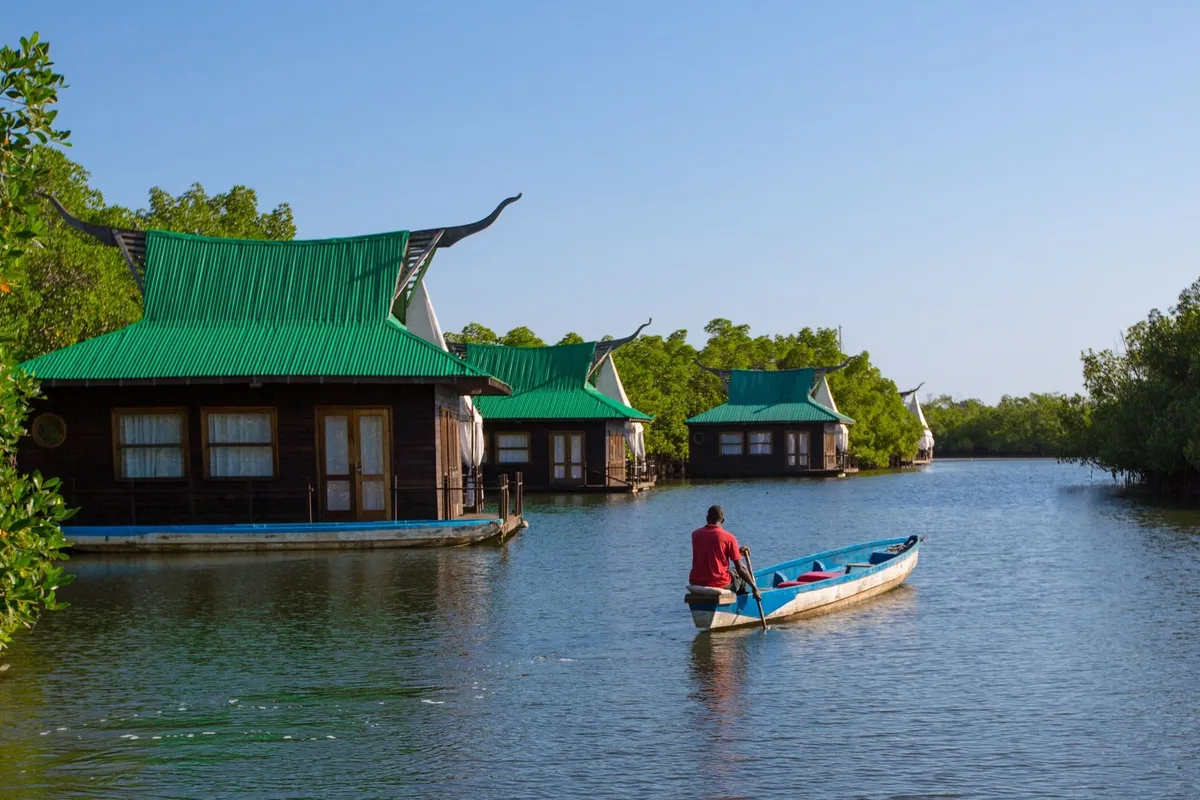
When booking floating resorts and lodges beyond the regulated canals of Amsterdam or the calm harbor basins of the Baltic, maritime realities change dramatically. Across tropical rivers, tidal fiords, flooded rainforests, and open marine blue holes, aquatic accommodations face extreme environmental forces. After sleeping on pontoons and hulls across four continents, I have found that glossy booking photos routinely gloss over deafening generator noise, rigid boat connection windows, unheated river showers, and severe luggage weight caps.
Choosing floating hotels outside Europe requires looking past interior design to inspect mooring mechanics, utility isolation, and transfer vulnerabilities. An off-grid raft anchored to a jungle riverbed behaves nothing like a steel ocean liner tethered to an urban quay. Below, I evaluate eight distinct water lodges across Asia, the Americas, Africa, and the Middle East, establishing explicit engineering benchmarks, verified costs, and field observations so you can select the right overseas floating accommodation for your technical and comfort requirements.
Evaluating Floating Hotels Outside Europe: Comparative Directory and Assessment Criteria
Selection Benchmarks: Mooring Engineering, Environmental Autonomy, and Logistics
To rigorously compare floating accommodations across contrasting biomes, I evaluate each property against five non-negotiable operational benchmarks:
- Mooring Integrity and Water Dynamics: How the structure accommodates environmental movement, ranging from five-meter Pacific ocean tides and ten-meter Amazon flood pulses to strong river currents and open-ocean swells.
- Power Architecture and Climate Control: The precise engineering behind in-room electricity, distinguishing between 24/7 commercial shore power, solar-inverter battery microgrids, run-of-the-river hydroelectric turbines, scheduled nocturnal generator runs, and complete unpowered off-grid living.
- Sanitation and Waste Containment: How greywater and blackwater are processed, whether through closed-loop holding tanks pumped ashore, multi-chamber biological microbial reed filters, or municipal marine hookups.
- Pier Logistics and Transfer Contingencies: The rigidity of scheduled water access, including mandatory arrival cutoffs, missed-boat penalty fees, and fixed-wing or floatplane baggage thresholds.
- Transparent Baseline Pricing: Total out-of-pocket costs, incorporating mandatory conservation levies, infrastructure taxes, and compulsory round-trip watercraft charters into base nightly figures.
Always verify whether air conditioning operates continuously or runs on an evening generator timer. In tropical reservoir lodges, daytime indoor temperatures inside uninsulated thatched floating bungalows can exceed 38°C when power is switched off.
Evaluating these systems reveals the operational trade-offs of aquatic hospitality. Where European botels plug directly into municipal sewage mains and urban electric grids, remote international water lodges must function as self-contained micro-utilities exposed to debris, sedimentation, and changing water levels.
Global Directory of Non-European Water Stays: Key Specs and Cost Baselines
The following directory outlines eight tested properties outside Europe. The widget controls below represent the criteria used to filter properties by geography, water biome, and operational electrical infrastructure.
Suggested Widget Controls: Filter by Region (Asia, Americas, Africa, Middle East) | Filter by Power Architecture (Zero Power, Scheduled Nocturnal A/C, Solar/Hydro Microgrid, 24/7 Shore Grid) | Sort by Nightly Entry Cost (Low to High / High to Low).
| Property Name | Location | Structural Type | Price From | Key Advantage | Key Drawback & Reality |
|---|---|---|---|---|---|
| Queen Elizabeth 2 | Dubai, United Arab Emirates | Moored Ocean Liner | 350 AED (~95 USD) / night | Stationary historic vessel with onboard heritage museum and stable municipal shore power | Moored in an industrial maritime port; completely non-walkable to urban Dubai |
| River Kwai Jungle Rafts | Sai Yok, Thailand | Woven Bamboo Rafts | 3,200 THB (~95 USD) / night | Total digital detox cooled by natural under-floor river currents and Mon cultural connections | Zero in-room electricity; evening kerosene lamps only; ambient cold river-fed showers |
| The FloatHouse River Kwai | Sai Yok, Thailand | Teak Floating Villas | 4,800 THB (~140 USD) / night | Spacious 90 m² teak villas featuring continuous 24/7 air conditioning and private docks | Daytime engine exhaust and wake wash from river-running longtail traffic from 06:00 to 18:00 |
| 500 Rai Floating Resort | Khao Sok, Thailand | Karst Lake Bungalows | 14,000 THB (~410 USD) / night | Direct deep-water freshwater swimming among dramatic limestone reservoir cliffs | Deluxe rooms restrict A/C to 18:00–06:00; mandatory 1,500 THB/person transfer fee on room-only stays |
| Spice Coast Cruises | Alleppey, India | Kettuvallam Houseboat | 16,000 INR (~190 USD) / night | Traditional nail-free jackwood build with dedicated private crew and regional Keralan meals | Mandatory stationary canal bank mooring from 17:30 to sunrise; evening mosquito exposure |
| Uakari Floating Lodge | Mamirauá, Tefé, Brazil | Assacu Log Rafts | 4,960 BRL (~900 USD) / 3-night package | Deep scientific wildlife immersion in flooded várzea forest; pink river dolphins at the deck | Strict package arrival days (Sat–Tue / Tue–Sat); zero cellular connectivity; multi-leg transit |
| The Manta Resort (Underwater Room) | Pemba Island, Tanzania | Submerged Offshore Pontoon | 1,700 USD / night | Bedroom submerged four meters inside a protected coral blue hole with nocturnal spotlighting | Open-ocean swell can induce motion sickness while submerged; $50/person/night compulsory fees |
| Nimmo Bay Wilderness Resort | MacKenzie Sound, Canada | Tidal Pontoon Cabins | 8,399 CAD (~6,150 USD) / 3-night package | Guided Great Bear Rainforest wilderness access powered by clean on-site hydro micro-turbines | Strict multi-night blocks; rigid 35 lbs (15.8 kg) floatplane luggage limit in soft duffel bags |
Standard room rates diverge significantly based on what the billing includes. While properties like the Queen Elizabeth 2 or The FloatHouse sell traditional nightly rooms with à la carte dining, wilderness outposts like Nimmo Bay and Uakari operate exclusively on multi-day packages encompassing floatplanes or speedboats, field guides, and all catering.
Southeast Asian River and Lake Sanctuaries: Thailand and India
Kanchanaburi and Khao Sok: Off-Grid Jungle Rafts and Luxury Lake Chalets
In western Thailand's Kanchanaburi province, the Khwae Noi River hosts two diametrically opposed aquatic experiences sharing the same water corridor. The FloatHouse River Kwai represents modern floating luxury, constructed from local bamboo and teakwood. Its 90-square-meter villas float on heavy pontoon assemblies linked by flexible timber gangways. Standard rates start at 4,800 THB (~140 USD) per night, which includes scheduled long-tail boat transfers from Phutakien Pier during regular afternoon check-in hours. The villas feature uninterrupted 24-hour electrical power, allowing continuous air conditioning and dependable hot water.
Directly upriver, River Kwai Jungle Rafts takes the opposite approach. Built from woven bamboo, timber, and floating rafts secured by heavy river chains, this property operates with zero mains electricity in guest accommodations, as outlined on the River Kwai Jungle Rafts official experience page. The nightly rate of 3,200 THB (~95 USD) buys a genuine digital detox. Evening illumination relies entirely on kerosene hurricane lamps mounted outside each doorway. Showers use unheated river-drawn water, and cooling depends on the steady mountain river current rushing beneath the deck floorboards.
Scheduled long-tail boat shuttles from Phutakien Pier to both Kanchanaburi properties operate hourly between 2:00 PM and 6:00 PM. Arriving after 6:00 PM requires booking a private long-tail boat charter, costing up to 1,200 THB.
Further south in Surat Thani, 500 Rai Floating Resort sits in the secluded karst basin of Cheow Lan Lake within Khao Sok National Park. Reaching the resort requires boarding a long-tail boat at Ratchaprapha Dam Pier for a 75- to 90-minute crossing. Scheduled boats depart twice daily at 11:30 AM and 3:00 PM. For room-only bookings, this transfer incurs a mandatory fee of 1,500 THB per person round-trip. While entry rates start around 14,000 THB (~410 USD) per night, guests in Deluxe bungalows must note a critical technical constraint: high-load electrical air conditioning is generator-restricted to run strictly from 6:00 PM to 6:00 AM.
Vembanad Lake Navigations: Traditional Kettuvallam Craft of Kerala
In southern India, the backwaters of Kerala provide a distinct form of mobile water lodging. Rather than static pontoons, Spice Coast Cruises operates a fleet of seven traditional kettuvallam houseboats across Vembanad Lake, managed by CGH Earth. These vessels measure up to 20 meters in length and are crafted entirely without metal nails. Jackwood planks are bound using coir rope hand-twisted from coconut fiber and sealed with black resin made from boiled cashew nutshells.
Starting rates for a private single-bedroom kettuvallam run approximately 16,000 INR (~190 USD) per night, which includes private crew navigation and authentic Keralan full-board meals cooked to order in the onboard galley. Itineraries begin with a midday check-in at 12:00 PM, spending the afternoon navigating shallow canals fringed by paddy fields and coconut groves. If you want to understand how these compare to regional competitors, read our dedicated guide to Kerala backwaters houseboat hotels.
Unlike stationary floating lodges, kettuvallams are governed by strict local waterway legislation. Under Kerala State navigation safety rules, all overnight passenger houseboats must cease cruising and moor statically along designated canal banks from 5:30 PM until sunrise. This curfew is strictly enforced to protect local artisanal fishermen who string out gill nets across the channels after dark. While moored to shore posts, electrical air conditioning runs off dedicated auxiliary generators or battery banks, but open windows invite aggressive canal insects, making intact mosquito netting essential.
Deep Wilderness Marine and Coastal Stays: Canada and East Africa
MacKenzie Sound: Tidal Pontoons and Wilderness Immersion in the Great Bear Rainforest
Positioned along the rugged coast of British Columbia, Nimmo Bay Wilderness Resort operates inside the remote waters of MacKenzie Sound within the Great Bear Rainforest. The resort consists of nine private cabins–divided between intertidal floating platforms and streamside stilt footings–linked by cedar walkways that rise and fall along guide piles with the Pacific tides. Nimmo Bay operates for six months each year, from mid-May through late October.
The engineering at Nimmo Bay centers on an off-grid, run-of-the-river hydroelectric micro-pelton system powered by a cascading waterfall directly behind the lodge. This system supplies clean electrical power to the floating accommodations, dining lounge, and outdoor floating cedar hot tubs. Booking is sold exclusively in multi-day expedition packages of three, four, or seven nights, with arrivals restricted to Mondays and Thursdays. For 2026, entry-level three-night inclusive packages start at 8,399 CAD (~6,150 USD) per person based on double occupancy, as documented on the Nimmo Bay packages page.
Nimmo Bay has no road access. Floatplane transfers departing Port Hardy or Vancouver enforce a strict luggage allowance of 35 pounds (15.8 kg) per person, packed exclusively into soft-sided duffel bags. Rigid hard-case luggage cannot be accommodated inside the aircraft cargo bays.
Daily outings involve boat and helicopter expeditions tracking grizzly bears, black bears, orcas, humpback whales, and Pacific salmon runs. For a detailed breakdown of cabin layouts and seasonal weather patterns, consult my complete Nimmo Bay Wilderness Resort review.
Pemba Island: Submerged Offshore Architecture in the Indian Ocean
Moored 250 meters off the northern coast of Pemba Island in Zanzibar, the Underwater Room at The Manta Resort provides an entirely distinct offshore experience. Engineered by Swedish marine architects, this floating island is tethered inside a natural, 12-meter-deep marine blue hole within the Kwanini Marine Conservation Area. The structure consists of three vertical levels: a rooftop stargazing terrace, a sea-level hardwood lounge and eco-bathroom, and an underwater master bedroom resting four meters beneath the surface.
Submerged beneath the Indian Ocean, large glass panels provide nearly 360-degree viewing of the surrounding coral reef. The property details its maritime specifications on the The Manta Resort Underwater Room portal. At night, downward-facing exterior spotlights illuminate the water column around the bedroom windows, attracting plankton, reef squid, batfish, and spanish dancer nudibranchs into view.
Rates for the Underwater Room start at 1,700 USD per night on an all-inclusive basis. However, guests must account for mandatory conservation and municipal fees: a 45 USD per person per night Kwanini Foundation impact fee, plus a 5 USD per person per night Zanzibar infrastructure tax. While structural moorings hold the platform securely inside the blue hole, tidal swells can induce motion sickness in sensitive travelers while inside the submerged capsule. To mitigate this risk, the resort maintains a reserved garden villa on the mainland shore throughout each guest's stay.
Flooded Forests and Maritime Heritage: Brazil and the Middle East
Mamirauá Reserve: Assacu-Trunk Floating Architecture in the Amazonian Várzea
Located deep within the Brazilian Amazon along the Solimões River, Uakari Floating Lodge floats inside the Mamirauá Sustainable Development Reserve. This protected flooded forest (várzea) experiences seasonal water fluctuations of 10 to 12 meters between high-water and low-water cycles. To withstand these dramatic hydraulic shifts, the lodge's five floating bungalows–housing ten guest rooms–are constructed atop buoyant trunks of harvested assacu (Hura crepitans) trees, held in alignment by heavy steel cables and vertical guide pilings.
The lodge functions as a communal conservation station run in partnership with local ribeirinho communities. Electrical energy is supplied by roof-mounted photovoltaic solar arrays paired with battery banks, while blackwater is processed through submerged, multi-chamber biological filtration tanks using aquatic plants and microorganisms to prevent untreated waste discharge into the river system. For an analysis of closed-loop systems, see our review of tropical floating eco-resort wastewater designs.
Reaching Uakari requires flying from Manaus to Tefé Airport (TFF), followed by a 1.5-hour covered speedboat transfer upriver. Expeditions operate strictly on fixed dates: three-night packages run Saturday to Tuesday, while four-night packages run Tuesday to Saturday, with prices starting from 4,960 BRL (~900 USD).
There is zero cellular coverage and no guest Wi-Fi on the platforms. In exchange for rustic conditions, guests can spot pink river dolphins (boto) and tucuxi swimming alongside the bedroom verandas, alongside guided motorized canoe excursions targeting red-faced uakari monkeys and black caimans.
Port Rashid Dock: Permanent Maritime Heritage Aboard the Queen Elizabeth 2
Contrasting completely with remote wilderness rafts, the Queen Elizabeth 2 in Dubai represents the urban adaptation of decommissioned maritime tonnage. The historic 293-meter Cunard ocean liner is permanently moored at Port Rashid Marina, connected directly to Dubai's municipal freshwater and high-voltage electrical grid. This provides complete structural stability without the swell, roll, or generator fluctuations inherent to untethered pontoons.
Guest rooms preserve original 1960s ocean liner detailing, including dark wood veneer paneling, brass fittings, and circular maritime portholes. Rates for standard Heritage Rooms start at an accessible 350 AED (~95 USD) per night, as confirmed on the Queen Elizabeth 2 official booking directory. Guests gain direct access to the ship's public rooms, the Queen's Grill, the 515-seat theatre, and the permanent onboard QE2 Heritage Exhibition displaying maritime artifacts spanning four decades of transatlantic crossings.
The primary operational compromise is the ship's physical location. Docked deep inside the commercial customs zone of Mina Rashid, the property cannot be accessed on foot, and there are no walking paths to downtown attractions. While the hotel offers an airport shuttle transfer for a fixed price of 150 AED each way, hailing a metered Dubai RTA taxi through the Careem app typically costs between 40 and 60 AED for the same journey into Downtown or to Dubai International Airport.
Logistics, Seasonality, and Engineering Realities of Overseas Floating Accommodation
Fixed Piers, Boat Transfers, and Maritime Curfew Regulations
Operating a hotel on open water introduces rigid logistical dependencies. Unlike terrestrial resorts where missed arrivals simply mean checking in late at the front desk, missing a water transfer can leave you stranded on a commercial pier overnight or incur heavy financial penalties.
The table below summarizes the transfer windows, boat types, and missed-connection consequences across the international floating properties evaluated:
| Property | Departure Point | Scheduled Timing | Missed Connection Penalty |
|---|---|---|---|
| River Kwai Jungle Rafts | Phutakien Pier (Sai Yok) | Hourly 14:00 to 18:00 | Private night long-tail charter up to 1,200 THB |
| 500 Rai Floating Resort | Ratchaprapha Dam Pier | 11:30 AM and 3:00 PM | Private lake boat charter from 3,000 to 4,500 THB |
| Spice Coast Cruises | Alleppey / Puthenangadi | 12:00 PM Midday Check-in | Stationary dock lock-in; cannot cruise past 17:30 curfew |
| Nimmo Bay Resort | Port Hardy / Vancouver | Fixed chartered floatplane | Forfeiture of flight leg; costly private emergency charter |
| Uakari Floating Lodge | Tefé Floating Port | Fixed days (Tue & Sat) | Missed expedition; next boat departs 3 to 4 days later |
Factoring transfer vulnerability into your travel itinerary is essential. For any stay requiring watercraft shuttles, I strongly advise arriving at the staging town or pier at least two hours prior to the final scheduled boarding call.
Off-Grid Utilities, Greywater Engineering, and Structural Stability
Sleeping on water requires recognizing that plumbing and electricity do not function like terrestrial municipal utilities. In unpowered properties such as River Kwai Jungle Rafts, showers draw ambient water straight from the river current. It is cool, silt-laden during rainy periods, and entirely unheated. Conversely, remote luxury pontoons like The Manta Resort rely on complex onboard reverse-osmosis desalination units and holding tanks that are pumped out via service tenders.
Acoustics and moisture present additional operational realities. On flowing waterways, river debris regularly knocks against hull pontoons throughout the night. In coastal sounds, the rhythmic creak of timber gangways sliding along steel guide piles during tidal shifts can disturb light sleepers. For a broader look at adapting to these physical conditions, read my overview of what it is like sleeping in a water cabin.
Final Verdict: Matching Global Floating Lodges to Specific Travel Profiles
Decision Matrix: Selecting Your Overseas Water Stay by Travel Priority
Choosing the right international floating lodge depends on your threshold for rustic living, physical tolerance for water movement, and total expenditure budget:
- For Complete Digital Detox and Low Budgets: Select River Kwai Jungle Rafts in Thailand. At 3,200 THB (~95 USD) per night, it provides an authentic off-grid experience lit by kerosene lanterns, provided you can handle ambient cold river showers and zero wall sockets.
- For Marine Solitude and Submerged Reef Viewing: Choose The Manta Resort Underwater Room off Pemba Island. At 1,700 USD per night, it delivers an unforgettable submerged bedroom viewing experience, though travelers must prepare for open-ocean swells and compulsory conservation levies.
- For Untouched Coastal Rainforests and High Budgets: Book Nimmo Bay Wilderness Resort in Canada. Starting from 8,399 CAD (~6,150 USD) for three nights, it offers world-class guiding, clean hydro-powered utilities, and floating hot tubs, provided you can pack within the strict 35-pound floatplane limit.
- For Biological Fieldwork and Flooded Rainforests: Reserve Uakari Floating Lodge in Brazil. Built on assacu logs inside the Mamirauá Reserve from 4,960 BRL (~900 USD) for three nights, it excels in wildlife observation for travelers comfortable with fixed arrival schedules and no mobile connectivity.
- For Maritime History and Zero Motion Sickness: Stay aboard the Queen Elizabeth 2 in Dubai. Starting at 350 AED (~95 USD) per night, it offers museum-grade ocean liner heritage and city-grade comfort moored to a stable commercial quay.
Booking Realities: Seasonal Planning and Practical Trade-Offs
Seasonal weather dramatically impacts water quality, water levels, and overall comfort across every international water lodge. Nimmo Bay requires booking 8 to 12 months ahead for its limited operational window between mid-May and late October. For Kerala kettuvallams, the intense southwest monsoon months of June and July bring heavy rain and rough lake conditions, making the drier winter months far more comfortable for cruising.
On Cheow Lan Lake and the Khwae Noi River, the tropical monsoon causes rapid rises in river volume and brown sediment discoloration, though the surrounding rainforest turns vibrant green. Balance the romance of living on water against the physical demands of generator schedules, boat transfer cutoffs, and baggage restrictions before making non-refundable reservations.