 Floating Hotel
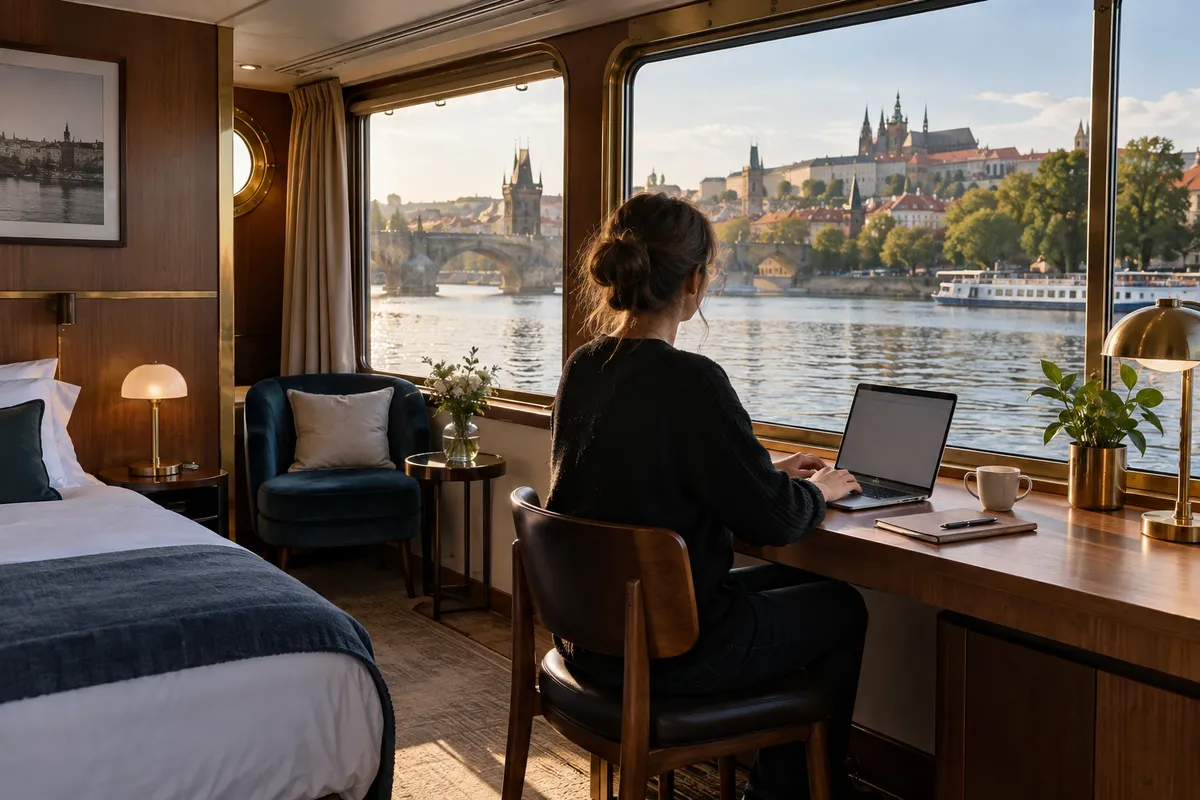
When you set up a laptop inside a floating hotel, the physical constraints of marine engineering immediately collide with daily office work. Over the past twelve years, I have stayed in more than seventy floating hotels, converted barges, and harbor botels across Europe, the Americas, and Southeast Asia, and glossy booking photos consistently gloss over noisy diesel generators, tiny berth dimensions, weak Wi-Fi, and the realities of gangways and harbor swell. Setting up an impromptu office afloat requires looking past the romantic river views to inspect structural bulkheads, network latency, and physical table surfaces.
Choosing reliable floating hotels for remote work means filtering out properties where vessel architecture destroys connectivity or where desks are merely decorative narrow shelves. In this guide, I examine twelve permanently moored botels, superyachts, and eco-rafts from our registry, detailing their real-world hull signal performance, desk dimensions, and acoustic isolation so you can safeguard your remote working schedule before walking across the gangway.
Remote Work from Floating Hotels: Evaluation Criteria and Waterfront Realities
How I Evaluated Floating Accommodations for Remote Productivity
Working from a floating hotel introduces mechanical and structural variables you never encounter in a typical concrete hotel. My field assessment relies on five specific technical benchmarks that determine whether a cabin can function as a productive remote office:
- Network Performance and Latency Architecture: Video conferencing demands more than high headline download speeds. As detailed in the official Zoom system requirements, 1080p HD group calls require a minimum of 3.8 Mbps upload and 3.0 Mbps download. Furthermore, per network performance guidelines from Cisco Meraki QoS standards, packet jitter must remain strictly below 30 ms to avoid audio robotic distortion and frame drops.
- Workstation Ergonomics: Under standard workstation benchmarks from the OSHA computer workstations guidelines, an ergonomic desk requires a minimum usable depth of 50 cm (20 inches) to maintain proper eye-to-screen distance and provide forearm support, paired with an independent chair rather than an immovable bed ledge.
- Mooring Acoustics and Operating Schedules: Marine stays present specific acoustic signatures, ranging from daytime river tour traffic to evening public venue operations and low-frequency shore-power transformer hum.
- Electrical Topology: Access to grounded 220V–240V mains outlets within arm's reach of the workspace, avoiding suspended cables that cross wet marine gangways or narrow cabin walkways.
- Vessel Dynamics and Visual Steadiness: Stability against passing river wakes, dock displacement, and pedestrian gangway resonance that can shake webcams during client calls.
Vessel Architecture vs. Network Signals: Steel Hulls and Water Reflections
The primary technical hurdle aboard botels for digital nomads is naval architecture. Riveted steel hulls and watertight transverse bulkheads function as physical radio-frequency shields. Research on shipboard wireless propagation published through IEEE demonstrates that internal steel bulkheads produce heavy signal attenuation, often dropping external cellular signals significantly before they reach lower berths. When an access point is positioned out in a central hallway, closing a heavy metal cabin door can drop Wi-Fi reception below usable video thresholds.
Waterline cabins also face the physics of multipath radio-frequency interference. Water surfaces reflect radio waves, and 2.4 GHz bands suffer noticeable multipath fading as signals bounce across the river before entering cabin ports. While higher 5 GHz channels deliver cleaner data streams over short distances, they struggle to penetrate iron and steel structures. If you rely on a cellular data connection, positioning a mobile hotspot router directly onto an exterior window ledge can bypass the hull's shielding and secure a stable signal.
If your cabin Wi-Fi struggles behind closed bulkheads, avoid working from the bed. Set your portable hotspot or smartphone right on the porthole sill to catch unshielded shore-tower line-of-sight signals, bypassing the steel hull's natural Faraday cage effect.
Tested Floating Hotels and Botels for Digital Nomads: Comparison and In-Depth Reviews
Side-by-Side Comparison: Hull Wi-Fi, Work Desks, and Pricing
The following registry includes twelve inspected floating properties. All rates represent base lead-in pricing; local municipal tourist taxes and mandatory dock surcharges are highlighted where applicable to prevent unexpected checkout bills.
| Vessel Name | Location | Vessel Type | Starting Price | Main Productivity Advantage | Main Productivity Bottleneck |
|---|---|---|---|---|---|
| Botel Amsterdam | Amsterdam, Netherlands | Passenger Botel | From 95 EUR | NDSM creative district access; free ferry connection | Fold-away wall desks; narrow room profiles (Amstel Botel) |
| Botel Matylda | Prague, Czech Republic | Historic Barge & Botel | From 85 EUR (variable) + 50 CZK tax | Dedicated desks in Klotylda Junior Suites (Botel Matylda) | Historic Matylda barge standard cabins lack work desks |
| Sunborn London Yacht Hotel | London, United Kingdom | Superyacht Hotel | From 180 GBP | Executive desks; 350m to Elizabeth line & DLR (Sunborn London) | London City Airport flight path noise and dock wake |
| OFF Paris Seine | Paris, France | Catamaran Botel | From 150 EUR + 8.45 EUR tax | In-room Wi-Fi; central Seine mooring (OFF Paris Seine) | Cocktail bar noise 18:00–23:00; passing riverboat wakes |
| Fingal | Edinburgh, United Kingdom | Converted Tender Ship | From 264 GBP | Bespoke writing desks; sheltered Alexandra Dock (Fingal) | High luxury pricing; distance from central Edinburgh |
| Arctic Bath | Harads, Sweden | Floating Water Cabins | From 5,995 SEK | Absolute silence; 24 m² private Water Cabin (Arctic Bath) | River freezes mid-Nov to mid-Apr; premium price tier |
| Botel Albatros | Prague, Czech Republic | Converted Botel | From 56 EUR + 50 CZK tax | Reopened 3 Sep 2026; Art Deco refit across 90 cabins (Botel Albatros) | Entry standard cabins are compact for multi-monitor setups |
| Hotel CPH Living | Copenhagen, Denmark | Converted Freight Barge | From 1,400 DKK | Built-in floor-to-ceiling harbor view desks (CPH Living) | 12-room wooden floorplan amplifies corridor foot traffic |
| Sunborn Gibraltar | Ocean Village, Gibraltar | 5-Star Superyacht Hotel | From 180 GBP | In-room writing desks; marina Wi-Fi (Sunborn Gibraltar) | Lower-deck marina promenade evening pedestrian noise |
| Queen Elizabeth 2 | Dubai, UAE | Historic Ocean Liner | From 350 AED + 22% fees + 15 AED tax | Full writing desks; massive hull stability across 13 decks (QE2) | Internal cabins lack natural light; steep mandatory taxes |
| The FloatHouse River Kwai Resort | Sai Yok, Thailand | Floating Teak Villas | From 4,800 THB | 90 m² villas; continuous mains grid power & Wi-Fi (The FloatHouse) | River current oscillations; isolated jungle road transfers |
| River Kwai Jungle Rafts | Sai Yok, Thailand | Eco Bamboo Rafts | From 3,200 THB | Absolute off-grid immersion for writing retreats (Jungle Rafts) | Zero in-room electricity, zero Wi-Fi, cold river showers |
Interactive Filter Widget Logic: When choosing among these twelve vessels, filter by work profile: select "Synchronous Ready" for guaranteed desks and video-capable Wi-Fi, "Asynchronous & Deep Work" for expansive floor plans, or "Digital Detox" for zero-connectivity retreats.
Urban Botels: Amsterdam, Prague, Paris, and Copenhagen
Urban botels place you directly in major city centers, but their working environments vary drastically depending on hull age and cabin category. At Botel Amsterdam, berthed at the NDSM Wharf, you gain direct access to creative shipyards and the free municipal ferry to Centraal Station. However, the guest cabins start at 95 EUR per night and feature compact fold-away wall desks rather than full ergonomic workstations. It suits solo laptop sessions, but anyone managing external monitors will struggle for surface space.
Prague offers a stark contrast between two floating options on the Vltava River. At Botel Matylda, remote workers must exercise extreme care during booking: the hotel consists of two moored vessels. The historic cargo barge Matylda has standard cabins without work desks. To secure a functioning workspace, you must book the newer vessel Klotylda, specifically reserving an Executive Double or Junior Suite with a dedicated writing table. Stays also incur Prague's mandatory municipal tourist tax of 50 CZK per person per night for up to 60 consecutive nights under Prague City Decree No. 19/2021 Sb. Meanwhile, the nearby Botel Albatros reopened on 3 September 2026 following an extensive capital reconstruction. With lead-in rates from 56 EUR, its 90 cabins (84 standard, 3 deluxe, 3 family) now offer clean 1930s Art Deco styling, though standard rooms remain compact for long multi-day sprints.
Moored at 86 Quai d'Austerlitz, OFF Paris Seine features 58 rooms and suites from 150 EUR per night with reliable in-room Wi-Fi. However, guests must budget for the mandatory Paris city tourist tax of 8.45 EUR per adult per night, and account for the popular onboard cocktail bar and plunge pool deck, where ambient noise levels peak daily between 18:00 and 23:00. In Denmark, Hotel CPH Living provides a different atmosphere along Christianshavn. Converted from a German cargo barge, this 12-room ship features floor-to-ceiling windows with built-in waterfront desks from 1,400 DKK per night. The primary compromise is structural: the wooden interior flooring transmits hallway footfalls directly into your cabin during calls.
Historic Ocean Liners, Luxury Superyachts, and Wilderness Floats
For remote professionals who require larger room footprints and certified business infrastructure, purpose-built superyacht hotels and historic ocean liners present a sturdier alternative. Sunborn London Yacht Hotel at Royal Victoria Dock offers 136 guest rooms from 180 GBP per night. Berthed 350 meters from Custom House station, it delivers full-sized desks and excellent Wi-Fi, though you must account for daytime aircraft approach noise from nearby London City Airport. Its sister vessel, Sunborn Gibraltar in Ocean Village Marina, provides 5-star superyacht cabins from 180 GBP with verified writing desks, insulated against Atlantic swells but exposed to promenade foot traffic on lower tiers.
At Alexandra Dock in Leith, Fingal represents an exceptionally quiet marine conversion. Once a Northern Lighthouse Board tender, its 23 luxury cabins start from 264 GBP per night and include artisan writing desks and stable dockside connectivity, well-isolated from harbor chop. In Dubai, the Queen Elizabeth 2 operates 447 rooms and suites across 13 decks at Mina Rashid from 350 AED per night. While the ship's enormous mass eliminates any feeling of motion, local tax regulations from the Dubai Department of Economy and Tourism require adding a 5% VAT, 7% municipality fee, 10% service charge, and a mandatory 15 AED Tourism Dirham fee per bedroom per night.
Wilderness properties demand an entirely different approach to digital productivity. In Thailand's Sai Yok national parks, The FloatHouse River Kwai Resort features 90 m² luxury floating villas from 4,800 THB per night with continuous mains electricity, air conditioning, and in-room Wi-Fi strong enough for daily correspondence. By contrast, its neighbor River Kwai Jungle Rafts (from 3,200 THB) is an explicit red-flag stay for synchronous corporate work: it operates completely off-grid with zero in-room electricity, zero Wi-Fi, cold river-fed showers, and evening kerosene lamps. Finally, Arctic Bath in Harads, Sweden, offers 6 floating Water Cabins (24 m²) starting from 5,995 SEK per night. These cabins float freely on the Lule River in summer and freeze solid into the ice from mid-November to mid-April, offering complete acoustic isolation for deep asynchronous work.
Waterfront Desk Ergonomics: Power, Stability, and Acoustic Management
Workstation Layouts: True Desks vs. Marine Built-Ins
Cabin layouts aboard converted vessels prioritize space-saving cabinetry over ergonomic postures. Many operators advertise a "desk" that is actually a narrow vanity counter measuring barely 30 cm deep. Setting a 15-inch laptop on these surfaces forces your wrists off the edge, causing rapid muscular fatigue. Under OSHA workstation standards, maintaining forearm support requires a depth of at least 50 cm. Before booking, examine cabin photography to ensure your knees have open clearance beneath the table rather than hitting a concealed life-jacket locker.
Electrical layout is another frequent obstacle aboard historic barges. Outlets are often restricted to a single pair located near the cabin entrance or behind the bed frame to avoid routing conduit through steel watertight bulkheads. I keep a braided 2-meter extension lead and a compact multi-plug adapter in my work bag so I can position my laptop near daylight without stretching cords across the entryway. Natural lighting should ideally enter from the side; facing an exposed river window directly creates blinding water glare that washes out screens during video meetings.
Motion Sickness, Vessel Wake, and Audio-Visual Discipline
Even permanently moored vessels respond to hydrodynamic forces. On active transit waterways like the Seine or the Vltava, commercial rivercraft and passenger catamarans generate displacement waves that induce noticeable roll. If you are presenting to clients, this motion can cause disorienting background tilting on camera. Activating software-based digital backgrounds or artificial background blur hides the rolling shoreline horizon from call participants, maintaining a professional visual baseline.
Acoustic management requires equal vigilance. Moored ships feature constant low-frequency mechanical noise from onboard cooling pumps, municipal shore-power converter units, and water slapping continuously against the hull plate. Standard built-in laptop microphones pick up these resonant frequencies effortlessly. Using a directional headset microphone paired with active software background noise suppression (such as Krisp or platform-level AI noise reduction) ensures your voice cuts through marine mechanical hum without disruption.
Critical Limitations, Risks, and Offline Alternatives
When Floating Stays Threaten Critical Deadlines
Floating accommodations are fundamentally unsuitable for specific technical workflows. If your role requires pushing massive uncompressed media files, continuous live video streaming, or maintaining zero-packet-loss SSH connections to remote servers, botel Wi-Fi backbones will expose you to critical failure. Network contention spikes sharply in the evenings between 19:00 and 22:00 when tourists return to their berths and stream video over shared local access points.
Meeting the Zoom 1080p standard (3.8 Mbps upload and 3.0 Mbps download per official specifications) is generally manageable on urban superyachts like Sunborn London, but becomes precarious on historic converted vessels where bandwidth is piped aboard via a single shared shoreline antenna. Furthermore, attempting synchronous corporate work at eco-resorts like River Kwai Jungle Rafts is practically impossible due to the total absence of power sockets and wireless connectivity.
Never schedule production software deployments or high-stakes client pitches from a floating hotel without a verified mobile tethering backup. Shoreline Wi-Fi feeds can disconnect during routine dock re-mooring, gangway maintenance, or heavy river drift.
Practical Redundancy: Preparing Your Floating Tech Stack
To insulate your work from marine infrastructure failures, prepare a dedicated floating tech kit before boarding:
- Cabin Placement Requests: Contact the botel front desk in advance to request a cabin on an upper deck (Promenade or Sun Deck) situated well above the waterline. Lower hull cabins suffer the heaviest cellular signal loss and receive the worst hallway Wi-Fi penetration.
- Local Physical SIM Cards: Relying on roaming eSIM profiles often introduces multi-hop latency and packet routing delays. Secure a local physical 5G/LTE SIM card upon arrival in the country to optimize cellular ping times.
- Window-Mounted Hotspot: Keep a standalone portable LTE/5G mobile router equipped with suction cups. Placing the router directly onto the exterior window glass bypasses steel plating and captures unshielded mobile signals from shore towers.
- Power Buffer: Carry a 25,000 mAh portable power bank supporting 65W USB-C Power Delivery. Vintage botel electrical grids can experience temporary voltage drops during shore-power changeovers, which can interrupt laptop charging mid-meeting.
Matching Floating Hotels to Remote Work Scenarios
Best for Executive Video Calls and Client-Facing Work
When professional reputation hinges on flawless audio clarity, steady framing, and certified broadband, your options should be restricted to purpose-built, heavily stabilized vessels moored in protected, tide-free docks. Sunborn London Yacht Hotel, Sunborn Gibraltar, and Edinburgh's Fingal represent the top tier. These vessels feature deep, dedicated writing desks, heavy acoustic dampening between guest cabins, and professional corporate-grade network installations that maintain packet jitter well below 30 ms.
Their sheltered basin moorings virtually eliminate wake roll from passing commercial barges, ensuring your webcam stays level during long executive conferences. For related insights on vessel motion physics, consult our analysis of motion sickness on moored floating hotels.
Best for Creative Sabbaticals, Asynchronous Sprints, and Digital Detox
If your schedule is primarily asynchronous—such as drafting code, writing manuscripts, or formulating quarterly roadmaps—visual immersion and daylight take precedence over symmetrical fiber speeds. Hotel CPH Living in Copenhagen delivers floor-to-ceiling harbor views directly over the work surface, while Prague's newly refitted Botel Albatros offers an economical European city base from 56 EUR per night.
For complete removal from urban distractions, The FloatHouse River Kwai Resort provides generous 90 m² floating teak villas backed by continuous grid electricity and sufficient Wi-Fi for steady asynchronous updates. Conversely, if you require a true digital detox to complete offline drafting without notifications, the kerosene-lit, non-electric environment of River Kwai Jungle Rafts enforces absolute disconnection. For a broader comparison of overwater architectural typologies, see our guide comparing overwater bungalows vs truly floating hotels.