Two of the nine are purpose-built pontoons on Thai reservoirs, two are traditional Indian hulls, and five are Swedish vessels or rafts on Lake Mälaren and Lake Yngern. That spread matters because a concrete pontoon, a sewn jackwood hull and a riveted steel ship behave differently underfoot, and they fail in different ways. Vembanad, the one brackish water on the list, is included because the kettuvallam route runs through the sheltered southern backwaters away from the sea mouth.
What Counts as a Lake Floating Hotel
Pontoons vs. Piles
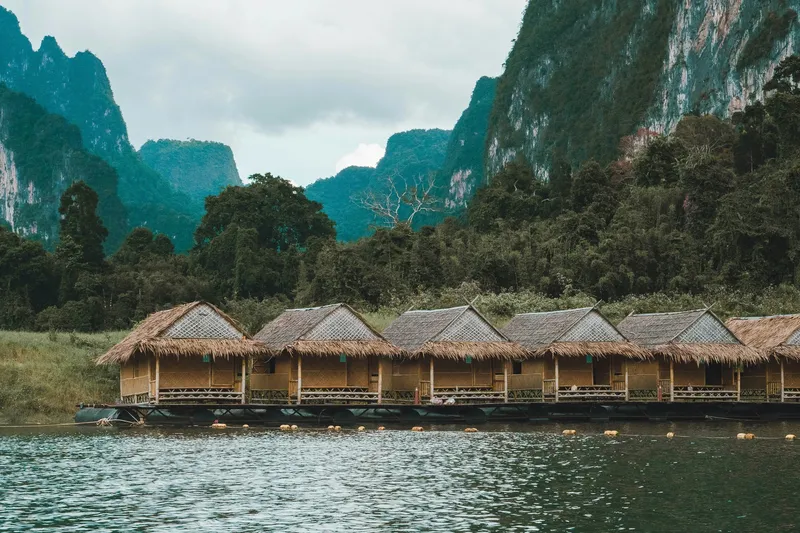
The structural difference between a floating lake resort and an overwater bungalow is buoyancy. Many properties sell stilted villas on driven lakebed piles as "floating suites"; a genuine floating room rises and falls on a buoyant foundation. The foundations here are concrete-encased polystyrene pontoons at 500 Rai and Z9, displacement steel hulls on the Stockholm ships, and timber or bamboo rafts at Flottellet and on the Kerala backwaters. Piles do not move with the water; pontoons do, which is why the gangway and the mooring lines tell you what you are booking.
Because inland lakes lack ocean waves, the moorings are simpler: shore-fastened steel cables, concrete deadweight anchors and articulated gangways with sliding joints. That kills the roll you get in a harbor, but it does not make the floor still. Passing longtails push a slow swell along the walkway, and the joints between floats click as the water moves. The Swedish ships are held against the quay by lines and rigid shore arms, so what you feel is a brief lift when a ferry passes.
When you look at photos of a lake hotel, find the waterline against the deck edge. A real pontoon sits low and shifts with the load; a stilted villa shows a fixed gap and a rigid walkway. Hinged ramps at the shore are the other giveaway.
Water Levels, Thermoclines and Insects
Reservoirs are not lakes in the way the photographs suggest. On Cheow Lan and Srinakarin, the water level follows dam releases and the monsoon, so the shoreline in April is not the shoreline in December. In the dry months the boarding ramps turn into steep inclines and the floats sit against exposed rock. Lake Mälaren is regulated and stays close to a fixed level, but winter ice changes how you reach a moored hull.
Swimming off your own deck is the main draw, and freshwater is less forgiving than the sea. Without salt, you float lower and tire faster, and a deep lake can hold a warm top layer over water that is cold two metres down. The bigger daily nuisance is insects. On still evenings, midges hatch along the shoreline and any lit cabin pulls them in; close the screens before you switch on the reading lamp, not after. At 500 Rai the longtails stop at dusk, so the water goes quiet just as the hatch starts.
How the Scores Work
I score each property 1–5 on five things that decide whether a stay works, then add the columns for a total out of 25. The scores are my own judgments, weighted toward the things that generate complaints, especially power and connectivity. A 5 means you do not have to think about it; a 1 means it will shape your day.
I score how much a passing boat moves the floor and how far sound travels through the deck; whether the air conditioning runs around the clock or on a schedule; how long the last leg takes and what a missed boat costs; whether mobile signal or Wi-Fi actually works; and whether deposits, park fees, transfers and taxes are published before you arrive.
| Property | Quiet mooring | Power & climate | Access | Connectivity | Fee clarity | Total |
|---|---|---|---|---|---|---|
| 500 Rai | 4 | 2 | 2 | 1 | 3 | 12 |
| Z9 | 4 | 5 | 4 | 4 | 4 | 21 |
| Spice Coast | 5 | 2 | 3 | 2 | 4 | 16 |
| Gurkha | 5 | 3 | 2 | 3 | 3 | 16 |
| Marina Rummet | 4 | 4 | 5 | 4 | 3 | 20 |
| Rygerfjord | 3 | 3 | 5 | 4 | 4 | 19 |
| The Red Boat | 3 | 3 | 5 | 4 | 4 | 19 |
| Mälardrottningen | 4 | 4 | 5 | 4 | 4 | 21 |
| Flottellet | 5 | 2 | 2 | 1 | 4 | 14 |
A total out of 25 can mislead. Z9 and Mälardrottningen tie at 21/25 for opposite reasons: Z9 because it is the only property here with continuous power and road access, Mälardrottningen because it is the only ship here with en-suite showers in every cabin. 500 Rai sits at 12/25 and still has the best water access on the list. If the one column you need is a 1, the total does not save the booking.
Deposits, Cards and Waste
The gap between an OTA listing and the resort's own terms is widest at the cash desk. On remote pontoons the card terminal depends on a satellite link, and the deposit is collected in cash at check-in: 500 Rai's package terms specify ≈ $74 (฿2,500) per room, refundable. The same terms exclude the national park fee, which is paid at the pier, so the room rate is not the number you need in your pocket. Read the package exclusions before comparing a direct rate with an agency rate.
Waste is the other constraint. A closed lake cannot dilute greywater, so the better operators use sealed holding tanks pumped out by service boat or bio-digesters. The visible rule is the food ban: at 500 Rai, outside food and drink are not permitted without prior arrangement, partly to keep plastic and crumbs out of the water and partly because everything that comes in has to be carried out. There is no shop and no ATM on the lake, so the ban is easier to follow if you shop before the pier.
Nine Properties at a Glance
Prices and What You Get
Rates are the lowest published entry rates, converted to dollars at about $0.99 (฿33.5), ≈ $1 (₹94.8) and ≈ $0.98 (kr 9.9). They are not fixed: peak season, weekends and holidays move them, and the basis column matters as much as the number – 500 Rai sells a two-night package, Spice Coast charters the whole boat, and the Swedish anchors are low-season singles or bunks.
| Property | Location | Water body | Type | From (USD) | Rate basis | Key strength | Main trade-off |
|---|---|---|---|---|---|---|---|
| 500 Rai Floating Resort | Ban Ta Khun, Thailand | Cheow Lan Lake (reservoir) | Floating pontoon resort | $418 | 2-night all-inclusive package | Direct kayak launch into limestone karst bays | Boat-access only; daytime A/C gap in base rooms; paid satellite Wi-Fi |
| Z9 Resort | Kanchanaburi, Thailand | Srinakarin Reservoir | Anchored water villas | $134 | Room + breakfast | Road access and modern curved villas | 80 km from Kanchanaburi; steep stairs and open boardwalks |
| Spice Coast Cruises | Alleppey, India | Vembanad backwaters | Cruising kettuvallam | $169 | Whole boat, full board (low season) | Nail-free jackwood hull and private chef | A/C only overnight; boat leaves on a fixed schedule; remote jetty |
| WelcomHeritage Gurkha Houseboats | Srinagar, India | Nigeen Lake | Stationary cedar houseboats | $100 | Room only, low season, incl. 18% GST | Carved cedar rooms on quiet Nigeen Lake | Shikara-only access; thin partitions; winter heating variable |
| Marina Rummet | Mariefred, Sweden | Lake Mälaren | Floating houseboat suite | $140 | Room only, 1–2 guests | Private roof deck facing Gripsholm Castle | No shower or flush toilet on board; 25 m walk to service building |
| Rygerfjord Hotel & Hostel | Stockholm, Sweden | Lake Mälaren (Söder Mälarstrand) | Converted ship botel | $66 | Cabin only, shared bathroom | Three ships, 90 cabins, walk to Gamla Stan | Compact cabins; thin walls; steep gangways |
| The Red Boat (Den Röda Båten) | Stockholm, Sweden | Lake Mälaren (Södermalm) | Converted steamer hostel | $60 | Cabin only, shared bathroom | Cheapest central berth, 10 minutes to Slussen | 5–7 m² cabins; shared bathrooms; hull noise |
| Mälardrottningen Yacht Hotel | Stockholm, Sweden | Lake Mälaren (Riddarholmen) | 1924 yacht hotel | $63 | Cabin + breakfast | 1924 yacht at Riddarholmen, 65 cabins | 6–8 m² standard cabins; no lift; steep stairs |
| Flottellet at Myssjö Gård | Nykvarn, Sweden | Lake Yngern | Off-grid floating suite | $424 | Whole raft, breakfast and sauna included | Total silence, solar power and a lake sauna | Seasonal; no shower; dry toilet; uninsulated; 100 m raft transfer |
The Swedish "from" figures are low-season singles or bunks; a summer double with a private bathroom can be three or four times the anchor. The Thai and Indian figures are per room or per boat, not per person, and the Indian rates exclude or include GST depending on the channel. Treat the table as a way to eliminate the wrong price bracket, then confirm the actual rate in the booking calendar.
Hulls, Pontoons and Draft
The construction explains the motion. 500 Rai and Z9 sit on concrete-encased polystyrene pontoons, which are heavy enough to damp the roll from a passing longtail but still move as a unit. The Stockholm botels are steel displacement hulls held against a quay; they are rock-steady in Riddarfjärden until a ferry wake lifts them a few centimetres. A timber kettuvallam is the liveliest of the three, because a sewn jackwood hull is designed to flex.
Draft matters more than length. A kettuvallam draws under a metre, which is why it can leave the main lake and follow the narrow canals where the paddy fields begin; a steel ship needs depth and stays on the quay. Flottellet is the opposite case: a light timber raft on a forest lake, pushed out by an electric motor and moored in a sheltered bay. It can sit over shallow water without dredging, but it also has no ballast, so it moves more than a pontoon when someone walks across the deck.
The Properties in Detail
Thailand: Cheow Lan and Srinakarin Reservoirs
500 Rai sits inside Khao Sok National Park on Cheow Lan Lake, and the last 90 minutes are by longtail from Chiew Larn Pier. The boats run to a schedule – 11:30 and 15:00 in, 10:00 and 13:30 out – and the shared transfer is ≈ $44 (฿1,500) per person round trip, with parking at the pier at ≈ $2.4 (฿80) a car per night. The 11:30 is the one I take now. On an earlier trip I treated the 15:00 like a city bus, stopped for coffee on the drive from Surat Thani, and reached the office at 15:10; the boat was already a speck against the karst. I spent the afternoon on the pier and paid for a private crossing, which is the most expensive coffee I have bought in Thailand.
The Deluxe Room is 36 square metres and sleeps two adults and two children, with a king bed and two mattresses on a mezzanine. Cooling is the catch: the base room's air conditioning runs from noon to 06:00, while the Villa and the suites run it around the clock. There is no mobile signal at the resort. The paid backup is satellite Wi-Fi at ≈ $10 (฿350) an hour or ≈ $44 (฿1,500) for 24 hours, and some direct packages include a nightly allowance. The all-inclusive package includes unlimited Wi-Fi but excludes the park fee and requires a refundable room deposit. Outside food and drink are not permitted without prior arrangement.
Z9 is the easier Thai option: 80 kilometres northwest of Kanchanaburi on Route 3199, with a car park above the bay and a steep staircase down to the floats. The curved villas sit on hinged pontoon sections, each with a swim ladder and a kayak launched from the deck; kayaks and paddleboards are free through daylight hours. Power is continuous, so the air conditioning stays on, and Wi-Fi is free in the villas. Check-in closes at 18:00, and the last 22 kilometres of road have no lighting – I would not drive it for the first time after dark.
India: Vembanad and Nigeen Lakes
Spice Coast Cruises runs six kettuvallams for CGH Earth: three single-cabin boats and three twin-cabin boats, each with an open lounge, a private bedroom and an en-suite bathroom. The hulls are jackwood planks sewn with coir and sealed with cashew-nut resin, with no metal nails, as the CGH Earth factsheet describes. Vembanad is brackish where it meets the sea, but the route stays in the sheltered southern backwaters away from the sea mouth.
A single-cabin boat starts around $170 (₹16,000) a night in the monsoon and climbs to ≈ $410 (₹38,000) in the peak winter season, full board and crew included; the twin-cabin boats run higher. Bedroom air conditioning runs from 19:00 to 07:00, and the generator is in a sound box, so the evening is quiet. Boarding is at the private Puthenangadi jetty in Muhamma, 75 kilometres from Kochi airport, and the cutoff is 14:30 – miss it and the boat leaves without you. Two nights is the useful minimum.
Gurkha is the stationary counterpart: 18 rooms – 15 Deluxe and three suites – in deodar cedar hulls moored on the western side of Nigeen Lake, opposite the Nigeen Club. The rooms are 19.5 square metres for a Deluxe and about 23 for a suite, with khatamband ceilings, walnut carving and a shared veranda over the water. Nigeen is quieter than Dal, but every exit is by shikara, including the five-minute crossing from the Nigeen Club steps. The cedar partitions are thin, and the property does not guarantee central air conditioning; ask whether your room has a split unit or only fans, and in winter whether the generator runs through the night.
Sweden: Stockholm and Lake Mälaren
Lake Mälaren covers 1,140 square kilometres, as Visit Sweden's lake guide notes, and reaches into central Stockholm. The Slussen lock and sluice system separates it from the Baltic, so the water at Söder Mälarstrand and Riddarholmen is fresh and non-tidal; the level is controlled by the Slussen dam. That is why the Stockholm botels can use steel hulls and fixed gangways without the tidal compensators a harbor ship needs.
Along Söder Mälarstrand, Rygerfjord fills three connected ships with 90 cabins, from ≈ $64 (kr 650), and The Red Boat occupies a 1914 steamer and a 1946 survey ship from ≈ $59 (kr 590). The entry cabins on both are hostel-simple: bunk cabins, shared bathrooms in the corridor, steep companionways and thin steel walls. At Riddarholmen, the 1924 yacht Mälardrottningen has 65 cabins with en-suite showers, from ≈ $62 (kr 625), but the standard double is 6–8 square metres and the bed is usually two 90 cm bunks, not a double.
Marina Rummet is a single floating room in the inner harbour at Mariefred, ≈ $140 (kr 1,385) for one or two guests and ≈ $190 (kr 1,885) for four. The 17 square metre cabin has four beds, a breakfast nook, a small fridge and a kettle; the 34 square metre roof deck looks across the water at Gripsholm Castle. There is no shower or flush toilet on board. The service building is 25 metres along the pier, not 50 as some listings say, and the walk is open to the weather. The first morning I carried a full kettle down the dock and back twice, because the cabin kettle holds barely two cups; after that I kept a two-litre bottle by the door.
Flottellet is the off-grid end of the list: a timber cabin on a solar-powered raft on Lake Yngern, reached by an electric raft across about 100 metres of water. The farm charges ≈ $420 (kr 4,200) for one or two guests, including breakfast, the rowboat and the wood-fired sauna. There is no shower on the raft – you wash in the lake or at the sauna – and the toilet is a dry separation unit in a glazed cubicle. The cabin is uninsulated, which the farm says plainly, so the gas heater matters. One cold night I ran it for an hour, slept in wool under two quilts, and woke to a room at outdoor temperature; it was the best sleep of the trip and the reason I now pack a thermal layer for any "summer" raft.
Transfers, Cash and Power
Boats, Luggage and Timing
Water-access lodges run on boat time, not hotel time. At Chiew Larn Pier, the second scheduled crossing is the last one, and missing it leaves you with a private boat at several thousand baht, if the light and the park rules allow it at all. The practical rule is to land at Surat Thani airport with at least two hours of slack, and to treat the boat as a flight: check in at the office, leave the big case, and be on the pontoon early.
The boat is also where luggage fails. A longtail has a low gunwale and an open deck; a shikara is narrower still. A hard-shell case has to be lifted over both, then sits in water on the floorboards. A 40-litre dry bag is the better unit for a lake trip: it goes on your lap, keeps spray out, and fits under a bunk. If you are bringing a case, leave it at the pier office where there is one and carry a soft bag for the crossing. The rest of the kit – shoes with grip, a headlamp, a power bank – matters more than a packing system.
Generator Hours, Deposits and Park Rules
Off-grid power is a schedule, not a utility. Charge phones and cameras while the generator is running, and carry a power bank for the hours when it is not; a cabin with the compressor off heats up quickly once the sun is on the water. At 500 Rai the base rooms and the Family Villa have the daytime gap, while the Villa and the suites do not, so the room category is also a climate decision. The same logic applies in reverse in Sweden: the old ships heat well in winter, but only one cabin on Rygerfjord has air conditioning for a heatwave.
Cash is still the working currency at the pier. Park entry, the municipal pier fee, parking and the room deposit are collected in cash or depend on a card terminal that may be offline; at 500 Rai the foreign-adult lake ticket is ≈ $8.9 (฿300) plus a ≈ $1.2 (฿40) pier fee. In Sweden, the Right of Public Access lets you swim, paddle and moor temporarily along most shoreline, but not within the grounds of a house or inside a bird sanctuary; the Swedish right of public access overview is the page to read before you tie up.
Which Property Suits You
By Travel Style
The scorecard is a filter. Start with the column you cannot compromise on, then choose within the properties that clear it.
- Setting over convenience: 500 Rai scores 12/25, the lowest here, because almost every column except quiet mooring costs you something. The water and the karst are the reason to accept it; go for two or three nights.
- A lake stay without the off-grid compromises: Z9 scores 21/25 on road access, continuous power and free kayaks. Its weak point is the last stretch – a steep staircase and open boardwalks over deep water.
- Heritage and slow water: Spice Coast and Gurkha both score 16/25. Spice Coast is the moving boat, Gurkha the stationary house; both reward two nights and punish one.
- A city base: Mälardrottningen (21/25) has the edge on cabin comfort, Rygerfjord and The Red Boat (19/25) on price; The Red Boat is the noisier of the two.
- Silence: Flottellet (14/25) is the quietest place here and the least convenient; Marina Rummet (20/25) trades plumbing for the best deck on the list.
When to Stay Ashore
Three conditions should send you to a shore hotel. If you need a lift or a step-free route, the Stockholm ships and the Thai pontoons are out; the gangways, sills and open boardwalks are not negotiable. If you rely on medical equipment that cannot lose power, an off-grid lodge with a generator window is the wrong base. And if you need video-call bandwidth, only Z9 and the Stockholm ships have Wi-Fi that will carry it; 500 Rai sells satellite access by the hour, and Flottellet has none.
What to Skip
A few specific things are not worth the money or the risk.
- The Private Pool Villa Suite at Z9 for a single night. It is the most expensive room on the property, and by the time you have checked in before 18:00, swum once and slept, the plunge pool is the thing you paid for and never used. Book it for two nights or take the Escape North.
- Saffron and "pashmina" from the shikara vendors at Gurkha. A seller quoted ≈ $11 (₹1,000) a gram for saffron that retails at ≈ $4.1 – $5.9 (₹380 – ₹550) a gram in Pampore and Srinagar; the government emporium has fixed, marked prices. Buy lotus stems and almonds from the veranda; buy saffron and shawls in town.
- The guided raft trip at Flottellet if you already have the rowboat. It costs ≈ $40 (kr 400) per person for 1.5 hours; the rowboat already gives you the bay, so take the guided trip only if you want the guide's eyes.