

When staying at wilderness floating lodges, marketing photos rarely show the practical hurdles: generator hum at midnight, unpredictable river currents, and transfer boats with strict daylight cutoffs. Over twelve years auditing moored vessels and off-grid pontoons across three continents, I have learned that isolation on water requires specific engineering tolerances. A remote water cabin depends entirely on autonomous energy systems, closed-loop waste treatment, and mooring tackle capable of withstanding dramatic hydrological swings.
Sleeping directly over deep water in pristine biomes offers true separation from urban noise, but it also strips away conventional municipal conveniences. This comparative guide evaluates eight tested off grid floating resorts and wilderness cabins, detailing their physical microgrids, transfer logistics, power schedules, and operational trade-offs so you can plan your expedition with zero surprises.
Selection Methodology: How We Evaluated Wilderness Floating Lodges and Remote Water Cabins
Hydro-Engineering, Microgrid Autonomy, and True Ecosystem Isolation
To differentiate authentic floating ecolodges from ordinary canal boats or novelty hotel pontoons moored near city roads, I evaluated each property against strict environmental and engineering criteria. The first condition is geographic and biological isolation: each lodge must be anchored in a natural ecosystem outside the reach of municipal sewer, water, and electrical infrastructure.
The second condition is autonomous microgrid performance. I audited how each lodge generates electricity, stores power in battery banks, and handles freshwater filtration without degrading the host basin. Untreated graywater or blackwater discharge into pristine rivers, lakes, or coral lagoons immediately disqualifies a facility from responsible off-grid ratings.
Third, structural mooring dynamics must address local hydrological forces. Whether handling the 10-meter seasonal water rises of an Amazonian floodplain, sub-zero river freezes in Swedish Lapland, or coastal tidal flushes in British Columbia, the floating infrastructure must demonstrate secure anchoring without destroying aquatic substrate or breaking access walkways.
Data Breakdown: Nightly Rates, Multi-Day Expedition Packages, and Minimum Stays
Pricing structures for wilderness water stays fall into two distinct operational models: standard nightly hotel rates and comprehensive multi-day expedition packages. Properties with relatively straightforward boat access–such as River Kwai Jungle Rafts starting from 2,200 THB per night or Arctic Bath from 5,995 SEK per night–allow flexible single- or multi-night reservations.
Conversely, deep wilderness lodges function as self-contained expeditions where booking standalone nights is practically impossible due to remote logistics. For instance, Uakari Floating Lodge sells stays as 3- to 7-night ecotourism packages, with 4-night packages starting from $1,100 USD per person. Stays at Nimmo Bay Wilderness Resort in 2026 begin at 8,399 CAD per person for an all-inclusive 3-night package, covering private charter floatplane transfers and guided excursions.
Specialty ocean suites introduce strict minimum-stay rules to protect logistics. The submerged bedroom at The Manta Resort costs from $1,840 USD per night but requires a mandatory 3-night minimum stay throughout the year, extending to a 5-night minimum during the peak season from December 20 to January 10.
When calculating expedition budgets for off-grid water cabins, always verify if quoted rates include marine park conservation tariffs, scheduled long-tail boat transfers, or required bush plane connections, which can add significant surcharges if booked independently.
Off-Grid Engineering: How Floating Ecolodges Power, Water, and Anchor in the Wild
Renewable Microgrids: Pelton Hydro Turbines and Solar Photovoltaic Arrays
Supplying consistent electric power to remote floating pontoons without continuous, noisy diesel exhaust requires site-specific renewable microgrids. At Nimmo Bay Wilderness Resort, the engineering team harnesses MacKenzie Sound's natural topography by operating an on-site Pelton wheel hydroelectric turbine. Fed by an 800-foot pipeline drawing from a cascading waterfall, this run-of-the-river power installation generates up to 80% to 85% of the resort's annual energy needs cleanly and silently.
In equatorial latitudes where consistent sunlight is abundant, solar photovoltaic arrays dominate. The Manta Resort anchors a self-sufficient floating platform with a dedicated solar panel and battery bank on its roof deck, powering bilge pumps, underwater marine observation lights, and freshwater pressurization silently above the reef.
At Uakari Floating Lodge in Brazil, rooftop photovoltaic panels supply solar power and heat domestic water across the guest bungalows. Heavy power loads like laundry and deep freezers are managed during high-sun hours, while inverters and deep-cycle battery banks maintain critical evening circuits without disrupting the quiet of the rainforest.
Water Management and Waste: Closed-Loop Filtration and Biological Systems
Waste management presents the most demanding engineering challenge for floating accommodations. Releasing untreated effluent into enclosed lagoons or pristine river ecosystems destroys local biomes and violates conservation charters. True nature floating hotels use multi-stage biological containment systems installed directly within their pontoon hulls or transferred through sealed, flexible flexible conduits to shore-based treatment facilities.
Uakari Floating Lodge manages human waste inside the Mamirauá Reserve using a dedicated biological sewage treatment system. Specially cultivated microorganisms break down organic effluent in sealed floating chambers, ensuring zero raw sewage enters the nutrient-sensitive flooded forest waters.
Freshwater sourcing requires equal diligence. Tropical facilities like Uakari employ extensive rainwater harvesting systems fitted with multi-layer sediment traps and micro-filtration screens. Conversely, River Kwai Jungle Rafts keeps infrastructure minimalist by supplying unheated, river-fed wash water directly to en-suite shower stalls, eliminating power-hungry boilers entirely.
Never flush personal hygiene items, paper tissues, or harsh antibacterial soaps down floating lodge drains. Biological micro-digesters depend on active living bacteria cultures to break down waste, and synthetic chemicals can kill the bio-bed within hours.
Forest Rivers and Mangrove Floodplains: Tropical Wilderness Floating Lodges
River Kwai Jungle Rafts and The FloatHouse: Zero-Power Immersion vs. Modern Villas
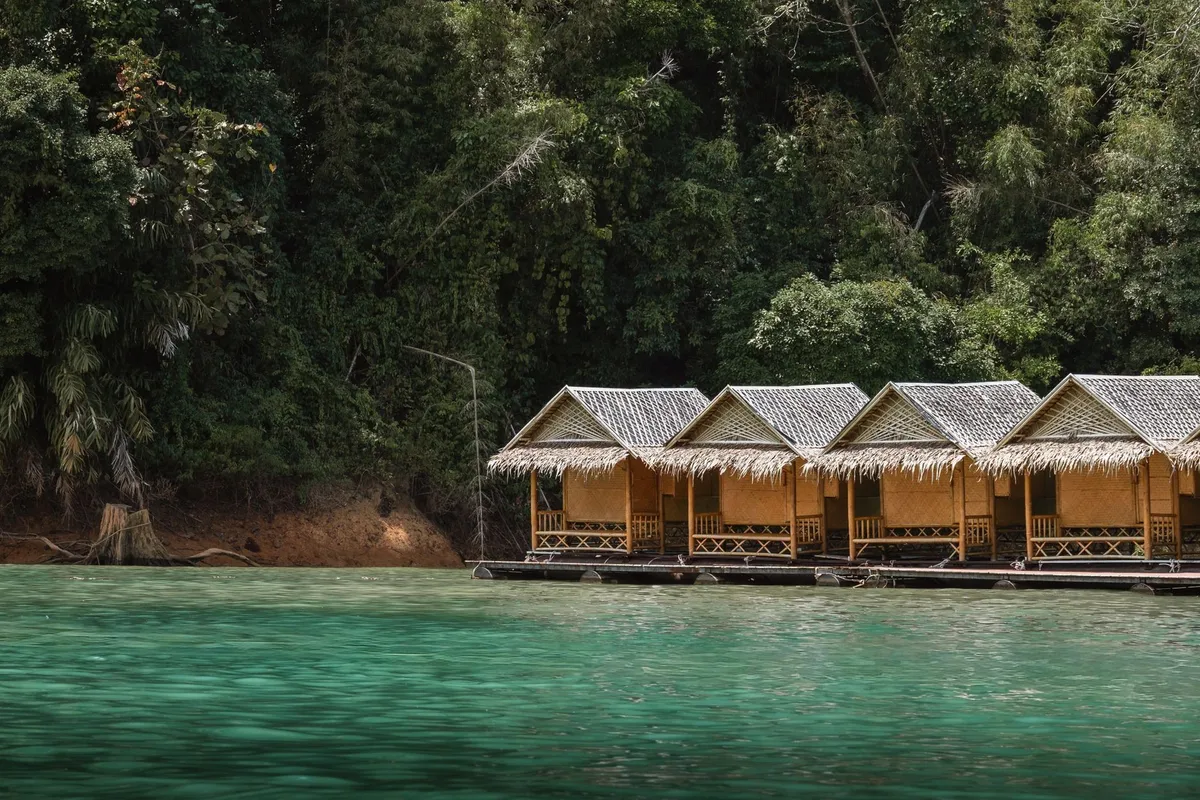
Along the winding Noi River in Thailand's Sai Yok district, two neighboring properties showcase radically different approaches to floating hospitality. River Kwai Jungle Rafts delivers a pure digital detox lodge experience. Built from native bamboo and anchored along the riverbank, the cabins feature zero in-room electricity, no air conditioning, and river-water cold showers.
At dusk, resort staff ignite kerosene hurricane lamps along the boardwalks and inside each bedroom, creating a flicker of warm light against the pitch-black jungle canopy. Device charging is not permitted in rooms; guests must bring electronics to the open-air reception desk during designated generator windows. Swimming directly behind the rafts requires life jackets due to the strong river current undertow safety risks.
Just downriver, The FloatHouse River Kwai Resort provides a stark comfort contrast. Its 89 m² custom teak villas feature private sundecks, indoor air conditioning, and satellite entertainment supported by hybrid generators and solar panels. Reaching both resorts requires boarding a wooden long-tail boat transfer from Phutakien Pier (15 minutes) or Pakseng Pier (40 minutes). The FloatHouse runs complimentary shared boats at 2:00 PM, 3:00 PM, and 4:00 PM, but missing these requires hiring a private boat for 1,000 THB before the strict 6:00 PM river navigation curfew.
Uakari Floating Lodge: Assacu-Log Engineering and Community Conservation in Mamirauá
Deep within the flooded Amazon basin near Tefé, Uakari Floating Lodge operates 10 guest rooms distributed across 5 floating wooden bungalows. What makes Uakari exceptional is its foundation: rather than plastic drums or concrete boxes, the entire structure is supported by buoyant assacu tree logs (Hura crepitans) chained together with heavy steel cables and secured to shore anchors.
This organic flotation system effortlessly accommodates the extreme 10- to 12-meter hydrological flood shift of the Mamirauá Sustainable Development Reserve. During the flooded season from April/May to July, the forest floor vanishes entirely under deep blackwater, meaning all wildlife tracking occurs silently from wooden canoes. In the low-water season from August to November, receding waters expose muddy banks and walking trails for foot excursions.
Operated in direct partnership with local riverine ribeirinho communities, the lodge combines community conservation with practical ecology. Rates start from $1,100 USD per person for a 4-night ecotourism package, which covers boat transit from Tefé airport, daily guided boat excursions, and full board prepared with regional Amazonian ingredients.
Spice Coast Cruises: Slow Travel Aboard Traditional Kettuvallam Rice Barges
In the backwaters of Alleppey, Kerala, Spice Coast Cruises delivers mobile water lodging aboard converted kettuvallam rice barges. Managed by eco-hospitality pioneer CGH Earth, these historic vessels are constructed without a single metal nail, using hand-shaped anjili timber planks sewn together with natural coir rope and sealed with boiled sardine oil and black resin.
Operating across Lake Vembanad and adjacent canal waterways, each kettuvallam is chartered exclusively with a three-person crew: a captain, an engine helmsman, and a private chef who prepares traditional Keralan meals over slow-burning stoves. Starting rates run from approximately 22,000 to 32,000 INR per night for private one-bedroom or two-bedroom configurations.
The vessel cruises under low-emission diesel power through agricultural backwaters during daylight before tying up along peaceful lake shores for the night. To preserve the auditory peace of the backwaters, cabin air conditioning is strictly limited to overnight docking hours between 7:00 PM and 7:00 AM, powered by an onboard auxiliary generator mounted in the stern.
Karst Lakes, Fjords, and Ocean Sanctuaries: Extreme Seclusion Floating Resorts
500 Rai Floating Resort: Solar Living Among the Cheow Lan Lake Limestone Karsts
Stationed inside Khao Sok National Park, 500 Rai Floating Resort sits surrounded by dramatic limestone karsts rising hundreds of meters out of Cheow Lan Lake. The setting offers tranquil freshwater immersion, but getting there requires strict schedule coordination. Travelers must take a 90-minute long-tail boat transfer from Ratchaprapha Dam Pier (Chiew Larn Lake Pier); the scheduled resort boat departs at 11:30 AM at 1,500 THB round-trip per person.
Before stepping onto the dock, every foreign visitor must pay a cash entrance fee of 300 THB per adult (150 THB per child) to the Department of National Parks checkpoint. Package rates begin from approximately 14,000 THB. Each floating villa features an attached kayak tied to the private deck, enabling instant exploration across silent, emerald-hued inlets where gibbons and hornbills gather at dawn.
Electrical power relies on floating solar collectors and battery banks backed up by quiet nighttime generators. In entry-level Deluxe Rooms and Family Villas, air conditioning is restricted to nighttime hours between 6:00 PM and 6:00 AM to preserve battery banks. Guests seeking 24-hour climate control must book the upgraded Villa or Family Suite categories, which run on reinforced electrical loops.
Nimmo Bay Wilderness Resort: Great Bear Rainforest Isolation via Floatplane
Positioned along the rugged coastline of British Columbia's Great Bear Rainforest, Nimmo Bay Wilderness Resort represents the pinnacle of remote, luxury off-grid engineering. Operating seasonally for five months from mid-May through mid-October, the resort accommodates up to 26 guests across nine floating and intertidal cabins linked by cedar boardwalks.
Access is restricted entirely to floatplane charter access or coastal boat tenders. The standard route involves a commercial flight from Vancouver to Port Hardy, followed by a 20-minute amphibious bush plane flight landing directly on the tidal waters of MacKenzie Sound. Due to aircraft payload and float cargo bay constraints, passengers must adhere to a strict luggage limit of 35 lbs (15.8 kg) packed in soft-sided duffel bags.
Packages for the 2026 season start at 8,399 CAD per person for an all-inclusive 3-night expedition. Beyond its Pelton wheel hydro turbine, the resort features outdoor wood-fired cedar hot tubs built alongside the waterfall plunge pool and provides continuous high-speed Starlink satellite connection across all floating suites.
The Manta Resort: Offshore Solitude in a Submerged Blue Hole Marine Sanctuary
Moored 250 meters off the western coast of Pemba Island in Zanzibar, the Underwater Room at The Manta Resort provides an extraordinary offshore sleeping environment. The tri-level floating platform is anchored over a 12-meter-deep natural blue hole marine sanctuary inside a pristine coral barrier reef.
The structure consists of a sea-level hardwood lounge and bathroom, an upper rooftop daybed platform designed for unobstructed stargazing, and an encapsulated glass bedroom submerged four meters beneath the ocean surface. Submerged exterior spotlights beneath the bedroom windows attract nocturnal reef wildlife, squid, and batfish into view throughout the night.
Rates for this solitary platform start from $1,840 USD per night based on double occupancy, with a standard 3-night minimum stay. Guests are issued a VHF radio and mobile phone for direct communication with the mainland base camp. Crucially, resort policy assigns guests a secondary luxury seafront villa on the mainland throughout their entire booking, ensuring secure luggage storage and an immediate land fallback in the event of squalls or heavy swells exceeding 25 knots.
Keep the underwater spotlights switched off for at least an hour before sleep. Allowing your eyes to adjust reveals bioluminescent plankton drifting past the glass panels, which gets completely washed out under the electric exterior lights.
Cold-Climate Hydrology and Sub-Zero Remote Water Cabins
Arctic Bath: Floating Cabins from Free River Drift to Frozen Solid Ice Mooring
In Harads, Swedish Lapland, Arctic Bath applies floating architecture to sub-arctic river hydrology. The retreat features six floating Water Cabins measuring 24 m² with 57.5 m² private timber sun decks, connected to the forested riverbank by a floating boardwalk access system. Starting rates for a floating Water Cabin begin at 5,995 SEK per night based on double occupancy, including breakfast and full spa access.
The engineering highlight of Arctic Bath is its seasonal adaptation. During warm summer conditions, the circular central spa and outlying guest cabins float on pontoons in the flowing Lule River. As winter arrives, temperatures plunge toward -30°C, and the entire river surface freezes solid, locking the floating cabins securely into thick sheets of river ice until spring thaw.
The resort welcomes dogs in designated cabins for an added pet fee of 500 SEK per stay. The central bathhouse features an open-air ice bath surrounded by wood-fired saunas, offering guests traditional Scandinavian contrast bathing routines directly in the river water.
Cold-Water Engineering: Thermal Envelopes, Hydronic Floors, and River Ice Dynamics
Building remote water cabins in sub-zero climates demands sophisticated heating and insulation strategies. Unlike tropical pontoons focused primarily on ventilation, Arctic Bath's cabins use hydronic underfloor heating systems paired with wood-pellet stoves and insulated panoramic glass walls to maintain a comfortable interior climate regardless of the freezing temperatures outside.
Connecting stationary utility conduits to floating structures in freezing rivers requires flexible, insulated pipe sleeves that flex as the river transitions from liquid flow to solid ice. The pontoons are constructed with angled ice-deflection skirts that prevent lateral ice compression from crushing the flotation chambers as the frozen surface expands.
Guests staying in the cabins during mid-winter will occasionally hear loud, echoing thuds and metallic cracks echoing beneath the floorboards. These sounds are not structural faults; they are natural acoustic pressure waves caused by thermal ice expansion across miles of frozen river, an unmistakable reminder of the sub-zero wild outside.
During winter freeze conditions, footpaths along the floating wooden walkways develop clear, invisible black ice. Always wear winter boots with rubber grip or micro-cleats when walking between the shore lodge and your cabin.
Critical Field Realities, Safety Constraints, and Practical Trade-offs
Remote Waterway Logistics: Mandatory Transfer Windows, Surcharges, and Floatplanes
Logistics for water hotels do not forgive late arrivals. Because navigation on unlit rivers and shallow coral lagoons is unsafe after dark, water lodges enforce strict daytime boat schedules that travelers must respect. At The FloatHouse River Kwai, joined complimentary boat transfers depart Phutakien Pier only at 2:00 PM, 3:00 PM, and 4:00 PM; missing the 4:00 PM run leaves you with a 1,000 THB private charter surcharge, and all river traffic halts completely at 6:00 PM.
Missing connections at deep-wilderness properties creates far more costly disruptions. If coastal fog delays an amphibious floatplane flight to Nimmo Bay, charter itineraries must be rescheduled around localized tide tables and daylight windows, potentially forcing an unscheduled overnight stay in Port Hardy or Vancouver.
Checkpoints on remote waterways often reject credit cards. Travelers heading into Khao Sok National Park for 500 Rai Floating Resort must bring sufficient Thai Baht currency to settle the official national park fee of 300 THB per adult in cash at the pier master's desk before their boat departs.
The Trade-offs of Off-Grid Living: Limited Power, River Undertows, and Digital Detox
Booking a floating ecolodge requires setting realistic expectations regarding everyday comforts. Travelers who expect endless 24-hour air conditioning, hair dryers, and high-pressure hot water showers may find pure off-grid living frustrating. Standard rooms at 500 Rai Floating Resort shut down villa AC between 6:00 AM and 6:00 PM, while Spice Coast Cruises houseboats run their cabin cooling only between 7:00 PM and 7:00 AM while moored for the evening.
Water currents around river-based pontoons represent a serious physical hazard. The Noi River running beneath River Kwai Jungle Rafts flows with deceptively rapid undertows, especially during tropical rainy seasons. Casual swimming around the pontoons is prohibited, and guests entering the river must wear life jackets and hold onto fixed stern safety ropes.
Internet connectivity spans two extremes across these destinations. If your travel requires daily communication or remote work, Nimmo Bay provides dependable Starlink satellite internet across its floating boardwalks. Conversely, River Kwai Jungle Rafts and 500 Rai feature negligible or non-existent cellular reception, transforming your stay into an intentional digital detox.
Interactive Comparison Matrix: 8 Verified Wilderness Water Lodges
The comparative matrix below indexes our field evaluations across all eight verified wilderness floating resorts. To evaluate properties for your trip, consider sorting by starting price to identify low-barrier river rafts versus luxury expedition packages, or filter by electrical availability (24/7 solar-hydro power versus night-restricted air conditioning versus lantern-only digital detox lodges).
| Property Name | Location | Type | Starting Rate | Main Advantage | Main Drawback |
|---|---|---|---|---|---|
| Arctic Bath | Harads, Sweden | Floating Spa Hotel | From 5,995 SEK | Architectural spa over Lule River; floats in summer and freezes into solid ice in winter | High seasonal pricing; only 6 water cabins; requires booking months ahead |
| River Kwai Jungle Rafts | Sai Yok, Thailand | Eco Floating Bamboo Rafts | From 2,200 THB | Authentic off-grid sensory immersion; zero electricity, illuminated only by kerosene lamps | No AC; river-fed unheated showers; strong river undertow prohibits free swimming |
| The FloatHouse River Kwai Resort | Sai Yok, Thailand | Floating Boutique Villas | From 4,800 THB | 89 m² custom thatched villas with private sundecks and 24/7 power comfort | Strict boat schedule; 18:00 check-in cutoff; 1,000 THB surcharge for off-hour boats |
| 500 Rai Floating Resort | Ban Ta Khun, Thailand | Floating Lake Resort | From 14,000 THB | Karst limestone scenery on Cheow Lan Lake; kayaks moored at each villa deck | 90-minute boat transfer; entry rooms (Deluxe/Family) restrict AC to 18:00–06:00 |
| The Manta Resort (Underwater Room) | Pemba Island, Tanzania | Submerged Floating Villa | From $1,840 USD | Glass bedroom submerged 4 meters deep in a pristine marine reserve blue hole | Steep pricing; 3-to-5-night minimum stay required; mandatory mainland villa fallback |
| Uakari Floating Lodge | Tefé, Brazil | Ecolodge on Floating Rafts | From $1,100 USD (4-night package) | Deep flooded Amazon immersion; buoyant assacu logs; run with riverine communities | Fixed multi-day package departures; rustic comforts; long river transit from Tefé |
| Nimmo Bay Wilderness Resort | Port McNeill, Canada | Wilderness Floating Resort | From 8,399 CAD (3-night package) | 80–85% Pelton-wheel hydro power from on-site waterfall; Great Bear Rainforest setting | Accessible strictly by floatplane; strict 35 lbs luggage limit; open mid-May to mid-Oct |
| Spice Coast Cruises | Alleppey, India | Traditional Kettuvallam Houseboat | From 22,000 INR | Nail-free wooden kettuvallam barge on Vembanad Lake with private chef and crew | AC restricted to night dock hours (19:00–07:00); generator vibration at stern mooring |
Final Verdict: Selecting the Ideal Off-Grid Floating Resort by Scenario
Scenario-Based Recommendations: Wilderness Purism, Adventure Luxury, and Coral Solitude
Selecting the right nature floating hotel depends on matching your personal tolerance for off-grid conditions with the logistical character of the waterway:
- For Pure Off-Grid Purism and Digital Detox: Choose River Kwai Jungle Rafts. Falling asleep to river water rushing underneath bamboo decks lit only by the soft glow of kerosene lamps delivers genuine detachment from modern technology. For deep biodiversity without luxury frills, book a package at Uakari Floating Lodge in the Brazilian Amazon.
- For Coastal Rainforest Luxury and Wildlife Safaris: Choose Nimmo Bay Wilderness Resort. Its combination of Pelton-wheel hydroelectric sustainability, gourmet dining, guided bear excursions, and Starlink connectivity makes it the benchmark for temperate rainforest retreats.
- For Sub-Arctic Wellness and Architectural Design: Book a floating Water Cabin at Arctic Bath. Experiencing the shift from floating river pontoon to ice-locked cabin while alternating between wood-fired saunas and ice plunges is unmatched in northern Europe.
- For Tropical Karst Seclusion: Choose 500 Rai Floating Resort. Gliding out onto Cheow Lan Lake in your private kayak while morning mist lifts off sheer limestone karsts is an unforgettable visual reward.
- For Solitary Marine Immersion: Secure the Underwater Room at The Manta Resort to watch reef fish cruise past your submerged pillow four meters below the Indian Ocean.
- For Cultural Heritage Cruising: Reserve a private wooden rice barge with Spice Coast Cruises to experience slow waterway navigation and freshly prepared Keralan cuisine across Lake Vembanad.
Pre-Departure Floating Lodge Checklist: Packing and Preparedness
Staying aboard remote water cabins requires deliberate gear choices. Based on my field inspections across these properties, keep the following items ready in your travel kit:
- Roll-top dry bag (20–30 L): Water spray during 90-minute long-tail boat transfers or wet zodiac landings will soak conventional duffel bags.
- High-capacity portable power bank: Crucial for properties with daytime power shutdowns or zero in-room electrical outlets like River Kwai Jungle Rafts.
- Rechargeable headlamp with red-light mode: Essential for moving along unlit timber boardwalks at night without ruining night vision or attracting flying river insects.
- Slip-on water shoes with non-marking rubber grip: Wet wooden decks, floating gangways, and mossy river docks get dangerously slick after rain.
- Local cash currency reserve: Mandatory for paying cash-only national park gate fees (such as the 300 THB Khao Sok entrance fee) and pier tipping.
- Compact soft-sided luggage: Rigid hard-shell suitcases are impossible to pack into small floatplane cargo holds (like Nimmo Bay's strict 35 lbs luggage limit) or long-tail boat bow compartments.