| Your stay | Fit | Reason |
|---|---|---|
| Solo or couple, cooking on board | Good | One self-contained room with a private entrance. |
| One adult and one child | Conditional | Both share the double bed; enter the child’s age when booking. |
| Two adults and a child | No | Three people exceed the two-guest capacity. |
| Full days in central Paris | More travel | Bus 244 connects the mooring area with Porte Maillot. |
Packing for a mooring of this kind is a two-line decision. I once hauled a 23 kg hard-shell case some 300 metres along a quay at dusk and regretted every one of those metres; on péniches I now travel with a soft bag on a shoulder strap, because the last stretch aboard is usually a gangway followed by steps down into the hull. The luggage notes in our packing list for floating hotel stays cover the rest.
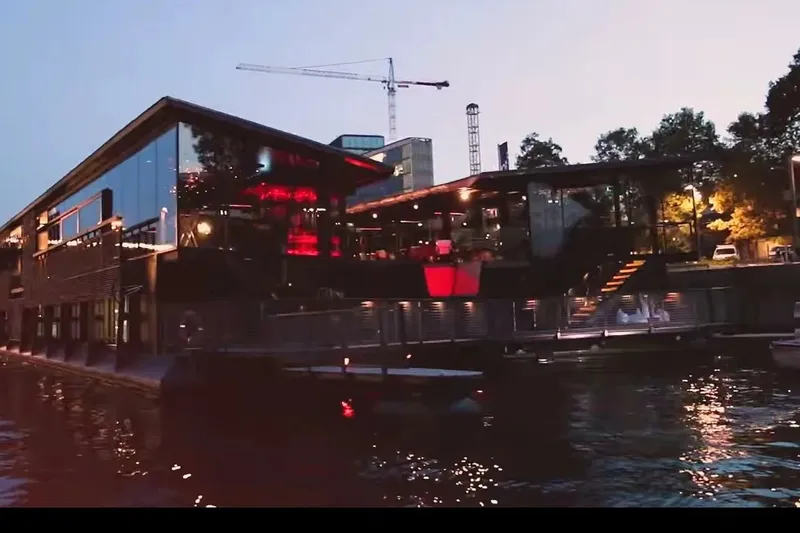
The péniche remains tied to its mooring throughout the stay. The rental is one studio, with no separate bedroom and no cruise included. A private entrance gives you independent access to the unit; it does not reserve the rest of the vessel or its decks for your use.
The room and its equipment
| Part of the studio | Equipment |
|---|---|
| Sleeping and living | 35 m²; one double bed, sofa, dining table, desk and flat-screen TV |
| Bathroom | Private walk-in shower, towels, hairdryer and toiletries |
| Kitchenette | Stovetop, microwave, refrigerator, coffee machine, kettle and kitchenware |
| Laundry | Washing machine and iron |
| Climate and connection | Air conditioning, heating, electric blankets, fan and free Wi-Fi |
The bed is listed as one double with no measurements. If you are tall, or used to a wide mattress, ask before you pay, because hull conversions fit whatever the frames allow and this is the detail you cannot fix after arrival.
Getting to the mooring with luggage
From Porte Maillot, take bus 244 towards Rueil-Malmaison RER to Les Moulins–Camping. From the stop, follow Route de Suresnes towards the Seine, then Allée du Bord de l’Eau to No. 30. I allow ten minutes for the final approach with a bag and finding the numbered mooring. The final gate and boarding instructions are part of the arrival arrangements.
The allée is a long riverbank road shared by moorings and the campsite. A destination pin for “Bois de Boulogne” leaves too much ground to cover; the useful arrival address is the full street and number. For a taxi I use that address and the host’s gate location. The campsite entrance at No. 2 is a different destination.
A gangway’s slope changes with river level. For anyone using a wheelchair or unable to manage steps, the relevant details are the boarding width, handrails, threshold and route from the gangway into the bathroom. A walk-in shower describes the shower alone. Arrange photographs of that whole route before committing to a non-refundable booking; the boarding and cabin access checklist separates those obstacles.
Bus times and the cost of the connection
The final scheduled 244 departure from Porte Maillot towards Rueil-Malmaison is at 00:30 every day. The first is at 05:40 Monday to Saturday and 06:05 on Sundays and public holidays. Those are departures from the terminus, not passing times at the mooring. The 244 timetable and stop map distinguish the weekday and weekend routes through the Bois.
In 2026, the standard Bus–Tram ticket costs ≈ $2.3 (€2.05) and the Metro–Train–RER ticket ≈ $2.8 (€2.55). A bus followed by the metro or RER therefore costs ≈ $5.1 (€4.6) one way, or ≈ $10 (€9.2) return for one adult using these single tickets. Navigo Day costs ≈ $14 (€12.3) for zones 1–5, excluding airport travel. These are separate ticket products: a Bus–Tram ticket does not cover the rail connection at Porte Maillot.
Late check-in ends at 23:30, earlier than the last bus departure from Porte Maillot. On arrival night the accommodation’s check-in window is the constraint. I arrange the gate code and arrival time in advance rather than rely on finding a staffed reception on the quay.
Routes to the Eiffel Tower and central Paris
| Destination | Route from the 244 at Porte Maillot |
|---|---|
| Eiffel Tower by RER | Walk to Neuilly–Porte Maillot RER C. Take the southbound train towards central Paris, via Avenue Foch and Boulainvilliers, to Champ de Mars–Tour Eiffel, the fifth stop. Walk along Quai Jacques Chirac towards the tower. |
| Eiffel Tower by metro | Line 1 towards Château de Vincennes to Charles de Gaulle–Étoile; change to line 6 towards Nation, get off at Bir-Hakeim and walk via Quai Jacques Chirac. |
| Arc de Triomphe | Line 1 towards Château de Vincennes to Charles de Gaulle–Étoile: two stops, with Argentine in between. |
| Louvre | Line 1 towards Château de Vincennes to Palais Royal–Musée du Louvre. |
On RER C the useful direction is towards Champ de Mars and central Paris, away from Pontoise. Train destinations vary, so the platform display must include Champ de Mars–Tour Eiffel. Allow time for the transfer from the bus stop into the RER station as well as the final walk to the tower.
For La Défense, cross Pont de Suresnes and continue to T2 at Suresnes–Longchamp; take the tram towards Pont de Bezons for three stops to La Défense. Suresnes–Mont-Valérien station, farther uphill on the same bank, has direct line L trains to Paris Saint-Lazare. Both alternatives involve crossing the bridge on foot before boarding.
The actual entrance to ParisLongchamp
The public entrance to the grandstand side is the Grille d’Honneur, 2 Route des Tribunes. From the Les Moulins–Camping area, the approach follows Route des Moulins and Route des Tribunes; the riverbank is outside the racecourse perimeter. The walk ends at an admission gate, not at a public shortcut through the grounds. The ParisLongchamp event and access information gives the entrance arrangements for each meeting. An event using a different gate takes precedence over this approach.
Parking across the river
There is no parking at the studio. An off-site option is EFFIA Suresnes Henri IV: tariffs and parking options, Place Henri IV, on the Suresnes side of the bridge. It opens 24 hours daily; the drive-up tariff is ≈ $10 (€9.3) for 12 hours and ≈ $21 (€19.1) for 24 hours, with a seven-day package at ≈ $46 (€41.7) subject to its conditions and available spaces. Reaching the boat from there requires a walk back across Pont de Suresnes. Garage charges are separate from the room price.
Meals without an on-board restaurant
There is no restaurant at the studio. For groceries and meals off the boat, Suresnes town centre is across Pont de Suresnes. I bring the first evening’s food and breakfast with my luggage, so dinner does not require another crossing after check-in. The washing machine also makes a longer stay more practical without adding a laundrette trip.
The nearby campsite has its own shop and food services, but these are facilities of a separate property. My meal plan uses the studio’s kitchenette and shops in Suresnes rather than assuming access to campsite services. A bed-and-breakfast category on a booking site is not a promise that breakfast comes with the selected room rate.
Working and sleeping on board
The desk gives a laptop a proper place away from the bed. For a work call, my fallback is a charged phone with mobile data: metal hulls affect wireless reception, and a Wi-Fi amenity does not specify upload speed or coverage at the desk. A speed reading taken inside the room is more useful for remote work than the presence of the Wi-Fi symbol.
Heating and cooling matter in a single-room hull because the sleeping area shares the same air as the kitchenette. In summer I keep cooking brief and use the air conditioning; in cold weather I keep wet coats away from the bed. Keeping the gangway door closed while the heating runs reduces the cold air entering the living area.
Passing vessels can send wash into a moored hull. Movement, fender contact and mooring-line creaks are different from airborne noise, so soundproofing does not remove all three. River traffic and the quay road are relevant to this address, but I would not promise a silent night or say how quickly another guest will adjust. The boat’s position also puts race-day arrivals and departures close to the approach road.
Booking.com shows no published guest rating for the studio. The platform’s separate four-out-of-five quality label assesses the property’s features; it is not a guest score.
Children, occupancy and house rules
The room capacity is two people in total: two adults, or one adult and one child. Children of any age are accepted, but there are no cots or extra beds. Two adults plus a child exceed the capacity even if they intend to share the double bed. The booking search needs the child’s age to return the applicable occupancy and price.
The lead guest must be at least 18. Check-in is 16:00–23:30 and check-out 01:00–11:00; an early departure still needs an agreed key-return arrangement. Smoking, pets and parties, including hen and stag celebrations, are not allowed.
For an adult travelling with a child, boarding and the exposed water edge require supervision separately from the sleeping arrangement. A child’s acceptance in the room does not establish childproof deck railings. The houseboat family safety checklist covers the gangway and water-edge checks that matter on arrival.
Room price, cleaning and tourist tax
The studio’s Booking.com room offersad are priced for the dates and guests entered. I budget from the reservation total for the whole stay, including any compulsory cleaning charge and taxes, with refundable security deposits kept separately. A nightly headline alone cannot establish the cost of a two-night stay.
Paris tourist tax in 2026 depends on the legal accommodation category. A chambre d’hôtes carries a fixed ≈ $2.9 (€2.6) per adult per night. Unclassified accommodation uses 5% of the pre-tax nightly cost per occupant, with additional taxes bringing the combined rate to 16.25%, capped at ≈ $18 (€15.93) per taxable adult per night. Under-18s are exempt from tourist tax.
For a conditional example, an unclassified room costing ≈ $110 (€100) before tax for two adults produces about $8.9 (€8.13) tourist tax per adult per night, before the cap becomes relevant. That is an illustration of the unclassified formula, not a room quote or a classification assigned to this studio. For two adults staying two nights under the chambre d’hôtes category, the fixed tourist tax would instead be ≈ $11 (€10.4) for the stay. The category and tax amount on the reservation determine which calculation applies.
Cancellation belongs to the individual offer. A non-refundable rate exposes the prepaid room cost if plans change; a flexible offer has a stated cancellation deadline and a penalty after it. I compare the whole-stay totals for the same dates and occupancy, with the cleaning charge included on both sides. The floating-stay booking cost checklist also distinguishes fees from refundable deposits.
My booking decision
I would book Studio sur l’eau for a solo or two-person stay built around the western side of Paris, because the kitchenette and 35 m² give me more useful living space than a compact cabin. For repeated trips to the Louvre and the Marais, I would pay for a more central mooring such as OFF Paris Seine: the bus connection here would become part of every sightseeing day. Before paying a non-refundable rate, I need the arrival instructions and photographs of the boarding route, plus the reservation’s full price including compulsory fees.