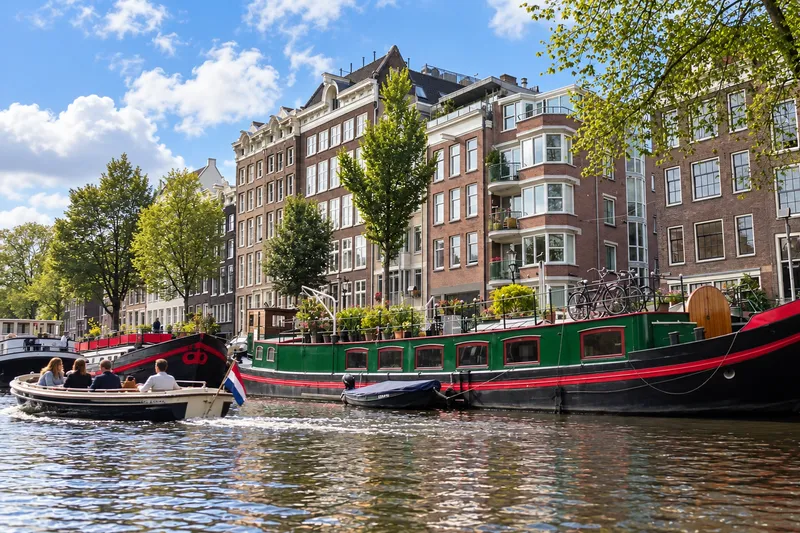
Quiet on the water comes down to three things: how sheltered the basin is, how much steel sits under your bunk, and whether you share a bathroom down a steel corridor. Booking photos show none of them, and neither does the nightly rate. A handful of questions at booking saves more sleep than any earplug, and most of them have a checkable answer before you pay a deposit.
Moorings: Sheltered Basins Beat the Open IJ
The IJ is a working waterway. Commuter ferries, cargo barges, and tugs run it all day, and their wash rolls across to any hull moored on the open river. A heavy vessel shrugs it off; a light, flat-bottomed barge rocks against its lines and creaks through its fenders. Hull weight is the simplest acoustic feature to check before you book, and it is the one operators rarely advertise.
Amsterdam's floating hotels sit in three different sound environments. Oosterdok, east of Centraal Station, lies behind the lock barriers, so hulls there avoid open-river swell but sit inside the city. The northern basins at Johan van Hasseltkanaal and Mariadistelkade are dead ends with almost no passing traffic. NDSM Wharf faces the open IJ and picks up both chop and whatever the quay is doing that weekend.
Weight is easy to judge from the hull type. A riveted steel lightship or a former passenger ship carries hundreds of tonnes and barely registers a passing barge. A converted freight barge sits high and light, and a houseboat on a concrete pontoon rides the surface rather than cutting through it. Two boats moored a hundred metres apart can give you very different nights.
The trade-off never changes: the quieter the basin, the further you are from the historic centre. Oosterdok puts you ten to fifteen minutes from Centraal; the northern basins put you a ferry or metro ride away. Decide which of the two matters more before you compare rates, because the calmest berths are never the central ones.
What Actually Makes Noise Inside a Boat
Stationary hotel boats do not run main engines, so there is no cruising drone to sleep through. The noise comes from smaller machinery: bilge pumps cycling, water-pressure boosters, and ventilation fans, all of which transmit through the floor frames. On a steel ship the hum is low and constant; on a timber barge it is a knock that carries further than you expect.
Ask how the boat is powered overnight. Moored botels normally plug into shore power and shut down their engines and generators, but a boat on a remote pontoon can run a generator into the evening, and that is the loudest thing you can share a night with. Ventilation is the other trade-off: sealed portholes on older iron hulls force you to rely on a fan, while an open hatch onto a busy quay trades stuffiness for street noise.
Partitions decide sleep more than hull material does. On the older freight barges the cabin walls are thin, and ordinary conversation from the next berth comes through. Where the cabins line a single narrow companionway, that corridor funnels every closing latch and every footstep. The clearest measure of how much of that traffic you will hear is how many cabins share one bathroom. On AmicitiA and Vita Nova the toilets and showers are communal, so guests cross the corridor at night; on MPS Holland each bunk cabin has its own shower and toilet, which removes most of the movement past your door.
Cabin dimensions are the detail most botels leave out. On the Oosterdok barges the standard cabins are bunk layouts, and a "double" can mean a narrow bed against the hull with little floor space; the Loft Letter suites at Botel and the two lightship suites are the roomy exceptions. If you are tall, or travelling as a pair who want separate beds, confirm the bed size and the bunk arrangement before you book.
Gangways and door sills are the other thing to weigh. Boarding ramps are steep, and cabin doors have raised watertight sills; a hard-shell case is awkward on both. I travel with a soft duffel on boat stays now, and I ask about the gangway before I book.
Wi-Fi is the promise that rarely survives contact with a steel hull. Signal reaches cabins on the deck where the router sits and fades on the deck below or behind a bulkhead, and on the older barges it can be weak across the whole boat. If you need to work, ask which deck the router is on.
What Your Invoice Adds: VAT and Tourist Tax
The rate on a booking engine is not what you pay. Dutch VAT on overnight accommodation rose from 9% to 21% on 1 January 2026, while food keeps the reduced 9% rate, which is why a room rate and a breakfast charge are taxed differently on the same invoice; the Belastingdienst rules on VAT for lodging set out the two rates. On top of VAT, Amsterdam charges a tourist tax of 12.5% of the overnight price excluding VAT, listed on the city's municipal tourist tax rates alongside a ≈ $17 (€15) day-tourist tax that cruise operators pay for passengers visiting for the day only.
Together the two taxes lift a quoted rate by roughly a third, and most botels show them as a separate line at check-in. A ≈ $100 (€95) cabin I booked one winter came to about $140 (€125) once 21% VAT and the 12.5% levy were added; on a net rate of ≈ $220 (€200) the arithmetic is about $46 (€42) in VAT and ≈ $28 (€25) in tourist tax. Ask for the total including tax before paying a deposit, and check whether breakfast is included or billed separately at 9%.
Amsterdam's Quiet Berths Compared
These are the moored properties I would weigh for a light sleeper, with the berth and cabin details that decide the night. The "from" figures are the operators' published starting rates for a standard cabin and move with the season and length of stay; on every one of these ships the cheapest cabins are also the ones nearest the corridor traffic.
| Name | Berth | Cabin type and deck | Bathroom | From, per night | Minimum stay |
|---|---|---|---|---|---|
| Hotel Asile Flottant | De Ceuvel, Johan van Hasseltkanaal (Noord) | Whole historic boats, 2–6 guests | Private, per boat | About $180 (€165) | – |
| Lightship Amsterdam | Amsterdam-Noord | Two suites (Machinery Room, Upper Store) | Private, en suite | About $390 (€350) | – |
| Botel Amsterdam | NDSM-pier 3 | Double, twin, quad cabins; Loft Letter suites on the upper deck | Private, en suite | About $100 (€95) | – |
| Hotelboot Zwaan | Oosterdok Steiger 3 (winter only) | 2–3 person cabins | Private, shower and toilet | On request | On request |
| MPS Holland | Oosterdok, 900 m from Centraal | Compact bunk cabins | Private, en suite | About $83 (€75) | – |
| AmicitiA | Oosterdok Steiger 2, opposite NEMO | Bunk cabins, lower deck | Shared, corridor | About $77 (€70) | – |
| Vita Nova | Oosterdok Steiger 2 | Bunk cabins | Shared, corridor | About $72 (€65) | – |
Noord and NDSM: Whole Boats, Heavy Steel, and the River
Hotel Asile Flottant: six boats on a quiet canal
At De Ceuvel, on the Johan van Hasseltkanaal, Hotel Asile Flottant rents out whole historic boats rather than cabins. Six vessels share a private jetty with a reception boat, and because you book the entire boat there is no shared corridor at all. The smallest, Anneliese, sleeps two in 25 m²; the largest, Holland, sleeps six in 80 m². The basin is a former shipyard cut off from the IJ navigation channel, so no tour boat passes. The trade-offs are physical rather than acoustic: the gangways are steep, the operator takes a ≈ $220 (€200) refundable security bond on arrival, and the site is genuinely hard to find on a first visit. The operator's own directions send you across on the free Buiksloterweg ferry and then about five minutes by bike; the route is on Asile Flottant's location page.
Reaching the Noord berths is part of the quiet. The free Buiksloterweg ferry from behind Centraal runs around the clock, thinning overnight, and the metro to Noorderpark takes about two minutes from Centraal, with a ten-minute walk from there to De Ceuvel; buses 391 and 394 stop at Mosplein.
Lightship Amsterdam: two suites in a 70-year-old lightship
Lightship Amsterdam is a former British lightship moored in Amsterdam-Noord, and it holds just two suites – the Machinery Room and the Upper Store – each with a king-size bed, a private bathroom, and its own entrance. With two parties on board there is no communal corridor, and the mass of the riveted hull absorbs passing wash that rolls the lighter canal boats. Guests get the front deck as a terrace, and you cannot cook on board. It is the priciest berth on this list; the suites and booking are on Lightship Amsterdam's site.
Botel Amsterdam: the NDSM base, and which deck to ask for
At NDSM-pier 3, Botel Amsterdam is a white passenger ship on the IJ with basic double, twin, and quadruple cabins plus the Loft Letter suites on the upper deck. It is the handiest base for the NDSM creative quarter, but it sits on open water, so the side of the ship matters: river-facing cabins take the early wash and passing engine hum, while wharf-facing cabins trade that for quay noise. Ask for an upper-deck cabin amidships, away from the boarding gangway and the reception foyer. The free GVB ferry F4 runs from NDSM-werf to Centraal Station roughly every 15 minutes through the day and every 30 minutes in the evening, with a thinner overnight timetable, and the crossing takes about ten minutes; the times are on the GVB ferry F4 timetable.
Check the NDSM cultural calendar before booking a wharf-facing room. An open-air music event on the quay will easily penetrate single-glazed boat windows, turning a bargain berth into a noisy headache.
Oosterdok: Central Berths and Their Trade-offs
Oosterdok Steigers 2 and 3
Oosterdok is the classic botel cluster, a 10 to 15-minute walk east of Centraal Station. The basin sits behind the locks, so hulls avoid the river's rolling swell, but the piers themselves are timber. That boardwalk carries a steady stream of travellers, hostel staff, and wheeled luggage, and the vibration reaches straight into the hulls alongside. Berths at the head of a pier catch every arrival. If you book here, ask for a cabin toward the stern, away from the pier gate.
AmicitiA, MPS Holland, and Vita Nova
Three long-standing vessels share these piers. AmicitiA is a converted 1897 freight barge moored opposite the NEMO Science Museum, about a kilometre from Centraal, with a sundeck and a bar; its cabins use shared corridor bathrooms. MPS Holland, 900 metres from Centraal, is the pick of the three for a light sleeper, because each bunk cabin has its own shower and toilet, which removes the night-time walk past your door, though the partitions stay thin. Vita Nova, at Steiger 2, is the cheapest of the group and also runs on shared facilities. On any of them, cabins by the stairwell hear the most.
Hotelboot Zwaan: a winter-only berth
Hotelboot Zwaan is the odd one out: it spends the cruising season sailing Dutch waterways as a bike-and-barge vessel and only becomes a stationary hotel in Oosterdok for the winter, from the beginning of October to the end of March. It is small – seven rooms – and the operator lists cabins with private hot showers and toilets and breakfast included, which cuts the corridor traffic that bigger botels generate. Rates are quoted on request rather than published, so confirm the price and any minimum stay directly; the seasonal schedule is on Hotelboot Zwaan's site.
How the Season Changes the Noise
Winter is the quietest time to sleep on an Amsterdam botel. The tour boats and most private traffic leave the canals, the Oosterdok basin sits still, and the botels that stay open are heated; the catch is condensation on cold mornings and a colder walk down the gangway. Summer reverses it: more river traffic, longer evenings on the quays, and open-deck bars. Booking for a warm month as a light sleeper, I would take a sheltered northern basin over a berth on the open IJ, and avoid the cabins nearest the shore-side terraces.
Booking Moves That Change How You Sleep
Before you pay a non-refundable deposit, get four answers from the operator:
- Which deck and which end of the ship is the cabin on? Upper deck amidships, away from the boarding gangway, is the quietest position on most of these vessels.
- Is the bathroom private or shared? Shared facilities mean corridor traffic all night; private ones remove it.
- Which way does the cabin face? On the IJ a river-facing cabin takes passing wash; a wharf-facing one takes quay noise.
- What is the total including 21% VAT and the 12.5% tourist tax, and is breakfast included?
Two things I would not skip. Avoid the cheapest cabin next to the reception desk or the luggage store, where early check-outs gather. And ask about the Wi-Fi before you rely on it: steel hulls and thick bulkheads block the signal in some cabins, and the routers usually sit on one deck only.
Time your arrival for the day service if you are heading to NDSM with luggage; after about seven in the evening the F4 drops to every 30 minutes and the overnight timetable is thin. Payment is worth confirming too: larger properties take international cards, while some smaller barges prefer Dutch debit cards or cash, so carry a fallback and enough cash for any security bond.
Gangway safety tracks the weather as much as the berth. After a wet, windy night the steel ramps and pontoons at the harbour berths turn slick, so I check the hourly forecast and any code geel, oranje, or rood warning on the KNMI weather app before walking down.
When to Stay Ashore Instead
Every moored hull moves a little when the wind gets up, and every one of them creaks. If you need absolute silence, a lift, or a wide marble bathroom, a brick hotel on land will serve you better. Floating berths are also a poor fit for reduced mobility: gangways shift with the water, entrance stairs are steep, and the door sills are raised.
Two options I would skip. The lowest-deck cabins beside the bilge pumps on the older barges are the noisiest berths on the ship and rarely worth the small saving. A wharf-facing room at NDSM during a quay festival is a false economy too, because the bass travels through the windows. If either is the only room left, take a land hotel that night and move onto the water on a quieter date.